Practicing Class 8 Social Science MCQ and Class 8 SST Part 2 Chapter 2 India’s Long Road to Independence MCQ Online Test with Answers daily helps in time management.
Class 8 India’s Long Road to Independence MCQ with Answers
MCQ on India’s Long Road to Independence Class 8
India’s Long Road to Independence MCQ Class 8
Question 1.
After the Great Uprising of 1857, how was India governed?
(a) By local kings independently
(b) Directly by the British Crown through the Viceroy and Secretary of State
(c) By the Indian National Congress
(d) Through a democratic assembly of princely states
Answer:
(b) Directly by the British Crown through the Viceroy and Secretary of State
Question 2.
Which of the following was promised in the 1858 Royal Proclamation?
(a) Full independence for India
(b) Respect for Indian princes and protection of people without imposing Christianity
(c) Establishment of Congress-led governance
(d) Complete abolition of British goods
Answer:
(b) Respect for Indian princes and protection of people without imposing Christianity
Question 3.
Who founded the Brahmo Samaj in 1828?
(a) Swami Vivekananda
(b) Raja Ram Mohan Roy
(c) Swami Dayananda Saraswati
(d) Jyotirao Phule
Answer:
(b) Raja Ram Mohan Roy
Question 4.
Which novel by Bankim Chandra Chattopadhyay inspired the Swadeshi Movement?
(a) Rajmohan’s Wife
(b) Anandamath
(c) Devi Chaudhurani
(d) Kapalkundala
Answer:
(b) Anandamath
Question 5.
What is the significance of the poem Vande Mataram?
(a) National Anthem of India
(b) National song and rallying cry during the Swadeshi Movement
(c) A religious hymn only
(d) Part of British propaganda
Answer:
(b) National song and rallying cry during the Swadeshi Movement

Question 6.
Where did Swami Vivekananda deliver his famous speech on India’s civilisation?
(a) London
(b) Chicago
(c) Calcutta
(d) Delhi
Answer:
(b) Chicago
Question 7.
When was the Indian National Congress formed?
(a) 1875
(b) 1885
(c) 1905
(d) 1916
Answer:
(b) 1885
Question 8.
Which festivals did Tilak popularise to inspire nationalist feelings?
(a) Diwali and Holi
(b) Ganesh Chaturthi and Shivaji Festival
(c) Eid and Christmas
(d) Makar Sankranti and Raksha Bandhan
Answer:
(b) Ganesh Chaturthi and Shivaji Festival
Question 9.
……………………….. In which year was the Anushilan Samiti formed?
(a) 1897
(b) 1902
(c) 1911
(d) 1920
Answer:
(b) 1902
Question 10.
Who led the tribal uprising called Ulgulan in Chota Nagpur?
(a) Bal Gangadhar Tilak
(b) Birsa Munda
(c) Dadabhai Naoroji
(d) Aurobindo Ghose
Answer:
(b) Birsa Munda
Question 11.
What was the main reason behind the 1905 Partition of Bengal?
(a) Administrative efficiency
(b) Divide and rule between Hindus and Muslims
(c) Economic development
(d) Religious harmony
Answer:
(b) Divide and rule between Hindus and Muslims
Question 12.
What does ‘Swadeshi’ mean?
(a) Support British goods
(b) Self-reliance and use of Indian goods
(c) Joining the British Army
(d) Religious reform
Answer:
(b) Self-reliance and use of Indian goods
Question 13.
Which newspaper was launched in 1906 to oppose the Partition of Bengal?
(a) Kesari
(b) Bande Mataram
(c) The Hindustan Times
(d) The Pioneer
Answer:
(b) Bande Mataram
Question 14.
Which event marked the split between Moderates and Extremists in Congress?
(a) Jallianwala Bagh Massacre
(b) Surat Session of 1907
(c) Lucknow Pact
(d) Simon Commission protests
Answer:
(b) Surat Session of 1907
Question 15.
Who was executed in 1908 for attempting to assassinate a British judge In Muzaffarpur?
(a) Aurobindo Ghose
(b) Khudiram Bose
(c) Prafulla Chaki
(d) Vinayak Deshpande
Answer:
(b) Khudiram Bose
Question 16.
Who founded the Ghadar Party in North America?
(a) Rash Behari Bose
(b) Lala Hardayal and Soban Singh Bhakna
(c) Subhas Chandra Bose
(d) Bhagat Singh
Answer:
(b) Lala Hardayal and Soban Singh Bhakna
Question 17.
What was the main aim of the Home Rule Movement launched in 1916?
(a) Complete independence from Britain immediately
(b) Self-government within the British Empire
(c) Promotion of Swadeshi goods
(d) Abolition of princely states
Answer:
(b) Self-government within the British Empire
Question 18.
Which Act allowed the British to arrest Indians without trial in 1919?
(a) Rowlatt Act
(b) Government of India Act
(c) Salt Act
(d) Cripps Mission Act
Answer:
(a) Rowlatt Act
Question 19.
Who returned his knighthood in protest against the Jallianwala Bagh massacre?
(a) Bal Gangadhar Tilak
(b) Rabindranath Tagore
(c) Mahatma Gandhi
(d) Subhas Chandra Bose
Answer:
(b) Rabindranath Tagore
Question 20.
Which movement did Gandhi launch in 1930 to protest the salt tax?
(a) Quit India Movement
(b) Civil Disobedience Movement
(c) Non-Cooperation Movement
(d) Home Rule Movement
Answer:
(b) Civil Disobedience Movement
Question 21.
Who became India’s first Prime Minister after Independence?
(a) Sardar Vallabhbhai Patel
(b) Mahatma Gandhi
(c) Jawaharlal Nehru
(d) Subhas Chandra Bose
Answer:
(c) Jawaharlal Nehru
Question 22.
Who was called the ‘Iron Man of India’ for integrating princely states?
(a) Sardar Vallabhbhai Patel
(b) Jawaharlal Nehru
(c) B.R. Ambedkar
(d) Subhas Chandra Bose
Answer:
(a) Sardar Vallabhbhai Patel
Question 23.
Who proposed the idea of a separate Muslim nation in 1930?
(a) Maulana Azad
(b) Muhammad Ali Jinnah
(c) Muhammad Iqbal
(d) Abdul Ghaffar Khan
Answer:
(c) Muhammad Iqbal
India’s Long Road to Independence Class 8 Assertion and Reason Questions
Question 1.
Assertion (A) Brahmo Samaj opposed idol worship and caste discrimination.
Reason (R) It promoted the practice of Vedic rituals and worship of multiple gods.
Codes
(a) Both A and R are true, and R is the correct explanation of A.
(b) Both A and R are true, but R is not the correct explanation of A.
(c) A is true, but R is false.
(d) A is false, but R is true.
Answer:
(c) A is true, but R is false.
Question 2.
Assertion (A) Bal Gangadhar Tilak used Ganesh Chaturthi and Shivaji festivals to mobilise people.
Reason (R) Tilak believed public gatherings could be used to create political awareness.
Codes
(a) Both A and R are true, and R is the correct explanation of A.
(b) Both A and R are true, but R is not the correct explanation of A.
(c) A is true, but R is false.
(d) A is false, but R is true.
Answer:
(b) Both A and R are true, but R is not the correct explanation of A.
Question 3.
Assertion (A) Aruna Asaf Ah hoisted the Congress flag at Gowalia Tank Maidan in 1942.
Reason (R) She also led the Non-Cooperation Movement in 1920.
Codes
(a) Both A and R are true, and R is the correct explanation of A.
(b) Both A and R are true, but R is not the correct explanation of A.
(c) A is true, but R is false.
(d) A is false, but R is true.
Answer:
(c) A is true, but R is false.
Question 4.
Assertion (A) The Swadeshi Movement encouraged boycott of foreign goods.
Reason (R) It was launched after the partition of Bengal in 1905 to promote Indian industries.
Codes
(a) Both A and R are true, and R is the correct explanation of A.
(b) Both A and R are true, but R is not the correct explanation of A.
(c) A is true, but R is false.
(d) A is false, but R is true.
Answer:
(a) Both A and R are true, and R is the correct explanation of A.
Question 5.
Assertion (A) Gandhi called off the Non-Cooperation Movement after Chauri Chaura incident.
Reason (R) He believed violent acts were justified against British rule.
Codes
(a) Both A and R are true, and R is the correct explanation of A.
(b) Both A and R are true, but R is not the correct explanation of A.
(c) A is true, but R is false.
(d) A is false, but R is true.
Answer:
(c) A is true, but R is false.
Question 6.
Assertion (A) Bhagat Singh threw bombs in the Central Legislative Assembly in 1929.
Reason (R) He aimed to kill British officers to avenge the Jallianwala Bagh massacre.
Codes
(a) Both A and R are true, and R is the correct explanation of A.
(b) Both A and R are true, but R is not the correct explanation of A.
(c) A is true, but R is false.
(d) A is false, but R is true.
Answer:
(b) Both A and R are true, but R is not the correct explanation of A.
Question 7.
Assertion (A) The Radcliffe Line divided India and Pakistan in 1947.
Reason (R) Cyril Radcliffe was an experienced Indian administrator familiar with local issues.
Codes
(a) Both A and R are true, and R is the correct explanation of A.
(b) Both A and R are true, but R is not the correct explanation of A.
(c) A is true, but R is false.
(d) A is false, but R is true.
Answer:
(c) A is true, but R is false.
Question 8.
Assertion (A) Sardar Vallabhbhai Patel integrated most princely states peacefully.
Reason (R) He used diplomacy, persuasion, and military action for reluctant states.
Codes
(a) Both A and R are true, and R is the correct explanation of A.
(b) Both A and R are true, but R is not the correct explanation of A.
(c) A is true, but R is false.
(d) A is false, but R is true.
Answer:
(a) Both A and R are true, and R is the correct explanation of A.
India’s Long Road to Independence Class 8 Fill in the Blanks
1. The secret revolutionary society ……………………….. was founded by Vinayak Damodar Savarkar.
Answer:
Abhinav Bharat
2. During the German Plot of 1915, Jatin Mukherjee was also popularly known as ……………………… .
Answer:
Bagha Jatin
3. The famous massacre ¡n 1919 where British troops fired on a peaceful gathering in Amritsar was called the …………………… .
Answer:
Jallianwala Bagh Massacre
4. The Home Rule Movement in 1916 was launched by Bal Gangadhar Tilak and ……………………. to demand self-government within the British Empire.
Answer:
Annie Besant
5. The political compromise between Gandhi and B.R. Ambedkar regarding separate electorates for the Depressed Classes was called the ………………………….. .
Answer:
Poona Pact
6. The poet and philosopher of Urdu who proposed a separate Muslim territory in 1930 was ……………………. .
Answer:
Muhammad Iqbal
7. The Indian National Army was reorganised under ……………………… during World War II to fight for India’s
independence.
Answer:
Subhas Chandra Bose
8. The leader who hoisted the national flag at Gowalia Tank Maidan during the Quit India Movement was ……………………. .
Answer:
Aruna Asaf Ah
9. The teenage freedom fighter from Assam, martyred in 1942 while attempting to hoist the national flag, was ……………………………… .
Answer:
Kanaklata Barua
India’s Long Road to Independence Class 8 True or False
1. The Royal Proclamation of 1858 promised to respect the rights and dignity of Indian princes.
Answer:
True
2. The Namdhari or Kuka Movement in Punjab opposed British rule by using foreign goods and supporting cow
slaughter.
Answer:
False
3. Bankim Chandra Chattopadhyay’s poem ‘Vande Mataram’ became a rallying cry during the 1905 Swadeshi Movement.
Answer:
True
4. The All India Muslim League was founded in 1906 to oppose British rule and support the Indian National Congress.
Answer:
False
5. The Surat Split in 1907 divided the Congress into Moderates and Extremists because the Extremists demanded Swaraj.
Answer:
True
6. Khudiram Bose and Prafulla Chaki successfully assassinated the British judge Douglas Ingallsford in 1908.
Answer:
False
7. The Cellular Jail in the Andaman Islands was used to exile and isolate revolutionaries through solitary confinement.
Answer:
True
8. The Lucknow Pact of 1916 marked an agreement between the Congress and the Muslim League, including acceptance of separate electorates for Muslims.
Answer:
True
9. Gandhi called off the Non-Cooperation Movement after the violent incident at Chauri Chaura in 1922.
Answer:
True
10. Kanaklata Barua, a teenage freedom fighter from Assam, survived the British attack while hoisting the national flag in 1942.
Answer:
False
India’s Long Road to Independence Class 8 Match The Following
Question 1.
| List I (Movement) | List II (Contribution) |
| A. Brahmo Samaj | 1. Promoted Vedic values, opposed ritualism |
| B. Arya Samaj | 2. Opposes child marriage, supported widow education |
| C. Shusshi ; movement | 3. Reconversion to Hinduism encouraged social pride |
| D. Phule and Vidyasagar | 4. Modern education for girls and marginalised groups |
Codes
A B C D
(a) 2 1 3 4
(b) 2 3 1 4
(c) 1 2 3 4
(d) 3 1 2 4
Answer:
(b) 2 3 1 4
| List I (Movement) | List II (Contribution) |
| A. Brahmo Samaj | 2. Opposes child marriage, supported widow education |
| B. Arya Samaj | 3. Reconversion to Hinduism encouraged social pride |
| C. Shusshi ; movement | 1. Promoted Vedic values, opposed ritualism |
| D. Phule and Vidyasagar | 4. Modern education for girls and marginalised groups |
Question 2.
| List I (Society) | List II (Activity) |
| A. Anushilan Samiti | 1. Training young men physically, morally, and intellectually |
| B. Abhinav Bharat | 2. Secret society for armed resistance against British |
| C. Ghadar Party | 3. Planned pan-India mutiny during WWI |
| D. Hindustan Socialist Republican Association | 4. Fundraising for revolutionary activities like Kakori robbery |
Codes
A B C D
(a) 1 2 3 4
(b) 1 2 4 3
(c) 2 1 3 4
(d) 1 3 2 4
Answer:
(a) 1 2 3 4
| List I (Society) | List II (Activity) |
| A. Anushilan Samiti | 1. Training young men physically, morally, and intellectually |
| B. Abhinav Bharat | 2. Secret society for armed resistance against British |
| C. Ghadar Party | 3. Planned pan-India mutiny during WWI |
| D. Hindustan Socialist Republican Association | 4. Fundraising for revolutionary activities like Kakori robbery |
Question 3.
| List I (Leader/Uprising) | List II (Place/ Action) |
| A. Namdhari Movement | 1. Punjab, opposed cow slaughter, promoted self-reliance |
| B. Revolt in Western Maharashtra | 2. Poona, killing British Officers during plague protest |
| C. Birsa Munda | 3. Chota Nagpur, mobilised tribal communities to reclaim land |
| D. Kundiram Bose | 4. Attempted assassination of British judge in Bengal |
Codes
A B C D
(a) 1 2 3 4
(b) 1 2 4 3
(c) 1 3 2 4
(d) 3 2 1 4
Answer:
(a) 1 2 3 4
| List I (Leader/Uprising) | List II (Place/ Action) |
| A. Namdhari Movement | 1. Punjab, opposed cow slaughter, promoted self-reliance |
| B. Revolt in Western Maharashtra | 2. Poona, killing British Officers during plague protest |
| C. Birsa Munda | 3. Chota Nagpur, mobilised tribal communities to reclaim land |
| D. Kundiram Bose | 4. Attempted assassination of British judge in Bengal |
Question 4.
| List I (Event) | List II (Year/Detail) |
| A. Partition of Bengal | 1. 1905, divide East (Muslim) and West (Hindu) Bengal |
| B. Swadeshi Movement | 2. Promote Indian goods, boycott British goods |
| C. National Council of Education | 3. 1906. Provide modern education in Bengal |
| D. Bande Mataram daily | 4. Launched by Bipin Chandra Pal to oppose partition |
Codes
A B C D
(a) 1 2 3 4
(b) 1 2 4 3
(c) 2 1 3 4
(d) 2 3 4 1
Answer:
(a) 1 2 3 4
| List I (Event) | List II (Year/Detail) |
| A. Partition of Bengal | 1. 1905, divide East (Muslim) and West (Hindu) Bengal |
| B. Swadeshi Movement | 2. Promote Indian goods, boycott British goods |
| C. National Council of Education | 3. 1906. Provide modern education in Bengal |
| D. Bande Mataram daily | 4. Launched by Bipin Chandra Pal to oppose partition |
Question 5.
| List I (Leader) | List II (Action) |
| A. Bhagat Singh | 1. Assembly bomb case, executed in 1931 |
| B. Chandrashekhar Azad | 2. Kakori train robbery organiser |
| C. Rash Behari Bose | 3. Helped train robbery organiser |
| D. Jam Mukherjee (Bagha Jatin) | 4. Gun battle at Balasore, died in 1915 |
Codes
A B C D
(a) 1 2 3 4
(b) 1 2 4 3
(c) 1 3 2 4
(d) 1 4 3 2
Answer:
(a) 1 2 3 4
| List I (Leader) | List II (Action) |
| A. Bhagat Singh | 1. Assembly bomb case, executed in 1931 |
| B. Chandrashekhar Azad | 2. Kakori train robbery organiser |
| C. Rash Behari Bose | 3. Helped train robbery organiser |
| D. Jam Mukherjee (Bagha Jatin) | 4. Gun battle at Balasore, died in 1915 |
Question 6.
| List I (Leader) | List II (Contribution) |
| A. Bina Das | 1. Attempted assassination of Governor of Bengal, imprisoned |
| B. Chandra Shekhar Azad | 2. Assassinated District Magistrate in Comilla |
| C. Rash Behari Bose | 3. Hoisted flag at Gowalia Tank Maidan during Quit India |
| D. Jam Mukherjee (Bagha Jatin) | 4. Shot at Gohpur police station at age 17 |
Codes
A B C D
(a) 1 2 3 4
(b) 1 2 4 3
(c) 2 1 3 4
(d) 1 3 2 4
Answer:
(c) 2 1 3 4
| List I (Leader) | List II (Contribution) |
| A. Bina Das | 2. Assassinated District Magistrate in Comilla |
| B. Chandra Shekhar Azad | 1. Attempted assassination of Governor of Bengal; imprisoned |
| C. Rash Behari Bose | 3. Hoisted flag at Gowalia Tank Maidan during Quit India |
| D. Jam Mukherjee (Bagha Jatin) | 4. Shot at Gohpur police station at age 17 |
Question 7.
| List I (Pact/Agreement) | List II (Year/ Detail) |
| A. Lucknow Pact | 1. 1916, Congress and Muslim League unite; separate electorates for Muslims |
| B. Gandhi-Irwin Pact | 2. 1931, release of non-violent political prisoners & suspend Civil Disobedience Movement |
| C. Poona Pact | 3. 1932, compromise on Depressed Classes representation |
| D. Lahore Resolution | 4. 1940, demand for separate Muslim-majority states |
Codes
A B C D
(a) 1 2 3 4
(b) 1 2 4 3
(c) 1 3 2 4
(d) 2 1 3 4
Answer:
(a) 1 2 3 4
| List I (Pact/Agreement) | List II (Year/ Detail) |
| A. Lucknow Pact | 1. 1916, Congress and Muslim League unite; separate electorates for Muslims |
| B. Gandhi-Irwin Pact | 2. 1931, release of non-violent political prisoners & suspend Civil Disobedience Movement |
| C. Poona Pact | 3. 1932, compromise on Depressed Classes representation |
| D. Lahore Resolution | 4. 1940, demand for separate Muslim-majority states |
Question 8.
| List I (Event/Leader) | List II (Detail) |
| A. Radcliffe Line | 1. July 1947, border demarcation for India & Pakistan |
| B. Vallabhbhai Patel | 2. Integrated princely states using diplomacy & force |
| C. Jawaharlal Nehru | 3. First Prime Minister of independent India |
| D. Subhas Chandra Bose | 4. Formed INA, declared Azad Hind Government |
Codes
A B C D
(a) 1 2 3 4
(b) 1 3 2 4
(c) 1 2 4 3
(d) 2 1 3 4
Answer:
(a) 1 2 3 4
| List I (Event/Leader) | List II (Detail) |
| A. Radcliffe Line | 1. July 1947, border demarcation for India & Pakistan |
| B. Vallabhbhai Patel | 2. Integrated princely states using diplomacy & force |
| C. Jawaharlal Nehru | 3. First Prime Minister of independent India |
| D. Subhas Chandra Bose | 4. Formed INA, declared Azad Hind Government |
India’s Long Road to Independence Class 8 Picture Based Questions
Question 1.
The image shows Swami Vivekananda, a prominent Indian monk and philosopher.
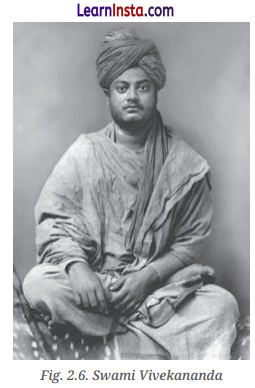
Which of the following statements is correct about him?
(a) He participated in the Revolt of 1857 against the British.
(b) He represented India at the Parliament of Religions in Chicago in 1893.
(c) He led the Non-Cooperation Movement in India.
(d) He founded the Indian National Congress in 1885.
Answer:
(b) He represented India at the Parliament of Religions in Chicago in 1893.
Question 2.
The Image shows a tribal leader who led an uprising against British exploitation in Eastern India in the late 19th century.
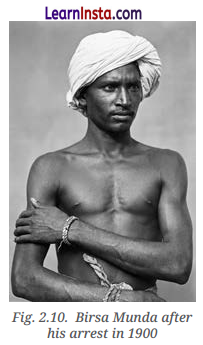
Which of the following statements is correct?
(a) He led the Kuka Movement in Punjab.
(b) He was involved in the Revolt of 1857.
(c) He led the Ulgulaan in Chota Nagpur to reclaim tribal land.
(d) He founded the All-India Muslim League.
Answer:
(c) He led the Ulgulaan in Chota Nagpur to reclaim tribal land.
India’s Long Road to Independence Class 8 Case Based Questions
Question 1.
Read the passage given below and answer the following questions.
In 1858, a ‘royal proclamation’ was issued in Victoria’s name, promising to respect ‘the rights, dignity and honour of native Princes’, which means that some 560 Indian princes would continue to rule their own states, but under British supremacy, or ‘paramountcy’ as it was called. The proclamation also assured the ‘natives of our Indian territories’ that they would be taken care of just like ‘all our other subjects’ and that there would be no attempt to impose Christianity on any of them.
(i) How did the 1858 Royal Proclamation assure the Indian princes about their states?
(a) They would be completely independent
(b) They would rule under British paramountcy
(c) Their states would be annexed immediately
(d) They would share power with European officials
Answer:
(b) They would rule under British paramountcy
(ii) According to the proclamation, how would the British treat the natives of India?
(a) As foreigners with limited rights
(b) Equally, like all other British subjects
(c) With strict religious restrictions
(d) With forced conversion to Christianity
Answer:
(b) Equally, like all other British subjects
(iii) How many Indian princes were mentioned as continuing to rule under the British?
(a) About 100
(b) About 250
(c) About 560
(d) About 1000
Answer:
(c) About 560
Question 2.
Read the passage given below and answer the following questions.
The idea of Swadeshi was not exactly new; from the late 19th century, a few Indian leaders promoted self-reliance. In 1886, the industrialist Jamsetji Tata established the Swadeshi Mills in Bombay, which became a model of textile production. Several Swadeshi-minded Indian businessmen started the Punjab National Bank in Lahore in 1895, solely with Indian capital; the Punjabi Nationalist leader, Lala Lajpat Rai, was one of its founding figures and early directors.
In 1901, the great Indian chemist Prafulla Chandra Ray founded the Bengal Chemicals and Pharmaceuticals Ltd. There are many more examples, all of them motivated by the desire to break the British monopoly in every area of the Indian economy.
(i) Who established the Swadeshi Mills in Bombay in 1886’
(a) Lala Lajpat Rai
(b) Jamsetji Tata
(c) Prafulla Chandra Ray
(d) Gopal Krishna Gokhale
Answer:
(b) Jamsetji Tata
(ii) Which bank was started with solely Indian capital in 1895?
(a) Bank of India
(b) Punjab National Bank
(c) Imperial Bank of India
(d) State Bank of India
Answer:
(b) Punjab National Bank
(iii) What was the main motivation behind these Swadeshi initiatives?
(a) To promote foreign trade
(b) To break British monopoly in the economy
(c) To expand British businesses in India
(d) To encourage European investments
Answer:
(b) To break British monopoly in the economy
Question 3.
Read the passage given below and answer the following questions.
The Cellular Jail in the Andaman Islands was a huge colonial prison far from the mainland. Known as ‘Kala Pani’ (Black Water), it was designed specifically for solitary confinement and was used by the British to exile and isolate revolutionaries. Prisoners faced horrific conditions, including extreme physical labour, such as extracting oil by hand, and brutal punishment for the slightest disobedience, all intended to break the spirit of freedom fighters.
(i) Why was the Cellular Jail called Kala Pani?
(a) Because it was surrounded by black rocks
(b) Because it was a remote prison far from the mainland
(c) Because prisoners wore black uniforms
(d) Because it was located in the Bay of Bengal
Answer:
(b) Because it was a remote prison far from the mainland
(ii) What was the main purpose of the Cellular Jail?
(a) To educate revolutionaries
(b) To exile and isolate freedom fighters
(c) To provide skilled jobs
(d) To promote British trade
Answer:
(b) To exile and isolate freedom fighters
(iii) Which of the following was part of the prisoners’ daily routine?
(a) Reading and writing letters freely
(b) Physical labour like extracting oil by hand
(c) Attending cultural programs
(d) Working in British offices
Answer:
(b) Physical labour like extracting oil by hand