Students revise important topics using Class 8 Social Science Extra Questions and Class 8 SST Part 2 Chapter 2 India’s Long Road to Independence Extra Question Answer before exams.
India’s Long Road to Independence Class 8 Extra Question Answer
Extra Questions of India’s Long Road to Independence Class 8
India’s Long Road to Independence Class 8 Very Short Question Answer
Question 1.
What was the main promise made in the 1858 Royal Proclamation?
Answer:
The main promise made in the 1858 Royal Proclamation was as follows
- Respect for Indian Princes: The 1858 Royal Proclamation promised to respect the rights, dignity, and honour of Indian rulers and allowed the princely states to continue under British supremacy.
- Protection of the People It assured Indians that the British Government would protect their rights, treat them fairly, and would not interfere in their religious beliefs or impose Christianity.
Question 2.
Why did Arya Samaj oppose ritualism and caste by birth?
Answer:
Arya Samaj opposed ritualism and caste by birth because
- Belief in Equality and Reform: Arya Samaj opposed ritualism and caste by birth because it believed in equality, rational thinking, and the true teachings of the Vedas.
- Social Upliftment: It promoted education for all, supported widow remarriage and women’s education, and worked to remove social inequalities

Question 3.
How did Swami Vivekananda connect spiritual revival with social action? (Competency-based Questions)
Answer:
Swami Vivekananda connected spiritual revival with social action in the following ways
- He founded the Ramakrishna Mission to combine spirituality with social service.
- He encouraged self-confidence, education, and scientific development to inspire practical social reforms.
Question 4.
Who led the Namdhari or Kuka Movement in Punjab?
Answer:
In Punjab, the Namdhari or Kuka Movement was led by Baba Ram Singh, who reformed Sikh society and opposed British rule, promoted self-reliance, rejected foreign goods, and inspired courage and devotion among his followers.
Question 5.
What was the main purpose of Anushilan Samiti ¡n Bengal?
Answer:
The main purpose of Anushilan Sämiti in Bengal was to train young men intellectually, morally, and physically, promote patriotism, and prepare them for revolutionary activities against British rule.
Question 6.
When and why the Surat split occurred within the Congress?
Answer:
The Surat split occurred in 1907 during the Congress session at Surat because the Extremists, led by Tilak, Lala Lajpat Rai, and Aurobindo Ghose, demanded Swaraj, while the Moderates wanted minor reforms, leading to a division and separate meetings.
Question 7.
How did the Home Rule Movement try to unite Hindus and Muslims? (Competency-based Questions)
Answer:
The Home Rule Movement tried to unite Hindus and Muslims in the following ways
- It was led jointly by Bal Gangadhar Tilak and Annie Besant, involving people from both communities in demanding self-government.
- It promoted shared political goals and cooperation, bringing Hindus and Muslims together against British rule.
Question 8.
What was the main aim of the Kakori Train Robbery?
Answer:
The main aim of the Kakori Train Robbery was to raise funds for revolutionary activities of the Hindustan Republican Association to fight against British rule in India.
Question 9.
Who led the Home Rule Movement along with Annie Besant?
Answer:
Bal Gangadhar Tilak led the Home Rule Movement along with Annie Besant to demand self-government for India within the British Empire.
Question 10.
How did women participate in revolutionary activities?
Answer:
Women participated in revolutionary activities in the following ways
- They took part in assassinations of British officials, like Suniti Chowdhury and Shanti Ghosh in Comilla.
- They attempted attacks on high-ranking officers, like Bina Das trying to assassinate the Governor of Bengal.
Question 11.
When and why did the Indian National Congress demand Purna Swaraj?
Answer:
The Indian National Congress demanded Purna Swaraj in December 1929 due to the following reasons
- They wanted complete independence from British rule instead of limited dominion status.
- They were frustrated with British repression, including arrests and violence against peaceful protests.
Question 12.
Which Ottoman title did the Khilafat Movement aim to protect?
Answer:
The Khilafat Movement aimed to protect the title of the Khalifa(Caliph), the religious and political leader of the Ottoman Empire.
Question 13.
Who threw bombs in the Central Legislative Assembly and when?
Answer:
Bhagat Singh threw bombs in the Central Legislative Assembly in 1929 to protest against British rule without causing any deaths.
Question 14.
Who supported separate electorates for the Depressed Classes?
Answer:
B.R. Ambedkar supported separate electorates for the Depressed Classes to ensure their political representation.
Question 15.
What idea did Muhammad Iqbal propose?
Answer:
Muhammad Iqbal proposed the idea of a separate Muslim territory in North-Western India to preserve Muslim culture and religion.
Question 16.
Why did Gandhi reject the Cripps Mission offer of dominion status?
Answer:
Gandhi rejected the Cripps Mission offer of dominion status due to the following reasons
- It did not grant full independence and kept Britain in control of defence, foreign affairs, and communication.
- It allowed provinces to opt out, which could divide India and weaken unity.
Question 17.
How did Kanaklata Barua become a symbol of youthful resistance? (Competency-based Questions)
Answer:
Kanaklata Barua became a symbol of youthful resistance by leading a procession at age 17 to hoist the national flag during the Quit India Movement in 1942, where she was shot by British police, showing courage and patriotism at a young age.
Question 18.
Name one factor, apart from Gandhi, that contributed to British exit.
Answer:
One factor, apart from Gandhi, that contributed to the British exit was the revolutionary efforts and uprisings, including mutinies in the Royal Indian Air Force and Navy, which showed Britain that it could not rule India without Indian support.
India’s Long Road to Independence Class 8 Short Question Answer
Question 1.
Explain how social reformers like Jyotirao Phule challenged social inequality.
Answer:
Social reformers like Jyotirao Phule challenged social inequality in the following ways
- He promoted modern education for girls and marginalised communities, opening schools to give them learning opportunities.
- He actively opposed caste discrimination and untouchability, speaking against social hierarchies that oppressed lower castes.
- He worked to improve the status of women, supporting widow remarriage and encouraging women to participate in social and public life.
Question 2.
Discuss the role of Bankim Chandra Chattopadhyay in inspiring patriotic feelings through literature.
Answer:
The role of Bankim Chandra Chattopadhyay in inspiring patriotic feelings through literature is as follows
- He wrote the novel Anandamath, which highlighted India’s past struggles and created pride among readers.
- He composed the song Vande Mataram, which became a powerful slogan during the Swadeshi Movement.
- He presented India as a divine motherland, encouraging love, unity, and devotion towards the nation.
Question 3.
Explain the main objectives of the Namdhari movement and its consequences.
Answer:
The main objectives and consequences of the Namdhari Movement are as follows
Objectives
- To reform Sikh society and promote devotion by upholding the name of God and moral discipline.
- To oppose British rule by rejecting foreign goods and creating their own postal and court systems.
Consequences
- The British executed 65 Kukas without trial and arrested Baba Ram Singh, exiling him to Burma.
- The movement inspired courages self-reliance, and resistance against British authority.
Question 4.
How did the Anushilan Samiti prepare youth for revolutionary activities in Bengal?
Answer:
The Anushilan Samiti prepared youth for revolutionary activities in Bengal in the following ways
- It provided intellectual, moral, and physical training to young men to build strength, discipline, and courage.
- Under the guidance of Aurobindo Ghose and Barindra Ghose, it spread nationalist ideas and revolutionary thinking.
- It organised secret activities and coordinated efforts to resist British rule through planned revolutionary actions.
Question 5.
The 1905 Partition of Bengal divided the region along religious lines, causing protests and political unrest. Evaluate how the Partition affected political mobilisation and communal relationships in India. (Competency-based Questions)
Answer:
The Partition affected political mobilisation and communal relationships in India in the following ways
- It sparked a national awakening with public meetings, rallies and singing of Vande Mataram, strengthening the national movement.
- It led to the growth of the Swadeshi and Boycott Movements, encouraging people to reject foreign goods and support Indian industries.
- It increased communal tensions as many Muslim leaders supported the partition for promised development in
East Bengal. - People tied rakhis to promote Hindu-Muslim unity, though divisions gradually deepened.
Question 6.
Describe the formation of the All India Muslim League and its role In communal politics.
Answer:
The All-India Muslim League was formed in December 1906 at Dhaka by Muslim leaders to protect Muslim political interests and to counter the growing influence of the Indian National Congress.
It aimed to ensure proper political representation for Muslims in legislative councils.
Its role in communal politics is as follows
- It promoted separate political interests for Muslims,
increasing divisions between communities. - It supported the idea of a separate Muslim nation, which strengthened communal politics and contributed to the Two-Nation Theory.
Question 7.
Explain the difference between Moderates and Extremists in the Congress after 1907 Surat Split. (Competency-based Questions)
Answer:
The difference between Moderates and Extremists in the Congress after 1907 Surat Split is as follows
| Basis | Moderates | Extremists |
| Demand | Wanted self-government within the British Empire and gradual reforms. | Demanded immediate Swaraj (complete self-rule). |
| Methods | Used constitutional methods like petitions, resolutions, and peaceful protests. | Used boycott, Swadeshi and mass movements to oppose British rule. |
| View of British rule | Believed British Rule could be reformed through Cooperation. | Believed British rule was unjust and needed strong resistance. |
| Leaders | Led by Dadabhaj Naoroji, Gopal Krishna Gokhale and Pherozeshah Mehta. | Led by Bal Gangadhar Tilak, Lala Lajpat Rai and Aurobindo Ghose. |
Question 8.
Compare the aims of the Non-Cooperation Movement and Civil Disobedience Movement. (Competency-based Questions)
Answer:
The aims of Non-Cooperation and Civil Disobedience can be compared as follows
| Non-Cooperation Movement | Civil Disobedience Movement |
| Its aim was to protest against British rule and attain Swaraj through non-cooperation. | Its aim was to achieve Purna Swaraj (complete independence) from British rule. |
| It aimed to weaken British authority by boycotting government institutions and foreign goods. | It aimed to directly challenge British authority by breaking unjust laws like the salt law. |
| It focused on withdrawing support from the British government. | It focused on openly defying British laws to end colonial control. |
Question 9.
Discuss the significance of revolutionary actions in India’s freedom struggle.
Answer:
The significance of revolutionary actions in India’s freedom struggle is as follows
- Revolutionary acts such as the Kakori Train Robbery and the Assembly Bomb Case openly challenged British authority and exposed colonial injustice.
- The bravery and sacrifice of revolutionaries like Bhagat Singh, Sukhdev and Rajguru inspired young Indians to join the freedom struggle.
- Revolutionary groups organised secret societies, raised funds and attempted armed uprisings, keeping the spirit of resistance alive across different regions of India.
Question 10.
Women actively participated in revolutionary activities, carrying out protests and even daring attacks against British officials. Explain the Importance of women revolutionaries in the struggle for Independence. (Competency-based Questions)
Answer:
The importance of women revolutionaries in the struggle for independence is as follows
- Their active participation proved that the freedom struggle was not limited to men, making it a truly mass movement involving all sections of society.
- By breaking social barriers and challenging traditional roles, they promoted gender equality and inspired greater social reform.
- Their courage and sacrifices strengthened the spirit of resistance and motivated more people, especially women and youth, to actively support the national movement.
Question 11.
Explain the Gandhi-Irwin Pact and its effect on Indian politics.
Answer:
The Gandhi-Irwin Pact was signed in 1931 between Mahatma Gandhi and Viceroy Irwin. Under this agreement, the British government agreed to release non-violent political prisoners and allow limited private salt production. In return, the Congress agreed to suspend the Civil Disobedience Movement and participate in the Round Table Conference in London.
Its effects on Indian politics are as follows
- It marked the first formal negotiation between the
- British government and the Indian National Congress.
- It temporarily paused mass protests and shifted the struggle towards constitutional discussions.
Question 12.
How did the Two-Nation Idea proposed by Muhammad Iqbal influence Indian politics?
Answer:
The Two-Nation idea proposed by Muhammad Iqbal influenced Indian politics in the following ways
- It encouraged the demand for a separate Muslim territory to preserve Muslim culture and religion.
- It strengthened the political position of the All-India Muslim League, which began focusing more on Muslim political interests.
- It increased differences between the Congress and the Muslim League, shaping debates about representation and the future political structure of India.
Question 13.
Describe the major events of the Quit India Movement.
Answer:
The major events of the Quit India Movement are as follows,
- In August 1942, Mahatma Gandhi launched the movement with the slogan ‘Do or Die,’ demanding immediate British withdrawal from India.
- Soon after its launch, Gandhi, Nehru, Patel, and other leaders were arrested, but protests spread across the country.
- The movement became widespread and intense, with over 100,000 people jailed and nearly 10,000 killed, showing strong public resistance against British rule.
Question 14.
How did Sardar Vallabhbhai Patel ensure the Integration of princely states into India?
Answer:
Sardar Vallabhbhai Patel ensured the integration of princely states through the following methods:
- Persuasion and Diplomacy: He utilised persuasion and diplomacy to integrate most of the states into India peacefully.
- Military Action: For a small number of reluctant states that were hesitant to join, military action was applied to secure their integration.
India’s Long Road to Independence Class 8 Long Question Answer
Question 1.
Examine the role of 19th-century social reform movements in laying the foundation for political consciousness in India.
Answer:
The role of 19th-century social reform movements in laying the foundation for political consciousness in India are as
- Reformers opposed child marriage, caste discrimination, and gender inequality1 encouraging people to question injustice.
- Schools and educational reforms created an educated middle class aware of rights and governance.
- Movements like Brahmo Samaj and Arya Samaj rejected blind rituals and encouraged a scientific outlook.
- Leaders like Swami Vivekananda inspired pride in India’s cultural heritage and strengthened national consciousness, which helped unite people and prepare the way for organised political nationalism.
- Reform organisations united people through debates and social action, preparing the ground for organised political nationalism.
Question 2.
Trace the formation of the Indian National Congress and its early objectives in the context of British governance.
Answer:
The Indian National Congress was founded in 1885 under the initiative of Allan Octavian Hume, along with prominent leaders like Dadabhai Naoroji and Womesh Chunder Bonnerjee, who became its first President.
The first session of the Congress was held in Bombay, attended by 72 delegates representing different regions, communities, and social backgrounds, marking the beginning of a unified political platform for Indians.
The early objectives of the Indian National Congress were as follows
- To demand increased representation of Indians in administration and decision-making, giving them a greater role in governance.
- To secure civil liberties and safeguard the rights of Indian subjects under British rule.
- To achieve reforms through constitutional methods, peaceful petitions and discussions with the British government, avoiding confrontation or violence in the initial phase.
Question 3.
Critically assess the Namðhari movement and the Western Maharashtra revolt as early expressions of political dissent.
Answer:
The Namdhari (Kuka) Movement, led by Baba Ram Singh in Punjab during the 1860s- 1870s, combined religious reform with resistance to British rule.
- It promoted moral discipline, opposed social evils like child marriage, rejected foreign goods, and created independent institutions such as private courts and a postal system to avoid colonial authority.
- The British suppressed it brutally, executing many followers without trial, showing its political challenge to colonial power.
- In Western Maharashtra, resentment grew after famine and plague (1896). Harsh British measures led to violent resistance, including the assassination of British officials by the Chapekar brothers, reflecting anger against oppressive colonial administration.
Question 4.
Discuss the significance of Birsa Munda’s revolt for tribal communities.
Answer:
The significance of Birsa Munda’s revolt for tribal communities is as follows
- The revolt revived tribal faith, traditions, and dignity, giving tribal communities a renewed sense of cultural identity.
- It strongly opposed British rule, exploitative landlords, and missionary interference, which threatened tribal customs and lands.
- The movement made tribals aware of their rights and encouraged them to unite against colonial authority and local exploitation.
- Birsa Munda successfully organised large tribal groups under a common cause, fostering leadership and solidarity among the tribes.
- Despite the suppression of the revolt and Birsa’s death in jail, the uprising became a lasting symbol of tribal resistance, courage, and the struggle for justice, inspiring future generations of tribal leaders.
Question 5.
Discuss the causes and outcomes of the Surat split.
Answer:
The causes and outcomes of the Surat Split (1907) are as follows
Causes
- The Moderates favoured gradual reforms and cooperation with the British, while the Nationalists demanded Swaraj, Swadeshi, and boycott of foreign goods, creating ideological differences.
- The Moderates wanted to step back from earlier radical resolutions passed at previous Congress sessions, which angered the Nationalists.
- During the Surat session of 1907, the Moderates prevented Bal Gangadhar Tilak from speaking, leading to intense clashes and arguments between the two groups.
Outcomes
- The Indian National Congress split into Moderate and Nationalist factions, weakening the unity of the freedom
movement. - The colonial government exploited this division, using it as an opportunity to suppress nationalist leaders and reduce the influence of the Congress in political agitation.
Question 6.
Analyse the causes and effects of the Non- Cooperation Movement.
Answer:
The causes and effects of the Non-Cooperation Movement are as follows
Causes
- The British government allowed detention without trial, curtailing basic civil liberties and creating widespread anger among Indians.
- The brutal firing on peaceful protestors, such as during the Jallianwala Bagh massacre, destroyed Indian faith in British justice and fairness.
- High prices, food shortages and heavy taxes increased public discontent, especially among peasants and workers.
Effects
- The movement transformed the freedom struggle into a nationwide mass movement, involving peasants.
Workers, students and women. - The boycott of foreign goods and widespread use of khadi promoted self-reliance and fostered economic nationalism among Indians.
Question 7.
Compare the concepts of Dominion Status and Purna Swaraj and explain why India opted for full independence. (Competency-based Questions)
Answer:
The comparison between the concepts of Dominion Status and Purna Swaraj are as follows
| Feature | Dominion Status | Purna Swaraj |
| Meaning | Self-governing within the British Empire; India under the British Crown | Full and absolute independence from British rule |
| Political Control | India controls internal matters, but Britain controls defence, foreign policy, and external affairs | India has full control over all political, administrative and foreign matters |
India opted for full independence due to the following reasons
- Measures like the Government of India Act 1919 and 1935 offered limited self-government, which fell far short of Indian aspirations.
- Movements like Non-Cooperation (1920-22), Civil Disobedience (1930-34) and the Quit India Movement (1942) showed the determination of the Indian people for complete freedom.
Question 8.
Examine the Two-Nation Theory, Its origins and its influence on partition.
Answer:
The Two-Nation Theory was the idea that Hindus and Muslims were two separate nations, with distinct religions, cultures, and social systems, and therefore Muslims could not he part of a Hindu-majority India.
Origins of the Two-Nation Theory are as follows
- It emerged in the early 20th century, gaining prominence after the formation of the All India Muslim League in 1906, which sought to protect Muslim political rights.
- Early proponents like Sir Syed Ahmed Khan emphasised Muslim education, social reform and the need for a separate political identity, arguing that Muslims and Hindus could not share power equally in a single state.
Its influence on Partition is as follows
- The theory justified the creation of Pakistan as a separate homeland for Muslims.
- It deepened communal divisions between Hindus and Muslims in the 1940s, contributing directly to the Partition of India in 1947, accompanied by large-scale migration, violence and displacement.
Question 9.
The Partition of India in 1947 led to mass migration, widespread violence, and the displacement of millions of people. Evaluate how the 1947 Partition created challenges for migrants and affected social harmony across communities. (Competency-Based Questions)
Answer:
The partition created the following challenges faced by the migrants
- Around 10-12 million people crossed borders, with Hindus and Sikhs moving to India and Muslims moving to Pakistan, often travelling under difficult and dangerous conditions.
- Migrants left behind their homes, farms, businesses and personal belongings, making it extremely challenging to rebuild their lives and livelihoods in unfamiliar areas.
- Communal riots, massacres and abductions led to the deaths of 1-2 million people, causing widespread trauma, insecurity and psychological distress during the migration process.
Its impact on social harmony were as follows
- The violence deepened mistrust between Hindus, Muslims and Sikhs, shattering centuries-old patterns of coexistence in towns and villages.
- Mixed communities were uprooted, resulting in the loss of social networks, cultural diversity, and traditional inter-community bonds.
Question 10.
Discuss the multIple approaches (moderates, nationalists, revolutionaries, Gandhians) that contributed to India’s Independence.
Answer:
India’s struggle for independence involved diverse approaches such as
- Leaders like Gopal Krishna Gokhale sought gradual reforms through petitions, dialogue, and legislative councils, emphasising loyalty to the British and moral persuasion.
- Leaders such as Bal Gangadhar Tilak demanded swaraj through assertive politics, public agitation, and boycott movements.
- Figures like Bhagat Singh, Chandrashekhar Azad and Lala Lajpat Rai used armed struggle and secret societies to challenge British authority directly.
- Mahatma Gandhi mobilised mass civil disobedience, non-violent protests and Satyagraha, uniting millions across classes, castes and regions.
- The interaction of all these strategies created pressure on the British, inspiring national unity and ultimately leading to India’s independence in 1947.
India’s Long Road to Independence Class 8 Case Based Questions
Question 1.
Read the passage given below and answer the following questions.
In India, Muslim leaders such as Muhammad Ali and Shaukat Ah, also known as the Ali brothers, and Maulana Abul Kalam Azad launched in 1919 the Khilafat Movement, which called for the preservation of the Caliph’s religious authority. Gandhi saw there an opportunity to unite Hindus and Muslims against British rule and to bring Muslims into the nationalist fold.
In 1920, an alliance was forged between Khilafat leaders and the Congress, with Gandhi and the Khilafat leaders promising to fight together for both Khilafat and Swaraj.
(i) What was the main goal of the Khilafat Movement?
Answer:
The main goal of the Khilafat Movement was to preserve the Caliph’s religious authority.
(ii) How did Gandhi involve himself ¡n the Khilafat Movement?
Answer:
Gandhi saw an opportunity to unite Hindus and Muslims against British rule and brought Muslims into the nationalist fold.
(iii) When was the alliance between the Congress and Khilafat leaders formed?
Answer:
The alliance was formed in 1920.
Question 2.
Read the passage given below and answer the following questIons.
The HRA reorganised itself as the Hindustan Socialist Republican Association (HSRA), which adopted a more defined socialist ideology. Its leaders, Chandrashekar Azad and Bhagat Singh, were keen to avenge Lala Lajpat Rai’s death. In December 1928, targeting a British police officer who had ordered the lathi charge on Lala Lajpat Rai, they assassinated a younger officer by mistake.
(i) What was the HSRA?
Answer:
The HSRA (Hindustan Socialist Republican Association) was a revolutionary organisation in India that followed a socialist ideology and aimed at ending British rule.
(ii) Why did Bhagat Singh and Chandrashekhar Azad want to attack the British police officer?
Answer:
They wanted to avenge the death of Lala Lajpat Rai, who had died after being injured in a lathi charge ordered by the officer.
(iii) What mistake did they commit in their attack?
Answer:
They mistakenly assassinated a younger British officer instead of the one who had ordered the lathi charge.
Question 3.
Read the passage given below and answer the following questions.
World War II ended in 1945 with a decisive victory of the Allies (in particular the U.S.A., the United Kingdom, the Soviet Union and China) over the Axis (Germany, Italy and Japan). Many European powers realised they could no longer hold on to their colonies; an era of decolonisation began. Britain. exhausted by the war, finally sought a transition towards India’s independence.
(i) Name the main countries that were part of the Allies.
Answer:
The main Allied countries were the U.S.A., the United Kingdom, the Soviet Union, and China.
(ii) What global change did World War II bring in terms of colonies?
Answer:
After World War II, many European powers realised they could no longer hold on to their colonies, leading to an era of decolonisation.
(ii) Why did Britain seek a transition towards India’s independence?
Answer:
Britain was exhausted by the war and sought to gradually transfer power and allow India to become independent.
India’s Long Road to Independence Class 8 Picture Based Questions
Question 1.
Answer the questions based on the picture given below.
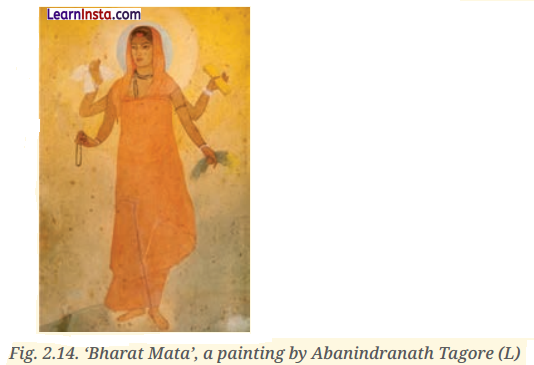
(i) Who was the artist of this painting?
Answer:
The painting was created by Abanindranath Tagore.
(ii) What does the ¡mage of Bharat Mata symbolise in the Indian freedom movement?
Answer:
It symbolises nationalism, unity, and the motherland calling for devotion and service during the struggle for independence.
(iii) Why was this image Important for Inspiring Indians during the colonial period?
Answer:
This image was important because it evoked patriotism and a sense of belonging, encouraging Indians to work for their country’s freedom.
Question 2.
Answer the questions based on the picture given below.
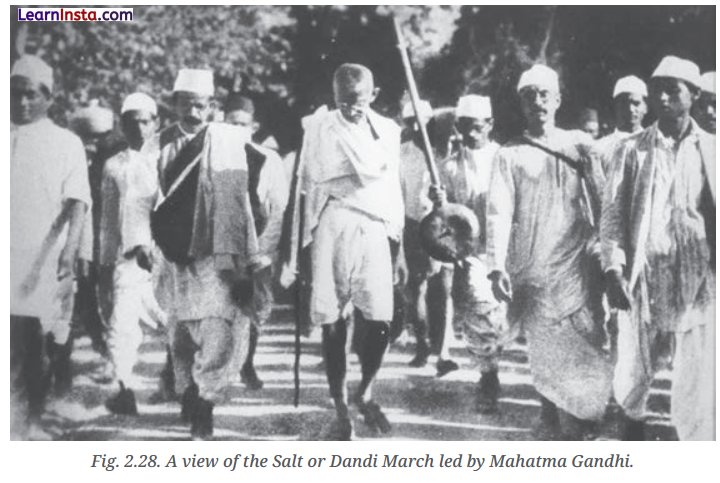
(i) What is the name of this movement?
Answer:
The movement is the Dandi March or Salt March of 1930.
(ii) What was the main purpose of the march?
Answer:
The main purpose was to protest against the British salt tax and assert India’s right to produce salt independently.
(iii) How did this march contribute to India’s freedom struggle?
Answer:
It mobilised mass participation, drew international attention, and strengthened non-violent civil disobedience against British rule.
Class 8 India’s Long Road to Independence Extra Questions for Practice
Objective Type Questions
Question 1.
What was a key aim of the Arya Samaj founded by Swami Dayananda Saraswati?
(a) Promote Islamic values
(b) Encourage widow remarriage and girls’ education
(c) Oppose English education
(d) Strengthen British rule
Question 2.
Who was the first President of the Indian National Congress?
(a) Dadabhai Naoroji
(b) Womesh Chunder Bonnerjee
(c) Allan Octavian Hume
(d) Bal Gangadhar Tilak
Question 3.
Who led the Namdhari (Kuka) Movement in Punjab?
(a) Baba Ram Singji
(b) Bal Gangadhar Tilak
(c) Rusa Munda
(d) Lala Lajpat Rai
Question 4.
In which year did the Quit India Movement begin?
(a) 1930
(b) 1942
(c) 1920
(d) 1947
Question 5.
Match the following
| List I (Leader) | List II (Contribution) |
| A. Bankim Chandra Chattopadhyay | 1. Composed Vande Mataram, promoted Indian languages |
| B. Swami Vivekananda | 2. Founded Ramakrishna Mission, inspired youth |
| C. Bal Gangadhar Tilak | 3. Used Ganesh Chaturthi & Shivaji festival to unite people |
| D. Rabindranath Tagore | 4. Set Vande Mataram to music, protested Jallianwala Bagh |
Codes
A B C D
(a) 1 2 3 4
(b) 1 2 4 3
(c) 1 4 3 2
(d) 2 1 3 4
Question 6.
Match the following
| List I (Movement) | List II (Detail) |
| A. Champaran Satyagraha | 1. Support indigo farmers in Bihar |
| B. Kheda Satyagraha | 2. Support peasants in Gujarat against high revenue |
| C. Non-Cooperation Movement | 3. Nationwide boycott of foreign goods, schools, courts |
| D. Salt March | 4. Civil disobedience against British salt monopoly |
Codes
ABCD
(a) 1 2 3 4
(b) 1 2 4 3
(c) 2 1 3 4
(d) 1 3 2 4
Question 7.
Assertion (A): Anushilan Samiti trained youth in Eastern India for nationalist activities.
Reason (R): It focused on education, moral development, and physical training.
Codes
(a) Both A and R are true, and R is the correct explanation of A
(b) Both A and R are true, but R is not the correct explanation of A
(c) A is true, but R is false
(d) A is false, but R is true
Question 8.
Assertion (A): The Salt March to Dandi began the Civil Disobedience Movement.
Reason (R): Gandhi encouraged people to collect salt in protest against British monopoly and taxes.
Codes
(a) Both A and R are true, and R is the correct explanation of A
(b) Both A and R are true, but R is not the correct explanation of A.
(c) A is true, but R is false
(d) A is false, but R is true
Subjective Type Questions
Question 1.
Name one social reformer who worked for women’s education in 19th-century India.
Question 2.
Who led the Ulgulaan uprising in Chota Nagpur?
Question 3.
Who founded the All-India Muslim League?
Question 4.
Describe the key contributions of Raja Ram Mohan Roy and Swami Dayananda Saraswati to social reform.
Question 5.
Describe the impact of the Chapekar brothers’ actions during the plague outbreak in Western Maharashtra.
Question 6.
What were the main reasons behind the British decision to leave India in 1947?
Question 7.
Trace the evolution of Indian nationalist movements from the Revolt of 1857 to the formation of the Indian National
Congress. Highlight the role of social reformers and early leaders.
Question 8.
Compare and contrast the approaches of Moderates, Extremists, Revolutionaries, and Gandhi in India’s independence movement. How did these different methods complement each other?