Students can use Kaveri Class 9 English Book Solutions and Class 9 English Kaveri Book Poem 4 Question Answer I Cannot Remember My Mother as a quick reference guide.
I Cannot Remember My Mother Poem Class 9 Question Answer
Class 9 English Kaveri Poem 4 Question Answer
Class 9 Kaveri Poem 4 I Cannot Remember My Mother Question Answer
Reflect and Respond (NCERT Page 126)
I. Work in pairs. Discuss the memories from your childhood that you remember. List them and share with your classmates and teacher.
Answer:
Some memories from my childhood that I remember are listening to bedtime stories told by my parents, playing with friends in the evening, celebrating festivals with family, and being comforted by my mother when I was afraid or upset. These memories are associated with feelings of happiness, safety, and warmth. Sharing them helps us understand how early experiences shape our emotions.
II. Discuss how children’s relationship with their mother can influence emotions and memories.
Answer:
Children’s relationship with their mother deeply influences their emotions and memories. A mother’s love, care, and presence give a child a sense of security and comfort. Even when memories fade with time, emotional experiences like her voice, touch, or care remain in the child’s mind. These feelings often get linked with nature, smells, sounds, and quiet moments, shaping how children remember love, warmth, and safety throughout their lives.
III. Match the words given in Column 1 with their meaninos in Column 2.

Answer:
| Column 1 | Column 2 |
| 1. hover | (v) linger or remain near a place |
| 2. hum | (i) sing a tune with your lips closed |
| 3. cradle | (vi) a small bed for a baby |
| 4. shiuli | (ii) a type of flower (coral jasmine) |
| 5. morning service | (iv) rituals conducted in a temple |
| 6. gaze | (iii) look steadily for a long time |
Check Your Understanding (NCERT Pages 127-129)
I. Fill in the blanks with appropriate words.
Stanza 1
1. The poet remembers his mother while he _________.
Answer:
is playing

2. The poet remembers the _________ but not the _________ . Setting: _________ (outdoor/indoor)
Answer:
tune/song; words. Setting: indoor
Stanza 2
1. The poet remembers his mother in the _________ season.
Answer:
early autumn
2. The poet remembers his mother by the smell of _________ .
Setting: _________ (outdoor/indoor)
Answer:
shiuli flowers Setting: outdoor
Stanza 3
1. The poet jeels that his mother _________ at him from the _________ .
Setting: _________ (outdoor/indoor)
Answer:
gazes; sky
Setting: outdoor
II. The senses of olfactory (smell), auditory (hearing), and visual (sight) are three of the five basic senses in humans.
Give examples of references to senses from the poem. Complete the table given below.

Answer:
| Stanza | Lines from the Poem | Sense |
| 3. | “I send my eyes into the blue of the distant sky” | Visual (sight) |
| 1. | … The tune of some song that she used to hum while rocking my cradle | Auditory (hearing) |
| 2. | “The smell of the shiuli flowers floats in the air” | Olfactory (smell) |
III. Read the poem silently once again and complete the following.
Question 1.
Two examples of alliteration from the poem are: (i) _________ and (ii) _________。
Answer:
(i) ‘some song’
(ii) ‘flowers float’
Question 2.
An example of onomatopoeia is _________ .
Answer: ‘Hum’
Question 3.
The poem uses imagery extensively. Explain.
Answer:
The poem makes effective use of imagery by appealing to the senses of sound, smell, and sight. The lullaby creates auditory imagery, the fragrance of shiuli flowers creates olfactory imagery, and the vast blue sky creates visual imagery. These images help the reader feel the poet’s emotional connection with his mother and make the poem vivid and touching.
Question 4.
Although the poem does not have a rhyme scheme, it is enjoyable because _________ .
Answer:
It flows naturally like a thought and expresses deep emotions in a simple and gentle manner
Question 5.
What is the tone of the poet? Why do you say so?
Answer:
The tone of the poem is calm, nostalgic, and tender. The poet remembers his mother with affection and quiet acceptance rather than grief or anger.
Question 6.
What impact does the title of the poem have on the overall mood of the poem?
Answer:
The title creates a mood of longing and emotional loss. It prepares the reader for a poem about faded memories but lasting emotional presence.
Question 7.
The poet uses ‘I cannot remember my mother’ as a refrain because _________ .
Answer:
It emphasises the fading of physical memory while highlighting the lasting emotional connection the poet has with his mother.
Question 8.
The poet uses symbolism to indicate the memory of his mother’s presence. Identify the symbols used in the poem.
Answer:
The ‘tune of the song’, ‘shiuli flowers’, ‘temple morning service’, and the ‘vast blue sky’ symbolise the mother’s love, peace, purity, and eternal presence.
Critical Reflection (NCERTPage 129)
I. Read the extracts given below and answer the questions that follow.
Extract 1
I cannot remember my mother; only sometimes, in the midst of my play a tune seems to hover over my playthings,
(i) Complete the following sentence appropriately.
The poet is reminded of his mother during his _________ .
Answer:
playtime
(ii) What is the primary emotion conveyed by the line ‘a tune seems to hover over my playthings’?
A. It enhances the joy of play.
B. It disrupts the playtime atmosphere.
C. It activates memories of the mother.
D. It symbolises the carefree nature of childhood.
Answer:
C. It activates memories of the mother.
(iii) In the context of the poem, what role does the hovering tune play during the speaker’s playtime?
Answer:
The hovering tune gently reminds the poet of his mother while he is playing. It brings her presence into his playtime without disturbing it, showing how her love continues to live in his memories.
(iv) State whether the following sentence is true or false.
The poet experiences the tune lingering over the playthings occasionally during playtime.
Answer:
True
(v) How could the poet feel his mother’s presence, even though she isn’t there?
Answer:
The poet feels his mother’s presence through memories, sounds, smells, and sights, such as the tune she hummed, the fragrance of flowers, and the stillness of the sky, even though she is not physically present.
Extract 2
I. feel that the stillness of my mother’s gaze on my face has spread all over the sky.
(i) What does the poet suggest about the stillness of his mother’s gaze spreading over the sky?
A. The mother’s gaze is physically present in the sky.
B. The sky is a symbolic extension of the mother’s presence.
C. The sky mirrors the mother’s emotions.
D. The stillness is fleeting and unrelated to the mother.
Answer:
B. The sky is a symbolic extension of the mother’s presence.
(ii) What emotion does the poet associate with the stillness of his mother’s gaze?
A. A sense of grief.
B. A sense of anticipation.
C. A sense of nostalgia.
D. A sense of serenity.
Answer:
D. A sense of serenity.
(iii) State whether the following sentence is true or false.
The poet suggests that the mother’s gaze has a tangible and visual effect on the sky.
Answer:
False
(iv) What is the purpose of likening the mother’s gaze to the sky?
Answer:
The poet likens his mother’s gaze to the sky to show that her love is vast, calm, and everlasting, surrounding him even in her absence.
(v) Complete the sentence appropriately.
The tone of the poet in the given extract is _________ because _________ .
Answer:
calm and reflective; he remembers his mother with quiet acceptance and emotional peace.
II. Answer the following questions.
Question 1.
What is the emotional impact of the refrain, ‘I cannot remember my mother’?
Answer:
The refrain creates a sense of loss while simultaneously highlighting the strength of emotional memory. It shows that although physical memories fade, emotional bonds remain powerful and enduring.
Question 2.
Interpret the connection between the poet’s mother and the following.
(i) shiuli flowers
Answer:
The fragrance of shiuli flowers reminds the poet of his mother. The flowers symbolise purity, peace and warmth, reflecting the gentle and sacred presence of his mother in his memories.
(ii) humming tune
Answer:
The humming tune represents the mother’s care and affection. It recalls the lullaby she used to hum while rocking him, symbolising comfort, security and maternal love.
Question 3
What role does nature play in the poet’s description of the memory of his mother?
Answer:
Nature acts as a medium through which the poet recalls his mother. Natural elements such as shiuli flowers and the sky help transform personal memory into a universal emotional experience.
Question 4
What can be inferred about the poet’s perception of the mother-child relationship?
Answer:
The poet views the mother-child relationship as deeply emotional and everlasting. Even after physical separation, a mother’s love continues to guide, protect, and comfort the child through memories and feelings.
Vocabulary in Context (NCERT Pages 131-133)
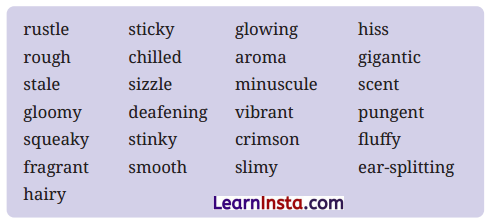
I. Work in pairs to classify the sensory words given in the box below. One example has been done for you.

Answer:
| Visual | Auditory | Olfactory | Tactile |
| glowing | hiss | aroma | sticky |
| gloomy | rustle | fragrant | rough |
| vibrant | squeaky | scent | chilled |
| crimson | sizzle | stinky | smooth |
| minuscule | deafening | pungent | slimy |
| gigantic | ear-splitting | stale | fluffy |
II. Fill in the blanks with sensory words in the box for the following passage written by Sarojini Naidu. There are two extra words.
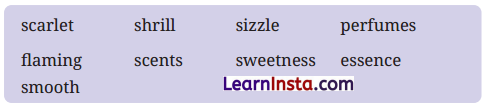
Come and share my exquisite March morning with me: this sumptuous blaze of gold and sapphire sky; these 1. _________ lilies that adorn the sunshine; the voluptuous 2. _________ of neem and champak and serisha that beat upon the languid air with their implacable 3. _________ ; the thousand little gold and blue and silver breasted birds bursting with the 4. _________ ecstasy of life in nesting time. And, do you know that the scarlet lilies are woven petal by petal from my heart’s blood, these little quivering birds are my soul made incarnate music, these heavy 5. _________ are my emotions dissolved into aerial 6. _________ this 7. _________ blue and gold sky is the ‘very me’…
Answer:
- Scarlet
- scents
- sweetness
- shrill
- perfumes
- essence
- flaming
III. Write numbers against each picture with the phrases that describe them with their sensory associations.
One example has been done for you.
1. beats of music echo in the air
2. melody of soothing scent dancing in the air
3. fragrant breeze of blooming buds
4. gentle lullaby, a soft melody
5. Colourful sky, painting a lively sight
6. attractive canvas painting the horizon

Answer:
3,4,5
6,1,2
Speaking Activity (NCERT Page 134)
I. Work in pairs. Think of an object, song, or a place that is memorable for you. Take turns to speak about it using the prompts given below
- Introduce it briefly
- Describe it in detail, including sensory details
- Narrate the specific memory associated with it
- Explain how it has impacted your life
- Summarise why this memory is meaningful to you even now
You may use the following phrases
- During my childhood…
- Growing up, I fondly remember…
- Recalling those early years, I can’t forget…
- In my younger days, I used to…
- I have a clear memory of…
- A routine activity in my childhood involved…
- A cherished part of my childhood includes…
- As a child, I was fond of…
- One of my favourite childhood moments is…
- Thinking about my early years, I recall…
- A common occurrence during my youth was…
Answer:
A memorable place from my childhood (Grandparents’ House)
During my childhood, one place that holds a special place in my heart is my grandparents’ house. It was a simple old house, but it felt warm and welcoming.
Growing up, I fondly remember the smell of freshly cooked food mixed with the fragrance of flowers from the courtyard. The walls were cool to the touch, and the sound of birds filled the mornings. In my younger days, I used to sit near the window, listening to my grandmother’s stories while feeling the soft breeze on my face.
One of my favourite childhood moments is spending evenings there, playing freely and laughing without any worries. Thinking about my early years, I recall how safe and happy I felt in that place.
That place has impacted me deeply because it taught me the value of love, simplicity, and togetherness. Even now, recalling those early years fills my heart with peace and happiness, which is why this memory remains meaningful to me.
Writing Task (NCERT Page 135)
I. Imagine you had been on a school trip to a scenic place which appealed to all your senses. Write a diary entry describing the place and why it was a memorable experience.
Contents of the diary entry
- begin with day, date, and time
- use only first person (I, my)
- capture sensory details
- express emotions
- focus on significant moments and experiences
- conclude with reflection
Answer:
Wednesday 21 December 20XX
6:00 p.m.
Dear Diary,
Today’s school trip to the hills was an experience I will always cherish. As soon as we arrived, the cool breeze, the scent of pine trees, and the soft rustle of leaves filled the air. The sky looked endlessly blue, and the distant mountains seemed calm and welcoming. I enjoyed walking along narrow paths, listening to birds and laughing with my friends. One special moment was when we sat quietly near a stream, letting the sound of flowing water wash away all our tiredness. I felt peaceful, happy, and completely free from daily worries. This trip taught me to appreciate nature’s beauty and the joy of simple moments. Even now, the memory fills me with warmth and gratitude.
Yours
XYZ