These Class 8 Science Curiosity Worksheet and Class 8 Science Chapter 12 How Nature Works in Harmony Worksheet with Answers are excellent for board exam practice.
Class 8 Science Chapter 12 How Nature Works in Harmony Worksheet
Class 8 How Nature Works in Harmony Worksheet
Worksheet On How Nature Works in Harmony Class 8 – How Nature Works in Harmony Worksheet Class 8
Let’s Begin
A. Multiple Choice Questions
Question 1.
Which type of interaction occurs when a tick feeds on a dog’s blood?
(a) Mutualism
(b) Commensalism
(c) Parasitism
(d) Competition
Question 2.
Which is the correct order for a grassland food chain?
(a) Grass → Grasshopper → Snake → Frog → Eagle
(b) Grass → Grasshopper → Frog → Snake → Eagle
(c) Grasshopper → Grass -> Snake → Eagle → Frog
(d) Eagle → Snake → Grasshopper → Grass → Frog
Question 3.
Growing only one type of crop repeatedly is called
(a) Poly-cropping
(b) Monoculture
(c) Organicfarming
(d) Croprotation.
Question 4.
Which of the following is an aquatic ecosystem?
(a) Forest
(b) Grassland
(c) Pond
(d) Desert
Question 5.
Observe the picture. What is likely to happen if the fish is removed?
(a) The dragonfly population may increase.
(b) The population of bees and butterflies may increase.
(c) Pollination may increase, s
(d) Flowering plants may produce more seeds.
Question 6.
This question consists of an Assertion (A) and a Reason (R). Read the Assertion and
Reason and choose the appropriate answer.
Assertion (A): The export of frog legs in the 1980s led to an ecological imbalance in India.
Reason (R): Reduction in frog populations increased agricultural pests, pesticide use and environmental harm.
(a) Both A and R are true and R is the correct explanation of A.
(b) Both A and R are true but R is not the correct explanation of A.
(c) A is true but R is false.
(d) A is false but R is true.

Question 7.
This question consists of an Assertion (A) and a Reason (R). ReacUhe Assertion and Reason and choose the appropriate answer.
Assertion (A): The Green Revolution led to increased food production in India.
Reason (R): The Green Revolution introduced traditional methods of farming using organic compost and manual tools.
(a) Both A and R are true and R is the correct explanation of A.
(b) Both A and R are true but R is not the correct explanation of A.
(c) A is true but R is false.
(d) A is false but R is true.
B. State True (T) or False (F).
1. A community is smaller than a population.
2. Migration is the seasonal movement of birds and animals from one place to another.
3. Kunapa Jala is a synthetic pesticide.
4. Heavy irrigation can disturb beneficial soil organisms like earthworms.
5. The Sundarbans were declared a UNESCO World Heritage Site in 1987.
C. Fill in the blanks.
1. __________ help protect coastal villages by slowing strong winds and waves during storms.
2. Farming that protects the environment and soil health is called __________ farming.
3. A simple sequence showing “who eats whom” is called a __________.
4. The transfer of pollen from the stamen to the carpel of a flower is called __________.
5. __________ play an important role in recycling nutrients.
6. __________ inspired many youngsters to study wildlife and protect the forests and biodiversity of India.
7. __________ helps control population size and keeps the ecosystem balanced.
D. Assign one word to the following terms.
1. Small umbrella-like structures on dead plants or trees, in rainy season.
2. Ancient text that emphasises on soil health and nourishment.
3. Group of the same species at one place/time.
4. Process of breaking down dead matter.
5. Parts of land or water set aside to conserve wildlife and their habitats.
6. Specific position of an organism in a food chain.
E. Match Column I with Column II.
| Column I | Column II |
| (i) Pollinators | (a) Orchids on tree |
| (ii) Mutualism | (b) Disperse seeds along their path |
| (iii) Commensalism | (c) Depend on other organisms for food |
| (iv) Decomposers | (d) Honeybee and flower |
| (v) Consumers | (e) Fungi and bacteria |
F. Write down the states of the famous protected areas that protect entire habitats including endangered animals, birds, and many rare plants.
1. Manas National Park __________
2. Eaglenest Wildlife Sanctuary __________
3. Pirotan Island Marine National Park __________
4. Jim Corbett National Park __________
5. Chilika Lake __________
Wonder Why?
A. Give reasons for the following.
1. It is important to maintain both biotic and abiotic balance in an ecosystem.
_____________________________________________________
_____________________________________________________
2. The removal of one species from a food chain affects many other species.
_____________________________________________________
_____________________________________________________
3. Overfishing leads to changes in plant populations around a water body.
_____________________________________________________
_____________________________________________________
4. Monoculture harms soil health and crop diversity
_____________________________________________________
_____________________________________________________
5. Use of tractors and synthetic fertilisers is now considered unsustainable.
_____________________________________________________
_____________________________________________________
6. Aquatic and terrestrial ecosystems often overlap in nature.
_____________________________________________________
_____________________________________________________
7. Farmland is considered a human-made ecosystem.
_____________________________________________________
_____________________________________________________
B. Study the food chain and answer the following questions.

Question 1.
What is a food chain? Which ecosystem is represented in this food chain?
_____________________________________________________
_____________________________________________________
Question 2.
What would happen if the snake population decreases?
_____________________________________________________
_____________________________________________________
Question 3.
Name the producer and primary consumer in the food chain.
_____________________________________________________
_____________________________________________________
Question 4.
Name the organism that will occupy the third level in a pyramid.
_____________________________________________________
_____________________________________________________
C. Read the paragraph and answer the following questions.
During summer vacation, Meena visited her grandparents’ village near the coast. She noticed tall, tangled mangrove trees growing along the shoreline. Her grandfather told her that these trees protect the village from storms and also provide a home for crabs, fish, and birds. He explained that many families earn their living by fishing in the mangrove creeks. Meena wondered how these trees could be so important for both nature and people.
Question 1.
How do mangroves help in preventing soil erosion?_____________________________________________________
_____________________________________________________
Question 2.
Name the largest mangrove forest in the world.
_____________________________________________________
_____________________________________________________
Question 3.
Why did UNESCO declare the Sundarbans a World Heritage Site?
_____________________________________________________
_____________________________________________________
Question 4.
How do mangroves reduce the impact of tsunamis and storms?
_____________________________________________________
_____________________________________________________
Question 5.
Which human activities are threatening mangrove forests?
_____________________________________________________
_____________________________________________________
D. Observe the given habitats and answer the following questions.
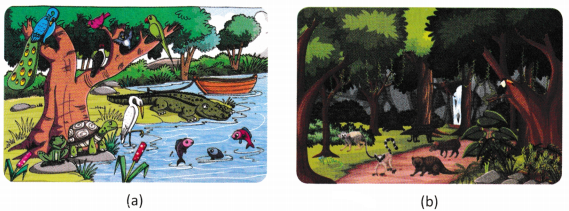
Question 1.
Identify the types of habitats in the given pictures. Write the biotic and abiotic components of both habitats.
_____________________________________________________
_____________________________________________________
Question 2.
Which habitat do you think has more plant diversity? Why?
_____________________________________________________
_____________________________________________________
Question 3.
What common characteristics do you observe in the two habitats?
_____________________________________________________
_____________________________________________________
Learn By Doing
A. Classify the following interactions and write their number in the correct column based on their nature of interaction in the given table. Analyse/Classify
1. Mangrove roots grow in salty coastal water.
2. An owl preys on a mouse.
3. Wind erodes loose soil in dry areas.
4. The soil near the pond is moist.
5. High humidity increases cloud formation.
6. Polar bears use ice for resting and hunting.
7. A lion hunts a zebra
8. A fish lays eggs in water.
9. A water snake eats fish.
| Interactions between biotic and abiotic components | Interactions between two abiotic components | Interactions among the biotic components |
B. Observe the following and classify them as herbivore, carnivore or cirpnivore in the space
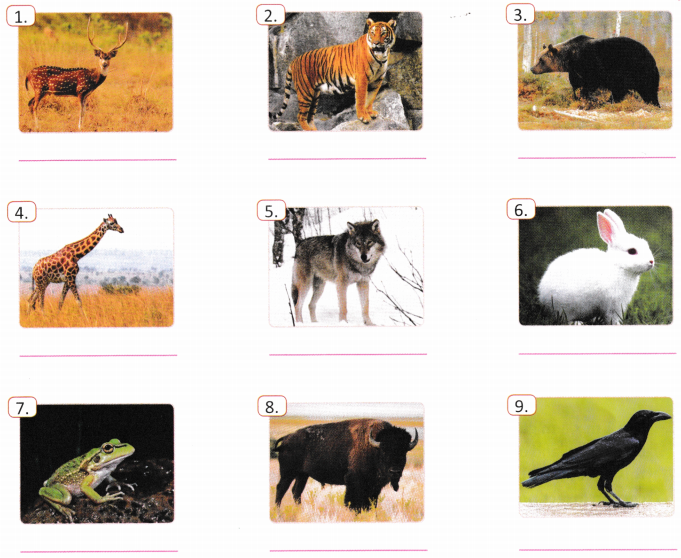
C. Write the missing animals in the blank boxes to complete the food chains.
1. Sun → Flowers → __________ → Bird
2. Sun → Seaweed → __________ → Dolphin
3. Wheat → Rat → __________ → Owl
4. Sun → Seed → __________ → Snake
Explore With Curiosity
A. Observe a forest patch and an agricultural field Compare the biodiversity and abiotic conditions in both places and write down the differences in the provided space.
_____________________________________________________
_____________________________________________________
_____________________________________________________
_____________________________________________________
B. If the soil in an agricultural field loses humus, what changes might occur in the plants and soil organisms?
_____________________________________________________
_____________________________________________________
_____________________________________________________
_____________________________________________________
C. In a 1 m x 1 m garden patch, a group observed fewer insects than usual this season — no butterflies, and only one or two ants. However, there were many grasshoppers. How might this affect the plant population in that area? What might be a reason for the decrease in certain insect populations?
_____________________________________________________
_____________________________________________________
_____________________________________________________
_____________________________________________________
D. A local pond near your village has recently become polluted with garbage and waste from nearby factories. Over the past few weeks, you notice that many water plants in the pond are turning brown and dying. What do you think will happen to the insects around the
_____________________________________________________
_____________________________________________________
_____________________________________________________
_____________________________________________________
E. An energy pyramid with organisms occupying trophic levels X, Y, and Z is shown below. Observe and answer the following questions.
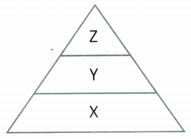
1. Identify the trophic levels to which crops, mice and eagles belong.
_____________________________________________________
_____________________________________________________
2. How does arranging organisms by numbers in a pyramid help us understand food chains better?
_____________________________________________________
_____________________________________________________
F. Study the food web and answer the following questions.
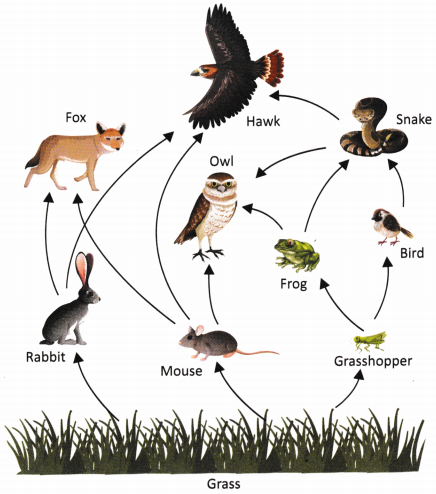
1. Define food web.
_____________________________________________________
_____________________________________________________
2. What would happen if the grass population decreases suddenly?
_____________________________________________________
_____________________________________________________
3. List the carnivores shown in the given food web.
_____________________________________________________
_____________________________________________________
4. From the given food web, write down three food chains that include a producer, primary consumer, secondary consumer and top consumer.
_____________________________________________________
_____________________________________________________
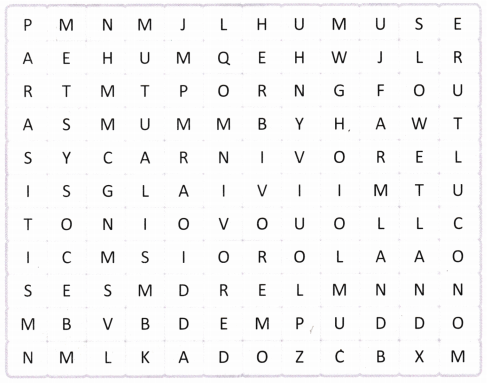
Word Puzzle
Find ten words related to this chapter in the given word search puzzle.
Suggested Activities
A. Visit a local farm or interview farmers about their cultivation methods. Ask them questions about the use of synthetic fertilisers, pesticides, irrigation methods, and crop rotation. Record and analyse to determine which practices are sustainable and which may harm the environment. Suggest ways to make farming eco-friendy, linking their recommendations to the concepts learned in the chapter.
B. Choose a flower like hibiscus, marigold, or sunflower and observe it for sometime. Notice if any insects or birds are visiting it and observe their activities, such as collecting nectar or touching pollen. Record your observations in a notebook and discuss how these visitors help transfer pollen, linking it to plant reproduction and biodiversity.
C. Research migratory birds that visit India, such as the Demoiselle Crane. Explore their migration routes, reasons for migration, and their role in the ecosystem. Collect related postal stamps, create migration maps, and design awareness posters showing how these birds help pollinate plants and control pests.