Students often prefer our concise Class 6 English Poorvi Worksheet and Class 6 English Chapter 13 Hamara Bharat-Incredible India! Worksheet with Answers Pdf for quick practice.
Class 6 English Chapter 13 Hamara Bharat-Incredible India! Worksheet with Answers
Class 6 English Hamara Bharat-Incredible India! Worksheet
Class 6 English Chapter 13 Worksheet – Class 6 Hamara Bharat-Incredible India! Worksheet
Warm up
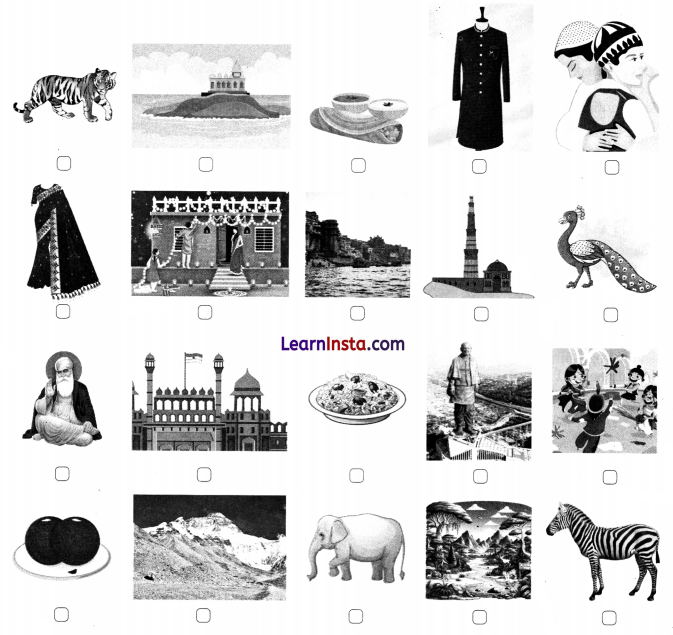
What kinds of images might represent India? Look at the following images and categorise them as famous Landmarks (L), Festivals (F), Traditional foods (T), Clothing (C), Wildlife (W) and Natural Landscapes (N).
Quiz: India’s Heritage
Question 1.
In which state is the Statue of Unity situated?
(a) Nagaland ______________
(b) Maharashtra ______________
(c) Gujarat ______________
(d) Kerala ______________
Question 2.
Which of the following is an ancient Indian text known for its teachings on duty and righteousness?
(a) Bhagavad Gita ______________
(b) Mahabharata ______________
(c) Ramayana ______________
(d) Vedas ______________
Question 3.
What is the traditional Indian art form that involves painting intricate patterns on the hands and feet with henna?
(a) Rangoli ______________
(b) Madhubani ______________
(c) Mehndi ______________
(d) Warli ______________

Question 4.
Which Indian festival is celebrated to honour the victory of good over evil, symbolized by the return of Lord Rama to Ayodhya?
(a) Holi ______________
(b) Diwali ______________
(c) Eid ______________
(d) Navratri ______________
Question 5.
Which Indian istate is renowned for its backwaters, houseboats, and the traditional dance form of Kathakali?
(a) Tamil Nadu ______________
(b) Karnataka ______________
(c) Kerala ______________
(d) Andhra Pradesh ______________
Question 6.
India is famous for which of the following global contributions?
(a) Bharatnatyam ______________
(b) Sanskrit ______________
(c) Cricket ______________
(d) Yoga ______________
Question 7.
What makes Indian cuisine unique and famous worldwide?
(a) Its use of only meat-based dishes ______________
(b) Spicy flavours and a wide variety of vegetarian options ______________
(c) Its lack of variety in spices ______________
(d) Its focus on desserts only ______________
Textbook
I. Read the extract given below and answer the questions that follow:
“So, are you ready to meet your friends from all over the country?” the teacher asked the students sitting in the big hall.
“Yes!” was the loud answer from the class.
“Can someone tell me for which programme are we here?” the teacher asked.
“Ek Bharat, Shreshtha Bharat”, the students answered together again.
“Please raise your hand to tell me what it is all about,” the teacher said.
Many hands went up and some were jumping to answer. The teacher asked Renu. With a smile on her face, she said, “It is to know that we all belong to one nation and that is the bond we share. And our unity in diversity makes us the most wonderful country in the world.”
Question 1.
What was the program discussed by the teacher?
(a) Global Exchange Program ______________
(b) Ek Bharat, Shreshtha Bharat ______________
(c) Cultural Awareness Week ______________
(d) National Unity Initiative ______________
Question 2.
What was Renu’s explanation about the program “Ek Bharat, Shreshtha Bharat”?
_________________________________________________________
_________________________________________________________
_________________________________________________________
Question 3.
State whether the following statement is True or False:
The students answered “Ek Bharat, Shreshtha Bharat” in response to the teacher’s question about the program.
_________________________________________________________
Question 4.
Read the following statements:
(i) The teacher asked Renu to explain the “Ek Bharat, Shreshtha Bharat” program.
(ii) Renu explained that the program highlights the unity and diversity of the country.
(a) (ii) is the cause for (i) ______________
(b) (i) is the cause for (ii) ______________
(c) (i) is true and (ii) is false ______________
(d) (i) is false and (ii) is true ______________
Question 5.
Which word in the given text means “the feeling of being part of a single group or nation”?
_________________________________________________________
II. Here’s a table With main points from the lesson.
| Child | Region | Art/Craft | Materials Used | Process | End Product |
| 1. Aakansha | Uttarakhand | Aipan | White rice flour paste, geru | Drawn on brick-red walls with white rice flour paste; made on floors, walls, and puja rooms | Beautiful, mathematical designs based on culture and nature |
| 2. Priyaranjan | Odisha | Dhokra metal craft | Clay, wax, brass scrap | Make clay figure, cover with wax, carve details, cover with clay, fire, pour melted brass scrap | Metal figures |
| 3. Chitra | Kerala | Coconut shell craft | Brown coconut shells | Clean and smoothen shell, shape it, fix a base, polish | Household items, jewellery |
| 4. Balamurali | Andhra Pradesh | Kondapalli toy-making | Soft wood, tamarind seed powder, sawdust | Carve wood parts, join, with makku, add details, finish, paint | Toys based on folk stories, animals, rural life |
- Read each row carefully to understand the traditional art or craft described.
- Identify the key materials and processes used in creating the art or craft.
III. Fill in the blanks.
Question 1.
Aakansha from Uttarakhand shared about ______________, a folk art made using ______________ and geru.
Question 2.
Priyaranjan’s tribe in Odisha practices a metal craft called ______________, which involves using clay, wax, and ______________
Question 3.
Chitra from Kerala makes household items and jewellery from ______________. The first step involves cleaning the ______________
Question 4.
Balamurali talked about the ______________ toy-making art from Andhra Pradesh, which uses soft wood and ______________ to join parts.
IV. Match the regions with their corresponding traditional art/craft. Write the correct options in the Answers Box provided.
| Column A | Column B |
| 1. Uttarakhand | (a) Coconut shell craft |
| 2. Odisha | (b) Aipan |
| 3. Kerala | (c) Dhokra metal craft |
| 4. Andhra Pradesh | (d) Kondapalli toy-making |
V. Answer the following questions.
Question 1.
Describe the process of making a Dhokra metal craft item as explained by Priyaranjan.
_________________________________________________________
_________________________________________________________
_________________________________________________________
Question 2.
What materials are used in the Kondapalli toy-making process shared by Balamurali?
_________________________________________________________
_________________________________________________________
_________________________________________________________
Question 3.
Why is it important to polish the coconut shell in Chitra’s craft?
_________________________________________________________
_________________________________________________________
_________________________________________________________
VI. Choose one traditional art or craft from the chart and explain why it interests you. What would you like to learn more about it?
_________________________________________________________
_________________________________________________________
_________________________________________________________
Art Integration
Draw a scene that represents one of the traditional crafts described in the chart. Label the key elements and explain your drawing.
(Use the space below for your drawing and explanation)

_________________________________________________________
_________________________________________________________
_________________________________________________________
_________________________________________________________
Grammar
Read the sentences given below and replace the underlined nouns with appropriate pronouns. Write your answers in the blanks provided.
Question 1.
Aakansha is from Uttarakhand. Aakansha is going to tell you about Aipan, a traditional folk art.
_________________________________________________________
_________________________________________________________
_________________________________________________________
Question 2.
Priyaranjan explained how his tribe practices Dhokra, a metal craft.
_________________________________________________________
_________________________________________________________
_________________________________________________________
Question 3.
The women in the family create beautiful Aipan designs. The women base the designs on cultural traditions and observations of nature.
_________________________________________________________
_________________________________________________________
_________________________________________________________
Question 4.
Chitra and her family make household items and jewellery from coconut shells.
_________________________________________________________
_________________________________________________________
_________________________________________________________
Question 5.
Balamurali’s village, Kondapalli, is known for making wooden toys. The toys are inspired by folk stories and rural life.
_________________________________________________________
_________________________________________________________
_________________________________________________________
Let us listen
Traditional Art Forms of India
Listen to two speakers talk about a traditional Indian art form. As you listen, answer the questions that follow:
Question 1.
What is the primary subject matter of Madhubani paintings?
(a) Historical events ______________
(b) Portraits of famous people ______________
(c) Gods, goddesses, animals, and nature ______________
(d) Urban landscapes ______________
Question 2.
State whether the following statement is True or False:
Madhubani paintings are traditionally made using synthetic dyes and pigments.
_________________________________________________________
Question 3.
What do fish and peacocks symbolize in Madhubani art?
_________________________________________________________
_________________________________________________________
Question 4.
Match the following tools used in Madhubani painting with their traditional use. Write the correct options in the Answers Box provided.
| Column A | Column B |
| 1. Twigs | (i) Creating intricate designs |
| 2. Matchsticks | (ii) Applying natural dyes |
| 3. Fingers | (iii) Detailing the artwork |
Question 5.
Fill in the blanks.
Madhubani art has gained ______________ recognition, and the paintings are now also done on ______________ and ______________
Let us speak
Compare and contrast Indian traditional art forms with those from another culture.
In small groups research on an Indian traditional art form and an art form from another culture (e.g., Japanese Ukiyo-e, African tribal art, Native American pottery).
Present the similarities and differences between the two art forms in terms of techniques, themes, materials, and cultural significance.
Create a piece of fusion art that combines elements from both art forms.
Present the report to the class.
_________________________________________________________
_________________________________________________________
_________________________________________________________
_________________________________________________________
_________________________________________________________
_________________________________________________________
_________________________________________________________
_________________________________________________________
Let us write
Exploring Traditional Indian Art Forms
Choose a traditional Indian art form that interests you, such as Warli painting, Madhubani art, Kathak dance, or any other. Write an essay describing this art form, including its origins, cultural significance, techniques, and your personal reflections on why you find it fascinating.
_________________________________________________________
_________________________________________________________
_________________________________________________________
_________________________________________________________
_________________________________________________________
_________________________________________________________
_________________________________________________________
_________________________________________________________
_________________________________________________________
_________________________________________________________