Get the simplified Class 7 Maths Extra Questions and Class 7 Maths Part 2 Chapter 1 Geometric Twins Extra Questions and Answers with complete explanation.
Class 7 Geometric Twins Extra Questions
Geometric Twins Extra Questions Class 7
Geometric Twins Class 7 Very Short Question Answer
Question 1.
Define geometric twins.
Answer:
Figure that have the exact same shape and size are called geometric twins.
Question 2.
If two triangles satisfy SSS Congruence rule. What can you say about angles?
Answer:
Angles are equal, because sides are equal.
Question 3.
A triangle has side AB = AC. A perpendicular AD is drawn to BC. Explain how RHS congruence proves ∠B = ∠C.
Answer:
In ΔABC, AB = AC, it is an isoscele triangle.
We draw perpendicular to BC.
∴ ∠ADB = 90°, ∠ADC = 90°
Now, AD is common.
AB = AC (Given)
Right angles at D are equal.
By RHS, ΔADB ≅ ΔADC and ∠B = ∠C.

Question 4.
If ΔABC ≅ ΔDEF, and ∠A = 35°, ∠E = 65°. Find ∠F.
Answer:
ΔABC ≅ ΔDEF
∴ ∠A = ∠D = 35°
Now, in ΔDEF,
∠D+∠E+∠F = 180°
arrow 35° + 65° + ∠F = 180° arrow ∠F = 80°
Question 5.
If ΔABC ≅ΔDEF and CA = 2x + 3, DF = 13. Find x.
Answer:
ΔABC ≅ΔDEF
arrow AC = DF(CPCT)
arrow 2 x+3 = 13 arrow 2 x = 10 arrow x = 5
Question 6.
If ΔDEF ≅ΔBCA, state the correspondence between the sides and angles.
Answer:
Sides : DE ⟷ BC, EF ⟷ CA, DF ⟷ BA
Angles : ∠D = ∠B, ∠E = ∠C, ∠F = ∠A
Question 7.
ΔABC and ΔXYZ have ∠B = ∠Y = 50°, ∠C = ∠Z = 30° and BC = YZ = 5 cm. Are the triangles congruent? Justify.
Answer:
∠A = 180° – (50°+30°) = 100° Similarly ∠Y = 50° Thus ∠B = ∠Y, BC = YZ, ∠C = ∠Z They satisfy ASA condition, therefore ΔABC ≅ΔXYZ.
Geometric Twins Class 7 Short Question Answer
Question 1.
To prove that ΔABC ≅ΔXYZ using the SAS congruence rule, it is given that AB = XY and BC = YZ. What additional information is required to establish the congruence?
Solution:
To apply the SAS congruence rule, we need two pairs of corresponding sides equal and the included angle between those sides equal.
Since AB = XY and BC = YZ, the required additional information is given by-
∠ABC = ∠XYZ
Question 2.
If ΔABC ≅ ΔPQR, with the correspondence ABC ⟷ PQR, list all the corresponding equal parts of the two triangles.
Solution:
If ΔABC ≅ ΔPQR, then
- Corresponding Vertices : A ⟷ P, B ⟷ Q, C ⟷ R
- Corresponding Sides : AB = PQ, BC = QR, AC = PR
- Corresponding Angles : ∠A = ∠P, ∠B = ∠Q, ∠C = ∠R
Question 3.
Two triangles have all three corresponding sides equal. Name the congruence condition used and state whether the triangles must be congruent.
Solution:
When two triangles have all three corresponding sides equal, the condition is said to be SSS (Side-Side-Side). Yes, the triangles must be congruent because SSS guarantees congruence.
Question 4.
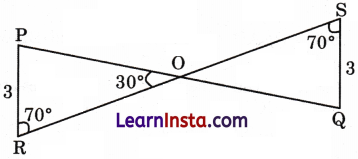
In the given figure, can you use ASA congruence rule and conclude that ΔPOR ≅ ΔQOS?
Solution:
In the two triangles POR and QOS,
∠R = ∠S (Each 70°)
Also, ∠POR = ∠QOS = 30° (vertically opposite angles)
So, in ΔPOR,
∠OPR = 180° – (70°+30°) = 80° (using
angle sum property of a triangle)
Similarly, in ΔQOS
∠OQS = 180° – (70°+30°) = 80°
Thus, we have ∠P = ∠Q,
PR = QS and ∠R = ∠S
Now, side PR is between ∠P and ∠R and side QS is between ∠Q and ∠S. So, by ASA congruence rule,
ΔPOR ≅ ΔQOS. Hence proved.
Question 5.
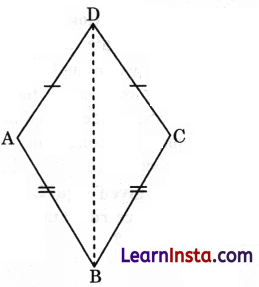
In Fig., AD = CD and AB = CB.
(i) State the three pairs of equal parts in ΔABD and ΔCBD.
Solution:
AD = CD, AB = CB and BD is common.
(ii) Is ΔABD ≅ ΔCBD? Why or why not?
Solution:
Yes, because their corresponding sides are equal.
(iii) Does BD bisect ∠ABC? Give reasons.
Solution:
Since, ΔABD ≅ ΔCBD, then ∠ADB = ∠CDB.
So, BD bisects angle ABC.
Question 6.
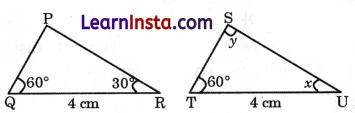
In the given congruent triangles under ASA, find the value of x and y, ΔPQR = ΔSTU.
Solution:
Given: ΔPQR = ΔSTU (By ASA rule)
∠Q = ∠T = 60° (given)
QR = TU = 4 cm (given)
∠x = 30° (for ASA rule)
Now in ΔSTU,
∠S + ∠T + ∠U = 180°
(Angle sum property)
∠y + 60° + ∠x = 180°
∠y + 60° + 30° = 180°
∠y + 90° = 180°
∠y = 180° – 90° = 90°
Hence, x = 30° and y = 90°.
Question 7.
Can two equilateral triangles always be congruent? Give reasons.
Solution:
No, any two equilateral triangles are not always congruent.
Reason: Each angle of an equilateral triangle is 60° but their corresponding sides cannot always be the same.
Question 8.
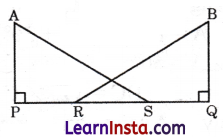
In the given figure, AP = BQ, PR = QS. Show that ΔAPS = ΔBQR.
Solution:
In ΔAPS and ΔBQR,
AP = BQ(Given)
PR = QS(Given)
RS = QS + RS
(Adding RS to both sides)
PS = QR
∠APS = ∠BQR = 90° (Given)
ΔAPS ≅ ΔBQR (by SAS rule)
Geometric Twins Class 7 Long Question Answer
Question 1.
In the following figure, ray PM bisects ∠QPR as well as ∠QSR.
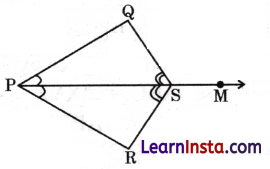
(i) State the three pairs of equal parts in triangles ΔQPS and ΔRPS.
Solution:
Three pairs of equal parts :
∠QPS = ∠RPS (PM bisects ∠QPR)
∠QSP = ∠RSP (PM bisects ∠QSR)
PS = PS (common side)
(ii) Are ΔQPS ≅ ΔRPS? Give reasons.
Solution:
The triangles ΔQPS and ΔRPS have two corresponding angles equal and the included side equal.
Therefore, ΔQPS ≅ΔRPS (by ASA congruence condition)
(iii) What can you conclude about the lengths QP and PR? Justify your answer.
Solution:
Since corresponding parts of congruent triangles are equal.
arrow QP = PR (by CPCT)
Question 2.
In ΔXYZ, XY = XZ and M is the midpoint of YZ.
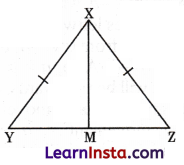
(i) State the three pairs of equal parts in ΔXMY and ΔXMZ.
Solution:
Three pairs of equal parts :
XY = XZ (given)
YM = MZ (∵ M is the midpoint of YZ)
XM = XM (common side)
(ii) Are ΔXMY ≅ ΔXMZ? Give reasons.
Solution:
The triangles ΔXMY and ΔXMZ have three pairs of corresponding sides equal.
Therefore, ΔXMY ≅ ΔXMZ
(by SSS congruence condition)
(iii) What can you say about ∠Y and ∠Z?
Give a reason.
Solution:
Since, corresponding parts of congruent triangles are equal.
∠Y = ∠Z (by CPCT)
Also, angles opposite equal sides of a triangle are equal.