Students can use Our Wondrous World Class 4 Solutions Chapter 5 Food for Health with Nature Class 4 Questions and Answers as a quick reference guide.
Class 4 EVS Chapter 5 Food for Health Question Answer
Growing up with Nature Class 4 EVS Question Answer
Our Wondrous World Class 4 EVS Chapter 5 Question Answer – Class 4 EVS Food for Health Question Answer
Discuss (Page 74)
Discuss in small groups and identify the food items having at least three different tastes.
Answer:
(Suggestive answer) Some food items having at least three different testes are:
- Bhel Puri – It tastes sweet, sour, and spicy
- Tamarind Chutney – It can be sweet, sour, and a little salty
- Chaat – It’s often spicy, sour, and salty

Discuss (Page 75)
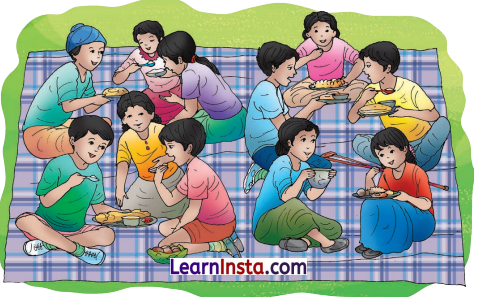
Why do we need to eat different kinds of food items?
Answer:
We need to eat different kinds of food because:
- Some food gives us energy: like rice, roti, and bananas.
- Some food helps us grow: like milk, eggs, pulses, and cheese.
- Some food keeps us safe from falling sick: like fruits and vegetables.
- Some food keeps our bones strong: like milk and curd.
- Some food helps our brain work well: like nuts and fish.
If we eat only one kind of food every day, our body won’t get all the things it needs. So we must eat a mix of foods to stay strong, smart, and full of energy!
Discuss (Page 77)
What happens if we eat food from a single group of foods everyday?
Answer:
If we eat food from only one group every day, our body won’t get all the nutrients it needs. We may feel weak or fall sick more often. That’s why we should eat different types of food to stay strong and healthy.
If we eat only one kind of food every day, like just rice or only fruits:
- Our body won’t get all the things it needs to grow and stay healthy.
- We may feel weak, tired, or fall sick more often.
- Our bones, eyes, and brain may not work properly.
That’s why we should eat different kinds of foods like fruits, vegetables, grains, milk, and pulses every day.
Discuss (Page 82)
Question 1.
Do you help in cooking at home?
Answer:
Yes, I help in cooking at home! I like to wash vegetables and stir the food while my mom is cooking. Sometimes, I also help set the table and serve food. It’s fun to help, and learn how to make yummy meals!
Question 2.
Do you think all family members should know how to cook? Why?
Answer:
Yes, I think all family members should know how to cook. This way, everyone can help when it’s time to make meals. It’s fun to cook together, and if someone is busy or sick, others can cook for them. Knowing how to cook helps everyone stay healthy and happy!
Think and Write (Page 73)
If you had to organise a food festival in your school, which dishes would you like to include? Make a list.
Answer:
If I have to organise a food festival, I would include:
- Yummy pani puries
- Hot and crispy samosas
- Sweet and soft gulab jamuns
- Tasty idlis with chutney and sambhar
- Cheesy pizzas
- Cold and fruity ice creams
- Healthy fruit salads
- Fluffy pav bhajies
Because everyone loves different types of food, I would include sweet, spicy, and healthy dishes so everyone can enjoy.
Write (Page 74)
Can you think of at least five ingredients or food items that match each of the tastes listed below? Write them down in the spaces provided. See the example given below:

Answer:

Write (Page 78)
Question 1.
Can you name a few more junk food items?
Answer:
Bread Pakoras, Kachories, Pakoras, Momos, Cream rolls, Patties, Puries, etc.
Question 2.
Why do you think we should avoid eating junk food?
Answer:
We should avoid eating junk food because it has lots of sugar, salt, and fat, which can make us feel tired and unhealthy. Junk food doesn’t give our body the important vitamins and nutrients it needs to grow strong. Eating too much junk food can also cause problems like stomachaches, tooth decay, and even make us gain extra weight.
Question 3.
List the junk food items that you will avoid.
Answer:
I will avoid following food items-Pizza, Burger, Samosa, Momo, French Fries, Chips, Chocolate, Kachori, Bread pakora etc.
Write (Page 81)
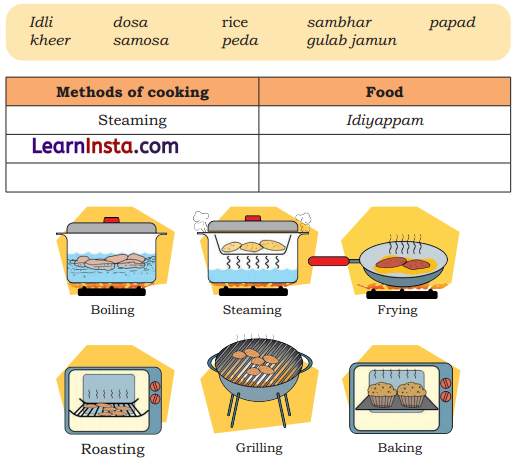
Identify different methods used to cook the food items given in the list below. One example is given for you. You can take help from your family members and add more items to the list.
Answer:
Different methods used to cook the food items given in the list are as follows.
| Methods of cooking | Food |
| Steaming | Idiyappam, idli |
| Boiling | Rice, sambhar, kheer |
| Frying | Dosa, gulab jamun, samosa, papad |
| Roasting | Peda, papad |
Find Out (Page 75)
Find out more about a millet-based food prepared at your home.
Answer:
Millet-based food prepared at our home
At home, we can prepare many healthy dishes using millets. Some examples are:
- Ragi porridge: a soft and healthy meal made with finger millet.
- Bajra roti: a thick roti made from pearl millet.
- Jowar bhakri: a flat bread made from sorghum flour.
- Ragi dosa: a crispy dosa made with ragi flour.
- Millet upma: a tasty dish made with mixed vegetables and little millets.
These foods are tasty and good for our health!
Find Out (Page 80)
Find out a ‘food thali’ from your region, and list its food items.
Answer:
We can take an example of Gujarati thali:
- Roti or Phulka: Soft wheat flatbread.
- Rice: Steamed rice as a base for curries.
- Dal (Gujarati Dal): A sweet and spicy lentil soup.
- Shaak (Vegetable curry): Mixed vegetables or potato curry.
- Kadhi: A yogurt-based curry with gram flour dumplings.
- Thepla: A spiced flatbread made with fenugreek leaves.
- Pickle (Achar): A tangy, spicy pickle to add flavour.
- Farsan: Snack items like dhokla, khandvi, or pakora.
- Sweet dish: Gulab Jamun or Basundi for dessert.
- Salad: Fresh veggies like cucumber and carrots with a tangy dressing.
This thali offers a balanced mix of flavours like sweet, spicy, tangy, and savoury!
Activity 1 (Page 79)
Make a food diary
1. Create a food diary of your daily routine for a week. Write down what you eat in a day for breakfast, lunch and dinner. An example is given. Expand the table for a week.
2. Encircle the food items that are healthy and put an ‘ X ‘ mark for items which are not healthy.
3. Identify the food groups missing in your daily routine. Discuss with your parents how these items can be included in the daily routine.

Answer:
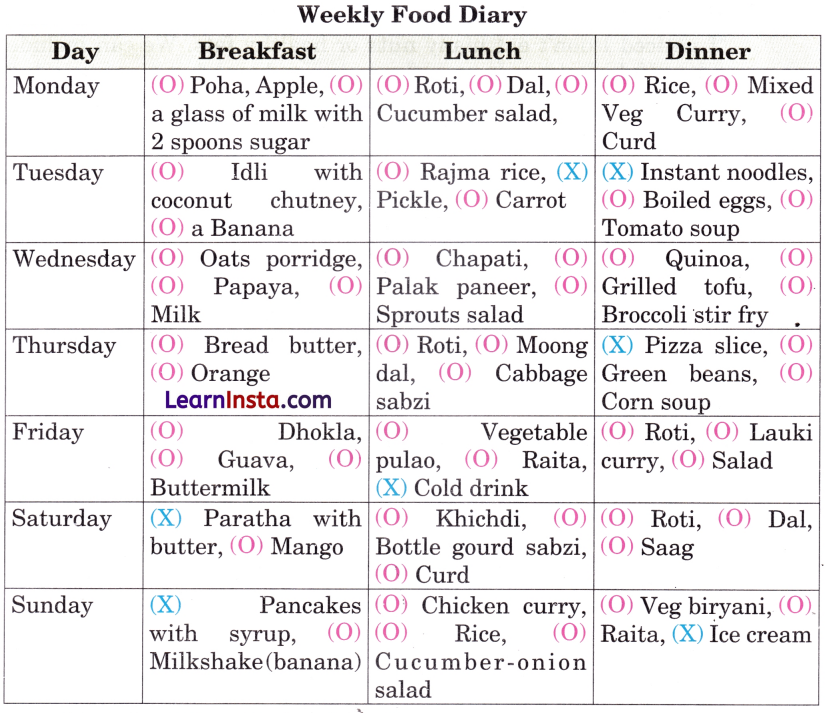
Healthy (O) vs Unhealthy (X)
Summary
- Healthy (O): Fresh fruits, vegetables, dals, milk, curd, whole grains, sprouts, boiled/steamed dishes.
- Unhealthy (X): Sugary tea, instant noodles, cold drinks, pizza, fried snacks, syrup-laden pancakes, excess butter, ice cream.
2. Food Groups Missing or Less Frequent
- Nuts and seeds: Not regularly consumed.
- Lean proteins: Limited inclusion of egg, tofu, or lean meats.
- Whole grains: Mostly wheat and rice; less variety like millets, quinoa.
- Healthy fats: Avocados, seeds, or olive oil are missing.
3. Discussion with Parents (Suggestive answer)
“I noticed I don’t eat many nuts or healthy fats. We can include a handful of almonds or walnuts in my breakfast or as snacks? Also, may be we can use more olive oil while cooking. Let’s also try different grains like jowar or bajra once a week.”
Let us Reflect (Pages 83-84)
Question 1.
Hands-on activity – food collage
Materials: Old magazines, newspapers, scissors, glue, and a blank sheet of paper.
Cut out pictures of food items and create a collage with three sections: energy-giving foods, body-building foods, and protective foods.

Answer:
(Suggestive answer). Here is a list of some food items as per their characteristics.
| Energy-giving foods | Body-building foods | Protective foods |
| 1. Rice 2. Wheat (Roti, Bread) 3. Sugar 4. Potatoes 5. Ghee or butter |
1. Milk 2. Eggs 3. Pulses (dal) 4. Meat or fish 5. Paneer (cottage cheese) |
1. Green leafy vegetables (spinach) 2. Fruits (oranges, guavas) 3. Carrots 4. Tomatoes 5. Gooseberry (amla) |
Note: Students to paste pictures themselves.
Question 2.
Check the label

(a) At home, pick up any one packaged food item from your kitchen. Check the label and note down the expiry date, and also two main ingredients.
Answer:
Students to do as directed.
(b) Why is it important to check labels before buying or eating packaged food items?
Answer:
It is important to check labels on packaged good to know the ingredients, expiry date, and nutritional value to ensure food is good, safe and healthy to eat.
Question 3.
Organise a food festival
Students may bring home-made food and organise a food festival at school. Parents may be encouraged to participate in the food festival.
Answer:
Students activity. Students to do themselves
Question 4.
Find and circle
Circle the words related to food in the grid below. One example is given below.

Answer:
