Practicing Class 8 Maths MCQ and Class 8 Maths Part 2 Chapter 4 Exploring Some Geometric Themes MCQ Questions Online Test with Answers daily helps in time management.
MCQ on Exploring Some Geometric Themes Class 8
Exploring Some Geometric Themes MCQ Class 8
Class 8 Exploring Some Geometric Themes MCQ
Multiple Choice Questions
Question 1.
How many remaining squares will there be the Step 2 of the Sierpinski carpet construction?
(a) 16
(b) 32
(c) 64
(d) 81
Answer:
(c) 64
Question 2.
What is the formula for the side count of a Koch Snowflake at step n ?
(a) 3 × 4n
(b) 8
(c) 3
(d) 3 × \(\left(\frac{4}{3}\right)^n\)
Answer:
(a) 3 × 4n
Question 3.
The name of the given solid figure is
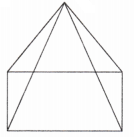
(a) triangular pyramid
(b) rectangular pyramid
(c) rectangular prism
(d) triangular prism
Answer:
(b) rectangular pyramid
Question 4.
All faces of a pyramid are always
(a) triangular
(b) rectangular
(c) congruent
(d) None of these
Answer:
(a) triangular
Question 5.
Total number of edges a cylinder has
(a) 0
(b) 1
(c) 2
(d) 3
Answer:
(c) 2
Question 6.
A solid that has only one vertex is
(a) pyramid
(b) cube
(c) cone
(d) rectangle
Answer:
(c) cone
Question 7.
Total number of edges of sphere has
(a) 0
(b) 1
(c) 2
(d) 3
Answer:
(a) 0

Question 8.
The solid with one circular edge, one curved face and one vertex is known as
(a) prism
(b) cylinder
(c) cone
(d) sphere
Answer:
(c) cone
Question 9.
When we cut a corner of a cube as shown in the figure, we get the cutout piece as
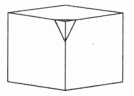
(a) square pyramid
(b) trapezium prism
(c) triangular pyramid
(d) a triangle
Answer:
(c) triangular pyramid
Question 10.
Which of these nets is a net of a cube?
[Competency Based Question]
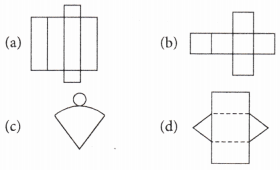
Answer:
(b)
Question 11.
Which of the following nets is a net of a cylinder?
[Competency Based Question]

Answer:
(c)
Question 12.
Looking at the following object from the side, what will be the view? [Competency Based Question]

Answer:
(d)
Question 13.
Which of the following three-dimensional figures has the top, side and front as triangles?
[Competency Based Question]

Answer:
(c)
Assertion-Reason Questions
Question 1.
Assertion (A) Every part of a Sierpinski carpet looks like a smaller version of the whole carpet.
Reason (R) The construction of the Sierpinski carpet is based on repeatedly dividing squares into 9 equal parts and removing the central square at each step.
(a) Both Assertion and Reason are true and Reason is the correct explanation of Assertion.
(b) Both Assertion and Reason are true but Reason is not the correct explanation of Assertion.
(c) Assertion is true but Reason is false.
(d) Assertion is false but Reason is true.
Answer:
(a) Both Assertion and Reason are true and Reason is the correct explanation of Assertion.
Question 2.
Assertion (A) Solid shapes can be drawn on a flat surface. This is called a 2D representation of 3D solid shapes.
Reason (R) A net is a skeleton outline of a solid that can be folded to make the solid.
(a) Both Assertion and Reason are true and Reason is the correct explanation of Assertion.
(b) Both Assertion and Reason are true but Reason is not’ the correct explanation of Assertion.
(c) Assertion is true but Reason is false.
(d) Assertion is false but Reason is true.
Answer:
(b) Both Assertion and Reason are true but Reason is not’ the correct explanation of Assertion.
Question 3.
Assertion (A) The number of faces of the given solid is 10.
Reason (R) The flat surface of a solid are called its faces.
(a) Both Assertion and Reason are true and Reason is the correct explanation of Assertion.
(b) Both Assertion and Reason are true but Reason is not the correct explanation of Assertion.
(c) Assertion is true but Reason is false.
(d) Assertion is false but Reason is true.
Answer:
(d) Assertion is false but Reason is true.
Question 4.
Assertion (A) A flat shape that can be folded to make a solid shape is called a net.
Reason (R) Net of a cylinder

(a) Both Assertion and Reason are true and Reason is the correct explanation of Assertion.
(b) Both Assertion and Reason are true but Reason is not the correct explanation of Assertion.
(c) Assertion is true but Reason is false.
(d) Assertion is false but Reason is true.
Answer:
(b) Both Assertion and Reason are true but Reason is not the correct explanation of Assertion.
Fill in the Blanks
1. Fractals represent ____________ geometric shapes that repeat similar patterns at smaller scales.
Answer:
self-similar
2. In the Sierpinski carpet, the number of remaining squares grows by a factor of ____________ at each step.
Answer:
8
3. The common portion of two adjacent faces of a cuboid is called a/an ____________. [NCERT Exemplar]
Answer:
edge
4. The corners of solid shapes are called its ____________.
Answer:
vertices
5. A triangular pyramid has ____________ faces ____________ edges and ____________ vertices. [NCERT Exemplar]
Answer:
4, 6 and 4
6. Out of ____________ faces of a triangular prism, ____________ are rectangles and ____________ are triangles.
Answer:
5, 3 and 2
7. In a image is a net of a ____________

Answer:
triangular prism
True/False
Question 1.
To construct a Sierpinski gasket, you divide a square into 9 equal parts.
Answer:
False
Question 2.
The perimeter of a Koch Snowflake decreases at each step.
Answer:
False
Question 3.
While rectangle is a 2D-figure, cuboid is a 3D-figure.
Answer:
True
Question 4.
A cylinder has no vertex.
Answer:
True
Question 5.
A triangular prism has 5 faces, 9 edges and 6 vertices. [NCERT Exemplar]
Answer:
True
Question 6.
All the faces, except the base of a square pyramid are triangular. [NCERT Exemplar]
Answer:
True
Question 7.
An isometric sketch does not have proportional lengths.
Answer:
False
Match the Columns
Question 1.
Match the Column A with Column B.
| Column A | Column B |
| (i) Sierpinski Carpet | (a) Replacing the middle third with a “bumb”. |
| (ii) Sierpinski Gasket | (b) Removing the central square of a 3 × 3 grid. |
| (iii) Koch Snowflake | (c) Removing the central inverted triangle. |
Answer:
| Column A | Column B |
| (i) Sierpinski Carpet | (b) Removing the central square of a 3 × 3 grid. |
| (ii) Sierpinski Gasket | (c) Removing the central inverted triangle. |
| (iii) Koch Snowflake | (a) Replacing the middle third with a “bumb”. |
Question 2.
Match the Column A with Column B.
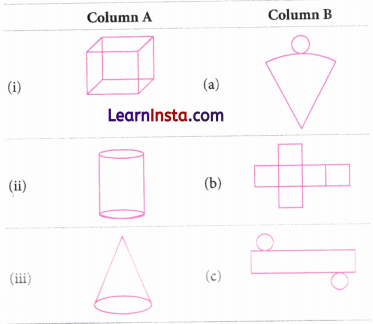
Answer:
(i) → (b), (ii) → (c), (iii) → (a)