Practice with Understanding Society India and Beyond Class 9 Solutions and Class 9 Social Science SST Chapter 7 Elections Question Answer NCERT Solutions to improve your exam performance.
Class 9 SST Chapter 7 Elections Question Answer
Class 9 Elections Question Answer
The Big Questions? (Page No. 161)
Question 1.
Why are elections essential to a democratic system?
Answer:
Elections are essential because they give people the opportunity to choose their representatives. Through elections, citizens participate in the democratic process and help form the government. Regular elections make elected representatives accountable to the people for their work. They also allow citizens to express their views peacefully through voting. Thus, elections strengthen democracy by ensuring that the government reflects the will of the people.
Question 2.
How do electoral systems and rules shape political representation and fairness?
Answer:
Electoral systems establish the clear rules for how representation is structured, directly determining whether leaders are chosen through direct or indirect methods. These rules define how citizens vote directly for local bodies, state assemblies, and the Lok Sabha, or how their elected representatives choose higher offices like the President, ensuring an organized and balanced distribution of political voice.
Question 3.
What role do institutions and laws play in ensuring free and fair elections?
Answer:
Institutions such as the Election Commission of India (ECI) play an important role in conducting elections. Election laws provide rules for voter registration, nomination of candidates, voting, counting of votes, and declaration of results. The ECI supervises the entire election process and ensures that these rules are followed. Together, the institutions and laws help make elections free, fair, peaceful, and transparent.
Question 4.
What challenges do elections face in practice, and how can these challenges affect democracy?
Answer:
Elections may face challenges such as unfair practices, misuse of money or influence, false information, and attempts to break election rules. Such practices can affect the fairness of elections and reduce people’s trust in the democratic process. It is important that elections are conducted honestly and peacefully so that every vote is respected. Free and fair elections help protect democracy and ensure that the government truly represents the people’s choice.

Elections Question Answer Class 9
InText Questions
Let’s Explore
Question 1.
Different democracies use different electoral systems. Make groups of 5-6 students. Each group will select six countries from different continents. Prepare and present a case study on the type of electoral system(s) operating in those countries, and discuss their latest election results of those countries. (Page No. 165)
Answer:
Do it yourself.
Question 2.
(i) Do you know what ETPBS is? (Page No. 168)
Answer:
ETPBS stands for Electronically Transmitted Postal Ballot System. It enables service voters to cast their vote on an electronically received postal ballot from their preferred location, which is outside their originally assigned voting constituency
(ii) Find out who are classified as service voters and who can vote using ETPBS?
Answer:
Service voters are:
(a) Members of the Armed Forces (Army, Navy and Air Force).
(b) Members of the Armed Police Forces serving outside their home state.
(c) Government employees posted outside India, along with their eligible spouses.
These service voters can vote using the Electronically Transmitted Postal Ballot System (ETPBS). It allows them to receive their postal ballot electronically and cast their vote even when they are away from their assigned voting constituency.
Question 3.
Find out the number of State parties and Registered Unrecognised Political Parties (RUPP). You may visit the website of ECI. (Page No. 176)
Answer:
As per the Election Commission of India, there are 62 recognised State Parties and 2,046 Registered Unrecognised Political Parties (RUPPs) in India. These numbers are subject to change whenever the ECI revises party recognition.
Question 4.
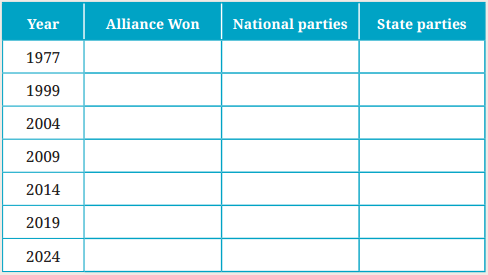
Read the passage carefully and complete the following table. (Page No. 177)
The year 1967 witnessed an end to the era of single-party-dominated elections in India, and an era of alliances began. Even though various states witnessed alliance politics starting from 1967, it was in 1977 that various political parties formed an alliance as the Janata Party against the backdrop of the National Emergency (1975-1977). The Janata Party formed the first coalition government at the national level, which was popularly known as the Janata Government. Since the late 1990s, the National Democratic Alliance (NDA), led by the Bharatiya Janata Party (BJP), and the United Progressive Alliance (UPA), led by the Indian National Congress (INC) until its dissolution in 2023 and subsequent reconstitution as the Indian National Developmental Inclusive Alliance, have been the major political alliances in Indian elections. Find out the name and the composition (number and name of the national and state parties) of the alliances that won in the following elections to the Lok Sabha.
Answer:
Do it yourself.
Think About It
Question 1.
You will turn 18 in a few years. As a responsible citizen, you should register yourself as a voter. Find out the various steps of the procedure for registration and the list of required documents for the same. Discuss, with anyone who has just turned 18 and has registered as a voter, the ease or difficulty faced in the voter registration process. (Page No. 168)
Answer:
Steps for Voter Registration: An eligible Indian citizen can register either online (the most common and easiest method) or offline:
- Online Method: Visit the official National Voters’ Service Portal (NVSP) or download the Voter Helpline App. Create an account and fill out Form 6 (Application for new voter registration).
- Offline Method: Obtain Form 6 from the office of the Electoral Registration Officer (ERO) or the local Booth Level Officer (BLO), fill it out, and submit it manually.
- Verification: A Booth Level Officer (BLO) visits the applicant’s residential address to physically verify the details.
- ID Issuance: Once approved, the name is added to the electoral roll, and a physical Voter ID card – the Electors Photo Identity Card (EPIC) is generated and sent via speed post.
List of Required Documents
- Identity & Age Proof (Any one): Aadhaar Card, PAN Card, Driving License, Indian Passport, or Class 10/12 Mark sheet/Passing Certificate.
- Proof of Ordinary Residence (Any one): Aadhaar Card, Current Water/Electricity/Gas connection bill, Bank Passbook, or Indian Passport.
- Photograph: One recent passport-sized color photograph.
Reflection: Ease vs. Difficulty
The Ease: The digital push by the Election Commission of India (ECI) has made online registration incredibly user-friendly. Uploading documents via mobile apps takes only a few minutes, and applicants can track their status in real-time.
The Challenges: First-time voters sometimes face minor difficulties if their uploaded documents are blurred, leading to rejection. Occasionally, there can be administrative delays in ground verification by the BLO or spelling errors printed on the final physical card.
Let’s Analyse
Question 1.
Look at the road to free and fair elections in the given image. Fill in the empty potholes with challenges after discussing them with your teachers and parents.
How can we overcome these challenges? (Page No. 178)
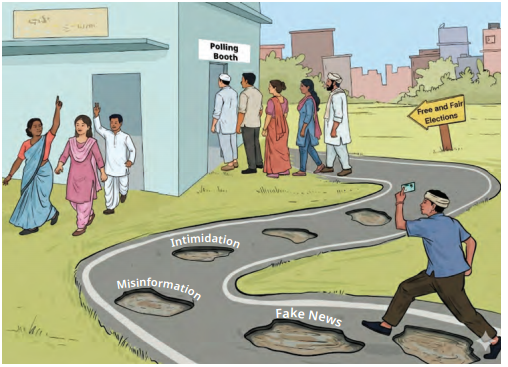
Figure. Challenges to free and fair elections
Answer:
Free and fair elections can be strengthened by strictly enforcing election laws and the Model Code of Conduct. The Election Commission of India should take prompt action against misinformation, fake news, intimidation, money power, hate speech, and other electoral offences. Election campaigns, including social media, should be closely monitored. Voter awareness should be increased so that citizens can identify false information and vote without fear or influence. Transparent voting through EVMs and VVPAT, along with active public participation, helps ensure that elections remain free, fair, and democratic.
Let’s Map
Question 1.
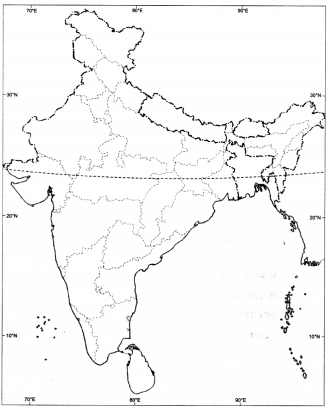
Choose any three states (including yours). Find the symbols of state parties belonging to those states and plot them on the given map of India. List their major agenda, as mentioned in their manifesto in the latest Lok Sabha/Vidhan Sabha/Local Body Elections. (Page No. 173)
Answer:
Do it yourself.
Question 2.
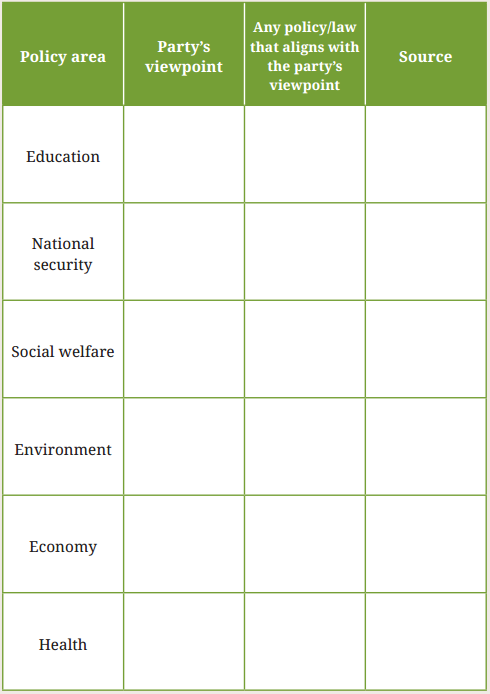
Form groups of 4-6 students. Identify and compare the policy preferences on the following parameters for two political parties in the last Lok Sabha Elections using credible sources like party manifestos, newspapers, etc. Present the points of comparison in a poster using bullet points, symbols, colour coding, etc. (Page No. 174)
Answer:
Do it yourself.
Elections Class 9 Questions and Answers
Questions and Activities (Page No. 179-182)
Question 1.
What reforms have been introduced by the ECI to make voting more inclusive for the following groups?
(a) People with Disabilities
(b) Service Voters
(c) Senior Citizens—60 years and above and 80 years and above
(d) Prisoners
(e) Persons in preventive detention
Answer:
(a) People with Disabilities (PwDs)
- Wheelchair and ramp facilities at polling stations.
- Braille-enabled EVMs.
- Saksham App for voter services.
- Volunteers to assist voters.
(b) Service Voters
Electronically Transmitted Postal Ballot System (ETPBS) enables them to vote from their place of duty.
(c) Senior Citizens (60 years and above; and 80 years and above)
- Better accessibility and assistance at polling stations.
- Home voting facility for senior citizens aged 85 years and above.
(d) Prisoners: Undertrial prisoners are generally not allowed to vote while in prison. However, a person in preventive detention can vote.
(e) Persons in Preventive Detention: They can cast their vote through the postal ballot facility.
Question 2.
What are the various functions of the Election Commission of India? Which of these functions is most important for the conduct of free and fair elections? Explain.
Answer:
The Election Commission of India supervises, directs, and controls the entire election process. It prepares and revises electoral rolls, conducts elections, announces election schedules, registers political parties, allots election symbols, enforces the Model Code of Conduct, monitors election expenditure, conducts voter awareness programmes, ensures peaceful polling, counts votes, and declares election results. It also settles disputes related to political parties and election symbols. Among all these functions, conducting elections in a free, fair and impartial manner is the most important because it ensures that every citizen’s vote is counted honestly and that the true will of the people is reflected in the election results.
Question 3.
Elections are the soul of a democracy. Do you agree? Why or why not?
Answer:
Yes, I agree. Elections are the soul of a democracy because they allow citizens to choose their representatives. They ensure public participation in governance, make the government accountable, provide equal voting rights to all eligible citizens, and enable people to replace a government that does not perform well. Thus, elections strengthen democracy and reflect the will of the people.
Question 4.
Explain at least three differences between the national and state/regional political parties.
Answer:
| National Political Parties | State/Regional Political Parties |
| They work at the national level. | They mainly work within one or a few states. |
| They contest elections across many states. | They mainly contest elections in a particular state or region. |
| They focus on national issues and policies. | They mainly focus on regional and state-specific issues |
Question 5.
Why should you vote? Arrange the following in the descending order of your choice. Discuss the reasons for your choice.
(a) Opportunity to choose my representative
(b) Makes me a responsible person
(c) Opportunity to change the non-performing representative
(d) Strengthens democracy
Answer:
Suggested descending order:
1. Strengthens democracy
2. Opportunity to choose my representative
3. Opportunity to change the non-performing representative
4. Makes me a responsible person
Reason: Voting strengthens democracy by giving citizens a voice in governance. It allows people to elect capable representatives and replace those who do not perform well. Voting also reflects responsible citizenship and helps build an accountable government.
Question 6.
What is the Special Intensive Revision (SIR) initiative of the ECI? Explain its objectives and the necessity of conducting SIR.
Answer:
The Special Intensive Revision (SIR) is a programme conducted by the Election Commission of India (ECI) to update and verify the electoral rolls before elections. During SIR, officials visit households to collect and verify voter information. Eligible citizens who have turned 18 years of age are added to the voter list, while the names of deceased persons, duplicate entries, people who have shifted residence, and ineligible voters are removed. Citizens are also given an opportunity to raise claims and objections before the final electoral roll is published.
The main objectives of SIR are to prepare an accurate and updated electoral roll, include all eligible voters, remove incorrect or duplicate entries, and ensure that every eligible citizen gets the opportunity to vote. Conducting SIR is necessary because it strengthens free and fair elections, prevents electoral fraud, improves the accuracy of voter records, and ensures that the electoral process remains transparent, inclusive, and trustworthy.
Question 7.
Match the political party name with its symbol.
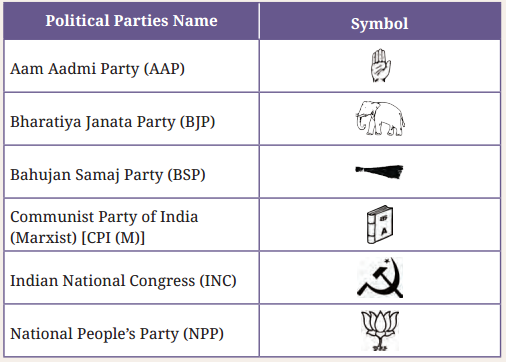
Answer:
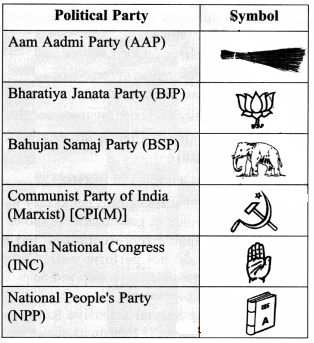
Question 8.
Read the case study and answer the questions.
Ishani and her mother were in the local market, the day before the state assembly elections. She noticed wall writing and campaign posters pasted everywhere. Large groups of campaigners were distributing pamphlets and raising slogans in support of the respective candidates. Isbani has turned 18 and will be voting for the first time. She had registered to vote through the ECI’s online portal. The next morning, she, along with her mother and her disabled elder brother, went to the polling station, which was well guarded by the police personnel. A wheelchair was made available to them, and volunteers guided them to the polling booth. Inside the polling booth, there were only three people who were performing all duties. Ishani had forgotten her voter ID card and Aadhaar card, but she was surprised as no one asked for them. After casting her vote, she was also able to see the WPAT slip. While leaving, she wondered how the police personnel vote, as they must be on duty from early morning till late evening. When she went home, she narrated her entire experience to her 89-year-old grandmother, who cast her vote from home.
(a) What initiatives were taken by the ECI to enable the voters to cast their vote?
Answer:
- Online voter registration.
- Wheelchair facility for persons with disabilities.
- Volunteers to assist voters.
- Security arrangements at the polling station.
- WPAT facility for verifying the vote.
- Home voting facility for senior citizens above 85 years.
(b) If Fshani was allowed to vote even without carrying her Voter ID card or Aadhaar card, which other document might she be carrying that is valid for voting?
Answer:
She might have been carrying any other identity document approved by the ECI, such as a Passport, Driving Licence, PAN Card, MNREGA Job Card, or Passbook with photograph issued by a bank or post office.
(c) Cite the examples of violations of the Model Code of Conduct.
Answer:
- Wall writing on public property without permission.
- Pasting campaign posters at unauthorised places.
- Campaigning after the prescribed campaign period ends.
- Distributing pamphlets or raising slogans in prohibited areas near polling stations.
(d) Give a suitable title to the passage.
Answer:
A First-Time Voter’s Election Experience OR Do it yourself.
(e) Find out how the police and army personnel cast their votes.
Answer:
Police personnel on election duty usually cast their votes through the postal ballot or Election Duty Certificate (EDC), while members of the Armed Forces vote through the Electronically Transmitted Postal Ballot System (ETPBS).
Question 9.
Study the chart and answer the questions.
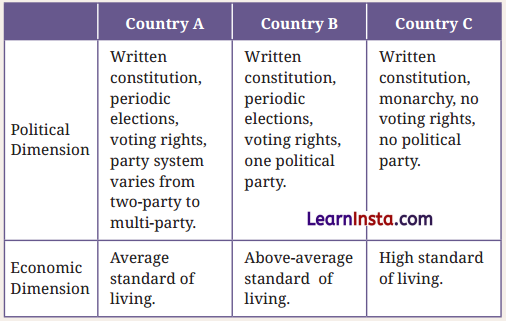
(a) What is the difference between having a voting right in a country with a multi-party system and another with a single-party system?
Answer:
In a multi-party system, voters can choose from several political parties, giving thkjn greater choice and representation. In a single-party system, voters have little or no choice ^ecause only one political party is allowed to contest elections.
(b) In which of the above countries would you like to stay and why?
Answer:
I would like to stay in Country A because it has a democratic system with voting rights and a multi-party system. It allows citizens to participate in elections and choose their representatives freely.
Question 10.
What are the challenges to conducting free and fair elections?
Answer:
Conducting free and fair elections faces several challenges such as the use of money power, distribution of gifts or bribes to influence voters, misuse of government machinery, fake news and misinformation, intimidation of voters, hate speech based on religion or caste, electoral violence, low voter awareness, and ensuring that all eligible voters, including persons with disabilities and senior citizens, can vote without difficulty. The Election Commission works to overcome these challenges by enforcing election laws and the Model Code of Conduct.
Question 11.
On the Stage.
Elections are to be held in your school for the posts of Head Girl, Head Boy, and Sports Captain.
Assume the roles of an Election Commissioner, Returning Officer, Polling Agent, Candidate, Campaigner, Polling Officer, Police Personnel, and a Journalist, and perform their roles while ensuring free, fair, and transparent elections.
Answer:
The roles can be performed in a free, fair, and transparent school election.
- Election Commissioner: Plans and supervises the entire election process, announces rules, and ensures fairness.
- Returning Officer: Manages nominations, prepares the voter list, and conducts the counting of votes.
- Polling Officer: Conducts voting at the booth, verifies voters, and maintains order during polling.
- Polling Agent: Represents candidates inside the polling booth and ensures no malpractice occurs.
- Candidate: Presents manifesto, participates in debates, and follows election rules.
- Campaigner: Helps candidates by spreading their ideas peacefully without violating rules.
- Police Personnel: Maintains discipline and security at the polling station.
- Journalist: Reports the election process, highlights fairness, and informs the school community.
Question 12.
Try to make videos or audio on topics like: My Vote My Nation; No Voter to be Left Behind; How to Eliminate the 111 of Money Power, etc.
Answer:
Students can record videos or audio by themselves on the topics mentioned in the question (Suggestive Script for Audio/Video).
Every vote is valuable because it gives citizens the power to choose their representatives and strengthen democracy. The Election Commission of India works to ensure that every eligible voter, including senior citizens, persons with disabilities, service voters, and people living in remote areas, can cast their vote easily. We should encourage everyone to register as voters, follow the Model Code of Conduct, and vote responsibly. A strong democracy is built when every eligible citizen participates in the electoral process.
Question 13.
Select one national or state political party. Using authentic and reliable sources such as the Election Commission of India (ECI) website, the official website of the selected political party, and newspapers. Prepare a comparative chart of the last two State Legislative Assembly elections. The chart should include the following details for the chosen party:
(a) Some promises made in the Election manifesto
(b) Percentage of votes polled
(c) Number of seats won
(d) Number of women who contested
(e) Number of women candidates elected.
Present the data for both elections in a clear and comparative format, citing all sources used.
Answer:
Bharatiya Janata Party
| Details | 2020 Delhi Assembly Election | 2025 Delhi Assembly Election |
| (a) Some promises in the Election Manifesto | Better infrastructure, clean water, improved healthcare and employment | Women’s welfare, better roads, improved education, free healthcare and employment opportunities |
| (b) Percentage of votes polled | 38.51% | 45.56% |
| (c) Number of seats won | 8 | 48 |
| (d) Number of women who contested | 9 | 9 |
| (e) Number of women candidates elected | 1 | 4 |
Question 14.
Do you think ‘One Nation, One Election’ can improve the efficiency of the electoral process? Divide the class and discuss it in two groups—one to examine its potential advantages and the other to analyse its limitations.
Answer:
Yes, I think ‘One Nation, One Election’ can improve the efficiency of the electoral process to a great extent. Conducting elections together can reduce government expenditure, save time and resources, reduce the burden on security forces and election officials, and allow governments to focus more on development instead of frequent election campaigns. It can also reduce the repeated enforcement of the Model Code of Conduct, ensuring continuity in governance. However, there are also challenges, such as the difficulty of managing elections across the entire country at the same time, the possibility of national issues overshadowing state issues, and constitutional complications if a government falls before completing its term. Therefore, while the idea has several advantages, it also requires careful planning and broad political consensus before implementation.