Practice with Class 9 SST Extra Questions and Class 9 Social Science SST Chapter 7 Elections Extra Questions and Answers to improve your exam performance.
Elections Class 9 Extra Question Answer
Extra Questions of Elections Class 9
Elections Class 9 Very Short Question Answer
Question 1.
Why are elections held at regular intervals?
Answer:
Regular elections give citizens an opportunity to choose their representatives periodically. They also ensure that the government remains accountable to the people and continues to enjoy their confidence.
Question 2.
What is the purpose of an election symbol?
Answer:
An election symbol helps voters identify political parties and candidates easily, especially those who may have difficulty reading the names printed on the ballot or EVM.
Question 3.
Why are election campaigns important?
Answer:
Election campaigns help political parties and candidates present their ideas, policies, and programmes. They also enable voters to compare different candidates before casting their votes.
Question 4.
What is meant by a recognised State party?
Answer:
A recognised State party is a political party that fulfils the conditions laid down by the Election Commission of India for recognition in a particular state.
Question 5.
Name one responsibility of a voter.
Answer:
A responsible voter should cast the vote freely and honestly without being influenced by money, gifts, fear, or any other unfair means.
Question 6.
What is VVPAT?
Answer:
VVPAT (Voter Verifiable Paper Audit Trail) is a device attached to an Electronic Voting Machine (EVM). It allows voters to verify that their vote has been recorded for the chosen candidate.
Question 7.
Why is voter awareness important?
Answer:
Voter awareness encourages citizens to participate in elections responsibly. It also helps them make informed decisions and strengthens democracy.
Question 8.
What is the role of the Opposition in a democracy?
Answer:
The Opposition keeps a check on the government, raises public issues, and ensures that the government remains accountable to the people.

Question 9.
Name one challenge to free and fair elections.
Answer:
One major challenge is the spread of misinformation and fake news, which can mislead voters and affect the fairness of the electoral process.
Elections Class 9 Short Question Answer
Question 1.
Why is equal representation important in a democracy?
Answer:
Equal representation ensures that people from different regions have a fair voice in the legislature. It prevents unequal distribution of seats aftiong constituencies and strengthens the democratic principle of equality. Delimitation helps achieve this objective by adjusting constituency boundaries according to population changes.
Question 2.
Explain any three features of a free and fair election.
Answer:
A free and fair election allows voters to cast their votes without fear or pressure. It is conducted in a transparent manner under the supervision of an independent Election Commission. Accurate counting of votes and equal opportunities for all eligible candidates also make elections fair.
Question 3.
How do political parties contribute to democratic governance?
Answer:
Political parties contest elections and provide citizens with different policy choices. They form governments or act as the Opposition after elections. Through debates and public engagement, they help ensure accountability and represent the interests of the people.
Question 4.
How has technology improved the electoral process in India?
Answer:
Technology has made elections more efficient and transparent. Digital platforms help voters register, check electoral details, and report election-related complaints. The use of EVMs, VVPAT, and online voter services has also improved the speed, accessibility, and reliability of elections.
Question 5.
Why is it important for citizens to vote responsibly?
Answer:
Responsible voting helps in electing honest and capable representatives. Citizens should vote based on.the candidates’ abilities and policies rather than being influenced by money, religion, caste, or false information. Responsible voting strengthens democracy.
Question 6.
Explain the importance of election laws in India.
Answer:
Election laws provide rules for conducting elections in a fair and orderly manner. They regulate voter registration, nomination of candidates, election campaigns, voting procedures, and settlement of disputes. These laws help maintain the credibility of the electoral process.
Elections Class 9 Long Question Answer
Question 1.
Describe the’role of the Election Commission of India in conducting elections.
Answer:
The Election Commission of India (ECI) is an independent constitutional body responsible for conducting free and fair elections. It prepares and updates electoral rolls, announces the election schedule, registers political parties, and allots election symbols. The ECI supervises the nomination process, polling, counting of votes, and declaration of results. It also enforces the Model Code of Conduct to ensure ethical campaigning. Through initiatives such as voter awareness programmes, digital services, and inclusive voting facilities, the ECI encourages greater participation in elections. These functions help maintain transparency, impartiality, and public confidence in the electoral process.
Question 2.
Explain the significance of political parties in a democratic system.
Answer:
Political parties play an essential role in the functioning of democracy. They contest elections and present different policies and programmes to the people. After elections, the majority party or alliance forms the government, while the remaining parties act as the Opposition. Political parties represent public interests, organise public opinion, and encourage political participation. They also hold the government accountable through debates and discussions in the legislature. By providing citizens with meaningful choices, political parties strengthen democratic governance.
Question 3.
Discuss the measures taken to make elections more inclusive in India.
Answer:
The Election Commission has introduced several measures to ensure that every eligible citizen can participate in elections. Braille-enabled EVMs, ramps, wheelchairs, and volunteers assist persons with disabilities at polling stations. Home voting has been introduced for eligible senior citizens and persons with benchmark disabilities. Service voters can cast their votes through the Electronically Transmitted Postal Ballot System (ETPBS). Digital platforms such as the Voter Helpline App and Saksham App have also made voter registration and election-related services more accessible. These initiatives promote equal participation in the democratic process.
Question 4.
Explain the role of laws in ensuring free and fair elections in India.
Answer:
Election laws provide the legal framework for conducting elections fairly. The Representation of the People Act, 1950 deals mainly with electoral rolls and delimitation of constituencies, while the Representation of the People Act, 1951 governs nominations, election campaigns, voting procedures, election offences, and settlement of; disputes. The Model Code of Conduct guides the behaviour of political parties and candidates during elections. Together with the Election Commission of India, these laws help prevent unfair practices and maintain the integrity of elections.
Question 5.
Describe the major challenges to conducting free and fair elections. Suggest suitable measures to address them.
Answer:
Conducting elections in a large and diverse country like India involves several challenges. These include misinformation, fake news, voter intimidation, misuse of money and muscle power, hate speech, and attempts to influence voters through unfair means. Such practices may weaken public trust in the electoral process. To address these challenges, strict enforcement of election laws, effective implementation of the Model Code of Conduct, voter awareness campaigns, use of technology such as EVMs and WPAT, and active participation by citizens are essential. These measures help ensure that elections remain free, fair, and transparent.
Elections Class 9 Source Based Questions
Read the sources given below and answer the questions that follow:
Question 1.
Regular and periodic elections are one of the most important features of a democratic system. Through elections, citizens exercise their right to vote and choose representatives who make decisions on their behalf. Elections also ensure that governments remain accountable to the people and seek a fresh mandate after completing their term. If elections are not held regularly or if people are denied the freedom to vote, democracy becomes weak. Therefore, free, fair, and transparent elections are essential for ensuring public participation and maintaining the legitimacy of the government.
(i) How do elections help in making the government accountable?
Answer:
Elections allow citizens to evaluate the performance of the government and choose whether to re-elect or replace their representatives. This keeps the government accountable to the people.
(ii) Why are free and fair elections considered essential for democracy?
Answer:
Free and fair elections ensure that every eligible citizen can vote without fear or pressure. They reflect the true choice of the people and strengthen public trust in democracy.
(iii) What could be the impact if citizens are not allowed to vote freely?
Answer:
If citizens cannot vote freely, the election results may not reflect the people’s choice. This can weaken democracy and reduce public confidence in the government.
Question 2.
The Election Commission of India (ECI) is an independent constitutional body responsible for conducting elections in a free, fair, and transparent manner. It prepares and updates electoral rolls, announces election schedules, registers political parties, allots election symbols, and supervises the entire election process. The ECI has also introduced several initiatives to make elections more inclusive. These include Braille-enabled Electronic Voting Machines (EVMs), home voting for eligible senior citizens and persons with benchmark disabilities, the Saksham App for persons with disabilities, and the Electronically Transmitted Postal Ballot System (ETPBS) for service voters. These measures encourage greater participation in elections and ensure that no eligible voter is left behind.
(i) Mention any two functions performed by the Election Commission of India.
Answer:
The Election Commission prepares and updates electoral rolls and conducts elections in a free and fair manner. It also registers political parties and allots election symbols.
(if) How has the Election Commission made elections more inclusive?
Answer:
The ECI has introduced facilities such as Braille- enabled EVMs, home voting for eligible senior citizens and persons with disabilities, and ETPBS for service voters to ensure wider participation.
(iii) Why is an independent Election Gommission important in a democracy?
Answer:
An independent Election Commission Conducts elections impartially and ensures that all political parties and candidates are treated fairly^ This strengthens public confidence in the electoral process.
Elections Class 9 Picture Based Questions
Look at the pictures and answer the questions that follow.
Question 1.

(i) Identify the device shown in the picture.
Answer:
The picture shows an Electronic Voting Machine (EVM) with Braille-enabled buttons, which helps persons with visual impairment cast their votes independently.
(ii) How does this device promote inclusive elections?
Answer:
The Braille-enabled EVM allows visually impaired voters to identify the buttons without assistance. This enables them to vote independently while maintaining the secrecy of their vote.
(iii) State one advantage of using EVMs in elections.
Answer:
EVMs make the voting process faster and more accurate. They also reduce the chances of invalid votes and help in quick counting of results.
Question 2.
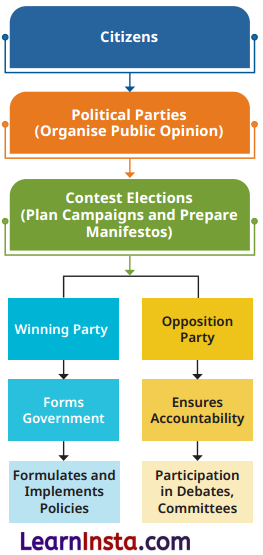
(i) What is the central idea conveyed through the picture?
Answer:
The picture shows that political parties are an essential part of democracy. They contest elections, form governments, represent citizens, and ensure accountability.
(ii) Mention any two roles performed by political parties.
Answer:
Political parties contest elections and prepare election manifestos. They also form the government or perform the role of the Opposition after elections.
(iii) Why are political parties considered important in a democratic system?
Answer:
Political parties provide citizens with different policy choices and represent public interests. They help ensure people’s participation in governance and strengthen democratic functioning.
Class 9 Elections Extra Questions for Practice
Multiple Choice Questions
Question 1.
Which institution ensures that election iules are followed by political parties and candidates during elections?
(a) Parliament
(b) Supreme Court
(c) Election Commission of India
(d) State Legislature
Question 2.
Which of the following is an example of an indirect election?
(a) Election to the Lok Sabha
(b) Election to the Vidhan Sabha
(c) Election to the Panchayat
(d) Election of the President of India
Question 3.
Which of the following helps voters verify that their vote has been recorded correctly?
(a) Electoral Roll
(b) VVPAT
(c) Election Manifesto
(d) Postal Ballot
Question 4.
Which digital platform allows voters to report violations of the Model Code of Conduct?
(a) Saksham App
(b) Suvidha App
(c) cVIGIL App
(d) Sugam App
Assertion & Reason Questions
Question 1.
Assertion (A): Election campaigns help voters understand the policies of different political parties.
Reason (R): During election campaigns, political parties communicate their ideas, programmes, and promises to the public.
(a) Both (A) and (R) are true and (R) is the correct explanation of (A).
(b) Both (A) and (R) are true but (R) is not the correct explanation of (A).
(c) (A) is true but (R) is false.
(d) (A) is false but (R) is true.
Fill in the blanks
1. The process of revising the boundaries of constituencies is called ___________
2. The ___________ App helps persons with disabilities access election-related services.
3. The ___________ Code of Conduct comes into force after the announcement of election dates.
4. The ___________ Trail allows voters to verify their vote after it is cast.
5. A government formed by two or more political parties is known as a ___________ government.
Very Short Answer Type Questions
Question 1.
Why are election manifestos important for voters?
Question 2.
What is the main objective of the Model Code of Conduct?
Question 3.
Name any two digital initiatives introduced by the Election Commission of India.
Question 4.
Why is transparency necessary during the counting of votes?
Question 5.
What is meant by voter participation?
Short Answer Type Questions
Question 1.
Explain how election symbols help both political parties and voters.
Question 2.
Describe the role of voters in ensuring the success of a democratic election.
Question 3.
How do recognised political parties differ from registered unrecognised political parties (RUPPs)?
Question 4.
Explain how the use of digital technology has improved election management in India.
Long Answer Type Questions
Question 1.
Explain how elections contribute to the legitimacy of a democratic government.
Question 2.
Describe the process followed by the Election Commission from the preparation of electoral rolls to the declaration of election results.
Question 3.
Discuss the importance of ethical conduct by political parties and candidates during elections.
Question 4.
Explain how citizens, political parties, the media, and the Election Commission together contribute to the success of democratic elections.