These Our Wondrous World Class 5 Worksheet and Class 5 EVS Chapter 10 Earth Our Shared Home Worksheet with Answers Pdf are excellent for board exam practice.
Earth Our Shared Home Class 5 EVS Worksheet Chapter 10
Class 5 EVS Earth Our Shared Home Worksheet
Class 5 EVS Chapter 10 Worksheet – Class 5 Earth Our Shared Home Worksheet
In this chapter, students learn that the Earth looks tiny from space, with no visible borders, showing how we are all connected. They explore global links through food, clothes, music, toys and stories. Students discover bird migration, yoga’s spread globally, and how items like chillies, sugar, marigolds, and cows have travelled across the world. They also learn about ‘Vasudhaiva Kutumbakam,’ which means ‘the world is one family,’ reminding us to care for each other and our planet.
Multiple Choice Questions
Question 1.
What is celebrated on 21st June every year around the world?
a. World Peace Day
b. International Yoga Day
c. Nature Day
d. Science Day
Question 2.
Which flower came from Mexico and is now popular in Indian festivals?
a. China
b. Brazil
c. South America
d. Egypt
Question 4.
How many characters does a DIGIPIN code have?
a. 5
b. 8
c. 10
d. 12
Question 5.
Which countries do Rosy Starlings migrate from to reach India?
a. China and Japan
b. Russia and Mongolia
c. Canada and USA
d. Brazil and Mexico

Question 6.
What is the full form of MoEFCC?
a. Ministry of Energy, Forest and Climate Care
b. Ministry of Environment, Forest and Climate Change
c. Ministry of the Earth, Forest and Clean Climate
d. Ministry of Ecology, Farming and Climate Council
Question 7.
Read the statements given below and choose the correct option.
Statement I: The method of making jaggery and sugar from sugarcane was first discovered in India.
Statement II: Sugar originally came to India from Europe.
a. Statement I is true.
b. Statement II is true.
c. Both statements I and II are true.
d. Both statements I and II are false.
Fill in the blanks.
1. ________ was the first Indian to see the Earth from space.
2. In India, ________ was commonly used to spice up food before chillies arrived.
3. Yoga has been practised in India for more than ________ years.
4. Rosy starlings help farmers by eating the ________ on the crops.
5. The pictures of Indian cows are found on ________ and ________ of Brazil.
State True (T) or False (F).
1. The Earth appears blue from space due to the presence of forests.
2. The MoEFCC logo represents the balance between human life and nature.
3. The Earth has visible borders and lines from space.
4. Yoga is only practised in India.
5. Portuguese travellers brought chillies to India from Brazil.
6. The marigold flower is native to India.
7. People across the world always knew about sugar and used it to sweeten their food.
Match the following.
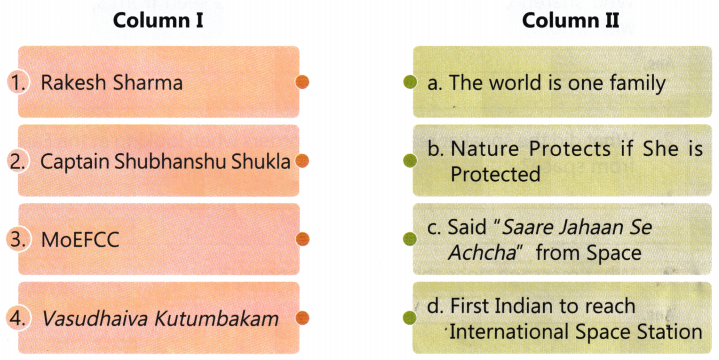
Unscramble the letters with the help of the given hints.
1. AYGO ________
A healthy practice that keeps the body fit and mind calm.
2. N I P D I G I ________
A digital code system that helps locate places in India.
3. G LA MO DIR ________
A flower that originated in Mexico and is used during festivals in India.
4. A G N O M ________
A fruit that originated in India and is loved all over the world.
Read the paragraph and answer the following questions.
After seeing the Earth from outside, the first thought that came to mind was that the Earth looks like one whole place. No borders visible from outside. It seems that no border exists, no state exists, no countries exist. We all are part of humanity, and the Earth is our one home, and all of us live in it.
Question 1.
Who shared this thought about the Earth as seen from space, and with whom?
Answer:
______________________________________
Question 2.
What did the speaker realise about borders when looking at the Earth from space?
Answer:
______________________________________
Question 3.
What message does this paragraph convey? Ans.
Answer:
______________________________________
Look at the picture and answer the following questions.

Question 1.
What is the girl doing in the picture?
Answer:
______________________________________
Question 2.
From which country did it originate?
Answer:
______________________________________
Question 3.
What does it help us with?
Answer:
______________________________________
Answer the following questions.
Question 1.
Why is the Earth called the “Blue Planet”?
Answer:
______________________________________
Question 2.
What is DIGIPIN, and how is it useful?
Answer:
______________________________________
Question 3.
How did chillies become part of Indian food?
Answer:
______________________________________
Question 4.
‘Nature has no boundaries’. Explain this statement.
Answer:
______________________________________
Question 5.
What does the Marigold remind us of?
Answer:
______________________________________
Question 6.
What does ‘Web of Life’ mean?
Answer:
______________________________________
Question 7.
Where do rosy starlings come from, and how do they help during their stay in India?
Answer:
______________________________________
Question 8.
What does the MoEFCC logo remind us of?
Answer:
______________________________________
Question 9.
Name three Indian cow breeds that are popular in Brazil.
Answer:
______________________________________
Question 10.
What does ‘Vasudhaiva Kutumbakam’ mean? Justify.
Answer:
______________________________________
Learn With Fun
Observe the images and complete the following table. (One example has been done for you.)

Paste the pictures of five birds that travel from different places to India in the space given below. Also, write the name of the place where they come from. (One example has been done for you.)

Make a colourful poster on the theme ‘Protect the Earth’.

With help a your teacher, elders, or the Internet, find out the names of some native Indian cow breeds and the states they come from and complete the table. One example has been done for you.

Word Puzzle
Complete the crossword with the help of the given clues.
Down
1. A traditional Indian sweetener made from sugarcane juice.
2. A bright orange or yellow flower that travelled from Mexico to India.
Across
3. A person trained to travel and work in space.
4. A 10-character digital code that acts like a digital address.
5. A small and round model of the Earth.
6. A type of insect that looks like a grasshopper.
7. An ancient Indian practice for health and peace.
