Practice with Understanding Society India and Beyond Class 9 Solutions and Class 9 Social Science SST Chapter 4 Early Humans and Beginning of Civilisation Question Answer NCERT Solutions to improve your exam performance.
Class 9 SST Chapter 4 Early Humans and Beginning of Civilisation Question Answer
Class 9 Early Humans and Beginning of Civilisation Question Answer
The Big Questions (Page No. 61)
Question 1.
How did humans live on Earth before the beginning of civilisation?
Answer:
Before the beginning of civilisation, humans lived on Earth as hunter-gatherers. They moved from place to place in search of food and water, used simple stone tools, lived in caves or temporary shelters, and later settled down in one place after the discovery of agriculture.
Question 2.
How did humans communicate before writing was invented?
Answer:
Before writing was invented, humans communicated through speech, gestures, and symbolic forms such as cave paintings, engravings, and body decoration. Later, early writing systems such as the Harappan script, Mesopotamian cuneiform, and Egyptian hieroglyphics were developed.
Question 3.
How is archaeology helpful in understanding our past?
Answer:
Archaeology helps us understand the past by studying material remains such as tools, artefacts, fossils, pottery, ornaments, buildings, and other objects left behind by early humans. These discoveries help archaeologists reconstruct how people lived before written records existed.
Question 4.
How did early civilisations interact with each other?
Answer:
Early civilisations interacted through trade, travel, and cultural exchanges. Through trade, they exchanged goods, ideas, technologies, and knowledge, which helped different civilisations grow and influence one another.

Early Humans and Beginning of Civilisation Question Answer Class 9
InText Questions
Let’s Explore
Question 1.
You have studied about the Harappan script in your previous grades. Observe this seal carefully and discuss why the script has not yet been deciphered. Also, find out what efforts have been made to decipher it. You can use your textbook, consult your teacher, or refer to online sources. (Page No. 62)
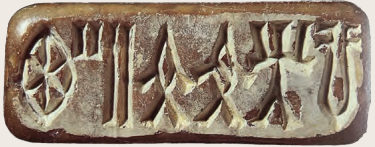
Harappan script on a seal
Answer:
The Harappan script has not yet been deciphered because no bilingual inscription (like the Rosetta Stone for Egyptian hieroglyphics) has been found to compare and understand its symbols. Also, the inscriptions are very short, making it difficult to identify the language or meaning.
Many scholars have tried to decipher the script by studying the symbols on seals, pottery, copper tablets, and other artefacts using linguistic analysis and computer-based techniques. However, no interpretation has been universally accepted, so the Harappan script remains undeciphered.
Question 2.
Let us observe the images given below and answer the following questions.
(i) Do you notice any changes in the shape or features of the skulls across different ancestors?
(ii) Can you observe a gradual straightening of the face?
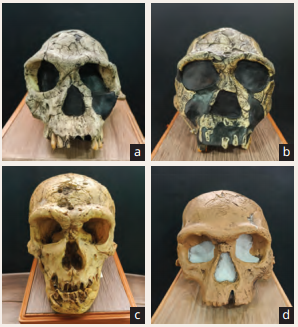
Figure: (a) Homo habilis lived in Olduvai Gorge, Tanzania and Kenya, 2-6 million years ago; made chopper stone tools
(b) Homo erectus lived in the Eastern African Rift Valley 2 million years ago; made handaxes and cleavers.
(c) Homo neanderthalensis lived in Europe and Southwest Asia till about 40000 years ago; made Middle Palaeolithic flake tools.
(d) Living humans, or the Homosapiens, are the only human species living today on Earth.
Answer:
(i) Yes. The skulls gradually become larger and rounder. The forehead becomes higher, while the jaws and teeth become smaller. The overall skull shape becomes more like that of modern humans.
(ii) Yes. The face gradually becomes straighter and flatter. The projecting jaws reduce, making the face appear more upright and similar to that of modern humans.
Question 3.
Can you find out which countries constitute West Asia in present times? (Page No. 79)
Answer:
At present, West Asia includes countries such as Turkey, Cyprus, Syria, Lebanon, Israel, Palestine, Jordan, Iraq, Iran, Kuwait, Saudi Arabia, Bahrain, Qatar, the United Arab Emirates, Oman, and Yemen.
Question 4.
Do you find any similarities between the temples in India and those of the Sumerian civilisation as centres of socio-cultural and economic activity? (Page No. 80)
Answer:
Yes, there are many similarities. Like the temples in India, Sumerian temples were not only places of worship but also served as centres of social, cultural, and economic activities. They were used for religious ceremonies, education, storing goods, collecting taxes, and managing trade and agricultural resources. They also brought people together and played an important role in the administration of the community.
Question 5.
The Epic of Gilgamesh, written during the Mesopotamian civilisation, is one of the earliest stories written. Try to find out more such stories and share in class. (Page No. 82)
Answer:
Some of the earliest stories written in ancient times include:
- Tale of the Shipwrecked Sailor (Ancient Egypt) – This is an exciting adventure story about a sailor who gets stranded on a magical island after a big storm. He meets a giant, talking serpent who comforts him and predicts his safe return home.
- Enuma Elish (Ancient Mesopotamia) – This is a famous creation myth written on clay tablets. It tells the epic story of how the warrior god Marduk defeated a giant dragon-goddess named Tiamat to create the earth and the sky.
- The Epic of Atrahasis (Ancient Mesopotamia) – This story is very interesting because it includes a huge flood. The gods get annoyed by how noisy humans are and decide to destroy them, but one wise man builds a giant boat to save animals and his family.
- The Mahabharata (Ancient India) – It is one of the world’s longest epics and describes the Kurukshetra War along with important moral teachings.
These ancient stories help us understand the history, beliefs, values, and culture of early civilisations.
Question 6.
Look at the social hierarchy pyramid in the image. What were the social classes of early Egypt? What were the different kinds of occupations? What could have been a typical daily routine of the people from each class?
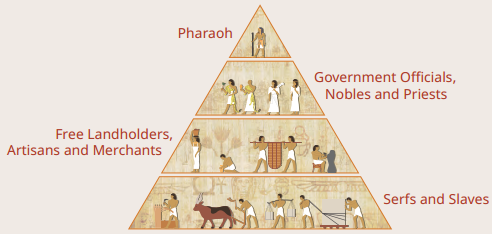
Social hierarchy Pyramid
Answer:
The social hierarchy in early Egypt consisted of the Pharaoh at the top, followed by government officials, nobles, and priests, then free landholders, artisans, and merchants, and finally serfs and slaves at the bottom.
- Pharaoh: Ruled the kingdom, made important decisions, and was regarded as the supreme ruler.
- Government officials, nobles, and priests: Helped administer the kingdom, collected taxes, managed religious activities, and advised the Pharaoh.
- Free landholders, artisans, and merchants: Cultivated land, produced goods, practised crafts, and carried out trade.
- Serfs and slaves: Worked in agriculture, construction, and other labour-intensive tasks, serving the upper classes.
This pyramid shows that Egyptian society was organised into different social classes, each with specific duties and occupations.
Question 7.
The Chinese script is logographic, with characters representing entire words or morphemes (smallest meaningful units of language), rather than sounds.

Explore more examples of Chinese characters that resemble the objects or ideas they represent. Note down at least two such characters and explain how their shapes are connected to their meanings. (Page No. 90)
Answer:
Two examples of Chinese logographic characters are:
Sun – This character looks like a square with a line inside, representing the shape of the sun. It symbolises daylight and the Sun.
Mountain – This character has three pointed peaks on the surface, resembling the shape of a mountain range. It directly represents the idea of a mountain.
These characters show how early Chinese writing used simple pictures of objects to represent words and ideas.
Think About It
Question 1.
Why do you think early humans left Africa to migrate to other regions? (Page No. 65)
Answer:
Early humans probably left Africa because of changes in climate and the environment. They migrated in search of food, water, natural resources, and suitable places to live, eventually spreading to different parts of Asia and Europe.
Question 2.
Why do you think the shift to farming during the Neolithic period is called a revolution rather than a simple change? Discuss with your classmates. (Page No. 67)
Answer:
The shift to farming during the Neolithic period is called a revolution because it brought major and lasting changes in human life. People changed from a nomadic lifestyle to permanent settlements, began producing their own food, domesticated animals, and developed new skills such as pottery and weaving. This transformation led to the growth of villages, trade, and organised societies, laying the foundation for the rise of civilisations.
Question 3.
Observe the chart below and identify the animals that were domesticated. Also try to identify the types of human habitats and objects that were used. Are any of these still used in present times? (Page No. 71-72)
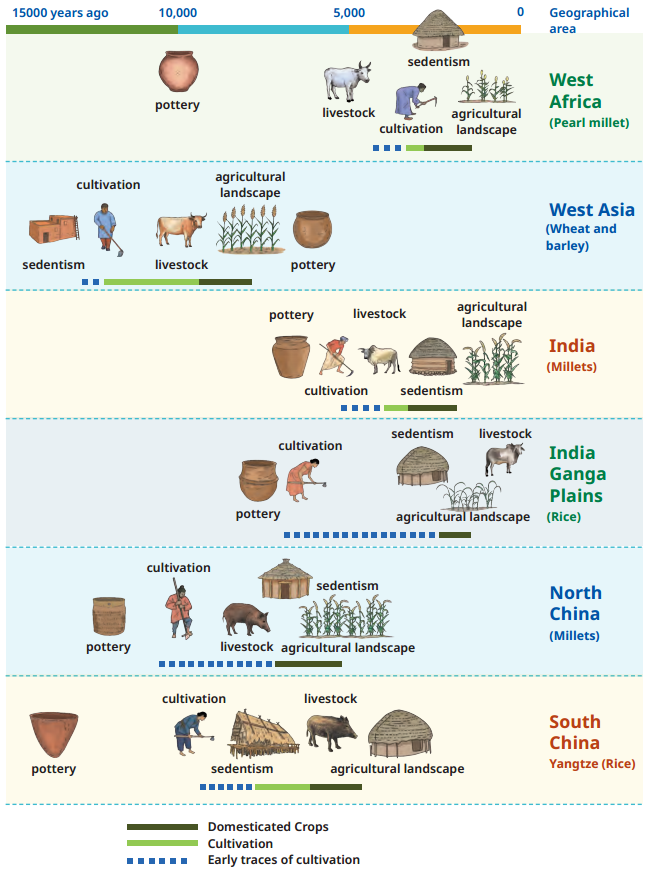
Figure. Transition to the agricultural way of life in different parts of the world
Answer:
The domesticated animals shown in the chart are cattle, sheep, goats, pigs, and buffaloes. The human habitats shown are permanent houses, huts, and settled villages. The objects shown include pottery, farming tools, and agricultural fields.
Yes. Many of these are still used today. People continue to rear cattle, sheep, goats, pigs, and buffaloes, live in permanent settlements, use pottery, practise agriculture, and cultivate crops.
Question 4.
Harappans had their own standard systems of weight and measurement. This is evident from the meticulously planned settlements and efficient interregional trade practices of the Harappans. They followed a binary multiple (1, 2, 4, 8, 16, etc.) system for weighing smaller units and used multiples of ten for larger denominations. Such cubical stone weights have been reported from several sites. Can you imagine how long-distance trade would have been affected had the Harappans not followed a standard system of weights? (Page No. 76)
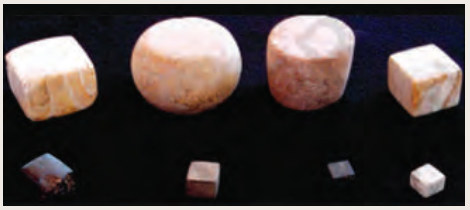
Figure. Stone weights
Answer:
Without a standard system of weights and measures, long-distance trade would have been difficult and unreliable. Traders would have faced confusion, unfair transactions, and disagreements while buying and selling goods. A standard system ensured accuracy, fairness, and efficient trade across different Harappan settlements.
Question 5.
Why were rivers important in the growth of early civilisations?
Answer:
Rivers were important because they provided water for drinking and irrigation, fertile soil for agriculture, and supported the growth of settlements. They also served as routes for transport and trade, helping early civilisations develop and prosper.
Question 6.
Why do you think there is a scale with a heart on one side and a feather on the other side of the figure below? What can this papyrus tell us about early Egyptian beliefs? (Page No. 85)
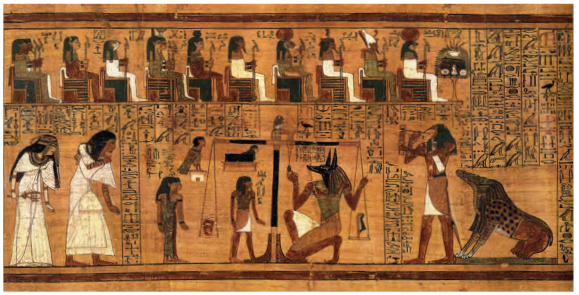
Figure. An illustration from the Papyrus of Ani
Answer:
The scale with a heart on one side and a feather on the other represents the ancient Egyptian belief that a person’s heart was weighed against the feather of Ma’at, the goddess of truth and justice. If the heart balanced with or was lighter than the feather, the person was considered truthful and worthy of entering the afterlife. If it was heavier because of sins, it was believed to be eaten by a monster. This papyrus tells us that the ancient Egyptians strongly believed in life after death, divine judgement, truth, justice, and moral conduct. It also reflects their belief that a person’s actions during life determined their fate after death.
Question 7.
Observe the images given below. What do they tell you about Egyptian fashion?
(i) Which social classes do you think used these items?
(ii) What clues in the images help you to make this guess?
Try to explain your reasoning based on the materials, designs, or accessories shown in the pictures. (Page No. 88)
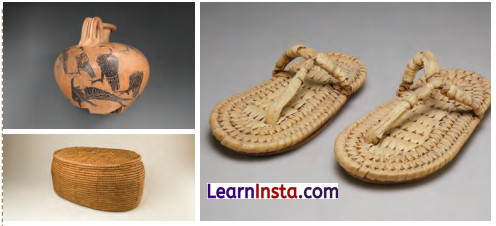
Figure. Daily items used by the Egyptians
Answer:
(i) These items were likely used by different social classes. Simple sandals and pottery were probably used by ordinary people for daily life, while finely made or decorated items may have been used by wealthy people or nobles.
(ii) The clues are the design, decoration, and quality of the objects. The simple design of the sandals suggests everyday use, while the decorated pottery indicates that some items were made with greater skill and may have belonged to wealthier people.
Question 8.
What could have been the other reasons for building the Great Wall of China? Explore and share your findings on the Great Wall through a model or presentation. (Page No. 92)
Answer:
Do it yourself.
Let’s Map
Can you locate the River Nile on the given map? Why do you think the northern part is called Lower Egypt and the southern part Upper Egypt? (Page No. 86)
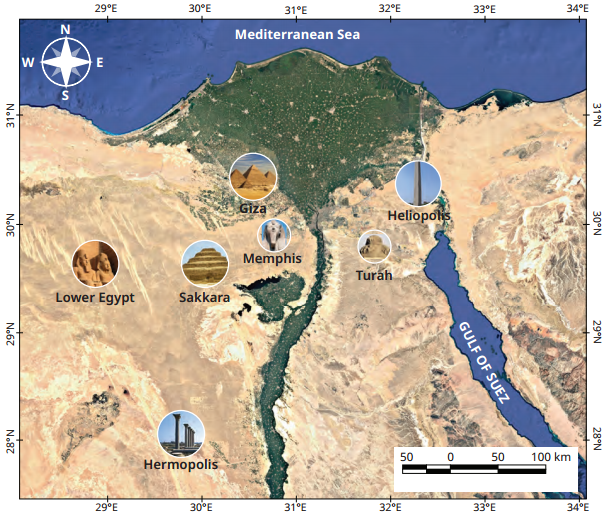
Figure. The region in which the Egyptian civilisation flourished
Answer:
Do it yourself.
Early Humans and Beginning of Civilisation Class 9 Questions and Answers
Questions and Activities (Page No. 93 – 94)
Question 1.
Do you think life became easier or more challenging after humans started farming? Give two reasons for your answer
Answer:
Life became easier after humans started farming because.
- They began producing their own food instead of depending only on hunting and gathering. They domesticated plants and animals, which ensured a more regular food supply.
- Farming also led to permanent settlements, the development of villages, the use of polished stone tools and pottery, and laid the foundation for the growth of civilisation.
Question 2.
The environment offers human societies both opportunities as well as challenges. Explain with reference to early farming communities and river- valley civilisations.
Answer:
The environment provided fertile land, water, and natural resources that enabled early farming communities to cultivate crops and domesticate animals. River valleys supported agriculture, permanent settlements, transport, and trade, leading to the growth of early civilisations such as the Indus-Saraswati, Mesopotamian, Egyptian, and Chinese civilisations. At the same time, changes in climate and the environment influenced where people settled and how they adapted their way of life.
Question 3.
Why do historians divide early human history into different ages such as Stone Age, Bronze Age, and Iron Age? What does this classification tell us about human progress?
Answer:
Historians divide early human history into different ages based on technological progress, such as the development and use of tools, the beginning of agriculture, and changes in human lifestyle and settlement patterns. This classification shows how humans gradually progressed from using simple stone tools as hunter-gatherers to practising agriculture, using metals like bronze and iron, establishing permanent settlements, and developing organised civilisations.
Question 4.
Imagine you are a Neolithic farmer. Describe one day of your life. What challenges would you face that a hunter-gatherer would not?
Answer:
As a Neolithic farmer, I wake up early in the morning and go to my fields to water the crops and remove weeds. After that, I feed the animals and repair fences around the fields. In the evening, I store the harvested grain and prepare for the next day’s work. The biggest challenges I face that a hunter-gatherer would not are crop failures and disease. If it doesn’t rain, my entire food supply dies, whereas hunter-gatherers can just move somewhere else. Also, living closely with animals and staying in one crowded village makes us get sick much more easily, and we have to worry about bandits stealing our stored grain.
Question 5.
Imagine that the Harappan script gets deciphered tomorrow. What new types of information do you think historians might learn?
Answer:
If the Harappan script is deciphered, historians may learn about the language, administration, trade, religious beliefs, social life, occupations, and daily activities of the Harappan people. It may reveal how their cities were governed, how goods were bought and sold, and how they interacted with other civilisations such as Mesopotamia. It could also provide information about their laws, customs, festivals, education, and methods of record-keeping. Deciphering the script would fill many gaps in our knowledge and help historians understand the Harappan civilisation, its people, and their achievements much more clearly.
Question 6.
Prepare a table with three columns—Palaeolithic, Mesolithic, and Neolithic—and fil in their distinctive features: tools, settlements, art, and subsistence.
Answer:
| Feature | Paleolithic | Mesolithic | Neolithic |
| Tools | Handaxes, cleavers, scrapers, borers and points | Microlithic tools and bone points | Polished stone tools |
| Settlements | Caves, rock shelters and temporary shelters | Caves and rock shelters | Permanent villages |
| Art | Cave paintings, body decoration, beads and engravings | Rock paintings | Pottery and craft production |
| Subsistence | Hunting and gathering | Hunting, fishing and gathering | Agriculture and animal domestication |
Question 7.
“Bronze Age civilisations developed independently but shared common features.’A Examine this statement with reference to the civilisations given in the chapter.
Answer:
The Sindhu-SarasvatT, Mesopotamian’, Egyptian, and Chinese civilisations developed independently in different river valleys. However, thqy shared several common features such as agriculture, permanent settlements, specialised crafts,\trade, writing systems, and organised governments. Each civilisation also developed its own distinctive culture, achievements, and traditions.
Question 8.
Although rivers provided many benefits, they also created challenges for early societies. Discuss both the advantages and disadvantages of settling near rivers.
Answer:
Rivers offered many advantages to early societies. They provided fertile soil for farming, a regular supply of water, fish for food, and easy transport and trade. These benefits helped people build permanent settlements and develop civilisations. However, rivers also created challenges. Floods could destroy crops and homes, droughts reduced the water supply, and changes in river courses sometimes forced people to move from one place to another. Therefore, while rivers supported the growth of civilisations, people also had to face and manage these natural challenges.
Question 9.
With the help of your teacher, find out more about the Code of Hammurabi. Why was it important? Do you think it was fair to all sections of society? Give reasons for your answer.
Answer:
The Code of Hammurabi was one of the earliest written law codes of the Babylonian civilisation. It was introduced by King Hammurabi to establish clear laws and punishments for different offences. It was important because it helped maintain law and order, protected property, regulated trade, and ensured that justice was administered according to written rules rather than personal decisions.
However, it was not completely fair to all sections of society because punishments often depended on a person’s social status. Wealthy people, commoners, and slaves were not always treated equally under the • law. Therefore, although the Code of Hammurabi was an important step towards a well-organised legal system, it did not provide equal justice to everyone.
Question 10.
If you had to choose one major innovation from early civilisations that changed the world permanently, what would it be and why?
Answer:
I would choose the development of writing as the most important innovation. The chapter describes the cuneiform script of Mesopotamia, the hieroglyphic script of Egypt, and the Harappan script. Writing made it possible to record laws, trade, administration, religious beliefs, and historical events. It helped preserve knowledge and enabled civilisations to pass information from one generation to another.
Question 11.
Compare the social hierarchy and daily life of people in the Egyptian civilisation with those in Mesopotamia or China. What similarities and differences do you notice?
Answer:
The Egyptian civilisation had a well-defined social hierarchy with the Pharaoh at the top, followed by government officials, nobles and priests, free landholders, artisans and merchants, and serfs and slaves. Like the people of Mesopotamia and China, the Egyptians depended on agriculture, specialised crafts, trade, and organised administration. However, the chapter specifically.presents the Egyptian social hierarchy, while for Mesopotamia and China it mainly highlights their achievements in writing, architecture, metallurgy, agriculture, and government rather than describing their social structure in detail. Thus, all three civilisations had organised societies, but the Egyptian social hierarchy is explained more clearly in the chapter.
Question 12.
Activity: Using maps, locate the major rivers and civilisations of Mesopotamia, Egypt, China, and the Sindhu-Sarasvatl Valley. Mark the trade links between them.
Answer:
Do it yourself.
Question 13.
Activity: Choose one early civilisation (Mesopotamia, Egypt, or China) and prepare a mini-scrapbook or a presentation showing their innovations in tools, writing, art, and architecture. Include pictures, brief descriptions, and explain their significance.
Answer:
Mini Scrapbook: Ancient Egyptian Civilisation
1. Tools
Picture: Bronze tools, sickles, ploughs
Description: Egyptians used bronze tools for farming, construction, and crafts.
Significance: These tools increased farming and helped build great monuments.
2. Writing
Picture: Hieroglyphic symbols on papyrus
Description: Egyptians used hieroglyphics, one of the world’s earliest writing systems.
Significance: It helped record history, religious beliefs, and government records.
3. Art
Picture: Wall paintings or sculptures
Description: Egyptian art included colourful paintings, statues, and carvings showing daily life and religious beliefs.
Significance: Their art preserved their culture and beliefs for future generations.
4. Architecture
Picture: The Great Pyramid of Giza and the Sphinx
Description: Egyptians built pyramids, temples, and tombs using stone.
Significance: Their architecture shows their advanced engineering skills and respect for their rulers and religion.
Conclusion: The Egyptian civilisation made remarkable contributions in tools, writing, art, and architecture. These innovations influenced later civilisations and continue to inspire people today.