Practicing Class 9 Science MCQ and Class 9 Science Exploration Chapter 4 MCQ Online Test with Answers Describing Motion Around Us daily helps in time management.
Class 9 Science Chapter 4 Describing Motion Around Us MCQ
Describing Motion Around Us MCQ
Class 9 Science Chapter 4 MCQ online test
Question 1.
A car moves along a straight road. It covers first half distance with speed 36 kmh-1 and the remaining half distance with 48 kmh-1. The average speed of the car is
(a) 42 kmh-1
(b) 41.14 kmh-1
(c) 4.14 kmh-1
(d) 50 kmh-1
Answer:
(b) 41.14 kmh-1
Question 2. A bus decreases its speed from 20 ms-1 to 10 ms-1 in 5 s. The acceleration of the bus is
(a) 4 ms-2
(b) 2 ms-2
(c) -2 ms-2
(d) -4 ms-2
Answer:
(c) -2 ms-2
Question 3.
When an object is thrown vertically upward with velocity 2.0 ms-1. The velocity of the object at the highest point is
(a) 2.0 m s-1
(b) – 2.0 m s-1
(c) Zero
(d) 4.0 m s-1
Answer:
(c) Zero
Question 4.
Which of the following graphs indicates that the body is at rest?
(a) s-t graph with inclined line
(b) s-t graph with horizontal line
(c) v-t graph with inclined line
(d) v-t graph with horizontal line
Answer:
(b) s-t graph with horizontal line
Question 5.
A velocity-time graph is a straight line parallel to the time axis. This indicates:
(a) The object is at rest
(b) The object has uniform acceleration
(c) The object has constant velocity
(d) The object is decelerating
Answer:
(c) The object has constant velocity

Question 6.
A particle is moving in a circular path of radius r. The displacement after half a circle would be
(a) Zero
(b) πr
(c) 2r
(d) 2πr
Answer:
(c) 2r
Question 7.
A body is thrown vertically upward with velocity u; the greatest height h to which it will rise is:
(a) u/g
(b) u2/2g
(c) u2/g
(d) u/2g
Answer:
(a) u/g
Question 8.
If the displacement of an object is proportional to square of time, then the object moves with
(a) uniform velocity
(b) uniform acceleration
(c) increasing acceleration
(d) decreasing acceleration
Answer:
(a) uniform velocity
Question 9.
The area under a v – t graph represents a physical quantity which has the unit
(a) m2
(b) m
(c) m3
(d) ms-1
Answer:
(a) m2
Question 10.
The slope of a velocity – time graph gives
(a) the distance
(b) the displacement
(c) the acceleration
(d) the speed
Answer:
(c) the acceleration
Question 11.
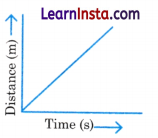
Which of the following figures represents uniform motion of a moving object correctly?
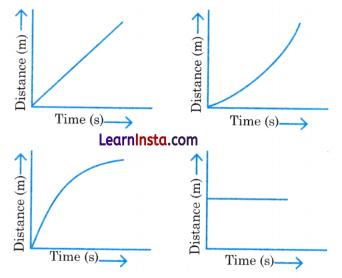
Answer:
(a)
Describing Motion Around Us Class 9 Assertion and Reason Questions
Directions: For Questions number (1) to (2), two statements are given — one labelled as Assertion (A) and the other labelled as Reason (R). Select the correct answer to these questions from the codes (a), (b), (c) and (d) as given below:
(a) Both Assertion (A) and Reason (R) are true and Reason (R) is the correct explanation of Assertion (A).
(b) Both Assertion (A) and Reason (R) are true, but Reason (R) is not the correct explanation of Assertion (A).
(c) Assertion (A) is true, but Reason (R) is false.
(d) Assertion (A) is false, but Reason (R) is true.
Question 1.
Assertion (A): Average velocity of an object can be zero even if average speed is not zero.
Reason (R): Average velocity depends on displacement while average speed depends on total distance travelled.
Answer:
(a) Both Assertion (A) and Reason (R) are true and Reason (R) is the correct explanation of Assertion (A).
Explanation:
When an object travels from A to B and returns to A, displacement is zero so average velocity = 0 divided by t = 0. But the object has travelled a total distance of 2AB, so average speed = \(\frac{2 AB}{t}\), which is not zero. The reason correctly explains why: velocity depends
on displacement (which can be zero) while speed depends on actual path length (always positive if motion occurred).
Question 2.
Assertion (A): Uniform circular motion is an example of accelerated motion.
Reason (R): In uniform circular motion, the speed of the object remains constant throughout.
Answer:
(b) Both A and R are true, but R is not the correct explanation.
Explanation:
A is true: Uniform circular motion is accelerated because the direction of velocity changes at every point, and since velocity is a vector, changing direction means changing velocity, and changing velocity means acceleration.
R is also true: Speed is indeed constant. However, R does not explain why it is accelerated. The reason for acceleration is the continuous change in direction (not because speed is constant). So R does not correctly explain A.
Describing Motion Around Us Class 9 Fill in the Blanks
1. The SI unit of displacement is ________.
Answer:
metre
2. The slope of a position-time graph gives the ________ of the object.
Answer:
magnitude of velocity
3. An object moving in a circular path with constant speed is said to be in ________ motion.
Answer:
uniform circular
4. The three kinematic equations are valid only when acceleration is ________.
Answer:
constant
5. The displacement of an object after one complete revolution in circular motion is ________.
Answer:
zero
Describing Motion Around Us Class 9 True or False
1. Distance can never be greater than the magnitude of displacement.
Answer:
False
(Reason: It is the other way around. Displacement magnitude is always less than or equal to total distance. Distance is always greater than or equal to the magnitude of displacement. They are equal only when the object moves in one direction without turning.)
2. An object in uniform circular motion has zero acceleration.
Answer:
False
(Reason: Even though the speed is constant in uniform circular motion, the direction of ve¬locity changes continuously. Since acceleration is the rate of change of velocity (a vector), and the direction changes, the acceleration is non-zero. There is a centripetal acceleration directed towards the centre of the circle.)
3. Average speed can be zero even when the object has moved.
Answer:
False
(Reason: Average speed = \(\frac{\text { Total distance }}{\text { Time }}\).
As long as the object has moved (distance > 0) and time > 0, average speed is always positive and cannot be zero. However, average velocity can be zero (when displacement is zero))
4. The kinematic equations v = u + at, s = ut + ½ at2, and v2 = u2 + 2as are valid for any type of motion.
Answer:
False
(Reason: These equations are valid only when the acceleration is constant (uniform acceleration). They cannot be used for motion with changing acceleration)
5. The slope of a velocity-time graph gives the displacement of the object.
Answer:
False
(Reason: The slope of a velocity-time graph gives acceleration (change in velocity divided by change in time). It is the area under the velocity-time graph (between the line and the time axis) that gives the displacement.)
Describing Motion Around Us Class 9 Match the Following
Question 1.
Match the following items given in Column A with that in Column B:
| Column A (Quantity) | Column B (Description) |
| 1. Distance | (a) Vector, can be zero |
| 2. Displacement | (b) Scalar, always positive |
| 3. Average Speed | (c) Slope of velocity time graph |
| 4. Acceleration | (d) Scalar, total path length / time |
Answer:
| Column A (Quantity) | Column B (Description) |
| 1. Distance | (b) Scalar, always positive |
| 2. Displacement | (a) Vector, can be zero |
| 3. Average Speed | (d) Scalar, total path length / time |
| 4. Acceleration | (c) Slope of velocity – time graph |
Question 2.
Match the following items given in Column A with that in Column B:
| Column A (Graph Feature) | Column B (Physical meaning) |
| 1. Horizontal line on position-time graph | (a) Constant acceleration |
| 2. Straight inclined line on position-time | (b) Object at a rest |
| 3. Area under velocity-time graph | (c) Constant velocity |
| 4. Straight inclined line on velocity-time | (d) Displacement |
Answer:
| Column A (Graph Feature) | Column B (Physical Meaning) |
| 1 Horizontal line on position-time graph | (b) Object at rest |
| 2. Straight inclined line on position-time | (c) Constant velocity |
| 3. Area under velocity-time graph | (d) Displacement |
| 4. Straight inclined line on velocity-time | (a) Constant acceleration |
MCQ On Describing Motion Around Us Class 9 for Practice
Choose the correct option in the following questions
Question 1.
A boy walks 6 m north, then 8 m east. What is the magnitude of his displacement?
(a) 14 m
(b) 10 m
(c) 2 m
(d) 48 m
Question 2.
Which of these quantities can be zero even when the object has moved?
(a) Distance
(b) Speed
(c) Displacement
(d) Average speed
Question 3.
A car moves with uniform velocity. The shape of its position-time graph is:
(a) A curve
(b) A horizontal straight line
(c) A straight line inclined to the time axis
(d) A parabola
Question 4.
An object moves with initial velocity u = 0, acceleration a = 5 ms-2 for 4 s. Its final velocity is
(a) 5 ms-1
(b) 10 ms-1
(c) 20 ms-1
(d) 40 ms-1
Question 5.
In uniform circular motion after one complete revolution, the displacement is
(a) 2 π R
(b) π R
(c) R
(d) Zero
Assertion-Reason Questions:
Directions: For Questions number (1) to (2), two statements are given – one labelled as Assertion (A) and the other labelled as Reason (R). Select the correct answer to these questions from the codes (a), (b), (c) and (d) as given below:
(a) Both Assertion (A) and Reason (R) are true and Reason (R) is the correct explanation of Assertion (A).
(b) Both Assertion (A) and Reason (R) are true, but Reason (R) is not the correct explanation of Assertion (A).
(c) Assertion (A) is true, but Reason (R) is false.
(d) Assertion (A) is false, but Reason (R) is true.
Question 1.
Assertion (A): When a car moves on a circular track at constant speed, it is said to be in accelerated motion.
Reason (R): Acceleration is the rate of change of speed.
Question 2.
Assertion (A): The distance covered by an object can never be less than the magnitude of its displacement.
Reason (R): The shortest distance between two points is a straight line.
Fill in the Blanks:
1 . An object is said to be at rest when its ________ with respect to the reference point does not change with time.
2. The magnitude of displacement is ________ or equal to the total distance travelled.
3. In a velocity-time graph, the area under the line and the time axis gives the ________ of the object.
4. When a vehicle slows down, the acceleration is ________ (positive/negative) because it acts opposite to the direction of motion.
5. In uniform circular motion, the speed is ________, but the velocity is ________.
State whether the statements given below are True or False:
1. A body can have zero displacement but non-zero total distance travelled.
2. The slope of a velocity-time graph gives the displacement of the object.
3. An object at rest has zero velocity and zero acceleration.
4. For the same deceleration, a vehicle moving at twice the speed requires four times the braking distance.
5. In uniform circular motion, the average velocity for one complete revolution is zero.
Match the Columns:
Question 1.
Match the following items given in Column A with that in Column B:
| Column A | Column B |
| 1. s = ut + ½ at2 | (a) Acceleration in terms of velocity |
| 2. v2 = u2 + 2as | (b) Velocity at any time |
| 3. v = u + at | (c) Displacement without time |
| 4. a = \(\frac{v-u}{t}\) | (d) Displacement at any time |
Question 2.
Match the following items given in Column A with that in Column B:
| Column A | Column B |
| 1. Slope of position-time graph | (a) Average acceleration |
| 2. Area under velocity-time graph | (b) Object at rest |
| 3. Horizontal line on velocity-time | (c) Average velocity magnitude |
| 4. Slope of velocity-time graph | (d) Displacement |
| (e) Constant velocity (zero acceleration) |