Practice with Understanding Society India and Beyond Class 9 Solutions and Class 9 Social Science SST Chapter 6 Democracy Question Answer NCERT Solutions to improve your exam performance.
Class 9 SST Chapter 6 Democracy Question Answer
Class 9 Democracy Question Answer
The Big Questions (Page No. 137)
Question 1.
How has the idea of democracy evolved o\er time and shaped our understanding of it today?
Answer:
The idea of democracy in India has evolved through a long historical process. Democratic traditions existed in ancient India through institutions such as the Sabha, Samiti, Vidhata, and the.ganas an4 samghas, where consultation, collective decision¬making, and shared responsibility were practised. The Bauddha Samghas also encouraged debate, voting, and the selection of leaders. Although foreign rule limited people’s participation in governance, the freedom struggle revived and strengthened democratic ideals. These traditions, together with global democratic values, influenced the Constituent Assembly in framing the Constitution of India, which established a democratic system based on liberty, equality, justice, fraternity, and popular participation.
Question 2.
What are the different forms of democracy, and how are they practised in India and other parts of the world?
Answer:
The main forms of democracy are direct democracy, representative democracy, parliamentary democracy, and presidential democracy. In a direct democracy, citizens themselves take part in decision-making on important issues. This form is seen in countries like Switzerland, where people directly vote on laws and policies. In a representative democracy, people elect representatives who make decisions on their behalf. India follows this system, where citizens choose their leaders through elections. Representative democracy is further of two types: Parliamentary and Presidential. India follows a parliamentary democracy, where the executive is drawn from the legislature and remains accountable to it. The government is formed by the party or coalition that wins majority support in Parliament. In a presidential democracy, such as in the United States of America, the President is elected separately from the legislature and functions independently of it. Although these systems differ in structure, they all follow the basic democratic principle that real power lies with the people, who express their will through elections.
Question 3.
What are the essential features of a democracy and how do they extend beyond government institutions?
Answer:
The essential features of democracy include popular sovereignty, universal adult franchise, rule of law, Fundamental Rights, separation of powers, accountability, transparency, a multi-party system, and safeguarding the rights of vulnerable groups. Democracy extends beyond government institutions through the active participation of citizens in elections, local self-government, civil society organisations, media, cooperatives, trade unions,.and community institutions. It also depends on citizens’ awareness of their rights and duties, honesty, fairness, and active participation in public life, making democracy a way of life and not merely a form of government.
Question 4.
What are the challenges faced by Indian democracy?
Answer:
Indian democracy faces challenges such as illiteracy, misinformation, inequality, poverty, fake news, corruption, criminalisation of politics, communalism, regionalism, and caste-based politics. Actions such as damaging public property, spreading misinformation, violating public rules, and remaining indifferent to public issues also weaken democratic values. These challenges highlight the need for responsible institutions and informed, active citizens who exercise their rights responsibly and perform their duties to strengthen democracy.

Democracy Question Answer Class 9
InText Questions
Let’s Explore
Question 1.
The Constitution not only guarantees Fundamental Rights to citizens but also outlines their Fundamental Duties and the Directive Principles of State Policy. Discuss their significance and identify the differences among them. (Page No. 141)
Answer:
Fundamental Rights are vital as they protect the freedom, equality, and dignity of every citizen. They are legally enforceable, which means individuals can approach the courts if these rights are violated. Fundamental Duties define the moral responsibilities of citizens towards the nation, society, and the Constitution, encouraging responsible and respectful behaviour. Directive Principles of State Policy act as guiding principles for the government while framing laws and policies aimed at achieving social and economic welfare. However, they are not enforceable in courts. The main difference lies in their nature and enforceability. Fundamental Rights are legal rights protected by the courts, Fundamental Duties are moral obligations of citizens, and Directive Principles serve as guidelines for governance. Together, they ensure a balanced democratic system based on rights, responsibilities, and welfare.
Question 2.
The Right to Education (Article 21A) was added in 2009, ensuring free and compulsory education for children aged 6 to 14. Discuss its significance. (Page No. 141)
Answer:
The Right to Education (Article 21A) ensures free and compulsory education for all children between the ages of 6 and 14 years. It helps every child access elementary education without discrimination, promotes equality of opportunity, and supports the overall development of children. It also strengthens democracy by creating informed, aware, and responsible citizens.
Question 3.
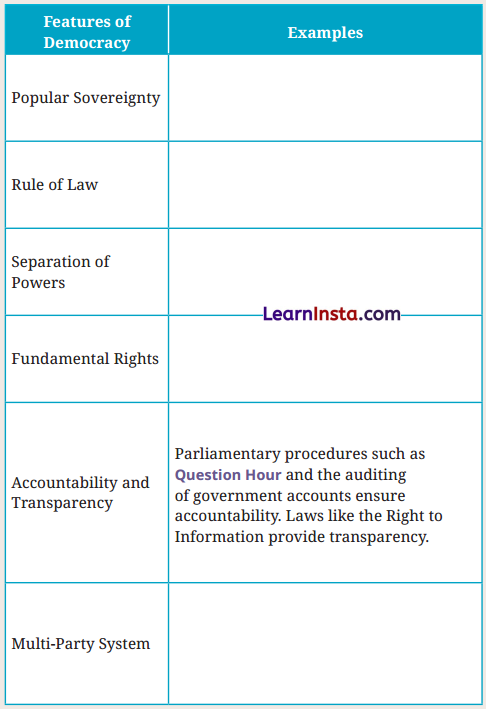
The first column of the table below lists\some key features of democracy in India. Fill in the second column with suitable examples from your state, town, or village. One row has been completed for you.
Answer:
| Features of Democracy | Examples |
| Popular Sovereignty | Citizens elect their representatives through free and fair elections using Universal Adult Franchise. |
| Rule of Law | Everyone is equal before the law, and disputes are decided by courts according to the law. |
| Separation of Powers | The Legislature makes laws, the Executive implements them, and the Judiciary interprets them. |
| Fundamental Rights | Citizens can approach the courts if their Fundamental Rights are violated. |
| Accountability And Transparency | Parliamentary procedures such as Question Hour and the auditing of government accounts ensure accountability. Laws like the Right to Information provide transparency. |
| Multi-Party System | Several political parties contest elections, and the party or coalition with a majority forms the government while the others serve as the opposition. |
Question 4.
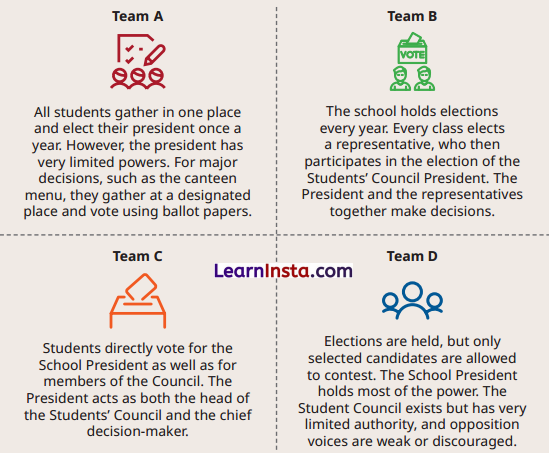
Select your ideal team from the below figure and give reasons for your selection. (Pages No. 147-148)
Imagine your school is celebrating a ‘Youth for Democracy’ festival. Students’ Councils from different countries are visiting your school. Each follows its own model of functioning, similar to how countries around the world practise democracy. Let us see what we can learn from them.
These examples show that systems may differ in how power is shared, who participates in decision-making, and whether Checks and balances are in place.
Answer:
Do it yourself.
Question 5.
Work in pairs or small groups. Choose any two of India’s neighbouring countries (Afghanistan, Bangladesh, Bhutan, China, Maldives, Myanmar, Nepal, Pakistan, or Sri Lanka) and find out the following:
(i) Does the country hold regular elections?
(ii) Who chooses the Head of the Government?
(iii) Is there more than one political party?
(iv) How much freedom do citizens have to express their opinions and criticise the government?
(v) How would you describe these systems? Give reasons for your answer.
Democratic or Partially democratic or Non- democratic (Page No. 149)
Answer:
The two neighbouring countries chosen are Nepal and Bhutan.
(i) Yes, Nepal and Bhutan hold regular democratic elections.
(ii) In Nepal, the Prime Minister is chosen by the members of the House of Representatives. In Bhutan, the Prime Minister is elected through parliamentary elections.
(iii) Yes, Nepal and Bhutan have a multi-party political system.
(iv) In Nepal, citizens generally enjoy freedom of speech and can express their opinions and criticise the government within the limits of the law. In Bhutan, citizens have the freedom to express their views, although certain legal restrictions apply.
(v) Nepal: Democratic, because it holds regular elections, has a multi-party system, and citizens, participate in choosing their government. Bhutan: Democratic, because it conducts regular elections, follows a parliamentary system, and allows people to elect their representatives.
Question 6.
A democratic system seeks to promote participation, ensure fairness, limit the concentration of power, and resolve disagreements peacefully. Identify examples from the below case study that reflect these features.
Case Study: Democracy at the Grassroots in India
Across India, several villages demonstrate how democracy functions beyond elections through active participation in local self-government. The following examples show how local bodies of democratic institutions at the grassroots in India can play a vital role in improving people’s lives.
1. Jethipura Gram Panchayat (Block Idar, Sabarkantha, Gujarat) Development Through People’s Participation Jethipura Gram Panchayat of Gujarat was awarded Nanaji Deshmukh Rashtriya Gaurav Gram Sabha Puraskar (NDRGGSP) in 2019 for its exemplary performance. It not only ensured the effective conduct of Gram Sabhas and proper maintenance of records, but also went a step further by organising Special Gram Sabhas. Other initiatives included timely and appropriate action on issues related to education, sanitation, and welfare of women and children. It also conducted Mahila Sabhas and ensured adequate quorum in Gram Sabhas, with active participation from marginalised sections of the society, including Scheduled Castes, Scheduled Tribes, and women.
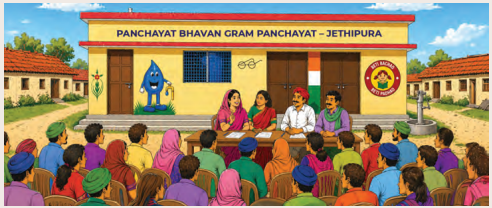
Figure. Gram Panchayat meeting (Representative image)
2. South Manubankul Gram Panchayat, Rupaichari Block, Tripura Tribal Areas Autonomous District Council, Tripura Women-Friendly Panchayat
The South Manubankul Gram Panchayat in Tripura functions as an active local government focused on improving people’s lives, decision-making, and providing facilities related to health, sanitation, and livelihoods. The Panchayat organises community programmes, supports self-help groups, and ensures the effective implementation of government schemes for village development. It also works towards improving cleanliness, education, and social awareness. Owing to its strong focus on women’s welfare and inclusive development, it has been recognised as a “women-friendly panchayat” at the national level by the Ministry of Panchayati Raj. Cases like these show that democracy in India is not limited to voting during elections. When citizens actively participate in grassroots and Panchayati Raj institutions, democracy becomes more responsive, inclusive, and effective at all levels. (Pages No. 151-152)
Answer:
The case studies reflect the features of a democratic system in the following ways:
- Participation: Jethipura Gram Panchayat ensured the effective conduct of Gram Sabhas, organised Special Gram Sabhas and Mahila Sabhas, and encouraged the active participation of Scheduled Castes, Scheduled Tribes, and women.
- Fairness: South Manubankul Gram Panchayat promoted women’s participation in decision-making and ensured the effective implementation of government schemes. It also focused on health, sanitation, livelihoods, education, and social awareness.
- Limited concentration of power: The Gram Sabha was involved in decision-making, allowing citizens to participate in local governance instead of leaving decisions to a single authority.
- Peaceful resolution of disagreements: Local bodies addressed issues related to education, sanitation, welfare, cleanliness, and village development through Gram Sabhas, community programmes, and democratic decision-making. These examples show that when citizens actively participate in grassroots and Panchayati Raj institutions, democracy becomes more responsive, inclusive, and effective at all levels.
Question 7.
India continues to work towards more inclusive institutions. Discuss in class about the advantages of increased representation of women in the legislature. (Page No. 153)
Answer:
Increased representation of women in the legislature makes democratic institutions more inclusive and representative. It encourages the active participation of women in decision-making and gives them a greater role in governance. It also helps ensure that issues related to women and society receive greater attention. Greater representation promotes equality, strengthens democratic participation, and contributes to more inclusive and effective governance.
Question 8.
In small groups, identify two or three examples of information shared on social media that you believe may be misleading, or false. Discuss what made you question their reliability and how such information can influence people’s opinions. Reflect on why access to accurate and authentic information is important in a democracy. (Page No. 155)
Answer:
In social media, we often come across information that may be misleading or false. For example, there are forwarded messages claiming that exam dates or results have been changed without any official announcement. During the COVID-19 pandemic, many posts were shared saying that home remedies or certain mixtures could cure the virus, which was not true. Sometimes, there are also messages saying that government schemes have been cancelled or new benefits have been added without any official confirmation. Such information can be questioned when it does not come from trusted or official sources, has no proof, or is widely forwarded without verification.
Sometimes, the content also feels exaggerated or unclear, which makes it doubtful. It can influence people’s opinions by creating confusion, fear, and false beliefs. It may also lead people to spread rumours and form wrong or biased views about important issues. Access to accurate and authentic information is very important in a democracy because it helps citizens make correct and informed decisions. When people have the right information, they can participate properly in elections and public discussions. It also prevents confusion and misuse of information, strengthens trust in government and institutions, and ensures that democracy works fairly and responsibly.
Question 9.
Observe the figure below and explore the various other digital and non-digital ways through which you can participate in a democracy. (Page No. 156)
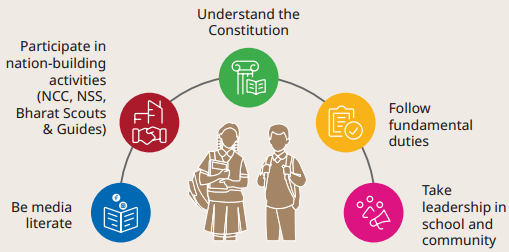
Figure. Youth and Democracy
Answer:
The figure shows that young citizens can participate in a democracy in several digital and non-digital ways. They can:
- Understand the Constitution and democratic values.
- Follow and perform their Fundamental Duties.
- Take leadership roles in school and community activities.
- Be media literate by identifying reliable information and avoiding misinformation.
- Participate in nation-building activities such as the NCC, NSS, Bharat Scouts and Guides.
These activities help young people become responsible, informed, and active citizens, thereby strengthening democracy.
Think About It
Question 1.
Why is it important that the ultimate source of power rests with the people in a democracy? (Page No. 140)
Answer:
It is important because the state derives its authority from the people. Citizens elect the government through free and fair elections, ensuring that the government represents the will of the people.
Question 2.
How does people’s participation through voting strengthen popular sovereignty? (Page No. 140)
Answer:
People’s participation through voting strengthens popular sovereignty because it allows citizens to directly choose their representatives. Through elections, people express their preferences and decide who will form the government. This ensures that the government reflects the will of the people and remains accountable to them. Regular and free elections also give citizens the power to change the government, which strengthens democracy and keeps power in the hands of the people.
Question 3.
What do you think would happen if the same organ of the government made laws, implemented them, and enforced them? Share your opinion with your classmates. (Page No. 142)
Answer:
If the same organ of the government made laws, implemented them, and enforced them, it would lead to a concentration of power in one institution. This could result in the misuse of authority, arbitrary decisions, and violation of citizens’ rights. The system of checks and balances would weaken, making it difficult to ensure fairness and justice. Therefore, the separation of powers among the Legislature, Executive, and Judiciary is essential to protect the Constitution, uphold the rule of law, and safeguard democratic values.
Question 4.
As we studied in earlier grades, the village serves as a unit of grassroots democracy in India, empowering rural communities to participate in decision-making processes. Many Indian leaders, such as Chaudhary Charan Singh and Babu Jagjivan Ram, who emerged from these rural backgrounds, advocated for the rights of the rural poor and other marginalised sections of society.
Explore and discuss the contributions o^eminent Indian leaders who worked towards strengthening grassroots democracy. (Page No. 154)
Answer:
Several Indian leaders have contributed to strengthening grassroots democracy by promoting rural development and encouraging people’s participation in governance. Mahatma Gandhi strongly supported the idea of Gram Swaraj, where villages are self-reliant, and people take decisions at the local level. Vinoba Bhave promoted the Bhoodan Movement, which encouraged voluntary land donation to support landless people and reduce inequality in rural areas. Jayaprakash Narayan supported decentralisation of power and stressed the importance of people’s participation in decision-making at the village level. These efforts collectively strengthened the idea that democracy becomes more effective when power is decentralised, and decision-making reaches the grassroots level. They helped make democracy more inclusive, participatory, and connected to the real needs of rural society.
Question 5.
Think: How do your actions as a student contribute to your school community and to democracy in a larger context?
Discuss: Talk to your classmates about a social or community issue that you care about. How can you, as a student, make a difference?
Act: Choose one activity to fulfil your civic responsibility this month. Reflect on how your actions contribute to strengthening democracy and community spirit. (Page No. 157)
Answer:
Do it yourself.
Democracy Class 9 Questions and Answers
Questions and Activities (Page No. 158-159)
Question 1.
Read the passage and answer the questions that follow:
A school cabinet was responsible for planning a Republic Day celebration, and members had different opinions on which activities to include. After a discussion, they decided to vote, and the activities supported by the majority were selected.
(a) Which democratic values are reflected in this situation?
(b) How does voting help resolve differences of opinion?
(c) Why is the majority decision important in a democracy?
(d) Mention responsibilities of elected representatives after a decision is made.
Answer:
(a) The situation reflects participation, discussion, majority decision-making, and equality.
(b) Voting allows people to express their choices, and the decision supported by the majority is accepted peacefully.
(c) It helps in taking decisions through discussion and voting, ensuring that the decision supported by the majority is accepted peacefully.
(d) Elected representatives should implement the decisions taken, work for the welfare of the people, and remain accountable to the citizens.
Question 2.
How would democracy be affected if citizens stopped following laws and civic responsibilities? Explain with an example.
Answer:
Democracy would weaken if citizens stopped following laws and civic responsibilities. Actions such as damaging public property, spreading misinformation, and violating public rules weaken democratic values. For example, spreading fake news on social media can create confusion and influence public opinion.
Question 3.
Which situation best reflects the idea of popular sovereignty and why?
(a) A law is passed without public discussion
(b) Citizens vote to choose their representatives
(c) A court gives a final judgment
(d) A minister takes an independent decision
Answer:
(b) Citizens vote to choose their representatives.
It reflects popular sovereignty because the state derives its authority from the people, who elect their representatives through free and fair elections.
Question 4.
The Rule of Law is violated when:
(a) Laws are applied equally to all
(b) Courts review government actions
(c) Powerful individuals are treated above the law
(d) Citizens challenge laws through legal means
Answer:
(c) Powerful individuals are treated above the law.
The Rule of Law ensures that no one is above the law and that everyone is treated equally before the law.
Question 5.
Why is the Rule of Law essential for protecting democracy?
Answer:
The Rule of Law ensures equality before the law and equal protection of the law. It establishes that no one is above the law, prevents the misuse of power, protects people’s rights, and promotes justice, accountability, and trust in the democratic system.
Question 6.
Is voting alone enough to make a country democratic? Support your answer with examples from the chapter.
Answer:
No. Democracy is not limited to elections. It also depends on the rule of law, Fundamental Rights, separation of powers, accountability, transparency, and active participation of citizens. The chapter also explains that democracy functions through local councils, public consultations, community- driven initiatives, civil society organisations, and Panchayati Raj Institutions.
Question 7.
Social media allows people to express opinions freely.
(a) How can this strengthen democracy?
(b) How can it weaken democracy if used irresponsibly?
Answer:
(a) Social media helps keep people informed about developments around the world, gives people a platform to express their opinions, raises issues concerning the public, and contributes to their resolution through appropriate mechanisms. It also promotes public participation in democratic processes.
(b) If used irresponsibly, social media can spread fake news and misinformation. Such misinformation can influence public opinion, create confusion, and sometimes even lead to conflict, thereby weakening democratic values.
Question 8.
Write a paragraph on what democracy means to you as a young citizen.
Answer:
As a young citizen, democracy means respecting the Constitution, understanding my rights and duties, and participating responsibly in society. I can strengthen democracy by being media literate, following my Fundamental Duties, participating in school and community activities, and contributing to nation-building. I should respect the rights of others, express my views responsibly, and avoid spreading misinformation. By acting honestly, fairly, and responsibly, I can help make democracy more inclusive, responsive, and effective.
Question 9.
Conduct a model parliament session or Gram Sabha in class on local issues—cleanliness, responsibilities towards public property, or school safety.
Answer:
In our class, a model Gram Sabha was conducted to understand how democratic decision-making takes place at the grassroots level. The teacher acted as the Sarpanch, and students participated as villagers in a Gram Sabha meeting.
The Sarpanch (Teacher): Today, we will discuss issues related to cleanliness, public property, and school safety. You may share your suggestions freely.
Riya: Sir, our classroom and corridor often have paper waste. We should keep dustbins in every corner of the school.
Arjun: We should also make a duty chart so that students take turns in keeping the classroom clean.
Simran: Sometimes benches and chairs are damaged. We should take responsibility and protect school property.
Rahul: During breaks, students run in corridors, which can cause accidents. We should follow safety rules.
The Sarpanch then encouraged everyone to vote on the suggestions. After voting, it was decided to implement a cleanliness duty chart, place dustbins in classrooms, and follow strict safety rules in corridors. This activity helped us understand how Gram Sabhas work through participation, discussion, and voting. It also taught us teamwork, responsibility, and respect for public property, which are important democratic values.
Question 10.
Choose any one democratic institution in India (such as Parliament, Election Commission, Judiciary, or Panchayat). Prepare a short note explaining:
(a) Its role in democracy
(b) How it ensures accountability and participation
Answer:
(a) The Judiciary upholds the Constitution and plays a vital role in protecting and promoting democratic values and the rights of all sections of society. It ensures that the laws enacted by Parliament and the State Legislative Assemblies are in accordance with the Constitution. As an impartial and independent institution, it safeguards citizens’ rights and upholds the spirit of the Constitution.
(b) The Judiciary reviews laws and constitutional ‘amendments’ to ensure that they are consistent with the spirit of the Constitution. If a law is inconsistent with the constitutional provisions, it has the power to declare it unconstitutional. Important initiatives such as Public Interest Litigation (PIL) have also been taken by the Judiciary to ensure access to justice for all.
Question 11.
What role does the Constitution play in strengthening democracy in India?
Answer:
The Constitution provides the framework for democratic governance in India. It guarantees and protects the Fundamental Rights of all citizens and ensures that no citizen is discriminated against based on religion, race, caste, sex, or place of birth. It establishes democratic institutions and processes that uphold liberty, equality, justice, and fraternity. It also provides for the separation of powers among the Legislature, Executive, and Judiciary and encourages active citizen participation through elections at the national, state, and local levels. The Constitution also provides for amendments under Article 368, ensuring that it remains flexible and responsive to changing socio-political needs without compromising its fundamental values.
Question 12.
What challenges do you think democracy in India faces today?
Answer:
Democracy in India faces several important challenges. One major challenge is inequality in society, which affects equal opportunities for all citizens. Another challenge is illiteracy and lack of awareness, which can prevent people from making informed decisions. The growing spread of fake news and misinformation on social media also influences public opinion in the wrong way. In some cases, corruption and weak implementation of laws reduce people’s trust in democratic institutions. Social divisions based on caste, gender, and region can also create barriers to unity and equal participation. These challenges need responsible citizens and strong institutions to ensure a healthy democracy.