Practice with Class 9 SST Extra Questions and Class 9 Social Science SST Chapter 6 Democracy Extra Questions and Answers to improve your exam performance.
Democracy Class 9 Extra Question Answer
Extra Questions of Democracy Class 9
Democracy Class 9 Very Short Question Answer
Question 1.
What is democracy?
Answer:
Democracy is a form of government in which the ultimate source of power lies with the people. It is based on the principles of liberty, equality, justice, and active participation of citizens in governance.
Question 2.
What is meant by Popular Sovereignty?
Answer:
Popular Sovereignty means that the state derives its authority from the people. Citizens exercise this authority by electing their representatives through free and fair elections.
Question 3.
State any two features of the Rule of Law.
Answer:
- Everyone is equal before the law and enjoys equal protection of the law.
- No person is above the law, and no one can be punished except according to the procedure established by law.
Question 4.
What is Universal Adult Franchise?
Answer:
Universal Adult Franchise gives every citizen who is 18 years of age or above the right to vote through a secret ballot, regardless of religion, race, caste, sex, or place of birth.
Question 5.
Why is the separation of powers important in a democracy?
Answer:
The separation of powers prevents the concentration of power in one institution. It creates a system of checks and balances among the Legislature, Executive, and Judiciary and helps protect democratic values.

Question 6.
Mention any two Fundamental Rights guaranteed by the Constitution.
Answer:
The two Fundamental Rights guaranteed by the Constitution are:
- Right to Equality
- Right to Freedom
Question 7.
What is the role of the Right to Information (RTI) Act, 2005?
Answer:
The Right to Information (RTI) Act, 2005 enables citizens to seek information from government agencies. It promotes transparency and accountability in the democratic system.
Question 8.
Why is the media called the ‘fourth pillar of democracy’?
Answer:
The media is regarded as the fourth pillar of democracy because it informs people about developments around the world, raises public issues, and contributes to their resolution through appropriate mechanisms.
Question 9.
What is meant by a multi-party system?
Answer:
A multi-party system is one in which several political parties contest elections and represent diverse social, regional, cultural, and ideological interests. The party or coalition with a majority forms the government, while the others function as the opposition.
Question 10.
Mention any two challenges faced by Indian democracy.
Answer:
The two challenges faced by Indian democracy are:
- Spread of fake news and misinformation.
- Illiteracy and inequality.
Democracy Class 9 Short Question Answer
Question 1.
Explain the democratic traditions that existed in ancient India.
Answer:
Democratic traditions in India date back to ancient times. Institutions such as the Sabha, Samiti, and Vidhata encouraged consultation and collective decision-making. The ganas and samghas also practised republican forms of governance. The Bauddha Samghas followed democratic methods such as discussion, voting, and the selection of leaders. These traditions laid the foundation for democratic values in India.
Question 2.
Explain the importance of Popular Sovereignty in a democracy.
Answer:
Popular Sovereignty means that the state derives its authority from the people. Citizens exercise this authority by electing their representatives and government through free and fair elections. This principle ensures that political power ultimately rests with the people and that the government remains accountable to them.
Question 3.
Describe the significance of the Rule of Law in a democratic country.
Answer:
The Rule of Law ensures that everyone is equal before the law and receives equal protection under the law. It prevents the misuse of power by ensuring that no person is above the law. It also guarantees that disputes are resolved fairly by the courts and helps protect the rights and freedoms of citizens, thereby strengthening democracy.
Question 4.
Explain the importance of the separation of powers in India.
Answer:
The Constitution divides the powers of government among the Legislature, Executive, and Judiciary. The Legislature makes laws, the Executive implements them, and the Judiciary interprets them. This separation prevents the concentration of power in one institution and maintains a system of checks and balances. It protects citizens’ rights, upholds the Constitution, and strengthens democratic governance by ensuring accountability and justice.
Question 5.
How does the Judiciary strengthen democracy in India?
Answer:
The Judiciary plays a vital role protecting and promoting democratic values. It ensures that the laws enacted by Parliament and the Stke Legislative Assemblies are in accordance with the Constitution. It safeguards the rights of citizens, upholds the spirit of the Constitution, and can declare unconstitutional laws invalid. Through initiatives such Public Interest Litigation (PIL), it also helps ensure access to justice for all. v
Question 6.
Explain the role of the media in’strengthening democracy.
Answer:
The media is regarded as the fourth pillar of democracy. It keeps people informed about developments around the world, raises issues concerning the public, and contributes to their resolution through appropriate mechanisms. By spreading awareness and encouraging informed public participation, the media strengthens transparency, accountability, and democratic values.
Question 7.
Differentiate between Direct Democracy and Representative Democracy.
Answer:
In Direct Democracy, citizens directly participate in decision-making on important public issues. Switzerland is an example of this system. In Representative Democracy, citizens elect representatives who govern on their behalf. India follows Representative Parliamentary. Democracy, where elected representatives make decisions and are accountable to the people through democratic institutions.
Question 8.
Explain how grassroots democracy strengthens democratic participation in India.
Answer:
Grassroots democracy enables citizens to participate directly in local governance through Gram Sabhas, Panchayati Raj Institutions, and Urban Local Bodies. It encourages people to take part in decision¬making, public consultations, and community-driven initiatives. These institutions make governance more responsive, inclusive, and accountable while empowering local communities to participate in the development of their villages and towns.
Question 9.
Describe the measures that promote accountability and transparency in a democracy.
Answer:
Accountability and transparency are strengthened through parliamentary procedures such as Question Hour and the auditing of government accounts. Institutions like the Comptroller and Auditor General (CAG), Central Information Commission (CIC), Lokpal, and Central Vigilance Commission (CVC) help ensure accountability. The Right to Information (RTI) Act, 2005 also enables citizens to seek information from government agencies, making governance more transparent.
Question 10.
Explain the major challenges faced by Indian democracy.
Answer:
Indian democracy faces challenges such as illiteracy, inequality, misinformation, and the spread of fake news through digital platforms. Such misinformation can influence public opinion, create confusion, and sometimes lead to conflict. Damaging public property, violating public rules, and remaining indifferent to public issues also weaken democratic values and affect the healthy functioning of democracy.
Democracy Class 9 Long Question Answer
Question 1.
Explain the historical development of democracy in India.
Answer:
Democracy in India has evolved over a long period. Ancient Indian institutions such as the Sabha, Samiti, and Vidhata encouraged consultation and collective decision-making. The ganas and samghas followed republican traditions, while the Bauddha Samghas practised discussion, voting, and the selection of leaders. During British rule, democratic participation was limited, but the freedom struggle revived democratic ideals. These traditions influenced the members of the Constituent Assembly while framing the Constitution of India. The Constitution established India as a democratic republic based on liberty, equality, justice, fraternity, and popular participation, reflecting both India’s democratic heritage and modern democratic principles.
Question 2.
Explain the essential features of democracy.
Answer:
Democracy is based on several essential features.
Popular Sovereignty means that the ultimate authority rests with the people. Universal Adult Franchise gives every citizen aged 18 years and above the right to vote. The Rule of Law ensures equality before the law and equal protection of the law. The separation of powers among the Legislature, Executive, and Judiciary prevents the concentration of power and maintains checks and balances. Democracy also guarantees Fundamental Rights, promotes accountability and transparency, supports a multi-party system, and safeguards the rights of vulnerable groups. These features ensure responsible governance and strengthen democratic values.
Question 3.
Describe the role of the Constitution in strengthening democracy in India.
Answer:
The Constitution of India provides the framework for democratic governance. It guarantees and protects the Fundamental Rights of all citizens and ensures that no citizen is discriminated against on the basis of religion, race, caste, sex, or place of birth. It establishes democratic institutions and provides for the separation of powers among the Legislature, Executive, and Judiciary. The Constitution upholds the ideals of liberty, equality, justice, and fraternity and encourages active participation through elections at the national, state, and local levels. It also provides for amendments under Article 368, enabling it to remain flexible and responsive to changing socio-political needsWhile preserving its fundamental values.
Question 4.
Explain the role of democratic institutions in strengthening democracy in India.
Answer:
Democratic institutions ensure that democracy functions effectively. Parliament and State Legislatures make laws and represent the people. The Executive implements laws and manages public administration. The Judiciary upholds the Constitution, protects the rights of citizens, and promotes justice. The Election Commission conducts free and fair elections. Institutions such as the Comptroller and Auditor General (CAG), Central Information Commission (CIC), Lokpal, and Central Vigilance Commission (CVC) promote transparency and accountability. Rural and Urban Local Bodies encourage people’s participation in governance, making democracy more inclusive, responsive, and accountable.
Question 5.
Explain how democracy extends beyond elections.
Answer:
Democracy extends beyond elections through the active participation of citizens in public life. Citizens participate in local councils, public consultations, and community-driven initiatives. Panchayati Raj Institutions, Urban Local Bodies, civil society organisations, cooperatives, and trade unions strengthen democratic participation. The media keeps people informed, raises public issues, and contributes to their resolution. The Right to Information Act, 2005 promotes transparency and accountability. Democracy also depends on responsible citizens who understand their rights and duties and actively contribute to nation-building.
Question 6.
Describe the role of women in strengthening democracy in India.
Answer:
Women play an important role in strengthening democracy. Indian women received voting rights when the Constitution came into force. The Constitution also provides reservation for women in Panchayats and Municipalities, encouraging their participation in local governance. Several States have increased this reservation to 50 per cent. Greater participation of women in decision-making institutions promotes equality, makes democratic institutions more inclusive and representative, and strengthens democratic governance at the grassroots level.
Question 7.
Discuss the challenges faced by Indian democracy and suggest how they can be addressed.
Answer:
Indian.democracy faces challenges such as illiteracy, inequality, misinformation, and the spread of fake news through social media and other digital platforms. Such misinformation can influence public opinion, create confusion, and sometimes even lead to conflict. Democracy is also weakened when citizens damage public property, spread misinformation, violate public rules, or remain indifferent to public issues. These challenges can be addressed by creating informed, responsible, and active citizens who understand their rights and duties, respect democratic values, follow the Rule of Law, and use media responsibly.
Democracy Class 9 Source Based Questions
Read the sources given below and answer the questions that follow:
Question 1.
Popular sovereignty means that the state derives its authority from the people. Citizens exercise this authority by electing their representatives and government through free and fair elections. Universal Adult Franchise gives every citizen who is 18 years of age or above the right to vote through a secret ballot, regardless of religion, race, caste, sex, or place of birth.
(i) What does the term ‘Popular Sovereignty’ mean?
Answer:
Popular Sovereignty means that the state derives its authority from the people.
(ii) Who is eligible to vote under Universal Adult Franchise?
Answer:
Every citizen who is 18 years of age or above is eligible to vote.
(iii) How do free and fair elections strengthen Popular Sovereignty?
Answer:
Free and fair elections enable citizens to elect their representatives and government. This ensures that political power rests with the people and that the government derives its authority from them.
Question 2.
The Rule of Law ensures equality before the law and equal protection of the law. It also establishes that no one is above the law. It further ensures that no citizen can be punished except according to the procedure established by law.
(i) What does the Rule of Law ensure?
Answer:
It ensures equality before the law and equal protection of the law.
(ii) According to the passage, who is above the law?
Answer:
No one is above the law.
(iii) Why is the Rule of Law important in a democracy?
Answer:
The Rule of Law ensures equality before the law and equal protection of the law. It establishes that no one is above the law and ensures that no citizen can be punished except according to the procedure established by law. This protects citizens rights and strengthens democracy.
Democracy Class 9 Picture Based Questions
Look at the pictures and answer the questions that follow.
Question 1.
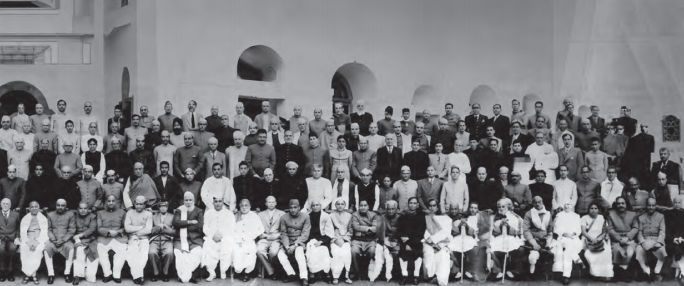
(i) Identify the picture.
Answer:
The picture shows the Constituent Assembly of India.
(ii) What was the main responsibility of this assembly?
Answer:
The Constituent Assembly was responsible for framing the Constitution of India.
(iii) Explain the role of this assembly in strengthening democracy in India.
Answer:
The Constituent Assembly drafted the Constitution of India, which provides the framework for democratic governance. It established democratic institutions, guaranteed Fundamental Rights, and upheld the ideals of liberty, equality, justice, and fraternity, thereby laying the foundation of Indian democracy.
Question 2.

(i) Identify the personality shown in the picture.
Answer:
The picture shows Dr. B.R. Ambedkar.
(ii) What role did he play in the making of the Constitution of India?
Answer:
Dr. B.R. Ambedkar was the Chairman of the Drafting Committee of the Constitution of India.
(iii) Explain his contribution to Indian democracy.
Answer:
As the Chairman of the Drafting Committee, Dr. B.R. Ambedkar played a key role in drafting the Constitution of India. The Constitution established the framework for democratic governance and guaranteed Fundamental Rights while upholding the ideals of liberty, equality, justice, and fraternity.
Class 9 Democracy Extra Questions for Practice
Multiple Choice Questions
Question 1.
Which democratic principle states that the\ultimate authority of the State rests with the people?
(a) Rule of Law
(b) Popular Sovereignty
(c) Separation of Powers
(d) Federalism
Question 2.
Which institution is recognised as the primary decision-making body in Scheduled Areas under the PESA Act?
(a) Gram Panchayat
(b) Municipal Council
(c) Gram Sabha
(d) Zila Parishad
Question 3.
Which of the following institutions promotes transparency by allowing citizens to obtain information from government agencies?
(a) Election Commission of India
(b) Right to Information (RTI) Act, 2005
(c) Parliament
(d) Supreme Court
Question 4.
Which democratic institution conducts free and fair elections in India?
(a) Judiciary
(b) Election Commission of India
(c) Legislature
(d) Central Vigilance Commission
Assertion & Reason Questions
Question 1.
Assertion (A): The separation of powers is an essential feature of democracy.
Reason (R): It prevents the concentration of power by dividing functions among the Legislature, Executive, and Judiciary.
(a) Both (A) and (R) are true and (R) is the correct explanation of (A).
(b) Both (A) and (R) are true but (R) is not the correct explanation of (A).
(c) (A) is true but (R) is false.
(d) (A) is false but (R) is true.
Fill in the blanks
1. Democracy is based on the principle that the ultimate source of power lies with the __________
2. The Constitution of India provides for amendments under Article __________
3. The __________ is regarded as the fourth pillar of democracy.
4. Every citizen who is __________ years of age or above has the right to vote under Universal Adult Franchise.
5. The __________ Act, 2005 promotes transparency by enabling citizens to seek information from government agencies.
Very Short Answer Type Questions
Question 1.
State any two functions of the Judiciary in a democracy.
Question 2.
Why is Universal Adult Franchise considered an important feature of democracy?
Question 3.
Mention any two ways in which the media strengthens democracy.
Question 4.
How do Gram Sabhas promote democratic participation at the grassroots level?
Short Answer Type Questions
Question 1.
Explain how the Rule of Law protects democratic values.
Question 2.
Describe the role of the Election Commission of India in strengthening democracy.
Question 3.
Explain how accountability and transparency are maintained in a democratic system.
Question 4.
Describe the importance of local self-government in strengthening democracy in India.
Long Answer Type Questions
Question 1.
Explain the role of the Constitution in strengthening democracy in India.
Question 2.
Discuss the essential features of democracy.
Question 3.
Explain how democratic institutions work together to strengthen democracy in India.
Question 4.
Discuss the challenges faced by Indian democracy and suggest measures to strengthen democratic values.