Get the simplified Class 7 Maths Extra Questions and Class 7 Maths Part 2 Chapter 6 Constructions and Tilings Extra Questions and Answers with complete explanation.
Class 7 Constructions and Tilings Extra Questions
Constructions and Tilings Extra Questions Class 7
Constructions and Tilings Class 7 Very Short Question Answer
Question 1.
What is a perpendicular bisector?
Solution :
A line that divides a segment into two equal parts at 90°
Question 2.
What type of triangle is formed when all sides are equal?
Solution :
Equilateral triangle.
Question 3.
What is tiling? Give one example of tiling in nature.
Solution :
Covering a surface using shapes without gaps or overlaps is called tiling.
Example: Front face of beehives.
Question 4.
Which regular polygon can tile a plane alone?
Solution :
Equilateral triangle, square, hexagon.

Question 5.
What is the locus of points equidistant from two end points of a segment?
Solution :
Perpendicular bisector.
Question 6.
What is the interior angle of a regular hexagon?
Solution :
120°
Question 7.
How many triangles are formed by joining centre to vertices of regular hexagen?
Solution :
6 triangles.
Question 8.
A point P lies on the perpendicular bisector of segment AB. If PA = 6 cm, find PB.
Solution :
PB = 6 cm.
Constructions and Tilings Class 7 Short Question Answer
Question 1.
Why is the perpendicular bisector method more accurate than using a scale to find the midpoint?
Solution :
Using a scale may lead to measurement errors due to thick markings, worn edges, or inaccurate reading.
The perpendicular bisector uses the property that all points equidistant from the endpoints lie on the bisector, ensuring an exact midpoint.
It relies on congruence and symmetry, not on numerical measurement.
Hence, the midpoint obtained by the perpendicular bisector method is precise and reliable.
Question 2.
Construct an angle of 70° using protractor. Then construct an angle congruent to this angle using compass and scale.
Solution :
Steps of Constructions :
1. Draw an angle 70° with protractor, i.e., ∠POQ = 70°
2. Draw a ray  using scale.
3. With O as centre and any convenient radius, draw an arc cutting the ray of ∠POQ at L and M.
4. With the same radius and A as centre, draw an arc cutting AB at X using compass.
5. Set the compass to length LM . With X as centre, draw an arc cutting the previous arc at Y.
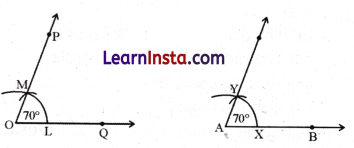
6. Join AY using scale. Thus, ∠YAX = 70° and ∠BAY is congruent to ∠POQ.
Question 3.
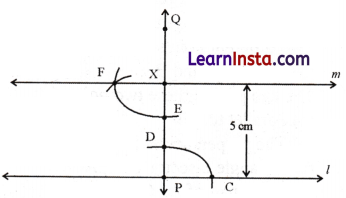
Draw a line PQuestion Construct a line parallel to it at a distance of 5 cm from it.
Solution :
Steps of Constructions :
1. Draw a straight line l using a ruler.
2. Choose any point P on l.
3. At point P , construct a perpendicular to line l using a ruler and compass.
4. On this perpendicular, mark a point X such that PX = 5 cm.
5. Through point X , construct a line perpendicular to PQ .
6. The line drawn through X is parallel to l and is at a distance of 5 cm from it.
Question 4.
Give two examples of tiling in daily life and explain why tiling is useful.
Solution :
(1) Floor tiles in homes and schools: Square or rectangular tiles cover the floor completely without gaps or overlaps.
(2) Brick walls: Bricks are arranged in a repeating pattern to cover the wall surface evenly.
Why tiling is useful :
(a) It covers a surface completely without gaps or overlaps.
(b) It makes surfaces strong, neat, and durable.
(c) It helps in efficient use of materials with minimal waste.
Question 5.
Your friend draws an angle but hides the measurement. Using only compass and ruler, copy that angle. How will you check if both angles are equal?
Solution :
Use the angle-copying construction with a ruler and compass to copy the given angle exactly.
After copying, place the copied angle over the original angle by tracing or rotating the paper; if both arms coincide, the angles are equal. Alternatively, check equality by verifying that the corresponding triangles formed during construction are congruent, which ensures both angles are equal without measuring.