Students often refer to NCERT Class 9 Advanced Maths Solutions Chapter 1 Sets Ex 1.3 to verify their answers.
Advanced Maths Class 9 Exercise 1.3 Solutions
Class 9 Advanced Maths Ex 1.3 Solutions
Question 1.
Find the union of sets A and B i.e. A ∪ B, in each of the following pairs.
(i) A = {1, 2, 3, 7}, B = {2, 7, 9}
(ii) A = {a, b, d, e} B = {a, e, i, o, u}
(iii) A = {x : x is natural number > 5} and
B = {x : x is natural number < 5}
(iv) A = Φ, B = {2, √2, -1, 0}
Solution:
The union of two sets A and B, denoted by A ∪ B, is the set containing all elements that belong to A, B, or both.
(i) Given, A = (1, 2, 3, 7}, B = (2, 7, 9}
The common elements are 2 and 7.
Therefore, A ∪ B = (1, 2, 3, 7, 9}
(ii) Given, A = {a, b, d, e}, B = {a, e, i, o,u}
The common elements are a and e.
Therefore, A ∪ B = {a, b, d, e, i, o, u}.
(iii) Given, A = (6, 7, 8, 9, …}, B = (1, 2, 3, 4}
Here, there are no common elements between A and B.
Therefore, A ∪ B = (1, 2, 3, 4, 6, 7, 8, 9, …}.
(iv) Given, A = Φ, B = (2, \(\sqrt{2}\), -1, 0}
Since A = Φ, the set A does not contain any element.
Therefore, A ∪ B = {2, \(\sqrt{2}\), -1,0}.
Question 2.
Evaluate each of the following.
(i) {1, 2} ∩ {1, 2, 5}
(ii) {1, 3, 5, 7, 9} ∩ { 2, 4, 6, 8}
(iii) { g, o, a, t} ∩ {c, a, t}
(iv) {x : x is an integer} ∩ {x : x is a negative integer}
Solution:
The intersection of two sets A and B, denoted by A ∩ B, is the set containing all elements common to both sets A and B.
(i) Let A = {1, 2}, B = {1, 2 ,5}
The common elements of set A and B are 1 and 2.
Therefore, A ∩ B = {1, 2}.
(ii) Let A = {1, 3, 5, 7, 9}, B = {2, 4, 6, 8}
There are no common elements in sets A and B.
Therefore, A ∩ B = Φ
(iii) Given, A = {g, 0, a, t}, B = {c, a, t}
The common elements of set A and B are a and t.
Therefore, A ∩ B = {a, t}.
(iv) Given A = {…, -3, -2, -1, 0,1, 2, 3, …},
B = {…,-3, -2,-1}
Every negative integer is an integer.
Hence, all elements of B belong to A.
Therefore, A ∩ B = {…, -3, -2, -1}.

Question 3.
Which of the following sets are disjoint?
(i) {x : x is a multiple of 2} and {x : x is a multiple of 3}
(ii) {e, π, √2, 0} and {e2, \(\frac{\pi}{2}\) √3, 1}
(iii) {x : x is a real number} and {x : x is an irrational number}
Solution:
Two sets are said to be disjoint, if they have no common element, i.e., A ∩ B = Φ
(i) Given A = {x : x is a multiple of 2} = {2, 4, 6, …} and B = {x : x is a multiple of 3} = {3, 6, 9,…}
The numbers 6, 12, 18,… are the multiples of both 2 and 3.
Sets A and B have common elements.
Therefore, these sets are not disjoint.
(ii) Given, A = {e, π, √2, 0} and B = {e2, \(\frac{\pi}{2}\) √3, 1}
Two sets have no common elements.
Hence, the sets are disjoint.
(iii) A = {x : x is a real number} and B = {x : x is an irrational number}
Every irrational number is a real number.
The set of irrational numbers is a subset of the real numbers.
Two sets have common elements.
Hence, the sets are not disjoint.
Question 4.
Find A – B in each of the following.
(i) A = {1, 3, 5, 8}, B = {3, 7, 8, 9}
(ii) A = {3, 0, 8}, B = {1, 3, 0, 8, 9}
(iii) A = {2, 6},B = {1, 3, 5, 9}
Solution:
The difference of two sets A and B, denoted by A – B, is the set of all elements belonging to A but not belonging to B.
(i) Given, A = {1, 3, 5, 8}, B = {3, 7, 8, 9}
The elements belonging to A but not to B are 1 and 5.
Therefore, A – B = {1, 5}.
(ii) Given, A = {3, 0, 8}, B = {1, 3, 0, 8, 9}
Now there is NO element belonging only to A.
Hence, A – B = Φ.
(iii) Given, A = {2, 6}, B = {1, 3, 5, 9}
No common elements.
Since there are no common elements between A and B. Hence, A – B = {2, 6}.
Question 5.
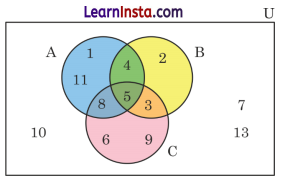
Use the Venn diagram given below to answer the questions that follow.
[Hint: You can find sets A, B, C and the universal set U from the given Venn diagram.]
(i) A’
(ii) B’
(iii) (A ∩ B)’
(iv) A’ ∪ B’
(v) A ∩ B ∩ C
(vi) A ∩ (B ∪ C)
Solution:
From the given Venn diagram,
U = {1, 2, 3, 4, 5, 6, 7, 8, 9, 10, 11, 13}
A = {1, 4, 5, 8, 11}
B = {2, 3, 4, 5}
C = {3, 5, 6, 8, 9}
(i) A’ = U-A
= {1, 2, 3, 4, 5, 6, 7, 8, 9, 10, 11, 13} – {1, 4, 5, 8,11}
= {2, 3, 6, 7, 9, 10, 13}
(ii) B’ = U – B
= {1, 2, 3, 4, 5, 6, 7, 8, 9, 10, 11, 13} – {2, 3, 4, 5}
= {1, 6, 7, 8, 9, 10, 11, 13}
(iii) A ∩ B = {4, 5}
(A ∩ B)’ = U – (A ∩ B)
= {1, 2, 3, 4, 5, 6, 7, 8, 9, 10, 11, 13} – {4, 5} = {1, 2, 3, 6, 7, 8, 9, 10, 11, 13}
(iv) A’ = {2, 3, 6, 7, 9, 10, 13}, B’ = {1, 6, 7, 8, 9, 10, 11, 13}
A’ ∪ B’ ={1, 2, 3, 6, 7, 8, 9, 10, 11, 13}
(v) The element common to all three sets is 5.
Hence, A ∩ B ∩ C = {5}
(vi) First, B ∪ C = {2, 3, 4, 5, 6, 8, 9}
Hence, A ∩ (B ∪ C) = {4, 5, 8}
Question 6.
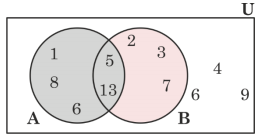
Verify A – B = A ∩ B’ using the Venn diagram given below:
Solution:
From the given Venn diagram,
U = {1, 2, 3, 4, 5, 6, 7, 8, 9, 13}
A = {1, 5, 6, 8, 13}
B = {2, 3, 5, 7, 13}
The common elements of A and B are 5 and 13.
Removing these from A, we get A – B = {1, 6, 8}
Now,
B’ = U – B = {1, 4, 6, 8, 9}
Therefore, A ∩ B’ = {1, 6, 8}
Since A – B = {1, 6, 8} and A ∩ B’ = {1, 6, 8}
Therefore, A – B = A ∩ B’ Hence verified.
Question 7.
For a competitive exam, 85% of students opted for a Mock Test in Mathematics and 75% opted for a Mock Test in Science.
(a) What is the minimum possible percentage of students who opted for both tests?
(b) If 10% opted for neither, how does the minimum percentage for both change?
Solution:
Let the total number of students be 100%.
Let M = students who opted for Mathematics and
S = students who opted for Science
Given, n(M) = 85% and n(S) = 75%
Using the formula,
n(M ∩ S) = n(M) + n(S) – n(M u S)
(a) Since the total percentage cannot exceed 100%, then
n(M ∪ S) = 100%.
Therefore, n(M ∩ S) = 85% + 75% – 100%
= 160% – 100%
= 60%
Hence, the minimum possible percentage of students who opted for both tests, is 60%.
(b) If 10% opted for neither test, then
n(M ∪ S) = 100% – 10% = 90%
Now, n(M ∩ S) = 85% + 75% – 90%
= 160% – 90%
= 70%
Hence, the minimum possible percentage of students who opted for both tests becomes 70%.
Question 8.
Let S be a set of 50 people. 35 people speak English and 25 speak Hindi. If k be the number of people who speak only English, then find the possible value of k, assuming every person speaks at least one of the two languages.
Solution:
Let E = set of people who speak English
and H = set of people who speak Hindi
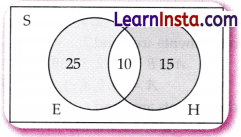
Given, n(S) = 50, n(E) = 35, n(H) = 25
Also, every person speaks at least one language.
Therefore, n(E ∪ H) = 50 and we know that
n(E ∪ H) = n(E) + n(H) – n(E ∩ H)
50 = 35 + 25 – n(E ∩ H)
50 = 60 – n(E ∩ H)
n(E ∩ H) = 10
Thus, 10 people speak both English and Hindi.
Now, k represents the number of people who speak only English.
Therefore, k = n(E) – n(E ∩ H)
= 35 – 10 = 25
Hence, the possible value of k is 25.
Question 9.
An organisation awarded certificates to its 56 students for at least one of the three activities of Origami, Instrumental music and Fine arts. If 17 students received the certificates for Origami, 28 for Instrumental music, 25 for Fine arts and only 4 students got the certificates for all the three activities. Find the number of students who received the certificates for exactly two activities.
Solution:
Let O = set of students receiving certificates in Ori-gami, I = set of students receiving certificates in Instru-mental music and F = set of students receiving certificates in Fine arts
Given, n(0 ∪ I ∪ F) =56, n(O) = 17, n(I) = 28, n(F) = 25 and n(0 ∩ l ∩ f) = 4
Let the number of students receiving certificates for exactly two activities be x.
Also, let the number of students receiving certificates for exactly one activity be y.
Now, n(0) + n(l) + n(F) = 70
In this total, students participating in exactly one activity are counted once, students participating in exactly two activities are counted twice, students participating in all three activities are counted three times.
Therefore, y + 2x + 3(4) = 70
y + 2x + 12 = 70
y + 2x = 58 …(i)
Again, the total number of students is 56.
Then, y + x + 4 = 56
y + x = 52 …(h)
Subtracting eq (ii) from (i),
(y + 2x) – (y + x) = 58 – 52
x = 6
Hence, the number of students who received certificates for exactly two activities is 6.
Question 10.
A survey of a group of 100 students in an international school revealed that 60 students could speak English, 50 students could speak German and 35 students could speak Spanish. Further 40 students could speak both English and German, 30 could speak both German and Spanish, 25 could speak both English and Spanish and 25 could speak all three languages. Let E represent the set of students who speak English, G represents the set of students who speak German and S represent the set of students who speak Spanish. Answer the following using a Venn diagram.
(a) How many students could speak at least two languages?
(b) How many students could speak at most one language?
(c) How many students could not speak any of the three languages?
Solution:
Let, E represent the set of students who speak English, G represents the set of students who speak German
S represent the set of students who speak Spanish
Given, n(U) = 100
n{E) = 60, n(G) = 50, n(S) = 35
n(E ∩ G) = 40, n(G ∩ S) = 30, n(E ∩ S) = 25
and n(E ∩ G ∩ S) = 25
Using Venn diagram, we get:
n(only in E ∩ G) = n(E ∩ G) – n(E ∩ G ∩ S) = 40 – 25 = 15
n(only in G ∩ S) = n(G ∩ S) – n(E ∩ G ∩ S) = 30 – 25 = 5
n(only in E ∩ S) = n(E ∩ S) – n(E ∩ G ∩ S) = 25 – 25 = 0
Now, n(only E) = 60 – (15 + 0 + 25) = 20
n(only G) = 50 – (15 + 5 + 25) = 5
n(only S) = 35 – (0 + 5 + 25) = 5
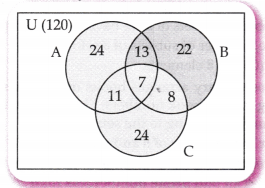
The total number of students who speak at least one language = 20 + 5 + 5 + 15 + 5 + 0 + 25 = 75
Therefore, the number of students who do not speak any of the three languages = 100 – 75 = 25
(a) Students who speak at least two languages are those who speak exactly two languages, together with those who speak all three languages.
= 15 + 5 + 0 + 25 = 45
(b) “At most one language” means students who speak either exactly one language or no language.
Students speaking exactly one language = 20 + 5 + 5 = 30
Students speaking no language = 25
Therefore, 30 + 25 = 55
(c) The number of students who do not speak any of the three languages = 100 – 75 = 25