Students revise important topics using Class 8 Social Science Extra Questions and Class 8 SST Part 2 Chapter 5 Citizenship Rights and Duties Extra Question Answer before exams.
Citizenship Rights and Duties Class 8 Extra Question Answer
Extra Questions of Citizenship Rights and Duties Class 8
Citizenship Rights and Duties Class 8 Very Short Question Answer
Question 1.
Who is a citizen?
Answer:
A citizen is a person who legally belongs to a country and is a recognised member of its political community.
Question 2.
Name one political right of a citizen.
Answer:
A citizen has political rights such as voting.
Question 3.
Which Article guarantees equality before the law?
Answer:
Article 14 guarantees equality before the law for all persons.
Question 4.
What is meant by Inclusion?
Answer:
Inclusion means creating an environment where everyone feels welcomed, respected, and valued.

Question 5.
Name one form of visible discrimination.
Answer:
One form of visible discrimination includes bullying and name-calling.
Question 6.
What does equity aim to achieve?
Answer:
Equity aims to give extra support to those who need it more so that everyone gets a fair chance to succeed.
Question 7.
Which article bans child labour in hazardous work?
Answer:
Articles 23 and 24 ban human trafficking, forced labour, and child labour.
Question 8.
What is Childline 1098 meant for?
Answer:
Childline 1098 is a national helpline for children in distress that helps rescue children from unsafe, abusive, and exploitative situations.
Citizenship Rights and Duties Class 8 Short Question Answer
Question 1.
What kind of information about rights and duties is found in the Indian Constitution?
Answer:
The Indian Constitution provides the following information about rights and duties
- The indian Constitution provides detailed information about the rights and duties of citizens.
- It guarantees Fundamental Rights that protect people from injustice and unequal treatment.
- The Constitution also lists Fundamental Duties that guide citizens to act responsibly.
- These duties include respecting the Constitution, the national flag and anthem, and the ideals of the freedom struggle.
Question 2.
What is discrimination, and mention its two common forms?
Answer:
Discrimination means treating people unfairly because of their identity or background. It denies individuals equal rights, opportunities, and respect in society.
Two forms of discrimination are as follows
- One common form is caste-based discrimination, where people face unequal 1reament due to their caste. This form of discrimination has historically led to social exclusion and limited access to education and public spaces.
- Another common form is gender-based discrimination, where people are treated unequally because they are male or female. Gender discrimination often affects access to education, health care, and employment.
Question 3.
How do Fundamental Rights create a ‘rhythm’ in democratic life in India?
Answer:
Fundamental Rights create a ‘rhythm’ in democratic life in the following ways
- The Right to Equality ensures that everyone is treated equally before the law and is protected from discrimination.
- The Right to Freedom allows citizens to express their views freely and participate in democratic life.
- The Right against Exploitation protects people from forced labour, child labour, and other forms of exploitation.
- The Right to Freedom of Religion gives every person the freedom to practise and follow the religion of their choice.
- Cultural and Educational Rights protect the language, culture, and educational interests of different communities.
- The Right to Constitutional Remedies enables citizens to seek justice if their Fundamental Rights are violated.
- Together, these rights promote freedom, equality, justice, and harmony, helping democracy function smoothly.
Question 4.
Describe the major categories of Fundamental Rights in India.
Answer:
Fundamental Rights in India are divided into major categories to protect different freedoms, such as
- The Right to Equality ensures equal treatment before law and bans discrimination.
- The Right to Freedom includes freedoms of speech, movement, and profession.
- The Right against Exploitation prohibits trafficking, forced labour, and child labour.
- The Right to Freedom of Religion guarantees freedom of conscience and religious practice.
- Cultural and Educational Rights protect the interests of minorities.
- The Right to Constitutional Remedies allows citizens to approach courts when rights are violated.
Question 5.
Explain the problems associated with discrimination in society.
Answer:
The problems associated with discrimination in society are as follows
- Discrimination creates inequality by denying equal opportunities to certain groups.
- It leads to social exclusion in education, employment, and public life.
- Discrimination harms the dignity and self-confidence of individuals.
- It creates divisions and tensions among communities.
- People facing discrimination often lack access to basic services like healthcare and housing.
Question 6.
How do inclusion practices help address inequality in schools and society?
Answer:
Inclusion practices help address inequality in schools and society in the following ways
- Inclusion practices ensure equal opportunities for all, regardless of background or ability.
- In schools, inclusion allows students from diverse backgrounds to learn together.
- It supports children with disabilities through suitable facilities and teaching methods.
- Inclusion reduces exclusion and builds confidence among disadvantaged students.
Citizenship Rights and Duties Class 8 Long Question Answer
Question 1.
Highlight the important role and significance of citizenship in India.
Answer:
The important role and significance of citizenship in India are as follows
- Citizenship in India provides individuals with a legal identity and full membership of the nation.
- It ensures equality before law and protection of individual rights regardless of caste1 religion, gender, or language.
- Citizenship allows people to participate in democratic processes such as voting, standing for elections, and expressing opinions.
- It promotes a sense of belonging and national unity in a diverse society with many cultures and communities.
- Citizenship guarantees access to Fundamental Rights that protect dignity1 liberty, and equality.
- Citizenship encourages responsibility towards the nation through respect for laws and democratic values.
- It strengthens democracy by ensuring that governance is based on the consent and participation of the people.
- Citizenship also protects individuals from discrimination and arbitrary treatment by the state.
Question 2.
Fundamental Rights are a key factor influencing democratic life in India. Explain this statement. (Competency Based Question)
Answer:
Fundamental Rights are a key factor influencing democratic life in India due to the following reasons
- Fundamental Rights form the foundation of democratic life by guaranteeing basic freedoms.
- They protect individual freedoms such as speech, expression1 and association.
- They ensure equality before the law and prohibit discrimination.
- They allow people to criticise policies and participate freely in public debate.
- They protect minority groups and vulnerable communities from injustice.
- They strengthen democracy by encouraging active participation of citizens.
- They provide legal remedies when rights are violated.
- These rights help in building a just and democratic society based on dignity and freedom.
Question 3.
Describe the Right to Equality and the Right to Freedom. How do they help in ensuring dignity and liberty for citizens? (Competency Based Question)
Answer:
The Right to Equality and the Right to Freedom are two important fundamental rights in India that help in protecting the dignity and liberty of citizens. The Right to Equality ensures that every citizen is treated equally before the law and that no one is discriminated against on the basis of religion, caste, gender, or place of birth. It also guarantees equal opportunities in education, jobs, and participation in public life, so that everyone has a fair chance to progress in society.
The Right to Freedom provides Citizens with the freedom of speech and expression, the right to assemble peacefully, and the freedom to move and live anywhere in the country. It allows people to share their opinions without fear and to choose their profession or place of residence freely. Together, these rights form the foundation of a democratic society where citizens can live freely, express themselves, and enjoy respect and equality.
Question 4.
Why are Inclusion and equality important for democracy?
Answer:
Democracy is based on the principle that all people are equal and have the right to participate in society. Inclusion and equality are essential for a strong democracy because of the following reasons
- Discrimination, which treats people unfairly due to caste, religion, gender, disability, language, appearance, or economic background, prevents people from enjoying their rights and weakens democracy.
- Inclusion ensures that everyone feels welcomed, respected, and valued, and that all citizens, especially those who have faced discrimination in the past, get equal opportunities in education, employment, and social life.
- When everyone is included, different voices and experiences are heard, which strengthens decision-making and ensures that citizens feel they belong to the society. This builds trust, unity, and cooperation among people, which are essential for a healthy democratic system.
- Leaders like Savitribai Phule and Anandibai Joshi fought against discrimination and worked to provide equal opportunities, particularly in education, showing that inclusion and equality strengthen democracy and help create a fair and just society for all.
Question 5.
Explain any five Fundamental Duties with suitable examples.
Answer:
Five Fundamental Duties with suitable examples are as follows
- Abide by the Constitution and Respect National Symbols Citizens must follow the Constitution and show respect for the National Flag and National Anthem.
- Example Standing up during the National Anthem in schools, offices, or public events, and following laws that ensure equality and justice.
- Promote Harmony and Brotherhood Citizens should foster unity, respect diversity, and treat everyone with dignity.
- Example Supporting classmates from different religions or communities, and standing against bullying or discrimination of women.
- Protect and Improve the Natural Environment: It is every citizen’s duty to care for the environment and show compassion towards animals.
- Example Planting trees, reducing plastic use, saving water, and preventing cruelty to animals.
- Safeguard Public Property and Maintain Peace Citizens should not damage public property and must resolve conflicts peacefully.
- Example Not scratching walls, vandalising buses or school property, and reporting or stopping acts of vandalism.
- Develop Scientific Temper and Spirit of Inquiry Citizens should think logically, question beliefs, and rely on reason.
- Example Using experiments to learn science, questioning superstitions, and making decisions based on facts rather than myths.
Question 6.
How are rights and duties related to each other? Explain with examples.
Answer:
Rights and duties are closely connected and support each other. Rights give people freedom, dignity, and equality, while duties guide people to use these freedoms responsibly. If people enjoy their rights but ignore their duties, society becomes unfair and disorderly.
For example, people have the right to freedom of speech, but they also have the duty not to spread hatred or harm
others with their words. Students have the right to education, and parents and guardians have the duty to ensure that children attend school regularly. Citizens have the right to use public places, but they also have the duty to keep them clean and not damage public property.
Rights are protected by law and can be enforced in courts, while duties are moral and social responsibilities. When citizens perform their duties sincerely, they help protect the rights of others and maintain peace and harmony in society. Therefore, a healthy democracy needs both rights and duties to function properly.
Citizenship Rights and Duties Class 8 Case Based Questions
Question 1.
Read the passage given below and answer the following questions.
Inclusion means creating an environment where everyone feels welcomed, respected, valued, and included, with equal access to opportunities. This is especially important for groups that have historically been excluded because of their social or economic background. Inclusion goes beyond just giving reservations; it means making sure everyone feels accepted and supported. In our Constitution, fundamental rights and duties together support inclusion.
(i) Define Inclusion In your own words.
Answer:
Inclusion means making sure all people are treated fairly and given equal chances to participate in society.
(ii) Name one reason why some groups may need special support to feel included.
Answer:
Some groups may face barriers due to poverty, discrimination, or long-standing social exclusion, which makes equal participation difficult.
(iii) State one way students can promote Inclusion In their classroom.
Answer:
Students can promote inclusion by treating everyone with respect, not excluding anyone from activities, and supporting classmates who need help.
Citizenship Rights and Duties Class 8 Picture Based Questions
Question 1.
Answer the questions based on the picture given below.
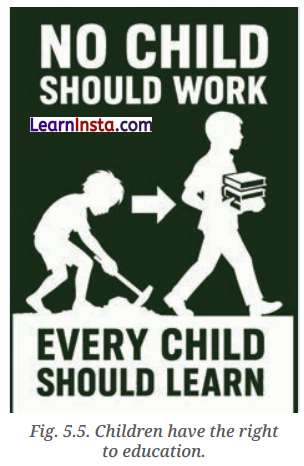
(i) What message is conveyed through the picture?
Answer:
The picture conveys that children should not be made to work and should be given the opportunity to go to school and learn.
(ii) Which child right is being highlighted through the Image?
Answer:
The image highlights the child’s right to education and protection from child labour.
(iii) How can following this message help in building a better society?
Answer:
Ensuring children learn instead of work helps create an educated, skilled population and supports social development and equality.
Class 8 Citizenship Rights and Duties Extra Questions for Practice
Objective Type Questions
Question 1.
Which Fundamental Right protects people from bonded labour and human trafficking?
(a) Right to Equality
(b) Right to Freedom
(c) Right against Exploitation
(d) Right to Freedom of Religion
Question 2.
Which Article of the Constitution guarantees free and compulsory education for children aged 6-14 years?
(a) Article 19
(b) Article 21
(c) Article 21A
(d) Article 32
Question 3.
Which of the following best explains the Idea of equity?
(a) Treating everyone exactly the same
(b) Giving extra support to those who need it more
(c) Providing help only to the rich
(d) Ignoring past disadvantages
Question 4.
Which Fundamental Duty asks citizens to protect public property?
(a) To promote harmony
(b) To preserve culture and heritage
(c) To safeguard public property and avoid violence
(d) To strive for excellence
Question 5.
Which of the following is an example of invisible discrimination?
(a) Beating someone
(b) Name-calling
(c) Excluding someone from group work
(d) Destroying public property
Subjective Type Questions
Question 1.
Name anyone Fundamental Right.
Question 2.
Which Article abolishes untouchability?
Question 3.
What is meant by discrimination?
Question 4.
Why is the Right to Constitutional Remedies called the heart and soul” of the Constitution?
Question 5.
Why is equity important for achieving real equality in society?
Question 6.
Mention any two Fundamental Duties and explain their importance.
Question 7.
Explain the Right to Equality and the idea of equity. How do both help in creating a fair society?
Question 8.
Describe the Right against Exploitation. Why are children given special protection under this right?
Question 9.
Explain the importance of Fundamental Duties in strengthening democracy and social harmony.