Students can use NCERT Class 9 Advanced Science Solutions Chapter 7 Chemical Bonding Question Answer to understand complex concepts with ease.
Chemical Bonding Class 9 Questions and Answers
Chemical Bonding Question Answer Class 9
Quick Check
Question 1.
What is meant by the octet rule?
Answer:
The octet rule is a principle that states that main- group elements tend to bond in ways to complete an octet (8 electrons) in their valence shell, so that they can attain the same stable electron configuration as a noble gas. To achieve this stable configuration, atoms either gain, lose or share electrons. This rule explains the ionic and covalent bonding between atoms to form molecules.
Question 2.
Why does hydrogen not follow the octet rule?
Answer:
Hydrogen has a single electron residing in its Is orbital (H is the first member of the periodic table). An ‘s’ orbital can hold a maximum of 2 electrons.
Hence, hydrogen requires only two electrons (a duet) to fill its valence shell and achieve stability, resembling the noble gas helium.

Question 3.
Give one example each of a molecule with
(a) incomplete octet
(b) expanded octet
(c) an odd electron
Answer:
(a) Incomplete Octet-BF3, BeCl2, AlCl3
(b) Expanded octet- SF6, PCl5, XeF2, XeF6
(c) An odd electron- NO, NO2
Question 4.
Why can boron form compounds with only six electrons around it?
Answer:
Boron (atomic no. 5) has an electronic configuration of 1s2 2s2 2p1. It has 3 electrons in its valence shell. It uses these to form three covalent bonds, resulting in (3 × 2 = 6) electrons in its outermost shell. This is Boron’s bonding capacity. It lacks enough electrons to form a standard four-bond octet as required by the Octet rule, making it ’electron-deficient1 (e.g., BF3 and BH3) and an exception to the rule.
Question 5.
What is meant by a duplet configuration?
Answer:
A duplet configuration is a stable electron arrangement where an atom has exactly two electrons in its first and only shell, i.e., K shell. This configuration resembles the stable noble gas Helium (1s2) and is predominantly found in light elements like hydrogen, lithium and beryllium. Stability is achieved with two electrons rather than an octet; hence, it is called a duplet configuration.
Question 6.
Why is NO considered an exception to the octet rule?
Answer:
Nitric oxide (NO), is considered an exception to the octet rule because it is an odd-electron molecule.
The octet rule states that atoms are most stable when they have eight electrons in their valence shell (i.e., four pairs). However, the NO molecule has a total of 11 valence electrons, with nitrogen contributing 5 and oxygen 6, making it impossible for both atoms to achieve a stable octet. As 11 is an odd number, one electron must remain unpaired.
Question 7.
Draw the Lewis dot structure of BF3 and explain why boron does not complete its octet.
Answer:

The central Boron atom (At. no. 5) has only 3 valence electrons, so it can form only three bonds, which leaves it with an incomplete octet. However, the 3 fluorine atoms each have 3 lone pairs achieves full octet by sharing one e– with boron. Thus, BF3 becomes an exception to the octet rule.
Question 8.
Assertion: SF6 violates the octet rule.
Reason: Sulphur can accommodate more than eight electrons.
(A) Assertion and reason, both are correct, and reason is the correct explanation of the assertion.
(B) Assertion and reason, both are correct, but reason is not the correct explanation of the assertion.
(C) Assertion is correct, but reason is a wrong statement.
(D) Assertion is wrong, but the reason is a correct statement.
Answer:
Option (A) is correct.
Explanation: SF6 (sulphur hexafluoride) violates the octet rule because the central sulphur atom is surrounded by 12 valence electrons rather than the expected eight. As Sulphur (At. no. 16) has an electronic configuration of [Ne]3s2 3p4, it can form 6 covalent bonds.
Sulphur accommodates this expanded octet because it has empty 3d orbitals, which allows it to form six covalent bonds.
Check Your Understanding
Question 1.
What is meant by the term ’electron sea’ in metals?
Answer:
The term ’electron sea’ in metals refers to the common pool of delocalised electrons in metallic bonding. These electrons are basically the valence electrons of the metal atoms, which are released when metal ions position themselves in a lattice in the metal. These electrons surround the positively charged metal cations and are shared by all atoms. As they are free moving, they are called a sea.
Question 2.
What type of particles are in a fixed position in a metal according to the Electron sea model?
Answer:
Fixed position in metal is occupied by the positively charged metal cations.
Question 3.
Define metallic bonding.
Answer:
Metallic bonding is defined as an electrostatic attraction between positively charged metal cations and a collective sea of valence electrons shared across all atoms, which is freely mobile across the metal.
Question 4.
Why are metallic bonds called non-directional?
Answer:
As in metallic bonds, valence electrons are collectively shared by the metal ions, and they surround positive ions uniformly, without being attached to any specific atom or axis; the bonds are non-directional.
Question 5.
Name two properties of metals explained by the electron sea model.
Answer:
- Electrical conductivity
- Malleability
- Ductility
- High melting point
- Thermal conductivity (Any two)
Question 6.
Explain how the electron sea model accounts for electrical conductivity in metals.
Answer:
Metal atoms share their valence electrons, which are not tied to any single atom but are free to move throughout the entire metallic structure, forming a sea of electrons. When an electric potential is applied across a metal, the negatively charged electrons flow freely towards the positive terminal, thus creating a current. This mobility with hardly any resistance accounts for electrical conductivity in metals.
Question 7.
How does the electron sea model explains thermal conductivity in metals?
Answer:
When one end of the metal is heated, the freely moving, collective pool of electrons (sea) gains kinetic energy and starts vibrating and also starts moving. They quickly transfer this energy to the other electrons, making them effective heat energy carriers.
Question 8.
Why can metals be beaten into thin sheets? Explain using the Electron sea model.
Answer:
In metals, the positive ions of metal are surrounded by a sea of electrons, which keeps moving around them. While being beaten into sheets or hammered, when one layer of metal ions is forced across another, the sea of electrons adjusts positions rapidly, and the deformed crystal lattice is restored. The lattice, however, never breaks. This allows metals to be ductile and malleable.
Question 9.
What is meant by ductility? How is it explained by the electron sea model?
Answer:
Ductility is the ability of metals to be drawn into wires. In metals, the positive ions of metal are surrounded by a sea of electrons, which keeps moving around them. While being beaten into sheets or drawn into wires, when one layer of metal ions is forced across another, the sea of electrons adjusts positions rapidly, and the deformed crystal lattice is restored. The lattice, however, never breaks. This allows metals to be ductile and malleable.
Question 10.
How is metallic bonding different from covalent bonding?
Answer:
| Metallic Bond | Covalent Bond |
| (i) A sea of electrons shared among metal cations constitutes a metallic bond. | (i) An electron pair is shared between specific non-metal atoms. |
| (ii) Non-directional bonds | (ii) Highly directional bonds |
| (iii) Responsible for ductility, malleability and conducting properties | (iii) Responsible for poor conductivity, brittle structures |
Question 11.
Explain the structure o1a metal according to the electron sea model.
Answer:
Metals have a fixed lattice of positively charged metal cations arranged in an orderly manner. These cations are surrounded by a large number of mobile, collective valence electrons referred to as ’sea of electrons’. These delocalised electrons are not bound to any specific atom but are shared throughout the entire metallic structure, lending unique properties to metal structures like malleability, ductility, high conductance, high melting point, etc.
Question 12.
If electrons in a metal were not free to move, which property would be most affected? Explain.
Answer:
Electrical conductivity. The free-moving negatively charged electrons create a flow of current towards a positive terminal when an external electrical field is applied to metals.
Question 13.
Explain why metals do not break when hammered, but instead change shape.
Answer:
In metals, the positive ions of metal are surrounded by a sea of electrons, which keeps moving around them. While being beaten into sheets or hammered, when one layer of metal ions is forced across another, the sea of electrons adjusts positions rapidly, and the deformed crystal lattice is restored. The lattice, however, never breaks. This allows metals to be ductile and malleable.
Question 14.
Copper is used for electrical wiring, while rubber is not. Explain using the electron sea model.
Answer:
Copper, being a metal, can be drawn into wires. Copper has metallic bonds, which contain a lot of free- moving electrons (delocalised), which carry electrical current. In contrast, rubber has covalent bonds, which are rigid and cannot be drawn into wires. Also, it does not have free electrons and acts as an insulator.
Question 15.
Why are metals generally good conductors of heat as compared to nonmetals?
Answer:
Metals have a mobile pool of electrons freely shared across the metal lattice. As one end of the metal is heated, the energy is quickly transferred across the metal through the electrons. Whereas, in non-metals, the electrons are held tightly in bonds and are not available.
Directions: In the following questions, a statement of Assertion (A) is followed by a statement of Reason (R). Mark the correct choice as:
(A) Both Assertion (A) and Reason (R) are true, and Reason (R) is the correct explanation of Assertion (A),
(B) Both Assertion (A) and Reason (R) are true, but Reason (R) is not th.e correct explanation of Assertion (A).
(C) Assertion (A) is true, but Reason (R) is false.
(D) Assertion (A) is false, but Reason (R) is true.
Question 16.
Assertion (A): Metals are good conductors of electricity.
Reason (R): Metals contain free electrons that can move under an electric field.
Answer:
Option (A) is correct.
Explanation: Metals are good conductors of electricity as they contain free electrons that can move under an electric field.
Question 17.
Assertion (A): Metallic bonds are non-directional.
Reason (R): Electrons in metals are localised between two atoms.
Answer:
Option (C) is correct.
Explanation: Metallic bonds are non-directional as electrons in metals are delocalised and are shared across the metal.
Question 18.
Assertion (A): Metals are malleable.
Reason (R): Layers of metal ions can slide while electrons continue to hold them together.
Answer:
Option (A) is correct.
Explanation: Metals are malleable as layers of metal ions can slide while electrons continue to hold them together.
Chemical Bonding Class 9 Extra Questions and Answers
Short Answer Type Questions
Question 1.
Identify the bonding and lone pairs in a water molecule and draw its Lewis structure.
Answer:
Lewis Structure of H2O molecule:

Two bonding pairs of electrons which are shared between O and H.
Two lone pairs of electrons on the oxygen atom.
Question 2.
Identify the number and types of bonds in ammonium (NH4+) ion?
Answer:
NH4+ (ammonium ion) contains three covalent bonds and one coordinate bond.
Three N-H covalent bonds formed by sharing of electrons.
The fourth bond is a coordinate bond where nitrogen donates a lone pair of electrons to H+.
Question 3.
Why do main group elements try to achieve an octet?
Answer:
The main group elements try to achieve an octet so that they can achieve stability like the closest noble gas.
Question 4.
The combination of atoms to form molecules is based on octet rule. Give two limitations of this rule.
Answer:
- Incomplete octet (less than 8 electrons): Octet rule cannot explain the formation of molecules like BeF2, and BF3 in which the central atom has less than 8 electrons in its valence shell.
- Expanded octet (more than 8 electrons): It cannot explain the formation of molecules such as PF5, SF6, etc., in which the central atom has more than eight electrons in its valence shell.
Question 5.
Given below are pairs of atoms. Identify the type of bond between each pair.
(a) P and Cl
(b) O and S
(c) Ca and O
(d) Be and F
Answer:
(a) Polar Covalent bond between P and Cl as both are non- metals and share the electron pairs.
(b) Polar Covalent bond between O and S as both are non- metals and share the electron pairs.
(c) Ionic bond between Ca and O as metal calcium transfers electrons to the non-metal oxygen.
(d) Covalent bond between Beryllium (Be) and Fluorine (F) as in compounds like BeF2, where the metal Be shares electrons with non-metal F.
Question 6.
Write the formula of compound and identify nature of the bond formed between element ‘X’ atomic number 20 and element ‘Y’ atomic number 8? Draw the Lewis dot structure.
Answer:
X – 2, 8, 8, 2 (Ca)
Y – 2, 6 (O)
Hence, atom X would like to lose 2 valence electrons (metal) and atom Y would try to gain 2 electrons (non metal) in order to complete their octet.
Formula would be XY or CaO.
Bond type-ionic
Lewis structure:

Question 7.
Write the Lewis dot structure of CO molecule.
Answer:
Step 1. Count the total number of valence electrons of carbon and oxygen atoms. The outer (valence) shell configurations of carbon and oxygen atoms are: 2s22p2 and 2s22p4, respectively. The valence electrons available are 4 + 6 = 10.
Step 2. The skeletal structure of CO is written as: CO.
Step 3. Draw a single bond (one shared electron pair) between C and O and complete the octet on O, the remaining two electrons are the lone pair on C.

This does not complete the octet on carbon, and therefore, we have to resort to multiple bonding (i.e., triple bond) between C and O atoms. This satisfies the octet rule conditions for both atoms.

Question 8.
The octet rule is disobeyed by the elements of the 3rd row and beyond it. Explain the reason behind the statement.
Answer:
Elements in the third row of the periodic table and beyond (periods 3, 4, etc.) often disobey the octet rule by forming “expanded octets” (more than 8 valence electrons) due to:
- Availability of empty d-orbitals which are energetically closer to 3s and 3p orbitals.
- Larger size of the elements in the 3rd row and below, reduces the steric hindrance. This allows more than four atoms (like F, Cl, or O) to surround the central atom which can use more than 8 valence electrons for bonding, e.g., SF6, PCl5, etc.
Question 9.
What is metallic bonding?
Answer:
Metallic bonding is the strong electrostatic attraction between positively charged metal ions and a “sea” of freely moving, delocalised electrons.
Question 10.
Given below are the melting points of some substances.
| Substance | A | B | C | D | E |
| Melting points | 0 | 112 | -123 | 2414 | -8 |
Which one of these is a metal and why?
Answer:
Metals have high melting points, and in the given table substance D has highest m.p so it is a metal.
Question 11.
Compare an ionic compound and a metal based on their bonding and conductivity.
Answer:
| Ionic compounds | Metals |
| Ionic bonding is seen | Metallic bonding is seen |
| Conducts electricity in molten and aqueous state | Conducts electricity in molten and solid state |
| Soluble in water | Insoluble in water |
Question 12.
Welding involves joining of two metal pieces together. For example, iron and copper. Give two properties of these metals which is useful for welding.
Answer:
As both Iron and copper are metals they have the following properties in common.
(a) High Electrical Conductivity: Both copper and iron are excellent conductors of electricity.
(b) High Thermal Conductivity: Both metals transfer heat very efficiently.
Question 13.
Magnesium ribbon can be cut and folded easily. Which property does it show and why?
Answer:
Magnesium is a metal. Hence, magnesium ribbon is highly malleable and ductile. These properties allow it to be easily cut and folded without breaking because its metallic bonds allow the atoms to slide past one another without fracturing the crystal lattice.
Question 14.
In a school project to explain the structure and property of solids, a student took a rectangular box and filled it up with hundred marble balls. The balls represent metal ions and the spaces between them are represent electron sea. What is this model represents and which properties of solids can be explained using this model?
Answer:
As the marble balls represent metal ions and the empty space around them represent sea of electrons- it is an electron sea bed model to explain metallic bonding. It explains how metal atoms are held together in a solid.
This model can explain the following properties:
Malleability
Ductility
- High melting point
- Electrical conductivity
- Thermal conductivity (Any four)
Question 15.
Why is an alloy harder than the pure metal? Define hardness of a material.
Answer:
Hardness is the resistance of a material to localised plastic deformation like scratch, indentation, etc.
In case of pure metals, the atoms can slip past each other easily on application of force. However, alloys contain different metal atoms which differ in shape and size and thus makes it harder for the atoms to move over each other easily.

Question 16.
Match the following correctly.
| Property | Reason |
| (a) High melting point | (a) Layers of atoms slide past each other |
| (b) Conducts electricity | (b) Positively charged ions are present |
| (c) Presence of delocalised electrons | |
| (d) Presence of strong metallic bonds |
Answer:
(a) High melting point- (d) Presence of strong metallic bonding
(b) Conducts electricity – (c) Presence of deÍocalised electrons
Long Answer Type Questions
Question 1.
Compare the properties of Ionic and Covalent compounds.
Answer:
| Ionic Compounds | Covalent Compounds |
| They are formed as a result of complete transfer of electrons (gain or loss) from one atom to another. | They are formed by sharing of electrons between two atoms. |
| These compounds are generally solids. | These compounds may be solids, liquids or gases. |
| They have generally high melting and boiling point. | They have generally low melting and boiling point. |
| Ionic compounds conduct electricity in the molten or dissolved state. | Covalent compounds are generally non-conductors of electricity. |
Question 2.
What is Octet rule? What are the exceptions to the octet rule? Give an example from each category explaining the exception.
Answer:
Octet rule is a principle governing chemical bonding in main group elements. It says that the elements bond in such a way that each atom involved gets exactly eight electrons in its valence shell to attain a stable noble gas configuration.
There are majorly three categories of exception to this rule.
Incomplete Octets, Expanded octets and Odd electron molecules.
(a) Incomplete Octets
Certain central atoms, particularly those in groups 2 and 13 (such as Beryllium and Boron), form stable compounds with fewer than eight electrons in their valence shell, e.g., BF3.
These are Electron-Deficient Molecules.
In BF3, the central atom Boron has 3 valence electrons which are shared with 3 Fluorine atoms. In this case, Boron gets only 6 valence electrons around it on bonding, yet the molecule remains stable.
(b) Expanded Octets
Elements in the third period (Row 3) of the periodic table and beyond can accommodate more than eight electrons in their valence shell. This is because of the availability of empty (d)-orbitals that can hold additional electrons, e.g., SF6
The central atom Sulphur forms six single bonds with Fluorine atoms. While each Fluorine atom attains a complete octet, Sulphur atom holds 12 electrons in its valence shell.
(c) Odd-Electron Molecules
Molecules with an odd total number of valence electrons cannot pair up all of their electrons to complete an octet for each atom, resulting in at least one unpaired electron, e.g., NO2.
The nitrogen atom has 5 valence electrons and the oxygen atoms have 6 each, which amounts to total 17 valence electrons. It is impossible to distribute 17 electrons evenly to satisfy the octet on all atoms.
Question 3.
Draw the Lewis structures of the following compounds:
(a) CH4
(b) SF2
(c) CO2
(d) PBr3
(e) H2S
Answer:
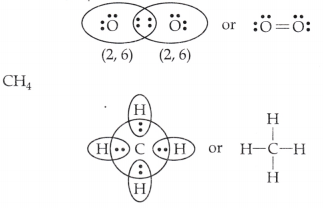
(a) Lewis structure of methane CH4.

(b) Lewis-dot structure of SF2

(c) CO2 Lewis structure

(d) Lewis structure of PBr3

(e) Lewis structure of H2S

Question 4.
Gallium is a metallic element of Group 3. It is similar to aluminium in its properties.
(a) Describe the structure and bonding in a metallic element using a labelled diagram.
(b) Explain why metallic elements such as gallium are good conductors of electricity.
Answer:
(a) A metallic element (such as gallium or aluminium) consists of a regular lattice of positively charged metal ions arranged in a closely packed, repeating structure. These ions are held together by a strong electrostatic attraction between them and a “sea” of delocalised valence electrons that move freely between the ions. This electrostatic attraction is called metallic bond.
A grid of closely packed positively charged spheres represent the metal ions and in the background smaller negatively charged spheres which are evenly distributed throughout represent the delocalised electrons.

(b) Metallic elements like Gallium owe the property of conductivity due to presence of a sea of delocalised electrons in their lattice structure. Their valence electrons are loosely bound to parent atoms and so they detach easily and are shared across all the atoms of the lattice as free moving, delocalised sea of electrons.
These electrons are responsible for carrying the charge or conductivity of the metal when an external potential difference is applied.
Question 5.
(a) What do you understand by bond pairs and lone pairs of electrons? Illustrate by giving one example of each type.
(b)What is an ionic bond? With two suitable examples explain the difference between an ionic and a covalent bond.
Answer:
(a) The shared pair of electrons present between the bonded atoms are called bond pairs.
The pair of electrons which does not take part in bonding is called lone pairs.
(b) Ionic bond: It is defined as the bond which is obtained by transference of electrons from one atom to other atom.
e.g., NaCl

Covalent bond: It is defined as the bonds which is formed by mutual sharing of electrons between them.
Case-Based MCQs
I. A characteristic property of metals is that they are malleable, and pure well-annealed samples can be very soft indeed. The paradox is that metallic bonds are usually strong, i.e., metals have strong cohesive energy: think of the force needed to break a steel bar. Perhaps understanding metallic bonding is best approached from the other characteristic metallic property, namely being good conductors of electricity (and heat, also carried by the electrons). In a well purified and annealed metal the accelerated electrons travel freely for tens of atomic diameters before being scattered by the thermal vibration of the atoms or perhaps by a defect.
Question 1.
Metals have lattice structures. What is the lattice made up of?
(A) Anions and cations
(B) Metal atoms
(C) Molecules in a sea of electrons
(D) Cations in a sea of delocalised electrons
Answer:
Option (D) is correct
Explanation: Lattice structure of metals is made up of metal cations surrounded by freely moving delocalised electrons.
Question 2.
Which of the following property cannot be considered as a typical metallic property?
(A) Low melting point
(B) Malleability
(C) Good thermal conductor
(D) Ductility
Answer:
Option (A) is correct
Explanation: Metals have high melting points.
Question 3.
A given solid Y is solid at room temperature, conducts electricity and can be drawn into wires. Which of the following diagram represents its structure?

Answer:
Option (A) is correct.
Explanation: A solid that conducts electricity is solid at room temperature and is ductile, is a metal. Diagram A illustrates the lattice structure of metals.
Question 4.
Which of the following statements is not as explained by the electron-sea model?
(A) It accounts for the shiny, reflective surface lustre of metals.
(B) Valence electrons are not bound to any specific metal atom.
(C) Metals possess high hardness because electrons are tightly bound in place.
(D) It is called as the free electron theory of metallic bonding.
Answer:
Option (C) is correct.
Explanation: Metal posses high hardness because electrons are delocalised and the metal atoms can move or slide past each other showing localised plasticity without the lattice being fractured.
Case-Based Subjective Questions
I. The octet rule is a fundamental theory in the chemical bonding of main-group elements, which achieve stable configurations by gaining, losing, or sharing electrons. However, the conventional octet rule, as depicted through Lewis structures, is inadequate for describing the electron delocalisation in boron allotropes and boron- rich compounds due to the electron deficiency of boron. To address this, we introduce the concept of fractional electron occupancies, which more accurately reflect the electron delocalisation in boron systems.
Question 1.
Give two examples of a molecule which violates the octet rule.
Answer:
SF6, PCl5, BeCl2, BCl3 (any two correct example)
Question 2.
Octet rule is generally disobeyed by elements of 3rd row and beyond. Explain with reason.
Answer:
Elements in the 3rd row and beyond often disobey the octet rule because they can accommodate more than 8 valence electrons in their outermost shell. This is known as hypervalency or an expanded octet. This is possible due to availability and accessibility of empty d-orbitals.
As 3d orbitals are close in energy to 3s and 3p orbitals, it is easier to participate in the bonding. Also the large size of these atoms reduces the steric hindrance around the central metal ion, so that they can accommodate more surrounding atoms.
Question 3.
Explain an electron deficient molecule?
Answer:
An electron-deficient molecule is a molecule that has fewer than 8 valence electrons. According to Octet rule all of the atoms involved in bonding should have a complete octet to achieve a stable noble gas configuration. However, typically Group 2 and Group 13 elements (such as boron or beryllium) form compounds which leave the central atom with an incomplete outer shell, rendering them highly reactive, e.g., BH3.
In BH3, the central B atom has only 6 electrons in the outermost shell, and it cannot complete its octet.

II. A convenient approach to obtain Lewis structures for compounds of the type YXn involves first constructing a trial structure that satisfies the valence of the outer atoms (e.g., 1 bond for fluorine, 2 bonds for oxygen, and 3 bonds for nitrogen) and placing the molecular charge (if any) on the central atom. The second step involves evaluating the electron count of the central atom, which can give rise to three possibilities: (i) if the central atom has an octet configuration, no change in the number of bonds is required; (ii) if the central atom (Y) exceeds the octet, a Y-X bond is relocated as a lone pair on X, which results in a formal positive charge on Y and a formal negative charge on X; and (iii) if the electron count on the central Y atom is less than an octet, a lone pair on the outer atom is relocated as a Y-X bond, which results in a formal negative charge on Y and a formal positive charge on X;
Question 1.
What is a Lewis structure?
Answer:
A Lewis structure is a diagrammatic representation of an atom or molecule which shows the bonding between atoms of a molecule and the lone pairs of electrons that may exist in the molecule. It uses dots to represent valence electrons and lines to represent covalent bonds.
Question 2.
Explain how to draw a Lewis structure giving stepwise instructions.
Answer:
(a) First calculate the total number of valence electrons on the atoms involved.
(b) Determine the skeleton by placing a central atom (usually the least electronegative).
(c) Draw single bonds between the central atom and surrounding atoms.
(d) Distribute remaining electrons as lone pairs to complete octets (or duets for H).
(e) If atoms lack an octet, form double or triple bonds as needed.
(f) Remember some molecules do not obey the octet rule.
Question 3.
Draw the Lewis dot structure of the following species.
(a) CO32-
(b) PO43-
(c) HNO3
Answer:

Chemical Bonding Class 9 MCQ
Question 1.
Why do atoms combine to form chemical bonds?
(A) To become compact
(B) To lose energy
(C) To achieve stability
(D) To create balance
Answer:
Option (C) is correct.
Explanation: Atoms combine together to form chemical bonds and achieve stability.
Question 2.
Which of the following is not isoelectronic with a noble gas?
(A) S2-
(B) Al3+
(C) Ba+
(D) None of the above
Answer:
Option (C) is correct.
Explanation: Ions isoelectronic with a noble gas should have 8 electrons in their outermost shell.
Sulphur-At .no.16 has a shell configuration 2, 8, 6 (K, L, M shells). S2- acquires 2 electrons to complete the octet in the outermost shell (Isoelectronic with Ar).
Aluminium- At. no. 13 has a shell configuration of 2, 8, 3 (K, L, M shells. Al3+ loses 3 electrons to complete octet (Isoelectronic with Ne).
Barium- At. no. 56 has 2 electrons in its outermost shell (6s). Ba+ on losing one electron still has one electron in its valence shell and 1 e– more than the closest noble gas Xenon.
Question 3.
The force of attraction that holds atoms together in a molecule is known as:
(A) Subatomic force
(B) Chemical bond
(C) Atomic force
(D) Molecular force
Answer:
Option (B) is correct.
Explanation: Chemical bond is the force of attraction holding atoms together to bring stability.
Question 4.
The correct Lewis dot structure for nitrogen trichloride has:
(A) 3 N-Cl bonds and 10 lone pairs of electrons.
(B) 3 N=C1 bonds and 6 lone pairs of electrons.
(C) 1 N-Cl bond, 2 N=Cl bonds and 7 lone pairs of electrons.
(D) 2 N-Cl bonds, 1 N=Cl bond and 8 lone pairs of electrons.
Answer:
Option (A) is correct.
Explanation: NCl3 Lewis Structure

Question 5.
Which of the following molecules contains a covalent triple bond?
(A) O2
(B) Cl2
(C) Br2
(D) N2
Answer:
Option (D) is correct.
Explanation:

Question 6.
Which of the following is a property of covalent compounds?
(A) Good conductors of electricity
(B) High melting point and boiling point
(C) Melt on passage of electricity
(D) Non-conductors of electricity
Answer:
Option (D) is correct.
Explanation: Covalent bonds are non-conductors of electricity because they do not have free electrons to carry electric charge.
Question 7.
Which kind of linkage is present in calcium chloride molecule?
(A) Covalent
(B) Electrovalent
(C) Coordinate
(D) Noble gas
Answer:
Option (B) is correct.
Explanation: Calcium chloride CaCl2 is an electrovalent compound as it is formed through the transfer of electrons from metal (calcium) to non-metal atoms (chlorine). Ca (At. no. 20) has a configuration of 2, 8, 8, 2 it can lose 2 electrons to obtain noble gas configuration. Cl (At. no. 17) has a configuration of 2, 8, 7 it can gain 1 electron to obtain noble gas configuration.

Question 8.
The conductivity of metals can be attributed to which of the following?
(A) Crystalline structure
(B) Mostly solid state
(C) Delocalised electrons
(D) Ionic lattice
Answer:
Option (C) is correct.
Explanation: The delocalised electrons in metals are actually pool of valence electrons that are not bound to any single atom. These electrons are free to move throughout the entire metallic lattice conducting heat and electricity.
Question 9.
Which one of the following has an ionic bond?
(A) H2O
(B) NO2
(C) NaCl
(D) C2H6
Answer:
Option (C) is correct.
Explanation:

Question 10.
Which one of the following does not follow the octet rule?
(A) PCl3
(B) AlCl3
(C) NF3
(D) None of the above
Answer:
Option (B) is correct.
Explanation: Compounds like BF3 and AlCl3 have fewer than 8 valence electrons around the central atom in their respective molecules. This leads to formation of incomplete octet. Hence, these are exceptions to the octet rule.

Question 11.
Which factor increases the strength of a metallic bond? G
(A) Low charge density
(B) Larger atomic radius
(C) Fewer electrons
(D) Smaller ion size and more electrons
Answer:
Option (D) is correct.
Explanation: The strength of a metallic bond increases primarily with a higher positive charge on the metal ion, a smaller ionic radius, and a greater number of delocalised electrons. These factors contribute in increasing the electrostatic attraction between the positively charged metal ions and the sea of delocalised electrons.
Question 12.
Metallic bonding is explained through:
(A) Octet rule
(B) Valence theory
(C) Electron sea bed
(D) All of the above
Answer:
Option (C) is correct.
Explanation: Metallic bonding is explained by electron sea bed model. It is an electrostatic attraction between the positively charged metal ions and the sea of delocalised electrons which are common to all the metal atoms in the lattice.
Assertion-Reason Questions
Directions: In the following questions, a statement of Assertion (A) is followed by a statement of Reason (R). Mark the correct choice as:
(A) Both Assertion (A) and Reason (R) are true, and Reason (R) is the correct explanation of Assertion (A).
(B) Both Assertion (A) and Reason (R) are true, but Reason (R) is not the correct explanation of Assertion (A).
(C) Assertion (A) is true, but Reason (R) is false.
(D) Assertion (A) is false, but Reason (R) is true.
Question 1.
Assertion (A): Magnesium oxide is a stable ionic compound formed when magnesium reacts with oxygen gas.
Reason (R): Magnesium transfers two electrons to oxygen, resulting in the formation of Mg2- and O2- ions, both attaining a stable noble gas configuration.
Answer:
Option (A) is correct.
Explanation: Magnesium (2, 8, 2) loses 2 electrons → Mg2+ (2, 8).
Oxygen (2, 6) gains 2 electrons → O2+ (2, 8).
Both ions attain the stable electron configuration of the noble gas Neon.
This electron transfer explains why MgO is a stable ionic compound.
Question 2.
Assertion (A): The octet rule is based on the chemical inertness of noble gases.
Reason (R): The octet rule explains the stability of compounds.
Answer:
Option (A) is correct.
Explanation: As atoms achieve the noble gas configuration of 8 valence electrons (Octet or duet as in He) they tend to become energetically most stable.
Question 3.
Assertion: Sodium metal is softer than potassium metal. Reason: Metallic bonds in potassium are weaker than in sodium due to larger atomic size.
Answer:
Option (D) is correct.
Explanation: Potassium metal is softer than sodium metal as the metallic bonds in potassium are weaker than in sodium due to larger atomic size.
Question 4.
Assertion: Mercury cannot conduct electricity at room temperature.
Reason: Mercury is liquid at room temperature.
Answer:
Option (D) is correct.
Explanation: Mercury is liquid at room temperature and can conduct electricity as it has delocalised electrons.