Students can use NCERT Class 9 Advanced Science Notes and Chapter 7 Chemical Bonding Class 9 Notes to understand complex concepts with ease.
Chemical Bonding Notes Class 9 Advanced Science
Class 9 Chemical Bonding Notes
Octet Rule and Lewis Structure
Octet Rule
The main group elements of the periodic table tend to acquire the nearest noble gas configuration to attain stability. This involves losing, gaining or sharing electrons present in the outermost shell of the atoms to attain 8 valence electrons or an octet, as shown by the ns2 npb configuration.
For example, Sodium has 1 electron in its outermost shell, so it tends to lose it to attain Neon (2,8) configuration. On the other hand, Chlorine has 7 electrons in its outermost shell, so it tends to gain an electron to attain the configuration of noble gas Argon (2,8,8). The atoms other than hydrogen tend to form bonds so that they are surrounded by eight valence electrons.
The octet rule is a fundamental chemical principle that governs the chemical bonding, including ionic and covalent, for main-group elements of the ‘s’ and ‘p’ blocks. However, there are certain exceptions to it. For example, Hydrogen, where the valence shell attains the electron configuration of helium, i.e., a total of two electrons (duet rule).

Thus, the octet rule helps in predicting the structure and stability of molecules, the type of chemical bonding – ionic or covalent, explaining the non-reactive nature of noble gases and the existence of exceptions to the rule. We can refer to the Octet rule as a guiding principle, but not a law.
Lewis Approach
The Lewis structure of an atom is a visual representation of the outermost or valence electrons of an atom that participate in bonding.
Valence electrons are shown as dots around the symbol of the atom, bonding electrons are represented as dots or lines between the atoms and electrons that do not participate in bonding are shown as lone pairs.
For example, Fluorine (Atomic no. 9) Electronic configuration-2,7
The number of valence electrons is 7.
Lewis dot structure for Fluorine:

Bonding in molecules:
Atoms can achieve a stable configuration by forming chemical bonds with other atoms. Hence, during bonding, the valence electrons are written around the atoms, and then electrons are shared in such a way as to complete the octet of each atom involved in bonding.
For example, the Lewis structure for hydrogen fluoride is

Here, the pair of dots (representing electrons) placed , between the symbols of the combining atoms represents the bonding electrons. The remaining dots represent the non-bonding electrons. As the name suggests, these do not contribute to the bonding. The line here indicates the bond between the hydrogen and fluorine atoms. Here, in the HF molecule, the hydrogen atom has only two electrons (a duplet) around it.
Similarly, in the chlorine gas molecule (Cl2), two chlorine atoms share their unpaired electrons by making a covalent bond, thus they each complete their valence shell:
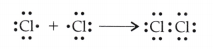
Now, each chlorine atom has an octet.
The electron pair shared by the Cl atoms is called a bonding pair; the other three pairs of electrons on each chlorine atom are called lone pairs.
Exceptions to the Octet Rule
Many stable molecules do not follow the octet rule. These are known as exceptions to the octet rule. Exceptions to the octet rule occur when atoms are stable with fewer than eight, more than eight, or an odd number of valence electrons.
Let us discuss these exceptions in detail.
Molecules with incomplete octets
Some elements have less than four valence electrons in their valence shells. In these cases, their atoms cannot form four bonds to complete the octet. Also, these do not have sufficient lone pairs that can complete the octet. As a result, the octet remains incomplete.
Molecules with atoms that possess less than an octet of electrons generally contain the lighter s- and p-block elements. For example, beryllium, with just four electrons around the central atom, and boron, typically with six.
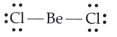
In the case of lithium, beryllium and boron, there are only 1,2 and 3 valence electrons, respectively. Therefore, these atoms can form 1, 2 and 3 bonds, respectively. Hence, in these cases, the central atom in the molecule would have 2, 4 and 6 electrons, respectively. These represent molecules that do not complete the octet and yet are stable. In the boron trifluoride molecule, one boron atom makes bonds with three fluorine atoms and is represented as :
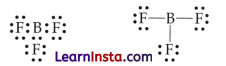
The lines here indicate the bond between the boron and fluorine atoms.
Molecules with expanded octets
Another exception to the octet rule is observed in expanded valence molecules. These molecules have more than eight valence electrons around the central atom.
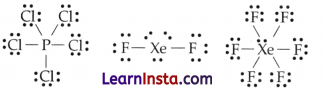
Such compounds with more than an octet of electrons around an atom are generally formed by the elements having more than four electrons in their valence shell. Elements in Period 3 and below, like (P, S, Se, I, Xe), can have more than 8 electrons because of available d-orbitals in their valence shell. Availability of one or more d-orbitals in bonding, in addition to the valence ns and np orbitals, leads to the formation of molecules with an expanded octet.
For example, in the case of sulphur hexafluoride, one atom of sulphur combines with six atoms of fluorine. The central sulphur atom has 12 electrons in its valence shell, representing an expanded octet.
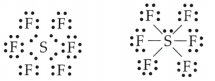
As sulphur has an [Ne]3s23p43d0 electron configuration, it could, in principle, accommodate more than eight valence electrons by using one or more d orbitals.
Similarly, Phosphorus pentachloride (PCl5) has 10 electrons around the central atom P, and XeF2 and XeF6 have 10 and 14 electrons around the central atom Xe, respectively.
We will learn about the formation of such compounds in higher classes.
Molecules with an odd number of electrons Most molecules or ions that consist of s- and p-block elements contain even numbers of electrons, and their bonding can be explained by assigning every electron to either a bonding pair or a lone pair.
However, certain molecules have an odd number of electrons. For example, molecules or ions containing d-block elements frequently contain an odd number of electrons. A few molecules containing only p-block elements also have an odd number of electrons.
For example, an atom of nitrogen with 5 valence electrons makes two bonds with an atom of oxygen (six valence electrons) to form a molecule of NO. It has a total of 11 valence electrons, five from N and six from O. The Lewis structure for this molecule can be represented as
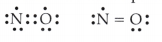
The two lines here indicate two bonds.
Here, nitrogen has 5 valence electrons around its atom. A double bond would place 7 electrons around nitrogen, and a triple bond would place 9. In both cases, we are unable to get an octet around nitrogen and oxygen, both atoms in the NO molecule.
Similarly, Nitrogen dioxide (NO2) has 17 valence electrons.
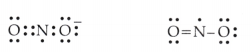
Whenever there is an odd number of electrons in a molecule, at least one atom would have an incomplete octet.
Secondly, in such a molecule, there would always be an unpaired electron.
2. Metallic Bonding and Electron Sea Model
Metallic Bonding
Metals as we know they show certain properties, like they are shiny or lustrous, hard materials, produce sound on hitting (sonorous), can be beaten into sheets (malleability), can be drawn into wires (ductile), they conduct heat and electricity (conductors) and have high melting points. For example, copper, aluminium, iron, etc.
All these specific properties associated with metals can be explained in terms of a simple model known as the electron sea model for metals.
We have already discussed bonding in ionic and covalent compounds, where the atoms bond by the transfer or sharing of electrons between specific atoms.
Similarly, in metals, the bonding can be explained through the electron sea model. It involves bonding between a very large number of atoms of the metal.
Metallic bonding is the electrostatic attraction between positively charged metal ions and a shared ‘sea’ of delocalised electrons. This bonding occurs between metal atoms, which are present in the lattice structure of the metal, and valence electrons, which are free to move throughout the entire material.
Let us understand this model and learn how we can explain the properties of metals by using this model.
Electron Sea Model
A metal atom has a few electrons in its outermost shell. These outer electrons are not held very tightly by the nucleus. Because of this, when many metal atoms come together to form a solid, these outer electrons do not remain attached to any one atom. Instead, they become delocalised and are free to move throughout the entire piece of metal.
As we know, on losing an electron, an atom becomes a cation- acquiring a positive charge. In metals, the atoms can be thought of as forming positive metal ions arranged in a regular pattern. These ions form a kind of fixed structure called the lattice. The free electrons move continuously and randomly in all directions around and between these ions. This collection of freely moving electrons is called a ‘sea of electrons’.
Thus, according to the electron sea model, a metal can be seen as a structure in which positive metal ions are fixed in their place, and a ‘sea’ of mobile electrons moves around them. This is why the model is called the electron sea model, as shown in Fig. 7.1.
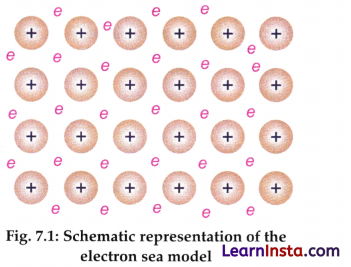
These ions and electrons together form a stable structure. The strong, non-directional force of attraction between the stationary positive ions and the moving sea of electrons holds the metal atoms together. This attraction is called metallic bonding.
It is important to note that, unlike covalent bonds, metallic bonds are not localised. The electrons are shared by all the atoms collectively, forming a non-directional bond that can adjust to shifting positions of the metal ions. The free-moving electrons or delocalised electrons act as charge carriers, allowing electricity and heat to move rapidly through the structure.
Metallic bonds are not broken when the metal is heated to the molten state. Instead, these bonds are weakened, disrupting the ordered array of metal ions to lose their definite, rigid structure (lattice) and turn liquid. However, these bonds can be completely broken when the metal is heated to its boiling point.
Electron sea model and properties of metal
Now, let us see how this simple electron sea model helps us to understand the properties of metals.
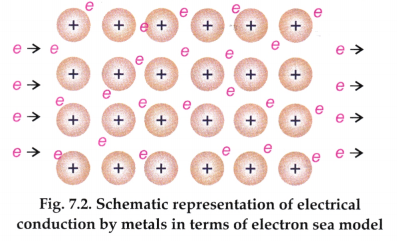
Electrical conductivity
As there is presence of a large number of electrons (delocalised) that are free to move, when we apply an electric field across a metal, they start moving in a particular direction towards the positive charge. This movement of electrons constitutes an electric current. That is why metals are good conductors of electricity.
Thermal conductivity
The thermal conductivity of a material is a measure of its ability to conduct heat.
When one part of a metal is heated, the electrons in that region gain kinetic energy and start moving faster. As they move, they transfer this energy to other parts of the metal. At the same time, the metal ions also vibrate more and help in passing the heat along through collisions with other electrons. In this way, heat spreads quickly. This is why metals are good conductors of heat.
Malleability and Ductility
The ability of metals to be beaten into thin sheets is referred to as malleability. In the electron sea model, the positive metal ions can slide over one another without breaking the structure. This is possible because the electrons are not fixed; they continue to move and hold the ions together. So, even when layers of the metal ions shift, the metal does not break.
Similarly, you know that ductility refers to the ability of metals to be drawn into wires. When we stretch a metal, these metal ions slide past each other without breaking the non-directional metallic bonds, allowing the metal to stretch into wires.
The free electrons help maintain the attraction between ions even when the shape changes.
Thus, we can say that the sea of electrons in the metallic bond causes deformation of the lattice but prevents breakage.
Remember that the electron sea model gives a simple picture and explains many basic properties of metals. The electrons are not completely given off to other atoms as in ionic bonding; rather, they are shared collectively by all atoms in the metal. ,