Practice with Class 9 SST Extra Questions and Class 9 Social Science SST Chapter 8 Building Blocks in Economics The Problem of Choice Extra Questions and Answers to improve your exam performance.
Building Blocks in Economics The Problem of Choice Class 9 Extra Question Answer
Extra Questions of Building Blocks in Economics The Problem of Choice Class 9
Building Blocks in Economics The Problem of Choice Class 9 Very Short Question Answer
Question 1.
What is scarcity?
Answer:
Scarcity is the condition in which resources are limited but human wants are unlimited. It forces individuals and societies to make choices about how resources should be used.
Question 2.
Why do economists study data?
Answer:
Economists study data to understand economic trends, analyse problems, and make informed decisions about production, consumption, and public policies.
Question 3.
What are factors of production?
Answer:
Factors of production are the resources used to produce goods and services. They include land, labour, capital, and technology.
Question 4.
Define opportunity cost with an example.
Answer:
Opportunity cost is the value of the next best alternative given up. For example, spending money on a movie instead of buying a book.
Question 5.
What is a Production Possibility Curve?
Answer:
A Production Possibility Curve shows the different combinations of goods that can be produced efficiently using available resources and technology.
Question 6.
Why are choices necessary in economics?
Answer:
Choices are necessary because resources are limited while human wants are unlimited. Individuals and societies must decide how best to use available resources.
Question 7.
What is a public good?
Answer:
A public good is a good or service available to everyone without exclusion, such as roads, parks, street lights, and police services.
Question 8.
What is labour-intensive production?
Answer:
Labour-intensive production is a method that relies more on human workers than machines to produce goods and services.
Question 9.
What role does technology play in production?
Answer:
Technology improves productivity and efficiency by helping producers use resources better and produce more goods and services.
Question 10.
Why are economic surveys important?
Answer:
Economic surveys provide information about economic performance and help governments and businesses make better economic decisions.

Building Blocks in Economics The Problem of Choice Class 9 Short Question Answer
Question 1.
Explain the relationship between scarcity and choice.
Answer:
Scarcity exists because resources are limited while human wants are unlimited. Due to scarcity, people cannot have everything they want and must make choices.‘Every choice involves selecting one option and giving up another, which creates an opportunity cost.
Question 2.
Describe the four factors of production.
Answer:
The four factors of production are land, labour, capital, and technology. Land includes natural resources, labour refers to human effort, capital includes tools and machinery, and technology refers to knowledge and innovations used in production.
Question 3.
Why do all economies face the problem of resource allocation?
Answer:
All economies face resource allocation problems because resources are scarce while wants are unlimited. They must decide how resources should be distributed among different uses to maximise benefits and satisfy as many wants as possible.
Question 4.
Explain the three central questions of an economy.
Answer:
Every economy must answer three questions what to produce, how to produce, and for whom to produce. These questions help determine the allocation of resources and ensure that production meets society’s needs efficiently.
Question 5.
Compare labour-intensive and capital-intensive production methods.
Answer:
Labour-intensive production uses more workers and fewer machines, while capital-intensive production uses more machinery and technology. The choice depends on costs, resource availability, and the nature of the product being produced.
Question 6.
How do consumers, producers, and governments interact in an economy?
Answer:
Consumers buy goods and services, producers manufacture them, and governments regulate economic activities. Their interactions determine production, prices, distribution, and the overall functioning of the economy
Building Blocks in Economics The Problem of Choice Class 9 Long Question Answer
Question 1.
Explain the concept of scarcity and discuss why it is considered the central problem of economics.
Answer:
Scarcity refers to the situation where resources are limited but human wants are unlimited. Since people always desire more goods and services than can be produced with available resources, choices have to be made. Scarcity affects individuals, businesses, and governments because they must decide how best to use resources such as land, labour, capital, and technology. It is considered the central problem of economics because all economic activities revolve around managing scarce resources efficiently. Due to scarcity, societies must answer important questions such as what to produce, how to produce, and for whom to produce. Thus, scarcity makes economic decision-making necessary.
Question 2.
What is opportunity cost? Explain its importance in everyday life with suitable examples.
Answer:
Opportunity cost is the value of the next best alternative that is sacrificed when a choice is rpade. Since resources such as money, time, and effort are limited, every decision involves giving up something else. For example, if a student spends an evening playing sports instead of studying, the opportunity cost is the study time lost. Similarly, if a family spends money on a vacation, it may have to postpone buying a new appliance. Understanding opportunity cost helps people make better decisions by comparing alternatives and choosing the option that provides the greatest benefit. It encourages efficient use of resources and promotes rational decision-making in everyday life.
Question 3.
Explain the three central questions of an economy. Why are these questions important?
Answer:
Every economy must answer three central questions: What to produce?, How to produce?, and For whom to produce? The first question determines which goods and services should be produced and in what quantities. The second question focuses on selecting the most efficient production methods and resources. The third question deals with how the produced goods and services will be distributed among people. These questions are important because resources are limited and cannot satisfy all wants. By answering them, societies can allocate resources efficiently, meet people’s needs, and ensure economic growth. Different economic systems answer these questions in different ways based on their priorities.
Question 4.
Compare market, planned, and mixed economies. Why is a mixed economy considered more practical?
Answer:
A market economy relies on private ownership and . decisions guided by demand and supply. A planned economy is controlled by the government, which decides what, how, and for whom to produce. A mixed economy combines features of both systems. In a mixed economy, private businesses operate freely, but the government regulates markets and provides public goods. Market economies encourage innovation and competition but may lead to inequality. Planned economies promote welfare but may reduce efficiency and innovation. A mixed economy is considered more practical because it combines the strengths of both systems while reducing their weaknesses. Therefore, most modem countries, including India, follow a mixed economy.
Question 5.
Discuss the role of government and markets in a mixed economy. How do they work together to promote economic development?
Answer:
In a mixed economy, both the government and the market play important roles. Markets encourage competition, innovation, entrepreneurship, and efficient production of goods and services. Businesses respond to consumer demand and seek profits. At the same time, the government regulates economic activities to ensure fairness, protect consumers, and prevent exploitation. It also provides public goods such as roads, schools, hospitals, and security services that may not be adequately supplied by private enterprises. The government implements welfare programmes and creates rules for fair competition. By working together, the government and markets help achieve economic growth, social welfare, and efficient resource allocation, making the economy more balanced and sustainable.
Building Blocks in Economics The Problem of Choice Class 9 Source Based Questions
Read the passage carefully and answer the questions that follow:
Question 1.
Economics is the study of how individuals and societies make choices to use limited resources to satisfy unlimited wants. Since resources such as land, labour, capital, and technology are scarce, people cannot have everything they desire. As a result, choices must be made regarding the use of available resources. Every choice involves an opportunity cost, which is the value of the next best alternative that is given up. Understanding scarcity and opportunity cost helps people make better economic decisions.
(i) Why do individuals and societies need to make choices?
Answer:
Individuals and societies need to make choices because resources are limited while human wants are unlimited.
(ii) What is meant by scarcity?
Answer:
Scarcity is the condition in which available resources are insufficient to satisfy all human wants.
(iii) Define opportunity cost.
Answer:
Opportunity cost is the value of the next best alternative that is sacrificed when a choibip is made.
Question 2.
A mixed economy combines features of both market and planned economies. In this system, private businesses operate to earn profits and respond to consumer demand, while the government regulates economic activities and provides public goods such as roads, schools, , and hospitals. Competition in the’market ‘ encourages innovation and efficiency, whereas government intervention helps ensure fairness and social welfare. As a result, most countries today follow some form of mixed economy.
(i) What is a mixed economy?
Answer:
A mixed economy is an economic system in which both the government and private sector play important roles.
(ii) Name any two public goods mentioned in the passage.
Answer:
Two public goods mentioned are roads and schools. (Hospitals may also be accepted.)
(iii) How does competition benefit the economy?
Answer:
Competition encourages innovation, improves efficiency, and motivates businesses to provide better goods and services.
Building Blocks in Economics The Problem of Choice Class 9 Picture Based Questions
Look at the pictures and answer the questions that follow:
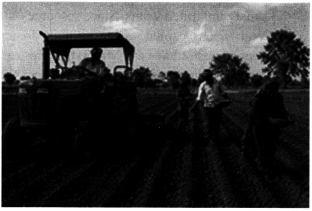
(i) Which factors of production are visible?
Answer:
Land, labour, capital, and technology.
(ii) Is the method labour-intensive or capital-intensive?
Answer:
Capital-intensive because machinery such as a tractor is used.
(iii) How does technology help agriculture?
Answer:
It increases efficiency, productivity, and output.
Question 2.
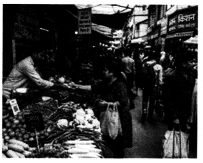
(i) Which economic system is reflected?
Answer:
Market economy.
(ii) What role do consumers play?
Answer:
They create demand by purchasing goods and services.
(iii) How do demand and supply influence the market?
Answer:
Demand affects what producers sell, while supply determines availability and prices.
Building Blocks in Economics The Problem of Choice Class 9 Graph based Question
Question 1.
Study the graph carefully and answer the questions that follow.
Production Possibility Curve: Production combinations of Rice and Machines using available resources. -..

(i) What is the maximum quantity of wheat that can be produced when no barley is produced?
Answer:
100 kg
(ii) How much wheat must be sacrificed if barley production increases from 50 kg to 75 kg?
Answer:
30 kg
(iii) What does the Production Possibility Curve (PPC) shown in the graph illustrate? Explain with reference to the graph.
Answer:
The Production Possibility Curve (PPC) illustrates that with limited resources, producing more of one good requires sacrificing some quantity of the other good. In the graph, when barley production increases from 0 kg to 100 kg, wheat production decreases from 100 kg to 0 kg, showing the trade¬off and opportunity cost involved in using scarce resources efficiently.
Class 9 Building Blocks in Economics The Problem of Choice Extra Questions for Practice
Multiple Choice Questions
Question 1.
What is the main problem that economics tries to solve?
(a) Unlimited resources and limited wants
(b) Limited resources and unlimited wants
(c) Unlimited resources and unlimited waijts
(d) Limited resources and limited needs
Question 2.
The value of the next best alternative that is ^iven up is called:
(a) Scarcity
(b) Deihand
(c) Opportunity Cost
(d) Supply
Question 3.
Which of the following is a factor of production?
(a) Inflation
(b) Technology
(c) Taxation
(d) Consumption
Question 4.
In a market economy, major economic decisions are mainly guided by:
(a) Government orders
(b) Parliament
(c) Demand and Supply
(d) Courts
Assertion & Reason Questions
Question 1.
There are two statement in each question marked as Assertion (A) and Reason (R). Choose your answer as per the options given below:
Assertion (A): A mixed economy combines features of both planned and market economies.
Reason (R): In a mixed economy, both the government and private sector participate in economic activities.
Options:
(a) Both (A) and (R) are true and (R) is the correct explanation of (A).
(b) Both (A) and (R) are true but (R) is not the correct explanation of (A).
(c) (A) is true but (R) is false.
(d) (A) is false but (R) is true.
Fill in the Blanks
1. Human wants are ________ and keep changing.
2. Economics studies how people use ________ resources to satisfy their wants.
3. The word economics comes from the Greek word ________
4. Production can be labour-intensive or ________ -intensive.
5. In a planned economy, most economic decisions are made by the ________
Very Short Answer Type Questions
Question 1.
What is meant by opportunity cost?
Question 2.
Name any two factors of production.
Question 3.
What does the x-axis represent in the PPC shown in the chapter?
Question 4.
Who prepares the Economic Survey of India?
Question 5.
What is a market economy?
Short Answer Type Questions
Question 1.
Differentiate between needs and wants with suitable examples.
Question 2.
Explain how scarcity leads to economic choices.
Question 3.
What is the significance of the Production Possibility Curve (PPC)?
Question 4.
How do economists help individuals, businesses, and governments make decisions?
Question 5.
Explain any two features of a planned economy.
Long Answer Type Questions
Question 1.
Explain the concept of opportunity cost with the help of a suitable example. Why is it important in decision-making?
Question 2.
Discuss the three key questions that every economy must answer. Why are these questions important?
Question 3.
Compare planned economy and market economy on the basis of ownership, decision-making, and competition.
Question 4.
Explain the factors that influence the choice between labour-intensive and capital-intensive methods of production.
Question 5.
Describe the features of a mixed economy. Why is a mixed economy considered more practical than a pure planned or pure market economy?