Practice with Understanding Society India and Beyond Class 9 Solutions and Class 9 Social Science SST Chapter 3 Atmosphere and Climate Question Answer NCERT Solutions to improve your exam performance.
Class 9 SST Chapter 3 Atmosphere and Climate Question Answer
Class 9 Atmosphere and Climate Question Answer
The Big Questions (Page No. 39)
Question 1.
What is the composition of the atmosphere?
Answer:
The Earth’s atmosphere is a mixture of gases, water vapour, and dust particles. It mainly consists of nitrogen (78%) and oxygen (21%), along with small amounts of argon (0.93%), carbon dioxide (0.04%), helium, neon, krypton, xenon, ozone, and hydrogen. Water vapour (0.1-0.4%) plays an important role in cloud formation and precipitation, while dust particles also contribute to weather processes.
Question 2.
How do the different layers of the atmosphere affect the planet Earth?
Answer:
The atmosphere is divided into five main layers, each performing important functions.
Troposphere
- Lowest layer of the atmosphere (about 12 km).
- Contains the air we breathe.
- Most clouds and water vapour are found here.
- Almost all weather phenomena such as rainfall, fog and hail occur in this layer.
Stratosphere
- Extends up to about 50 km.
- Contains the ozone layer.
- Ozone protects life by absorbing harmful ultraviolet radiation from the Sun.
- Suitable for aeroplane flights because it is free from major weather disturbances.
Mesosphere
- Extends up to about 80 km.
- Most meteorites entering from space bum up in this layer before reaching the Earth.
Thermosphere
- Extends from about 80 km to 700 km.
- Contains the ionosphere, which helps radio communication.
- Auroras occur in this layer.
Exosphere
- Outermost layer of the atmosphere.
- Very thin air is present here.
- Light gases like hydrogen and helium escape into space from this layer.
Together, these layers protect the Earth, regulate temperature, support communication systems and make life possible.
Question 3.
What is the mechanism of monsoon?
Answer:
Monsoon refers to the seasonal reversal of wind direction during a year.
South-West Monsoon (Summer Monsoon)
- During summer, the Indian landmass heats up faster than the surrounding oceans.
- A low-pressure area develops over land.
- The Indian Ocean remains relatively cooler and develops high pressure.
- Winds blow from high-pressure areas to low- pressure areas.
- Moist winds move from the sea towards the land and bring rainfall.
- This monsoon occurs mainly from June to September and provides most of India’s annual accounts for most of the rainfall in the country throughout the year.
North-East Monsoon (Winter Monsoon)
- During winter, the Indian landmass cools faster than the surrounding oceans.
- High pressure develops over land and low pressure over the sea.
- Dry winds blow from land towards the sea.
- After crossing the Bay of Bengal, these winds pick up moisture and bring rainfall to parts of south¬eastern India, especially Tamil Nadu, Andhra Pradesh and parts of Karnataka.
Thus, the monsoon is caused by the unequal heating and cooling of land and sea, resulting in seasonal reversal of winds and rainfall.

Question 4.
How can we reduce our carbon footprint?
Answer:
A carbon footprint is the total greenhouse gases released by human activities. To reduce it, we need to adopt eco-friendly habits in our daily lives.
Steps to reduce the carbon footprint are:
- Save energy: Switch off lights and fans when not in use, and use energy-efficient appliances.
- Use renewable energy: Solar panels, wind energy, and hydropower instead of fossil fuels.
- Use Eco-friendly transport: Walk, cycle, carpool, or use public transport instead of private vehicles.
- Plant trees: Trees absorb carbon dioxide and help improve air quality.
- Reduce, reuse, recycle: Minimise waste by recycling paper, plastic, glass and metals.
- Adopt Sustainable lifestyles: Use cloth bags, avoid single-use plastics, and prefer environmentally friendly products.
- Conserve water: Save water to reduce the energy required for its supply and treatment.
Atmosphere and Climate Question Answer Class 9
InText Questions
Think About It
Question 1.
Can you imagine what would happen if there were no atmosphere? Discuss your thoughts with your friends and teachers. (Page No. 39)
Answer:
If there were no atmosphere, life on Earth would not be possible. There would be no oxygen for living organisms to breathe and no carbon dioxide for plants to make food. The Earth would be exposed directly to the Sun’s harmful ultraviolet radiation. There would be no clouds, rainfall, wind, or weather. Daytime temperatures would become extremely hot, while night time temperatures would become extremely cold because there would be no atmosphere to regulate heat. Meteorites would strike the Earth’s surface directly without burning up. Therefore, the atmosphere is essential for protecting life, maintaining suitable temperatures, and supporting weather and climate.
Question 2.
You might have noticed that sometimes the wind is so strong that it is difficult to walk against it. Can you think of some other times when strong winds have caused problems for you? (Page No. 45)
Answer:
Strong winds can cause many problems in daily life. During storms or cyclones, strong winds may uproot trees, damage houses, electric poles, and crops. They can make it difficult for people to walk, ride bicycles, or drive vehicles safely. Strong winds can also blow away roofs, hoardings, and lightweight objects, causing accidents and disruption of normal life. Sometimes, power supply and communication services are also affected due to damage caused by strong winds.
Question 3.
Hindustani Classical music associates certain ragas with specific seasons. Find out which ragas are connected to each season with the help of your elders and teachers. (Page No. 45)
Answer:
In Hindustani Classical Music, certain ragas are traditionally associated with particular seasons because they are believed to reflect the mood and beauty of that season.
| Season (Rtu) | Associated Ragas |
| Vasanta (Spring) | Raga Basant, Raga Bahar |
| Grishina (Summer) | Raga Deepak (traditionally associated with summer) |
| Varsha (Monsoon/ Rainy Season) | Raga Megh, Raga Megh Malhar, Raga Miyan ki Malhar |
| Sharad (Autumn) | Raga Shree, Raga Durga |
| Hemanta (PreWinter) | Raga Hemant |
| Shishira (Winter) | Raga Malkauns, Raga Jaunpuri |
Let’s Explore
Question 1.
Find out other categories of wind based on speed and their common effects, and share your findings in class. (Page No. 46)
Answer:
Apart from calm, light breeze, strong breeze, and storm, winds can be classified into several categories based on their speed and effects:
| Category of Wind | Speed (Approx.) | Common Effects |
| Gentle Breeze | 12-19 km/hr | Leaves and small twigs move continuously. |
| Moderate Breeze | 20-28 km/hr | Dust and loose paper are lifted; small branches move. |
| Fresh Breeze | 29-38 km/hr | Small trees begin to sway; waves form on water bodies. |
| Gale | 62-74 km/hr | Twigs break off trees; minor structural damage may occur. |
| Strong Gale | 75-88 km/hr | Trees sway strongly; damage to buildings may occur. |
| Hurricane force | Above 118 km/hr | Severe damage to buildings, trees, power lines, and transport systems. |
Question 2.
“Describe in your own words how monsoon affects the lives of the people around you.” (Page No. 52)
Answer:
Monsoon has a significant impact on the lives of people around us. Farmers depend on monsoon rainfall for sowing and growing crops. A good monsoon helps increase agricultural production and ensures sufficient water in rivers, reservoirs, ponds, and wells. It also supports drinking water supply and electricity generation in some areas.
Monsoon influences daily life by bringing relief from summer heat and improving water availability. However, heavy rainfall can cause floods, waterlogging, traffic disruptions, damage to houses and crops, and the spread of water-borne diseases. In some years, weak monsoons may lead to water shortages and drought conditions.
Thus, monsoon greatly affects agriculture, water resources, transportation, livelihoods, and the overall economy of the country.
Question 3.
My Carbon Footprint
Step 1: My Daily Habits
Tick the options that best describe you.
A. Transport
- I usually walk/use a cycle. (Low impact)
- I use public transport/carpool. (Medium impact)
- I travel by private car even for short distances. (High impact).
- I take flights more than twice a year. (Very high impact)
B. Electricity Use
- I always switch off electrical appliances (lights, fans, etc.) when not in use. (Low impact)
- I sometimes forget to switch off electrical appliances (lights, fans, etc.). (Medium impact)
- I leave electrical appliances (lights, fans, etc.) on frequently. (High impact)
C. Water Use
- I use water judiciously, for example, just one bucket of water for bathing. (Low impact)
- I sometimes waste water (leaving the tap running/ more buckets of water for a bath/ long showers). (Medium impact)
- I rarely think about saving water. (High impact)
D. Waste and Plastics
- I reuse, recycle, and avoid single-use plastics. (Low impact)
- I sometimes use disposable plastics (bottles/ bags/straws). (Medium impact)
- I often throw away plastic and do not recycle. (High impact)
Step 2: Score Yourself
- Low impact choices = 1 point
- Medium impact choices = 2 points
- High impact choices = 3 points
- Very high impact choices = 4 points
Low add up your total score: _____________ points
Step 3: My Climate Action Pledge
Think about two simple changes you can make to
reduce your score, and write them down below.
1. _________________________________
2. _________________________________
Answer:
Do it yourself
Let’s Analyse
Note down the weather report from a local newspaper for two weeks and observe the changes occurring in the weather. (Page No. 47)
Answer:
Do it yourself.
Atmosphere and Climate Class 9 Questions and Answers
Questions and Activities (Page No. 57-59)
Question 1.
What is the atmosphere? Explain its composition with the help of a pie diagram.
Answer:
The atmosphere is a blanket of air surrounding the Earth. It is pulled down around the Earth by gravity and is a mixture of gases in various proportions, vital for the survival of all living beings on the Earth. It shields us from the harmful radiation coming from the Sun, including ultraviolet radiation, and regulates the Earth’s temperature by trapping some of the Sun’s energy and preventing it from escaping back into space.
Composition of the atmosphere:
- Nitrogen – 78%
- Oxygen-21%
- Argon – 0.93%
- Carbon dioxide – 0.04%
- Other gases (helium, neon, krypton, xenon, ozone and hydrogen) – 0.03%
- The atmosphere also contains water vapour (generally 0.1% – 0.4%) and tiny dust particles.
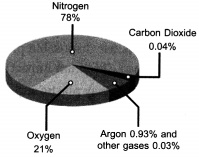
Pie Chart of the composition of the atmosphere
Question 2.
Draw a labelled diagram of the structure of atmosphere.
Answer:
Do it yourself
Question 3.
Which are the four main seasons of India?
Answer:
The Indian Meteorological Department (IMD) recognises four main seasons:
- Winter (December-Early April)
- Summer or Pre-Monsoon (April-June)
- Monsoon or Rainy Season (June-September)
- Post-Monsoon or Retreating Monsoon (October- December)
Question 4.
Why do you not feel the pressure of the atmosphere?
Answer:
We do not feel the pressure of the atmosphere because the air pressure acting on our body from all directions is balanced by the pressure inside our body. The gases and fluids present within our body exert an equal outward pressure that balances the atmospheric pressure. As a result, there is no net force acting on our body, so we do not feel the weight of the atmosphere. We notice changes in atmospheric pressure only under special conditions, such as at high altitudes or underwater.
Question 5.
In which layer of the atmosphere do aeroplanes fly and why?
Answer:
Aeroplanes generally fly in the Stratosphere because it is free from clouds and major weather disturbances. This makes flying smoother and safer.
Question 6.
Distinguish between the following:
(a) The Troposphere and Stratosphere
| Troposphere | Stratosphere |
| Lowest layer of the atmosphere. | Lies above the troposphere. |
| Extends up to about 12 km. | Extends up to about 50 km. |
| Weather phenomena occur here. | Almost free from weather disturbances. |
| Temperature decreases with altitude. | Contains the ozone layer. |
| Contains most water vapour and clouds. | Aeroplanes fly in this layer. |
(b) The South-West Monsoon and North-East Monsoon
| South West Monsoon | North East Monsoon |
| Occurs from June to September. | Occurs from October to February. |
| Winds blow from sea to land. | Winds blow from land to sea. |
| Brings most of India’s rainfall. | Generally dry winds. |
| Caused by low pressure over land in summer. | Caused by high pressure over land in winter. |
| Moisture-laden winds. | Gives rainfall mainly to the south-eastern coast after crossing the Bay of Bengal. |
Question 7.
Do it yourself: (Table) shows the average monthly temperatures and rainfall amounts for 10 representative stations. Study these figures on your own and convert them into temperature and rainfall’ graphs. The visual representations will help you grasp their similarities and differences at a glance. One such graph (Figure) is already prepared for you. See if you can arrive at some broad generalisations about our diverse climatic conditions.
7.1. Now look at Table again. Re-arrange the 10 stations according to their distance from the equator.
Answer:
From nearest to farthest from the Equator:
1. Thiruvananthapuram (8°29’N)
2. Bengaluru (12058TN1)
3. Chennai (13°4’N)
4. Mumbai (19°N)
5. Nagpur (21°9’N)
6. Kolkata (22°34’N)
7. Shillong (24°34’N)
8. Jodhpur(26°18’N)
9. Delhi (29°N)
10. Leh (34°N)
7.2 Find out:
(a) Two stations with the most extreme climate.
(b) Two stations influenced by retreating monsoons.
(c) The two hottest stations in the months of
(i) February (ii) June
Answer:
(a) Delhi and Jodhpur.
(b) Chennai and Thiruvananthapuram.
(c) (i) February: Mumbai and Nagpur
(ii) June: Jodhpur and Delhi
7.3. Now find out:
(a) Why does Shillong experience more rainfall than Kolkata?
(b) Why does Delhi receive more rainfall than Jodhpur?
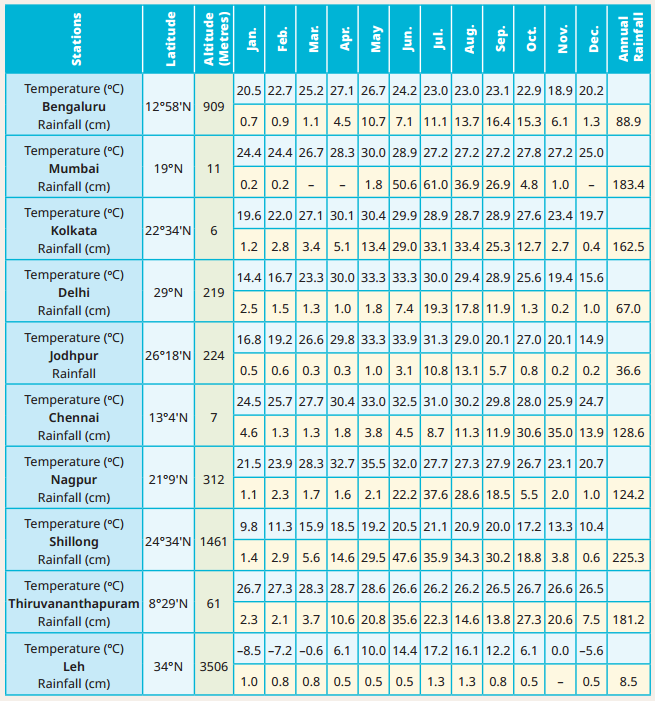
Table Average monthly temperatures and rainfall for 10 representative stations (temperature and rainfall data are representational)
Answer:
(a) Shillong receives more rainfall because the moisture-laden South-West Monsoon winds are forced to rise over the hills around Shillong, causing orographic rainfall.
(b) Delhi receives more rainfall because it is mdre strongly influenced by the South-West Monsoon winds, whereas Jodhpur lies in the arid region of Rajasthan and receives much less rainfall.
Based on Table and the information given in the chapter, the answers are:
7.4. Now think why
(a) Thiruvananthapuram has an equable climate?
(b) Chennai has more rainfall only after the fury of the monsoon is over in most parts of the country?
(c) Leh has moderate precipitation almost throughout the year?
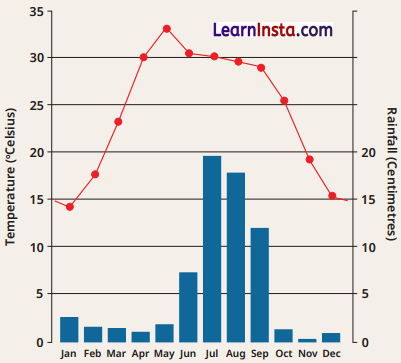
Figure: Temperature and Rainfall of Delhi
Answer:
(a) Thiruvananthapuram has an equable climate because it is located close to the sea. The moderating influence of the sea keeps temperatures nearly uniform throughout the year, with only a small annual range of temperature.
(b) Chennai receives most of its rainfall during the North-East (Retreating) Monsoon. After crossing the Bay of Bengal, the North-East Monsoon winds pick up moisture and bring rainfall to Chennai during October to December.
(c) Leh lies in the rain shadow region of the Himalayas, so the South-West Monsoon winds do not reach it effectively. As a result, it receives only a small amount of precipitation throughout the year.
7.5. Despite these differences across regions, can you observe any substantial evidence to conclude that the monsoons provide a very strong framework, lending overall climatic unity to the whole country?
Answer:
Yes. Although different regions of India experience variations in temperature and rainfall, the seasonal pattern of the South-West Monsoon and the North-East (Retreating) Monsoon influences the climate of almost the entire country. The monsoon brings rainfall to most parts of India during a definite season and plays a vital role in agriculture, water resources, and daily life, thereby providing overall climatic unity to the country.
Question 8.
Collect pictures of houses and clothing of people from different regions of India. Examine whether they reflect any relationship with the climatic conditions or the relief of those regions.
Answer:
| Region | Houses | Clothing | Reason |
| Himalayan Region | Houses with sloping roofs made of wood and stone | Woollen clothes | Cold climate and heavy snowfall |
| Rajasthan | Thick-walled houses with small windows | Light cotton clothes and turbans | Hot and dry desert climate |
| Coastal Regions (Kerala, Tamil Nadu) | Well-ventilated houses with sloping roofs | Light cotton clothes | Hot, humid climate and heavy rainfall |
| Assam | Houses built on stilts (raised platforms) | Light cotton clothes | Heavy rainfall and frequent floods |