Practice with Class 9 SST Extra Questions and Class 9 Social Science SST Chapter 3 Atmosphere and Climate Extra Questions and Answers to improve your exam performance.
Atmosphere and Climate Class 9 Extra Question Answer
Extra Questions of Atmosphere and Climate Class 9
Atmosphere and Climate Class 9 Very Short Question Answer
Question 1.
What is the atmosphere? Why is it important?
Answer:
The atmosphere is a blanket of air surrounding the Earth. It is pulled down around the Earth by gravity and is a mixture of gases in various proportions. It is vital for the survival of all living beings, shields the Earth from harmful solar radiation, and regulates the Earth’s temperature by trapping some of the Sun’s energy.
Question 2.
State the composition of the atmosphere.
Answer:
The atmosphere is mainly composed of nitrogen (78%), oxygen (21%), argon (0.93%), carbon dioxide (0.04%), and other gases (0.03%). It also contains water vapour and tiny dust particles. Water vapour generally ranges from 0.1% to 0.4% and plays a significant role in cloud formation and precipitation.
Question 3.
Mention any four characteristics of the troposphere.
Answer:
The troposphere is the lowest layer of the atmosphere with an average height of about 12 kilometres. It contains the air we breathe, most of the water vapour and clouds. Nearly all weather phenomena such as rainfall, fog and hail occur in this layer. Temperature decreases with increasing altitude.

Question 4.
Why is the stratosphere important?
Answer:
The stratosphere extends up to about 50 kilometres above the Earth’s surface. It contains the ozone layer, which filters the Sun’s harmful radiation, including ultraviolet radiation. Since it is free from clouds and weather disturbances, it is the ideal layer for aeroplanes to fly.
Question 5.
Differentiate between weather and climate.
Answer:
Weather refers to the hour-to-hour and day-to-day conditions of the atmosphere at a particular place. Climate refers to the average weather conditions and variations over a large area for an extended period, usually thirty years or more.
Question 6.
What is humidity? How does it affect us?
Answer:
Humidity refers to the presence of water vapour in the air. As the air becomes warmer, its capacity to hold water* vapour increases, leading to higher humidity levels. High humidity slows the evaporation of sweat, making people feel hot and uncomfortable.
Question 7.
What is atmospheric pressure? How does it change with altitude?
Answer:
Atmospheric pressure is the pressure exerted by the weight of air on the Earth’s surface. It is highest at sea level and decreases with increasing altitude. Warm air rises to form low-pressure areas, while cold air sinks to form high-pressure areas.
Question 8.
Explain the difference between sea breeze and land breeze.
Answer:
A sea breeze blows from the sea towards the land during the day because the land becomes warmer than the sea. A land breeze blows from the land towards the sea during the night because the land cools faster than the sea.
Question 9.
What is the South-West Monsoon? Why is it important?
Answer:
The South-West Monsoon is the summer-monsoon that blows from the sea towards the land between June and September. It accounts for most of the rainfall in the country throughout the year. It is important because it supports agriculture and provides water to rivers, reservoirs and wells.
Question 10.
What are the main causes of climate change? Mention any two ways to reduce it.
Answer:
Climate change is mainly caused by human activities such as burning fossil fuels, deforestation and industrial pollution, which increase greenhouse gases in the atmosphere. It can be reduced by lowering our carbon footprint, using renewable energy, protecting forests and adopting sustainable lifestyles.
Atmosphere and Climate Class 9 Short Question Answer
Question 1.
Explain the composition of the Earth’s atmosphere.
Answer:
The Earth’s atmosphere is composed of a mixture of various gases. Nitrogen (78%) and oxygen (21%) are the two primary and most abundant gases. Argon makes up 0.93%, carbon dioxide 0.04%, while helium, neon, krypton, xenon, ozone and hydrogen are present in smaller quantities. The atmosphere also contains water vapour (generally 0.1%-0.4%) and tiny dust particles, and its composition varies with altitude.
Question 2.
Describe the characteristics of the troposphere.
Answer:
The troposphere is the lowest and most important layer of the atmosphere, with an average height of about 12 kilometres. It contains the air we breathe, along with most of the water vapour and clouds. Nearly all weather phenomena such as rainfall, fog and hail occur in this layer. Temperature decreases with increasing altitude, and the tropopause separates it from the stratosphere.
Question 3.
Explain the importance of the stratosphere.
Answer:
The stratosphere lies above the troposphere and extends up to about 50 kilometres. It is free from clouds and weather disturbances, making it the. ideal layer for aeroplanes to fly. It contains the ozone layer, which filters the Sun’s harmful radiation, including ultraviolet radiation. The upper boundary of the stratosphere is called the stratopause.
Question 4.
Explain the five elements of weather and climate.
Answer:
The five main elements of weather and climate are temperature, humidity, precipitation, atmospheric pressure and wind. Temperature is mainly influenced by insolation. Humidity refers to the presence of water vapour in the air. Precipitation includes drizzle, rain, snow, sleet and hail. Atmospheric pressure is the pressure exerted by the weight of air, while wind is the movement of air from high- pressure areas to low-pressure areas.
Question 5.
Explain how sea breeze and land breeze are formed.
Answer:
A sea breeze blows from the sea towards the land during the day because the land becomes warmer than the sea, creating a low-pressure region over land. At night, the land cools faster than the sea, creating a higher-pressure region over land. Air then moves from the land towards the sea, forming a land breeze. These local winds help create moderate climatic conditions in coastal regions.
Question 6.
Explain the mechanism of the South-West Monsoon.
Answer:
During summer, the Indian landmass heats up faster than the surrounding oceans, creating a low-pressure area over the Indian subcontinent. The Indian Ocean remains relatively cooler and has high pressure. Moist winds move from the ocean towards the land, bringing rainfall. The South-West Monsoon occurs between June and September and accounts for most of the rainfall in the country throughout the year.
Question 7.
Describe the North-East Monsoon and its importance.
Answer:
The North-East Monsoon occurs from October to
February. During this season, the Indian landmass cools faster than the surrounding oceans, creating high pressure over land and low pressure over the sea. Cold and dry winds blow from land to sea. After crossing the Bay of Bengal, they pick up moisture and bring rainfall mainly to Tamil Nadu, Andhra Pradesh and parts of Karnataka.
Question 8.
Describe the four main seasons recognised by the India Meteorological Department (IMD).
Answer:
The India Meteorological Department recognises four main ‘seasons in India. Winter lasts from December to early April. Summer or Pre-monsoon extends from April to June, or up to July in north-western India. The Monsoon or Rainy (Advancing Monsoon) season generally lasts from June to September. The Post-monsoon (Retreating Monsoon) season lasts from October to December.
Question 9.
Explain the causes and effects of climate change.
Answer:
Climate change refers to long-term changes in weather patterns caused mainly by human activities such as burning fossil fuels, deforestation and industrial pollution. These activities increase greenhouse gases such as carbon dioxide, methane, nitrous oxide and water vapour, trapping heat and raising global temperatures. As a result, floods, droughts, melting glaciers, rising sea levels, loss of biodiversity, and impacts on human health, agriculture and livelihoods are becoming more frequent.
Question 10.
Suggest measures to reduce climate change.
Answer:
Climate change can be reduced throtigh collective efforts by lowering our carbon footprint, using renewable energy, protecting forests and adopting sustainable lifestyles. Individuals can also save electricity and water, use public transport or bicycles, avoid single-use plastics, recycle waste and plant more trees. Every small step counts in creating a healthier and greener future.
Atmosphere and Climate Class 9 Long Question Answer
Question 1.
Explain the composition of the atmosphere and state its importance.
Answer:
The atmosphere is a blanket of air surrounding the Earth. It is pulled down around the Earth by gravity and is a mixture of gases in various proportions. Nitrogen (78%) and oxygen (21%) are the two primary and most abundant gases. Argon makes up 0.93%, carbon dioxide 0.04%, while helium, neon, krypton, xenon, ozone and hydrogen are present in smaller quantities. The atmosphere also contains water vapour (generally 0.1%-0.4%) and tiny dust particles. It is vital for the survival of all living beings, shields the Earth from harmful radiation coming from the Sun, including ultraviolet radiation, regulates the Earth’s temperature by trapping some of the Sun’s energy, and influences weather and climate.
Question 2.
Describe the five layers of the atmosphere and mention one important feature of each.
Answer:
The atmosphere is divided into five layers based on changes in temperature and air density with increasing altitude. The troposphere is the lowest layer where the air we breathe and nearly all weather phenomena occur. The stratosphere contains the ozone layer and is free from clouds and weather disturbances, making it ideal for aeroplanes. The mesosphere is the layer where most meteorites entering from space burn up, and temperature decreases with altitude. The thermosphere contains the ionosphere, which reflects radio waves and helps in radio communication, and auroras occur in this layer. The exosphere is the outermost layer from which light gases such as hydrogen and helium gradually escape into space.
Question 3.
Explain the elements of weather and climate.
Answer:
The five main elements of weather and climate are temperature, humidity, precipitation, atmospheric pressure and wind. Temperature is mainly influenced by insolation, the incoming solar energy intercepted by the Earth. Humidity refers to the presence of water vapour in the air. Precipitation includes all forms of water falling from clouds, such as rain, snow, sleet, drizzle and hail. Atmospheric pressure is the pressure exerted by the weight of air on the Earth’s surface. Wind is the movement of air from high-pressure areas to low-pressure areas. These elements together determine the weather and climate of a place.
Question 4.
Explain the formation of sea breeze and land breeze.
Answer:
Sea breeze and land breeze are local winds that help create moderate climatic conditions in coastal regions. During the day, the land becomes warmer than the sea, creating a low-pressure region over the land. Cool air then blows from the sea towards the land, forming a sea breeze. At night, the land cools faster than the sea and develops higher pressure. Air moves from the land towards the sea, forming a land breeze. These local winds influence the weather and climate of coastal areas.
Question 5.
Explain the mechanism of the South-West and North-East Monsoons.
Answer:
The South-West Monsoon occurs between June and September. During summer, the Indian landmass heats up faster than the surrounding oceans, creating a low-pressure area over the Indian subcontinent, while the Indian Ocean remains relatively cooler and has high pressure. Moist winds move from the sea towards the land, bringing rainfall. It accounts for most of the rainfall in the country throughout the year. The North-East Monsoon occurs from October to February. During winter, high pressure develops over land and low pressure over the sea.
Cold and dry winds blow from land to sea, and after crossing the Bay of Bengal, they bring rainfall mainly to Tamil Nadu, Andhra Pradesh and parts of Karnataka.
Question 6.
Describe the four main seasons recognised by the India Meteorological Department (IMD).
Answer:
The India Meteorological Department (IMD) recognises four main seasons in India. Winter generally lasts from December to early April. Summer or Pre-monsoon extends from April to June, or up to July in north-western India. Monsoon or Rainy (Advancing Monsoon) generally lasts from June to September and is dominated by the South-West Monsoon. Post-monsoon (Retreating Monsoon) extends from October to December. During this season, the monsoon withdraws from most parts of India, while the south-eastern coast receives rainfall from the North-East Monsoon.
Question 7.
Explain the importance of the monsoon in India.
Answer:
The monsoon plays a vital role in the lives of people in India. Most of India’s agriculture depends on monsoon rainfall because farmers rely on rain for sowing and growing crops. A good monsoon ensures sufficient food production and water supply in rivers, reservoirs and wells. Monsoon also affects daily life, transport, festivals and employment, especially in rural areas. However, excessive rainfall can cause floods, while weak monsoons can lead to droughts. Thus, the monsoon greatly influences the economy, lifestyle and livelihoods of people in India.
Question 8.
Explain the causes, effects and measures to reduce climate change.
Answer:
Climate change refers to long-term changes in weather patterns caused mainly by human activities such as burning fossil fuels, deforestation and industrial pollution. These activities increase greenhouse gases such as carbon dioxide, methane, nitrous oxide and water vapour, trapping heat and raising global temperatures. As a result, floods, droughts, melting glaciers, rising sea levels and loss of biodiversity are becoming more frequent. Climate change also affects human health, agriculture and livelihoods. It can be reduced by lowering carbon footprints, using renewable energy, protecting forests and adopting sustainable lifestyles.
Question 9.
Describe the characteristics and importance of the troposphere and the stratosphere.
Answer:
The troposphere is the lowest and most important layer of the atmosphere, with an average height of about 12 kilometres. It contains the air we breathe, most of the water vapour and clouds, and nearly all weather phenomena such as rainfall, fog and hail occur in this layer. Temperature decreases with altitude. The stratosphere lies above the troposphere and extends up to about 50 kilometres. It contains the ozone layer, which filters the Sun’s harmful radiation, including ultraviolet radiation. Being free from clouds and weather disturbances, it is the ideal layer for aeroplanes to fly.
Question 10.
Differentiate between weather and climate and explain the elements that influence them.
Answer:
Weather refers to the hour-to-hour and day-to-day condition of the atmosphere at a particular place, whereas climate refers to the average weather conditions and variations over a large area for an extended period, usually thirty years or more. The main elements influencing weather and climate are temperature, humidity, precipitation, atmospheric pressure and wind. Temperature depends on insolation, humidity refers to the presence of water vapour in the air, precipitation includes all forms of water falling from clouds, atmospheric pressure is the pressure exerted by the weight of air, and wind is the movement of air from high-pressure areas to low-pressure areas. These elements together determine the weather and climate of a place.
Atmosphere and Climate Class 9 Source Based Questions
Read the sources given below and answer the questions that follow:
Question 1.
The atmosphere is a blanket of air surrounding the Earth. It is pulled down around the Earth by gravity and is essential for the survival of all living beings. It protects the Earth from the Sun’s harmful radiation, including ultraviolet rays, and helps regulate the Earth’s temperature by trapping some of the Sun’s energy. The atmosphere is composed mainly of nitrogen (78%) and oxygen (21%), along with small amounts of argon, carbon dioxide, water vapour, and other gases. It is divided into five layers based on changes in temperature and air density with increasing altitude.
(i) Which gas forms the largest part of the Earth’s atmosphere?
Answer:
Nitrogen.
(ii) Name the force that holds the atmosphere around the Earth.
Answer:
Gravity.
(iii) Mention any two functions of the atmosphere described in the passage.
Answer:
It protects the Earth from the Sun’s harmful radiation, including ultraviolet rays.
It regulates the Earth’s temperature by trapping some of the Sun’s energy.
Question 2.
The South-West Monsoon occurs between June and September. During summer, the Indian landmqss heats up faster than the surrounding oceans, creating a low-pressure area over the land. The Indian Ocean remains relatively cooler and develops high pressure. Moisture-laden winds blow from the sea towards the land, bringing rainfall. The South-West Monsoon accounts for most of the rainfall in the country throughout the year and plays a vital role in agriculture and water resources.
(i) Between which months does the South-West Monsoon occur?
Answer:
The South-West Monsoon occurs between June and September.
(ii) In which direction do the South-West Monsoon winds blow?
Answer:
They blow from the sea towards the land.
(iii) Why is the South-West Monsoon important for India?
Answer:
The South-West Monsoon accounts for most of the rainfall in the country throughout the year. It is important because it supports agriculture and provides water to rivers, reservoirs and wells.
Atmosphere and Climate Class 9 Picture Based Questions
Question 1.
Look at the pictures and answer the questions that follow:
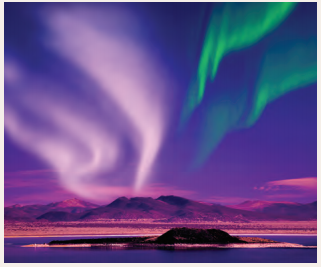
(i) Identify the natural phenomenon shown in the picture.
Answer:
The picture shows an Aurora (Aurora Borealis or Aurora Australis).
(ii) In which layer of the atmosphere does this phenomenon occur?
Answer:
It occurs in the thermosphere.
(iii) Explain how these are formed.
Answer:
Auroras are formed when charged particles from the Sun interact with gases in the Earth’s upper atmosphere near the North and South Poles. This interaction produces colourful displays of light called Aurora Borealis in the Northern Hemisphere and Aurora Australis in the Southern Hemisphere.
Class 9 Atmosphere and Climate Extra Questions for Practice
Multiple Choice Questions
Question 1.
Which gas helps in cloud formation andprecipitation?
(a) Oxygen
(b) Nitrogen
(c) Watervapour
(d) Argon
Question 2.
Which layer of the atmosphere extends from about 80 km to 700 km?
(a) Troposphere
(b) Mesosphere
(c) Thermosphere
(d) Exosphere
Question 3.
Which of the following is associated with clear and sunny weather?
(a) Low pressure
(b) High pressure
(c) Humidity
(d) Rainfall
Question 4.
Which traditional Indian season corresponds to July-August?
(a) Vasanta
(b) Grishma
(c) Varsha
(d) Hemanta
Question 5.
Which coast receives significant rainfall from the North-East Monsoon?
(a) Gujarat Coast
(b) Konkan Coast
(c) Tamil Nadu Coast
(d) Kerala Coast
Question 6.
Which of the following is a greenhouse gas mentioned in the chapter?
(a) Hydrogen
(b) Methane
(c) Neon
(d) Helium
Assertion & Reason Questions
Question 1.
Assertion (A): The north-east monsoon is important for Tamil Nadu.
Reason (R): The north-east monsoon winds pick up moisture from the Bay of Bengal before reaching the eastern coast.
(a) Both (A) and (R) are true, and (R) is the correct explanation of (A).
(b) Both (A) and (R) are true, but (R) is not the correct explanation of (A).
(c) (A) is true, but (R) is false.
(d) (A) is false, but (R) is true.
Fill in the blanks
1. The boundary between the stratosphere and mesosphere is called the __________________
2. Auroras are seen in the __________________
3. The south-west monsoon is also known as the __________________
4. The Arabic word from which monsoon is derived is __________________
5. The movement of air from high pressure to low pressure is called __________________
Very Short Answer Type Questions
Question 1.
Name any two gases present in small quantities in the atmosphere.
Question 2.
What is the transition zone between the troposphere and stratosphere called?
Question 3.
Which monsoon is called the winter monsoon?
Question 4.
Name one local wind that affects coastal regions.
Question 5.
What is the full form of IMD?
Short Answer Type Questions
Question 1.
Why is water vapour important in the atmosphere?
Question 2.
How does the ozone layer help living organisms?
Question 3.
Why does temperature decrease from the Equator towards the poles?
Question 4.
What are the two major types of monsoon winds in India?
Question 5.
Mention any two consequences of climate change.
Long Answer Type Questions
Question 1.
Explain the role of the thermosphere in the atmosphere.
Question 2.
Describe the four main seasons recognised by the IMD.
Question 3.
Explain the difference between weather and climate.
Question 4.
Explain the causes of the Punjab Floods 2025 mentioned in the case study.
Question 5.
Suggest five measures to reduce carbon footprint.