Practicing Class 7 Maths MCQ and Class 7 Maths Chapter 2 Arithmetic Expressions MCQ Questions Online Test with Answers daily helps in time management.
MCQ on Arithmetic Expressions Class 7
Arithmetic Expressions MCQ Class 7
Class 7 Maths MCQ Chapter 2 Arithmetic Expressions
Multiple Choice Questions
Question 1.
What is the value of the expression 12 ÷ 4?
(a) 3
(b) 4
(c) 5
(d) 6
Answer:
(a) 3
Question 2.
Which is the largest value?
(a) 6 × 7
(b) 8 + 10
(c) 72 ÷ 2
(d) 45 – 2
Answer:
(d) 45 – 2
Question 3.
Which of the following expressions hasa smaller value than the expression 4 × 9?
(a) 5 × 10
(b) 64 + 12
(c) 40 – 5
(d) 250 ÷ 2
Answer:
(c) 40 – 5

Question 4.
Which of these is not equal to 12?
(a) 2 × 6
(b) 4 × 8
(c) 72 ÷ 6
(d) 18 + (-6)
Answer:
(b) 4 × 8
Question 5.
Which of the following expressions has the smallest value?
(a) 48 ÷ 6
(b) 4 × 3
(c) 19 – 10
(d) 9 + 1
Answer:
(a) 48 ÷ 6
Question 6.
What is the expression for ‘6 more than twice 4’?
(a) 6 + 4 × 2
(b) 2 × 4 + 6
(c) 4 + 6 × 2
(d) 2 + 6 × 4
Answer:
(b) 2 × 4 + 6
Question 7.
Which pair of expressions is equal in value?
(a) 6 × 5 and 5 × 6
(b) 20 – 5 + 3 and 20 – 5 – 3
(c) 2 + 3 × 4 and 2 × 3 + 4
(d) 30 – 10 – 5 and 30 – 10 + 5
Answer:
(a) 6 × 5 and 5 × 6
Question 8.
What is the correct way to evaluate 35 + 4 × 3?
(a) Add first, then multiply
(b) Multiply first, then add
(c) Do both together
(d) None of these
Answer:
(b) Multiply first, then add
Question 9.
What are the terms in the expression 48 – 13 + 5?
(a) 48, 13, 5
(b) 48, -13, 5
(c) 48, 13
(d) 13, 5
Answer:
(b) 48, -13, 5
Question 10.
Which expression does not give a value of 34?
(a) 7 × 4 + 6
(b) 4 × 8 + 2
(c) 3 × 10 + 4
(d) 6 × 5 + 5
Answer:
(d) 6 × 5 + 5
Question 11.
In the expression (5 + 3) × 6, which operation is done first?
(a) 5 + 3
(b) 6 × 3
(c) 6 + 5
(d) 5 × 6
Answer:
(a) 5 + 3
Question 12.
What is the value of 6 + 3 × (4 + 2)?
(a) 54
(b) 24
(c) 30
(d) 15
Answer:
(b) 24
Question 13.
Which expression represents a situation where someone groups 4 marbles in each bag and has 6 bags, plus 7 loose marbles?
(a) 4 × (6 + 7)
(b) 4 + 6 × 7
(c) 4 × 6 + 7
(d) (4 + 6) × 7
Answer:
(c) 4 × 6 + 7
Question 14.
A container has x litres of water. If 3 such containers are used and 5 litres are spilled, what is the expression for the remaining water?
(a) 3x – 5
(b) x – 5
(c) 3(x – 5)
(d) x + 3 – 5
Answer:
(a) 3x – 5
Question 15.
In the expression 10 + (4 + 9), which property is applied when we regroup as (10 + 4) + 9?
(a) Commutative Property
(b) Associative Property
(c) Distributive Property
(d) Substitution Property
Answer:
(b) Associative Property
Question 16.
What is the value of the expression 6 – (3 – 8)?
(a) 11
(b) 1
(c) -5
(d) 5
Answer:
(a) 11
Question 17.
Which of these shows is correct?
(a) 4 × (6 + 3) = 4 × 6 + 4 × 3
(b) 5 × 7 = 5 + 5 + 5 + 5 + 5 + 5 + 5
(c) 2 × (9 – 5) = 2 × 9 + 9 × 5
(d) None of these
Answer:
(a) 4 × (6 + 3) = 4 × 6 + 4 × 3
Question 18.
What is 6 × (10 – 2)?
(a) 60 – 2
(b) 60 – 12
(c) 60 – 48
(d) 60 – 8
Answer:
(b) 60 – 12
Question 19.
What is the first step in simplifying the expression 3 + 4 × (2 – 1)?
(a) Multiply 4 by 2
(b) Add 3 and 4
(c) Subtract 1 from 2
(d) Multiply 4 by 1
Answer:
(c) Subtract 1 from 2
Question 20.
What is the value of 3 × (5 – 2) + 7?
(a) 21
(b) 13
(c) 16
(d) 19
Answer:
(c) 16
Question 21.
Which of the following is not true?
(a) 14 × 20 – 6 × 20 = (14 – 6) × 20
(b) (10 + 9) × 55 = 10 × 55 + 9 × 55
(c) 75 × 4 + 75 × 3 = 75 × (4 + 3)
(d) 2 × (46 + 24) = 2 × 46 + 24 × 2
Answer:
(c) 75 × 4 + 75 × 3 = 75 × (4 + 3)
Question 22.
Which expression correctly shows the difference between the two products 14 × 10 and 6 × 10?
(a) (14 + 6) × 10
(b) (14 – 6) × 10
(c) (6 × 14) – 10
(d) 14 + 6 × 10
Answer:
(b) (14 – 6) × 10
Question 23.
In the expression 45 + 3 × 7, which operation is performed first?
(a) Addition
(b) Multiplication
(c) Subtraction
(d) None of these
Answer:
(b) Multiplication
Question 24.
What is the value of the expression 20 – (4 + 5)?
(a) 11
(b) 15
(c) 9
(d) 18
Answer:
(a) 11
Question 25.
What is the value of 5 × (3 + 2)?
(a) 15
(b) 25
(c) 20
(d) 10
Answer:
(b) 25
Question 26.
Which of the following is correct?
(a) 40 – (15 + 5) = 20
(b) 4 × (5 – 6) = 44
(c) 6 × 7 = 49
(d) 3 + 6 × 2 = 18
Answer:
(a) 40 – (15 + 5) = 20
Question 27.
Which expression correctly applies the distributive property?
(a) 4 × (6 – 2) = 4 × 6 – 4 × 2
(b) 3 + (5 × 4) = 8 × 4
(c) 2 × 3 + 4 = 14
(d) 5 × (2 + 3) = 10 + 3
Answer:
(a) 4 × (6 – 2) = 4 × 6 – 4 × 2
Question 28.
What is (64 ÷ 8) + 3 × 2?
(a) 17
(b) 13
(c) 11
(d) 14
Answer:
(d) 14
Question 29.
Choose the expression with the highest value.
(a) 10 + 25
(b) 5 × 8
(c) 70 – 10
(d) 7 × 7
Answer:
(c) 70 – 10
Assertion-Reason Based Questions
Study the Assertion (A) and Reason (R) statements given below and choose the correct alternative.
Question 1.
Assertion (A): 45 – 15 + 10 equals 40.
Reason (R): Operators must be done from left to right when not using brackets in addition and subtraction.
(a) Both A and R are true, and R is the correct explanation of A.
(b) Both A and R are true, but R is not the correct explanation of A.
(c) A is true but R is false.
(d) A is false, but R is true.
Answer:
(a) Both A and R are true, and R is the correct explanation of A.
Question 2.
Assertion (A): 30 – 15 equals 20.
Reason (R): Subtraction is the process of finding the difference between two numbers.
(a) Both A and R are true, and R is the correct explanation of A.
(b) Both A and R are true, but R is not the correct explanation of A.
(c) A is true but R is false.
(d) A is false, but R is true.
Answer:
(d) A is false, but R is true.
Question 3.
Assertion (A): 3 × 84 ÷ 2 = 3 × 42 = 126
Reason (R): Multiplication is always performed before division.
(a) Both A and R are true, and R is the correct explanation of A.
(b) Both A and R are true, but R is not the correct explanation of A.
(c) A is true but R is false.
(d) A is false, but R is true.
Answer:
(c) A is true but R is false.
Question 4.
Assertion (A): 3 × 7 + 4 gives the same value as 4 + 3 × 7.
Reason (R): An arithmetic expression is defined as a combination of numbers and arithmetic operators.
(a) Both A and R are true, and R is the correct explanation of A.
(b) Both A and R are true, but R is not the correct explanation of A.
(c) A is true but R is false.
(d) A is false, but R is true.
Answer:
(b) Both A and R are true, but R is not the correct explanation of A.
Question 5.
Assertion (A): The expression 6 × 5 + 3 has only two terms.
Reason (R): Multiplication does not create separate terms unless followed or preceded by a ‘+’ or a sign.
(a) Both A and R are true, and R is the correct explanation of A.
(b) Both A and R are true, but R is not the correct explanation of A.
(c) A is true but R is false.
(d) A is false, but R is true.
Answer:
(a) Both A and R are true, and R is the correct explanation of A.
Question 6.
Assertion (A): In the expression 9 – (4 + 5), the value inside the parentheses should be calculated first.
Reason (R): The rule for solving expressions is that subtraction always comes before multiplication.
(a) Both A and R are true, and R is the correct explanation of A.
(b) Both A and R are true, but R is not the correct explanation of A.
(c) A is true but R is false.
(d) A is false, but R is true.
Answer:
(c) A is true but R is false.
Question 7.
Assertion (A): An expression involving only addition can be evaluated in any order.
Reason (R): The commutative property of addition ensures the sum remains unchanged regardless of the order.
(a) Both A and R are true, and R is the correct explanation of A.
(b) Both A and R are true, but R is not the correct explanation of A.
(c) A is true but R is false.
(d) A is false, but R is true.
Answer:
(a) Both A and R are true, and R is the correct explanation of A.
Question 8.
Assertion (A): 2 × (5 + 3) = 2 × 5 + 2 × 3.
Reason (R): The multiple of a sum is the same as the sum of the multiples.
(a) Both A and R are true, and R is the correct explanation of A.
(b) Both A and R are true, but R is not the correct explanation of A.
(c) A is true but R is false.
(d) A is false, but R is true.
Answer:
(a) Both A and R are true, and R is the correct explanation of A.
Question 9.
Assertion (A): The expression 60 + (30 – 10) becomes 60 – 30 + 10.
Reason (R): Brackets can be removed by changing signs when preceded by a minus.
(a) Both A and R are true, and R is the correct explanation of A.
(b) Both A and R are true, but R is not the correct explanation of A.
(c) A is true but R is false.
(d) A is false, but R is true.
Answer:
(d) A is false, but R is true.
Question 10.
Assertion (A): (15 – 5) × 2 = 15 × 2 – 5 × 2.
Reason (R): The Distributive property states that changing the order of the terms does not change the sum.
(a) Both A and R are true, and R is the correct explanation of A.
(b) Both A and R are true, but R is not the correct explanation of A.
(c) A is true but R is false.
(d) A is false, but R is true.
Answer:
(c) A is true but R is false.
Question 11.
Assertion (A): In the expression a + (b × c), you should add a and b first.
Reason (R): Addition has lower precedence than multiplication.
(a) Both A and R are true, and R is the correct explanation of A.
(b) Both A and R are true, but R is not the correct explanation of A.
(c) A is true but R is false.
(d) A is false, but R is true.
Answer:
(d) A is false, but R is true.
Fill in the blanks.
1. An _____________ is a mathematical phrase that uses numbers and arithmetic operators (such as addition, subtraction, multiplication, and division) to calculate a value.
Answer: Arithmetic Expression
2. The expression 17 + 3 evaluates to _____________
Answer: 20
3. 21 ÷ 7 can be read as _____________
Answer: Division of 21 by 7
4. The product of 6 and 4 is _____________
Answer: 24
5. 14 – 9 is _____________ than 3 × 2.
Answer: less
6. Expressions can be compared using symbols like _____________, _____________, and _____________
Answer: <, >, =
7. 81 ÷ _____________ = 3 × 3.
Answer: 9
8. 9 × 5 is _____________ than 8 × 6.
Answer: less
9. Write two different expressions equal to 36 using atleast two operations. _____________
Answer: 12 × 3, 10 × 3 + 6
10. Write two expressions using different operators but having the same value _____________
Answer: 32 ÷ 8 + 3, 10 × 2 – 13
11. In 45 + 3 × 7, we do _____________ first.
Answer: Multiplication
12. The expression (12 + 4 × 3 – 6) ÷ 2 evaluates to _____________
Answer: 9
13. 100 – (25 + 15) simplifies to _____________
Answer: 60
14. In 50 – 18, the terms are _____________ and _____________
Answer: 50, -18
15. The expression -21 – 4 can be rewritten as the sum _____________ + _____________
Answer: -21, -4
16. The value of (30 + 5) × 2 is _____________
Answer: 70
17. 12 × 2 – (6 + 4) + 3 equals _____________
Answer: 17
18. 2 × (12 + 8) = _____________ + _____________
Answer: 2 × 12, 2 × 8
19. 4 × (7 – 3) = _____________ – _____________
Answer: 4 × 7, 4 × 3
20. When a minus sign comes before a bracket, each term inside the bracket must be written with the _____________ sign.
Answer: Opposite
21. 10 × 98 + 3 × 98 = (_____________ + _____________) × 98
Answer: 10, 3
22. (25 – 10) × 3 = _____________ – _____________
Answer: 25 × 3, 10 × 3
23. The multiple of a sum is the same as the _____________ of the multiples.
Answer: Sum
Compare and write ‘<‘, ‘>’ or ‘=’.
1. 3 × 8 _____________ 2 × 13
Answer: <
2. 64 ÷ 8 _____________ 7 + 1
Answer: =
3. 356 + 428 _____________ 355 + 429
Answer: =
4. 699 – 325 _____________ 700 – 324
Answer: <
5. 100 ÷ 10 _____________ 5 × 2
Answer: =
6. 533 – 186 _____________ 532 – 186
Answer: >
7. 1023 + 125 _____________ 1022 + 128
Answer: <
8. 113 – 25 _____________ 112 – 24
Answer: =
9. 245 + 289 _____________ 246 + 285
Answer: >
10. 213 – 77 _____________ 214 – 76
Answer: <
11. (15 – 10) × 14 _____________ 14 × (10 – 15)
Answer: >
12. (63 – 48) × 22 _____________ 22 × (48 – 63)
Answer: >
13. 25 × (40 + 18) _____________ 25 × (41 + 17)
Answer: =
14. 35 × (30 – 18) _____________ 34 × (29 – 17)
Answer: >
15. (12 – 6) × 18 _____________ 18 × (6 – 12)
Answer: >
State whether the following statements are True or False.
1. Different expressions can never give the same value.
Answer: False
2. 14 + 3 = 12 + 4.
Answer: False
3. If Rani saves ₹ 50 each day, then in 7 days she will have saved ₹ 350.
Answer: True
4. The expression 7 + 8 means ‘the product of 7 and 8’.
Answer: False
5. The expression 100 – 25 gives a value greater than 25 + 25.
Answer: True
6. The value of the expression 18 ÷ 3 is 6.
Answer: True
7. Expressions 8 + 7 and 5 + 10 have equal value.
Answer: True
8. Terms are the parts of an expression separated by a ‘+’ sign.
Answer: True
9. Brackets are always solved last in a mathematical expression.
Answer: False
10. The value of (10 – 3) × 2 is 14.
Answer: True
11. The terms in the expression 5 – 3 are 5 and 3.
Answer: False
12. In the expression 5 + 6 × 2 – 3, subtraction is performed before multiplication.
Answer: False
13. The commutative property of multiplication means (3 × 4) × 5 = 3 × (4 × 5).
Answer: False
14. The expression 18 ÷ 3 + 2 × 4 simplifies to 18 when following the correct order of operations.
Answer: False
15. The multiple of a sum (difference) is the same as the sum (difference) of the multiples.
Answer: True
16. 8 × (5 – 2) = 8 × 5 – 8 × 2.
Answer: True
17. Removing brackets changes the signs if preceded by a minus.
Answer: True
18. 5 × (4 – 1) is equal to 15.
Answer: True
19. 100 – (40 + 20) = 100 – 40 – 20
Answer: True
Match the Following Table.
Question 1.
| Expression | Statements |
| (i) 5 × 3 + 4 | (a) The total cost of 8 items costing ₹ 10 each, minus ₹ 25. |
| (ii) 8 × 10 – 25 | (b) A group of 5 students, each having 3 candies and 4 extra candies. |
| (iii) 12 ÷ 3 + 2 | (c) 9 boxes with 5 toys in each box, plus 8 extra toys. |
| (iv) 7 × 6 + 5 | (d) 7 bags with 6 apples in each bag, plus 5 more apples. |
| (v) 15 – (4 × 2) | (e) A team of 12 players divided into groups of 3, with 2 players left out. |
| (vi) 9 × 5 + 8 | (f) Ravi had 15 pencils. He gave 4 of his friends 2 pencils each. |
Answer:
| Expression | Statements |
| (i) 5 × 3 + 4 | (b) A group of 5 students, each having 3 candies and 4 extra candies. |
| (ii) 8 × 10 – 25 | (a) The total cost of 8 items costing ₹ 10 each, minus ₹ 25. |
| (iii) 12 ÷ 3 + 2 | (e) A team of 12 players divided into groups of 3, with 2 players left out. |
| (iv) 7 × 6 + 5 | (d) 7 bags with 6 apples in each bag, plus 5 more apples. |
| (v) 15 – (4 × 2) | (f) Ravi had 15 pencils. He gave 4 of his friends 2 pencils each. |
| (vi) 9 × 5 + 8 | (c) 9 boxes with 5 toys in each box, plus 8 extra toys. |
Case-Based Questions
Question 1.
A school is planning a trip for its students. The school needs to arrange transport. Each bus can carry 40 students, and 5 buses have been booked for the trip. Also, 10 students will travel in private cars.
Based on the above information, solve the following questions.
(i) Write an expression to represent the total number of students going on the trip by bus.
(ii) How many students are going on the trip by bus?
(iii) If 2 more students decide to travel by private cars, how many students will now travel in total?
(iv) If the school adds 2 more buses, how many total students can now travel by bus?
Answer:
(i) 5 × 40
(ii) 200
(iii) 212
(iv) 280
Question 2.
A bookshop sells books in different genres. The shop has 8 genres of books, with each genre having 5 books. Additionally, there are 10 extra books on display in the shop.
Based on the above information, solve the following questions.
(i) How many books are there in each genre?
(ii) What is the total number of books in the shop?
(a) 40
(b) 50
(c) 60
(d) 70
(iii) If 5 books are sold, how many books will remain in the shop?
(iv) If 3 more genres of books are added to the shop, how many books will there be in total?
Answer:
(i) 5
(ii) (b) 50
(iii) 45
(iv) 65
Complete the following table.
Question 1.

Answer:
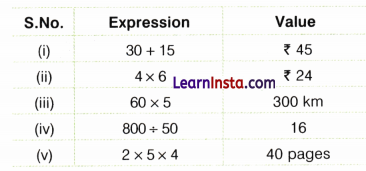
Question 2.

Answer:
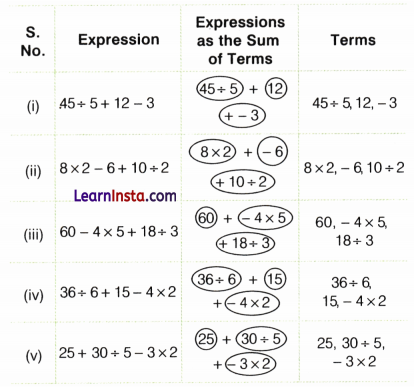
Question 3.

Answer:
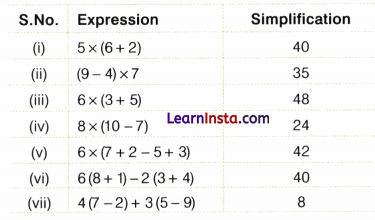
Very Short Answer Type Questions
Question 1.
What is the inverse of -12?
Answer:
12
Question 2.
Write the value of 6 + (4 × 3).
Answer:
18
Question 3.
What is 100 – (40 + 30)?
Answer:
30
Question 4.
Which operator is performed last in the expression 4 + 6 × (7 – 5)?
Answer:
Addition
Question 5.
Simplify 3 × (2 + 1).
Answer:
9
Question 6.
Find an effective way of evaluating 84 × 36. Also, find the value.
Answer:
3024
Short Answer Type Questions
Question 1.
Use the distributive property to simplify 5 × (4 + 3).
Answer:
35
Question 2.
Write an expression for the total cost of 3 books, each costing ₹ 50, and evaluate it.
Answer:
3 × 50 = 150
Question 3.
A teacher asked students to arrange themselves in groups of 6. There were 37 students in total, and one student, Alex, decided not to participate. Write the expression for the total number of groups formed and identify the terms.
Answer:
(37 – 1) ÷ 6
Terms (37 – 1), 6
Question 4.
Write two expressions that have the same value as 60 ÷ 3.
Answer:
40 ÷ 2, 80 ÷ 4
Question 5.
Solve the expression (12 + 5) × 3 – 4.
Answer:
(12 + 5) × 3 – 4 = 47
Question 6.
Consider the two expressions
(a) 85 + 15 – 3
(b) 85 + 15 + 3
For each of these expressions, identify the expressions from the following collection that are equal to it.
I. 85 + (15 – 3)
II. 85 – (3 – 15)
III. 85 + (15 + 3)
IV. 85 – (15 + 3)
Answer:
(a) 85 + 15 – 3 = (I) 85 + (15 – 3)
(b) 85 + 15 + 3 = (III) 85 + (15 + 3)
Question 7.
Remove brackets and simplify.
(a) 100 – (35 + 15)
(b) 50 – (20 – 5)
(c) (8 + 6) × 2
Answer:
(a) 50
(b) 35
(c) 28
Question 8.
Compare the expressions without solving completely.
(a) 13 + 24 _____________ 14 + 23
(b) 7 × 8 _____________ 6 × 9
Answer:
(a) 13 + 24 = 14 + 23
(b) 7 × 8 > 6 × 9
Question 9.
A farmer planted 15 rows of tomato plants, with 10 plants in each row. He already had 5 rows of plants from the previous year. Write an expression for the total number of plants and identify its terms.
Answer:
15 × 10 + 5 = 155
Question 10.
In a school play, there are two groups of students-actors and dancers. The actors are arranged in 5 rows with 4 actors in each row, while the dancers are arranged in 3 rows with 4 dancers in each row. How many actors and dancers are there in total?
Answer:
Actors: 5 × 4 = 20
Dancers: 3 × 4 = 12
Total = 20 + 12 = 32
Question 11.
Lina has a job where she earns ₹ 30,000 per month. She spends ₹ 10,000 on rent, ₹ 7,000 on groceries and ₹ 3,000 on transportation every month. How much will Lina save in six months? Write the appropriate expression and then find the value of the expression.
Answer:
30,000 – (10,000 + 7,000 + 3,000) × 6; ₹ 60,000
Question 12.
Find different ways of evaluating the following expressions.
(a) 2 – 3 + 4 – 5 + 6 – 7 + 8 – 9 + 10 – 11
(b) 5 – 5 + 5 – 5 + 5 – 5 + 5 – 5 + 5 – 5
(c) 7 – 8 + 9 – 10 + 11 – 12 + 13 – 14 + 15 – 16
Answer:
(a) -5
(b) 0
(c) -5
Long Answer Type Questions
Question 1.
Solve and explain step-by-step.
(a) 5 × (9 + 11)
(b) 100 – (25 + 30)
(c) 3 × (4 + 6) – 8
Answer:
(a) 5 × (9 + 11) = 100
(b) 100 – (25 + 30) = 45
(c) 3 × (4 + 6) – 8 = 22
Question 2.
A tank holds 120 litres of water. If each bucket removes 15 litres, how many buckets are needed to remove all the water? Write an expression to represent this scenario and solve it. If each bucket could only remove 10 litres of water instead of 15 litres, how many buckets would be needed to remove all the water from the tank? Show your calculations.
Answer:
8 buckets; 12 buckets
Question 3.
Using the distributive property, simplify the expression 5 × (3 + 8) – 4 × (6 – 2). Show all steps in detail.
Answer:
5 × (3 + 8) – 4 × (6 – 2) = 39