Practicing Class 7 Maths MCQ and Class 7 Maths Chapter 7 A Tale of Three Intersecting Lines MCQ Questions Online Test with Answers daily helps in time management.
MCQ on A Tale of Three Intersecting Lines Class 7
A Tale of Three Intersecting Lines MCQ Class 7
Class 7 Maths MCQ Chapter 7 A Tale of Three Intersecting Lines
Multiple Choice Questions
Question 1.
What is the name of the triangle whose two angles are 40° and 70°?
(a) Scalene
(b) Obtuse
(c) Isosceles
(d) Equilateral
Answer:
(c) Isosceles
Question 2.
A triangle with all three sides of equal length is called a/an
(a) scalene triangle
(b) isosceles triangle
(c) equilateral triangle
(d) right-angled triangle
Answer:
(c) equilateral triangle

Question 3.
Which of the following is NOT a type of triangle based on its sides?
(a) Scalene triangle
(b) Isosceles triangle
(c) Equilateral triangle
(d) Right-angled triangle
Answer:
(d) Right-angled triangle
Question 4.
Which of the following statements is true about an equilateral triangle?
(a) All sides are of different lengths.
(b) It has one right angle.
(c) All sides are of equal length.
(d) It has two sides of equal length.
Answer:
(c) All sides are of equal length.
Question 5.
The lengths of two sides of an isosceles triangle are 5 cm and 12 cm. The length of the third side is
(a) 12 cm
(b) 5 cm
(c) 17 cm
(d) 6 cm
Answer:
(a) 12 cm
Question 6.
Which of the following is not a set of measures of the sides of a triangle?
(a) 7 cm, 3 cm, 5 cm
(b) 8 cm, 12 cm, 18 cm
(c) 5 cm, 6 cm, 14 cm
(d) 5 cm, 12 cm, 15 cm
Answer:
(c) 5 cm, 6 cm, 14 cm
Question 7.
Which of the following best defines an exterior angle of a triangle?
(a) An angle formed inside the triangle.
(b) An angle formed by extending one side of the triangle.
(c) An angle that is the supplement of an interior angle.
(d) An angle formed by bisecting an interior angle.
Answer:
(b) An angle formed by extending one side of the triangle.
Question 8.
If one exterior angle of a triangle is 120°, then what is the sum of the two remote interior angles?
(a) 60°
(b) 90°
(c) 120°
(d) 180°
Answer:
(c) 120°
Question 9.
In ∆ABC, if the exterior angle at vertex A is 110° and the interior angle at vertex B is 40°, then what is the measure of the interior angle at vertex C?
(a) 30°
(b) 40°
(c) 70°
(d) 60°
Answer:
(c) 70°
Question 10.
Which of the following is true about the exterior angle?
(a) The exterior angle is equal to the sum of the interior angles.
(b) The exterior angle is equal to the difference between the interior angles.
(c) The exterior angle is equal to the sum of the two remote interior angles.
(d) The exterior angle is equal to twice the interior angle.
Answer:
(c) The exterior angle is equal to the sum of the two remote interior angles.
Question 11.
What is the sum of the interior angles of any triangle?
(a) 90°
(b) 180°
(c) 270°
(d) 360°
Answer:
(b) 180°
Question 12.
If two angles of a triangle are 45° and 55°, then what is the measure of the third angle?
(a) 70°
(b) 80°
(c) 90°
(d) 100°
Answer:
(b) 80°
Question 13.
If the interior angles of a triangle are in the ratio 2 : 3 : 4, then what are the measures of the angles?
(a) 20°, 30° and 40°
(b) 40°, 60° and 80°
(c) 45°, 60° and 75°
(d) 60°, 80° and 100°
Answer:
(b) 40°, 60° and 80°
Question 14.
If one angle of a triangle is 65° and the other two angles are in the ratio 2 : 3, then the other two angles are
(a) 40°, 65°
(b) 46°, 69°
(c) 61°, 44°
(d) None of these
Answer:
(b) 46°, 69°
Question 15.
The sides of a triangle have lengths (in cm) 10, 6.5, and a, where a is a whole number. The minimum value of a is
(a) 6
(b) 5
(c) 3
(d) 4
Answer:
(d) 4
Question 16.
In the given figure, PQ = PS. The value of x is
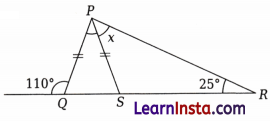
(a) 35°
(b) 45°
(c) 55°
(d) 70°
Answer:
(b) 45°
Question 17.
In an ∆ABC, which of the given conditions holds?
(a) AB – BC > CA
(b) AB + BC < CA
(c) AB – BC < CA
(d) AB + CA > BC
Answer:
(d) AB + CA > BC
Question 18.
In the three angles of a triangle, one is twice the smallest and another is three times the smallest. The angles are
(a) 30°, 40° and 90°
(b) 30°, 60° and 90°
(c) 20°, 60° and 100°
(d) 50°, 100° and 30°
Answer:
(b) 30°, 60° and 90°
Assertion-Reason Based Questions
Study the Assertion (A) and Reason (R) statements given below and choose the correct alternative.
Question 1.
Assertion (A): The sum of the interior angles of any triangle is always 180°.
Reason (R): This property holds regardless of the type of triangle.
(a) Both (A) and (R) are true, and (R) is the correct explanation of (A).
(b) Both (A) and (R) are true, but (R) is not the correct explanation of (A).
(c) (A) is true, but (R) is false.
(d) (A) is false, but (R) is true.
Answer:
(b) Both (A) and (R) are true, but (R) is not the correct explanation of (A).
Question 2.
Assertion (A): In an equilateral triangle, the measures of each angle are 60°.
Reason (R): The sum of the angles in a triangle is 180°, and in an equilateral triangle, all angles are equal.
(a) Both (A) and (R) are true, and (R) is the correct explanation of (A).
(b) Both (A) and (R) are true, but (R) is not the correct explanation of (A).
(c) (A) is true, but (R) is false.
(d) (A) is false, but (R) is true.
Answer:
(a) Both (A) and (R) are true, and (R) is the correct explanation of (A).
Fill in the blanks.
1. There are ____________ sides in a triangle.
Answer: Three
2. There are ____________ vertices in a triangle.
Answer: Three
3. The total number of sides and vertices in a triangle is ____________
Answer: Six
4. Angle opposite to the side AC of ∆ABC is ____________
Answer: ∠B
5. Side opposite to the vertex R of ∆PQR is ____________
Answer: PQ
6. The perpendicular line segment from a vertex to its opposite side is called the ____________ of the triangle.
Answer: Altitude
7. The sum of the lengths of any two sides of a triangle is ____________ than the length of the third side.
Answer: Greater
8. Write the value of p in the given blank spaces.

Answer:
(i) 110°
(ii) 60°
(iii) 130°
(iv) 25°
9. Write the value of p in the given blank spaces.

Answer:
(i) 70°
(ii) 60°
(iii) 65°
(iv) 40°
10. An exterior angle of a triangle is equal to the sum of its two ____________ opposite interior angles.
Answer: Interior
11. Two interior opposite angles of an exterior angle of a triangle are 40° and 35°. The measure of the exterior angle is ____________
Answer: 75°
12. An exterior angle of a triangle is of measure 145°, and one of its interior opposite angles is of measure 85°. The measure of the other interior angle is ____________
Answer: 60°
13. If the exterior angle is acute, then each opposite interior angle is an ____________ angle.
Answer: Acute
14. If the exterior angle is a right angle, then each opposite interior angle is a ____________ angle.
Answer: Acute
15. In a triangle, the measures of two angles are 105° and 25°. Then, the measure of the third angle of the triangle is ____________
Answer: 50°
16. If the measure of each of the two equal angles of a triangle is 45°, then the measure of the third angle of the triangle is ____________
Answer: 90°
17. If the ratio of three angles of a triangle is 1 : 2 : 3, then the measure of the smallest angle of the triangle is ____________
Answer: 30°
18. In a triangle, the measure of one of the angles is 60° and the measure of one of the other two angles is half of the other. The measure of the smallest angle of the triangle is ____________
Answer: 40°
19. Observe the given triangles and write the value of angle p in the given blank spaces.

Answer:
(i) 45°
(ii) 25°
(iii) 60°
(iv) 80°
(v) 70°
(vi) 45°
20. Write the values of x and y, respectively, in the given blank spaces.

Answer:
(i) 50° and 90°
(ii) 70° and 70°
(iii) 110° and 70°
(iv) 45° and 75°
State whether the following statements are True or False.
1. The vertices of a triangle are three collinear points.
Answer: False
2. A triangle has four sides.
Answer: False
3. A triangle is said to be equilateral if each of its sides has the same length.
Answer: True
4. A triangle is said to be isosceles if any two of its sides are of the same length.
Answer: True
5. There is a triangle whose two altitudes are two of its sides.
Answer: True
6. In a scalene triangle, each angle has ma easure of 60°.
Answer: False
7. In an isosceles triangle, the sum of the lengths of any two sides is greater than the length of the third side.
Answer: True
8. The exterior angle of a triangle is equal to the sum of the two opposite interior angles.
Answer: True
9. Every triangle has six exterior angles, two at each vertex.
Answer: False
10. The exterior angle is always greater than each of the interior opposite angles.
Answer: True
11. An exterior angle can be less than an interior angle of a triangle.
Answer: False
12. The sum of the three interior angles of a triangle is always 180°.
Answer: True
13. If one angle of a triangle is 90°, then the sum of other two angles must be 90°.
Answer: True
14. The angle sum property holds for all types of triangles, including scalene, isosceles, and equilateral triangles.
Answer: True
15. In a triangle, if two angles are known, then the third angle can be found using the angle sum property.
Answer: True
16. The angle sum property is only applicable to right-angled triangles.
Answer: False
Match the columns.
Question 1.
| Column I | Column II |
| (i) Equilateral triangle | (a) One angle is exactly 90° |
| (ii) Isosceles triangle | (b) All sides are of equal length |
| (iii) Scalene triangle | (c) Two sides are of equal length |
| (iv) Right-angled triangle | (d) Line segment from a vertex perpendicular to the opposite side |
| (v) Altitude | (e) All sides are of different lengths |
Answer:
| Column I | Column II |
| (i) Equilateral triangle | (b) All sides are of equal length |
| (ii) Isosceles triangle | (c) Two sides are of equal length |
| (iii) Scalene triangle | (e) All sides are of different lengths |
| (iv) Right-angled triangle | (a) One angle is exactly 90° |
| (v) Altitude | (d) Line segment from a vertex perpendicular to the opposite side |
Case-Based Questions
Question 1.
In a craft class, students were asked to cut different triangles from coloured paper to make a picture.
Add three triangles
Triangle A: All three sides are of equal length, 5 cm each.
Triangle B: Two sides are 6 cm, and the third side is 4 cm.
Triangle C: The sides are 3 cm, 4 cm, and 8 cm.
Based on the above information, answer the following questions.
(i) Which type of triangle is Triangle A?
(ii) Which type of triangle is Triangle B?
(iii) Is Triangle C a valid triangle?
(iv) Find the perimeters of Triangle A and Triangle B.
Answer:
(i) Equilateral
(ii) Isosceles
(iii) No
(iv) 15 cm, 16 cm
Complete the following table.
Question 1.
| Types of Triangles | Number of Equal Sides |
| (i) Equilateral triangle | |
| (ii) Isosceles triangle | |
| (iii) Scalene triangle | |
| (iv) Right-angled triangle |
Answer:
| Types of Triangles | Number of Equal Sides |
| (i) Equilateral triangle | 3 |
| (ii) Isosceles triangle | 2 |
| (iii) Scalene triangle | 0 |
| (iv) Right-angled triangle | 0 or 2 |
Very Short Answer Type Questions
Question 1.
If one of the acute angles of a right-angled triangle is 62°. Then, what is the measure of the other acute angle?
Answer:
28°
Question 2.
If two sides of an isosceles triangle are 3 cm and 8 cm, then what is the length of the third side?
Answer:
8 cm
Question 3.
If one of the angles of a triangle has a measure of 100°, and the other two angles are equal. Then, what is the measure of each of the two angles?
Answer:
40°
Question 4.
Find the value of an unknown angle x from the given figure.

Answer:
40°
Question 5.
In the given figure, AB = AC, and BC is extended to the point D. Then, calculate the value of y-x.

Answer:
72
Short Answer Type Questions
Question 1.
Construct an equilateral triangle whose side is 4 cm.
Answer:

Question 2.
Find the number of altitudes in a triangle and draw a rough diagram.
Answer:
2
Question 3.
Find the value of x inthe given figure.

Answer:
70°
Question 4.
In the given figure, find the values of x, y, and z.

Answer:
20°, 130°, 50°
Question 5.
Find the value of ∠A + ∠B + ∠C + ∠D + ∠E + ∠F in the given figure.

Answer:
360°
Question 6.
Find the values of x and y in the given figure.

Answer:
x = 135°, y = 45°
Question 7.
Construct a triangle whose sides are 3 cm, 4 cm, and 5 cm.
Answer:

Long Answer Type Questions
Question 1.
Construct a triangle whose two sides are 4 cm and 5 cm long and one angle is 60°.
Answer:

Question 2.
Find the perimeter of an equilateral triangle whose side is 60 cm long.
Answer:
180 cm
Question 3.
If the angles of the triangle are (x – 40°), (x – 20°), and (\(\frac{1}{2}\)x – 10°), then find the values of all the angles.
Answer:
60°, 80° and 40°
Question 4.
During a school picnic, students decide to set up a triangular play area using ropes. The vertices of the triangular play area are marked as X, Y, and Z. The lengths of the sides are given as follows:
XY = 5 metres, YZ = 12 metres, and XZ = 13 metres.
(A) Calculate the perimeter of the triangular play area XYZ. Show your calculations.
(B) The sum of the interior angles of ΔXYZ is ____________ degrees.
Answer:
(A) 30 m
(B) 180
Activity
Properties of a triangle

Across
3. ____________ is the height if we take the opposite side as the base.
6. A triangle is a ____________ sided polygon.
8. We get an ____________ when we extend any side of the triangle.
9. ____________ is a triangle in which two sides are equal and the base angles opposite to the equal sides are also equal.
10. ____________ is A polygon with the least number of sides.
11. The point where all three medians intersect each other is called ____________
Down
1. The common endpoint of two or more line segments or rays is called ____________
2. A triangle having all sides equal is called a ____________
4. In a right-angled triangle, the sum of the squares of the base and the perpendicular is ____________
5. In a ____________, all three sides are of equal length.
7. A triangle having one angle equal to 90 degrees is called a ____________
Answer:
Across
3. Altitude
6. Three
8. Exterior
9. Isosceles triangle
10. Triangle
11. Centroid
Down
1. Vertex
2. Equilateral triangle
4. (Hypotenuse)2
5. Median
7. Right angle