These Class 7 Science Curiosity Worksheet and Class 7 Science Chapter 1 The Ever Evolving World of Science Worksheet with Answers are excellent for board exam practice.
Class 7 Science Chapter 1 The Ever Evolving World of Science Worksheet
Class 7 The Ever Evolving World of Science Worksheet
Worksheet On The Ever Evolving World of Science Class 7 – The Ever Evolving World of Science Worksheet Class 7
A. Multiple-Choice Questions
Question 1.
Science is best described as
(a) A collection of facts
(b) A way of thinking and discovering
(c) Reading textbooks only
(d) Memorizing experiments
Question 2.
What does Science encourage us to do?
(a) Believe everything we hear
(b) Stop asking questions
(c) Observe, think, and ask questions
(d) Only study living things

Question 3.
How did early humans measure time?
(a) By digital watches
(b) By observing shadows in sunlight
(c) By electric clocks
(d) By listening to birds
Question 4.
This question consists of an Assertion (A) and a Reason (R). Read the Assertion and Reason and choose the appropriate answer.
Assertion (A): Ice melts into water when kept at room temperature.
Reason (R): Melting of ice cannot be reversed.
(a) Both A and R are true, and R is the correct explanation of A.
(b) Both A and R are true, but R is not the correct explanation of A.
(c) A is true but R is false.
(d) A is false, but R is true.
Question 5.
This question consists of an Assertion (A) and a Reason (R). Read the Assertion and Reason and choose the appropriate answer.
Assertion (A): We should step out of the classroom and try activities and experiments.
Reason (R): Doing experiments helps us understand the world better.
(a) Both A and R are true, and R is the correct explanation of A.
(b) Both A and R are true, but R is not the correct explanation of A.
(c) A is true but R is false.
(d) A is false, but R is true.
B. State True (T) or False (F).
1. Science only deals with living things.
2. All changes we observe around us can be reversed.
3. Scientific ideas in one field can inspire questions in another.
4. Early humans used mobile phones to measure time.
5. The movements of the Earth and Moon do not affect our daily lives.
C. Fill in the blanks.
1. Early human used the position of the ____________ and its ____________ to tell the time.
2. Scientific learning is not limited to the classroom; it continues in the ____________ world.
3. As we grow, our ____________ change due to life processes.
4. Light helps us to ____________ and understand our surroundings.
5. The Earth rotates around its ____________ and revolves around the ____________
D. Match the terms given in Column I with their correct descriptions given in Column II.
| Column I | Column II |
| (i) Water Cycle | (a) Ripening of fruits |
| (ii) Reversible Change | (b) Strong desire to learn |
| (iii) Irreversible Change | (c) Supports life |
| (iv) Earth | (d) Continuous movement of water within the Earth and atmosphere |
| (v) Curiosity | (e) Melting of wax |
Wonder Why?
A. Plants can make their food, but animals cannot. Why?
__________________________________________________
__________________________________________________
__________________________________________________
__________________________________________________
B. Why does a battery stop working after some time?
__________________________________________________
__________________________________________________
__________________________________________________
__________________________________________________
C. What causes day and night?
__________________________________________________
__________________________________________________
__________________________________________________
__________________________________________________
D. Read the conversation between Diya and Sana based on their observations.
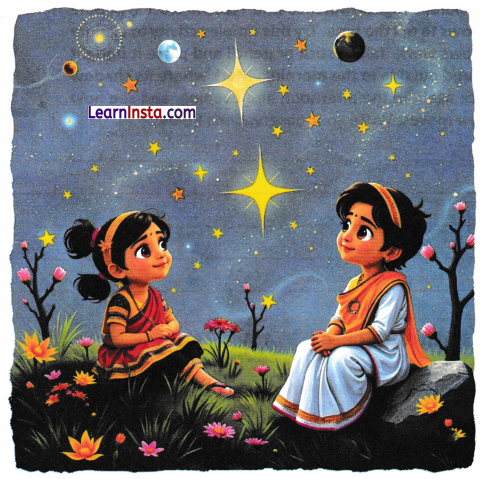
Diya: Hi Sana! I tried counting the stars in the sky, but I could not finish. Can anyone count the number of stars in the sky?
Sana: Hi Diya! No, we cannot count them. There are thousands of stars in the sky.
Diya: That sounds amazing! But why can’t we count them?
Sana: The sky is so big, and some stars are too far or faint to see, making it impossible to count them all.
Answer the following questions based on the above conversation:
Question 1.
What are stars?
__________________________________________________
Question 2.
How do scientists study stars and galaxies?
__________________________________________________
Question 3.
Why do we see stars only at night and not during the day?
__________________________________________________
Learn By Doing
Long ago, before digital watches and electric clocks, people used shadows to tell the time. Try this simple activity to explore how shadows work. Take a stick or pencil and place it upright in the ground outside in the morning. Mark where its shadow falls. Check again in the afternoon and evening, and see how the shadow moves. Write your observations below.
__________________________________________________
__________________________________________________
__________________________________________________
__________________________________________________
__________________________________________________
Explore With Curiosity
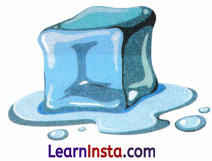
Observe the image and answer the following questions.
Question 1.
What is happening in the picture?
__________________________________________________
__________________________________________________
Question 2.
What kind of change is it?
__________________________________________________
__________________________________________________
Question 3.
Can this change be reversed?
__________________________________________________
__________________________________________________
Word Puzzle
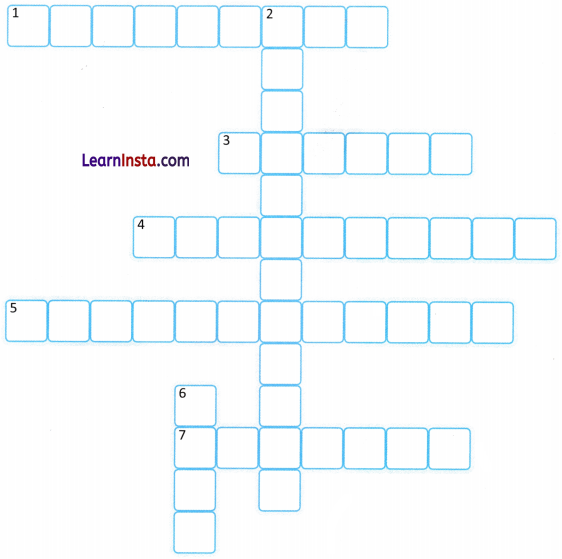
Complete the crossword with the help of the given clues.
Across
1. Strong desire to learn
3. Good conductors of heat and electricity
4. Continuous movement of water through evaporation, condensation, and precipitation
5. Water cools down and changes water into liquid water, forming clouds
7. Sun, Moon, and Earth line up in a straight light
Down
2. Changes that cannot be reversed
6. Form of energy that changes the temperature of a substance
Activities
A. Have you ever wondered why some fruits taste sour? With the help of your elders and teachers, find out why certain foods and fruits are sour. Try to explore the idea of acidity in the foods you eat every day. Make a list of 4-5 sour foods and note what you learned about them.
B. Sometimes you may notice small puddles of water on the road in the morning, but by afternoon, they are gone. This happens because of evaporation. Can you think of other times when water dries up on its own? Make a list of examples of evaporation that you observe in your daily life.
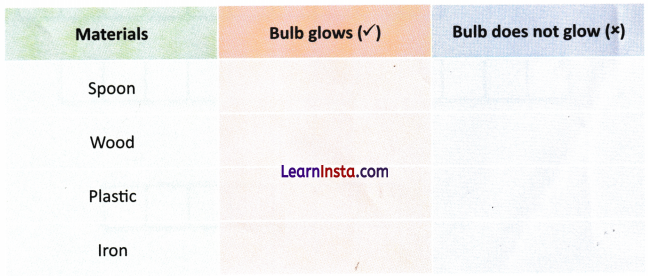
C. Create a simple electric circuit using a battery, a bulb, and wires as shown in the figure. Then, place each of the following materials—spoon, wood, plastic, and iron—one at a time between the ends of the wire. Observe whether the bulb lights up or not.
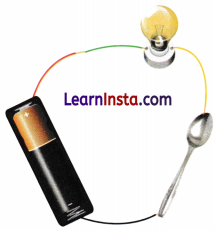
Put a tick (✓) if the bulb glows and a cross (✗) if the bulb does not glow in the appropriate column.