Working through Class 9 English Notes and Class 9 English Kaveri Chapter 6 Twin Melodies Summary in English & Hindi simplifies the understanding of long chapters.
Summary of Twin Melodies Class 9
Twin Melodies Summary Class 9
- ‘Twin Melodies’ follows Shruti Sharma, a young violinist torn between her love for Indo-Western fusion music and her father’s strict belief in classical tradition.
- Across three acts, the chapter shows her fear, confrontation, and final acceptance, leading to understanding and harmony between tradition and change.
About the Author
- Mitra Phukan is an Indian writer, columnist, and cultural commentator known for her works on art, music and society.
Her writing often explores the interaction between tradition and modernity, highlighting human emotions, creativity and changing cultural values.
Main Characters
SHRUTI SHARMA
A young violinist who plays Indo-Western fusion music. She respects tradition but struggles to express her choices to her strict father. She represents courage and self-belief.
GURU NABIN SHARMA
A renowned classical violinist and Shruti’s father. Initially rigid, he later reflects on his past and accepts change.
LEELA DEVI
Shruti’s mother and a mediator. She helps Nabin understand Shruti by reminding him of his own past.

AVINASH
The tabla player who is outspoken and supports Shruti in facing her fears.
IQBAL
The flautist and rehearsal host. Calm and encouraging, he urges Shruti to be honest.
PETER
The keyboard player. Cheerful and supportive, he eases Shruti’s anxiety with humour.
Twin Melodies Summary in English
Act I
A Musical Beginning
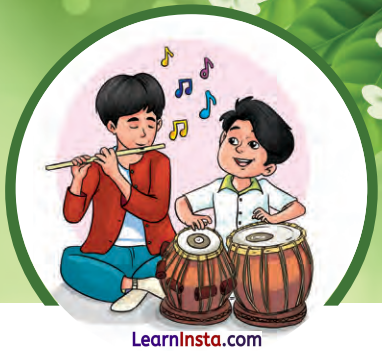
- Act I opens with a beautiful Indo-Western fusion music performance played at its crescendo.
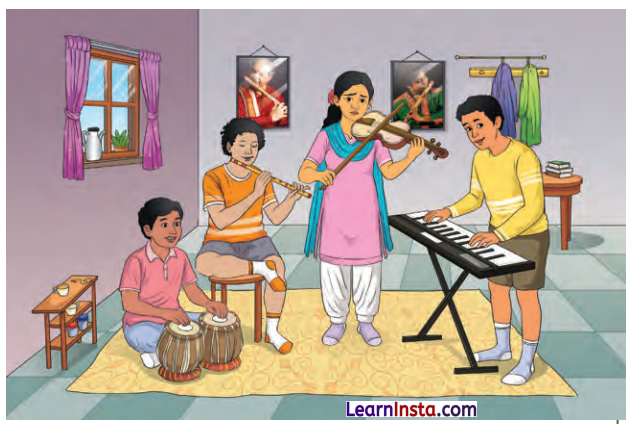
- Four children-Shruti, Iqbal, Avinash and Peter-are seen performing together in Iqbal’s room, which is filled with books and posters of famous Indian flautists.
- Each member plays a different instrument-violin, tabla, flute and keyboard-blending Indian classical and Western musical styles.
Newspaper Praise and Shruti’s Unease
- After the rehearsal ends, Iqbal picks up a newspaper and reads out a review praising Shruti’s performance with her father, Guru Nabin Sharma.
- While her friends celebrate her success, Shruti remains disturbed and thoughtful.
- It becomes clear that she has not informed her parents about her fusion practice sessions or the upcoming concert.
The Problem: Fear of Disappointing Her Father
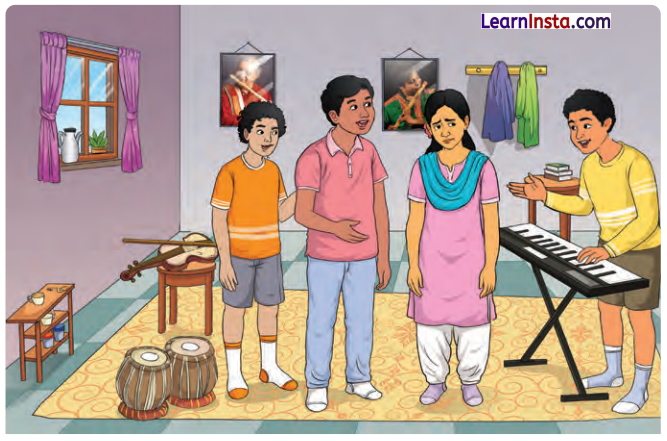
- Shruti explains that her father is a strict follower of Classical Hindustani music.
- He believes that ragas and aalaaps are the only pure and meaningful forms of music.
- Shruti fears that he will consider fusion music a desecration of the violin, which he regards as sacred.
Inner Conflict: Respect vs. Passion
- Shruti deeply respects her father’s views and values his opinion as a guru and parent.
- She does not want to hurt his feelings or make him believe that she disrespects classical Hindustani music.
- At the same time, Shruti feels a strong passion to experiment with Indo-Western fusion music.
- This creates an inner conflict as she struggles to balance respect for her father with her own passion for music.
Friends’ Support and Encouragement
- Seeing Shruti’s worry, her friends offer constant emotional support. They encourage her to be honest and courageous.
- Shruti agrees to talk to her father about it openly.
Act II
A Tense Family Moment
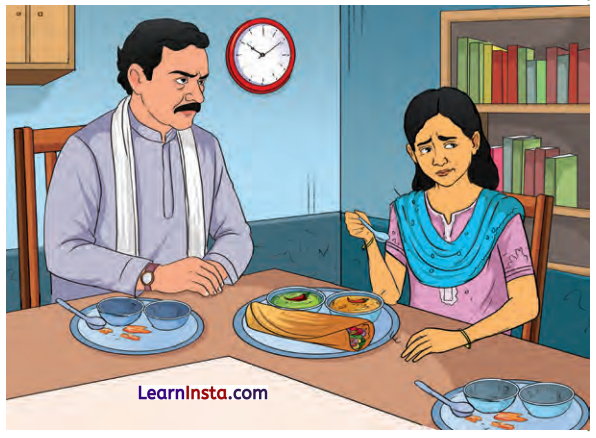
- Act II opens in Shruti’s home after dinner, where her parents, Nabin and Leela, are seen clearing the dining table.
- Shruti remains seated, staring at her food and taking her last bite slowly, clearly lost in thought.
- With visible hesitation, Shruti finally speaks and requests her father not to get angry.
- Nabin suddenly becomes serious and formal, but he refuses to offer reassurance.
Parents’ Reaction to Shruti’s Decision
- As soon as Shruti reveals that the concert is a group performance, Nabin immediately rejects the idea.
- He firmly states his belief that frequent performances reduce the value of art.
- When Shruti finally admits that the concert is an Indo-Western fusion performance, Nabin reacts harshly and angrily and leaves the room.
- Leela, her mother, scolds Shruti for hiding the truth and stresses the importance of honesty, after which Shruti promises to be more open in the future.
Act III
Hope Through Music
- Act III opens at Iqbal’s house, where Avinash and Peter are already present and preparing their instruments for practice.
- Shruti arrives, still troubled by her father’s earlier reaction but unable to stay away from music.
- Despite her worries, Shruti enjoys the fusion piece and decides to practise it one last time.
Unexpected Entry of Parents
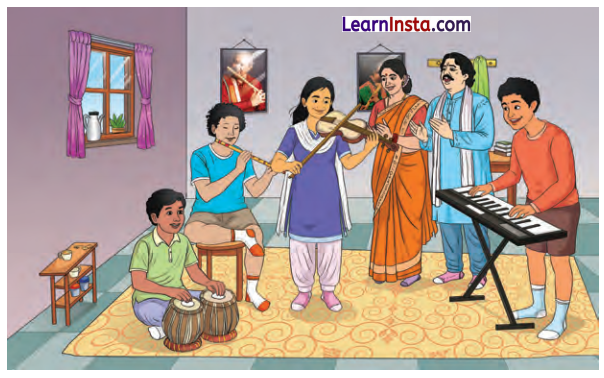
- In the middle of the rehearsal, Shruti’s parents quietly enter the room and stand in a corner without interrupting.
- As the music continues, they become deeply engrossed, listening carefully to every note.
- Nabin, who earlier opposed fusion music, is seen tapping his feet and enjoying the performance.
Appreciation and Acceptance
- When the performance ends, both parents applaud warmly.
- Nabin praises the entire group and specially appreciates
- Shruti for maintaining the raga perfectly while blending it with Western music.
- He offers the children the use of his own music room so they can practise regularly.
Revelation and Understanding
- Shruti thanks her parents and assures them that she will always respect her art and discipline.
- Nabin admits that it was Leela who helped him reflect and understand the situation more clearly.
Past and Realisation
- Leela reveals that Nabin himself once faced opposition when he chose to play the violin instead of following his family’s tradition of vocal music.
- At that time, the violin was not accepted easily in Indian classical music and his choice was seen as going against tradition. Through this memory, Nabin realises that his fears about Shruti were baseless.
Resolution and Support
- Nabin assures Shruti of his complete trust and support and promises to encourage her fusion group at the concert.
- The play ends with emotional reconciliation, showing that tradition and change can exist together when there is understanding, trust and love.
The title ‘Twin Melodies’ is appropriate because the chapter brings together two forms of music-Classical Hindustani and Indo-Western fusion. It highlights the harmony between tradition and modern expression, showing how both musical styles can coexist through understanding, acceptance and mutual respect.
Twin Melodies Summary in Hindi
यह लेख श्रुति नाम की एक युवा वायलिन वादिका की कहानी का सारांश प्रस्तुत करता है जो अपने रूढ़िवादी पिता की असहमति के वाबजूद एक फ्युजन संगीत कार्यक्रम में प्रदर्शन करना चाहती है।
श्रुति एक फ्यूजन बैंड मं और अपने पिता नबीन शर्मा जो कि एक हिंदुस्तानी शास्त्रीय वायलिन वादक और स्कूल के प्रधानाचार्य हैं, को आगामी संगीत कार्यक्रम के बारे में बताने से बहुत डरी हुई है। उसके पिता शुरू में फ्यूजन संगीत को वायलिन का अपमान बताकर खारिज कर देते हैं।
उसकी रिहर्सल को छुप कर देखने और उनकी प्रतिभा को देखने के बाद उन्हें एहसास होता है कि उनके डर निराधार थे और उन्हें उनकी संगीत यात्रा पर गर्व होने लगता है।
Themes (Main Ideas) of Twin Melodies
Tradition vs. Modern Expression
The chapter highlights the conflict between classical musical traditions and modern fusion, showing how both can coexist with understanding.
Respect for Art and Discipline
True music requires dedication, practice, and respect for its roots, even when experimenting with new styles.
Courage to Express One’s Passion
Shruti’s journey shows the bravery needed to speak honestly about one’s dreams despite fear of disapproval.
Parental Expectations and Understanding
The story explores how rigid expectations can change through reflection, dialogue and empathy.
Harmony through Acceptance
Acceptance of change leads to harmony, proving that growth does not mean abandoning tradition but enriching it.
Literary Devices of Twin Melodies
- Humour Light humour appears in friendly teasing during rehearsals and Leela’s playful remarks, easing tension.
- Conflict The main conflict is between classical tradition and modern fusion music.
- Irony Nabin criticises fusion music at first but later enjoys and praises the same performance.
- Dialogue Dialogue drives the play, revealing emotions and changing attitudes.
- Imagery Scenes like the rehearsal room and dinner table help readers visualise the action.
- Symbolism Fusion music symbolises change, while the violin represents tradition and discipline.
- Metaphor The line ‘each bay has its own wind’ suggests every generation follows its own path.
- Contrast The contrast between classical Hindustani music and Indo-Western fusion music highlights the central conflict between tradition and modern expression.
Twin Melodies Class 9 Word Meanings
- Fusion – The intentional blending of different musical traditions or styles to create a new form
- Crescendo – A gradual increase in the loudness and emotional intensity of a musical performance
- Desecration – Disrespect towards something sacred
- Ragas and Aalaaps – Elements of Hindustani classical music
- Artist of any worth – A musician of genuine skill, integrity and artistic discipline
- To bite the bullet – To deal with an unpleasant or difficult situation in a courageous and determined way
- Familiarity breeds contempt – A proverb meaning excessive exposure can reduce respect or seriousness
- Contempt – A strong feeling of dislike and disrespect
- Hubbub – A loud noise
- Iterated – Repeated
- Engrossed – Deeply absorbed or fully occupied in an activity
- Evidently – Clearly and obviously
- Soulful – Expressing deep emotion and sincerity, especially in music
- Painstakingly – Done with great care and effort
- Worked his fingers to the bone – Work very hard
- Root – Show support