Each of our Ganita Prakash Class 6 Worksheet and Class 6 Maths Chapter 10 The Other Side of Zero Worksheet with Answers Pdf focuses on conceptual clarity.
Class 6 Maths Chapter 10 The Other Side of Zero Worksheet with Answers Pdf
The Other Side of Zero Class 6 Maths Worksheet
Class 6 Maths Chapter 10 Worksheet with Answers – Class 6 The Other Side of Zero Worksheet
A. Choose the correct option.
Question 1.
The opposite of 200m north is
(a) 200m south
(b) 200m east
(c) -200m north
(d) -200m south
Answer:
(a) 200m south
Question 2.
The sum of (-102) + (+98) is
(a) -200
(b) 200
(c) -4
(d) 4
Answer:
(c) -4
Question 3.
The difference of (-12) – (-98) is
(a) -86
(b) -110
(c) 86
(d) -96
Answer:
(c) 86
Question 4.
The least integer lying between 1 and -9 is
(a) -10
(b) -8
(c) 10
(d) 8
Answer:
(b) -8
Question 5.
In which of the following pairs of integers, the first integer is not on the left of the other integer on the number line?
(a) (-3, 5)
(b) (-5, -3)
(c) (-4, 5)
(d) (0, -9)
Answer:
(d) (0, -9)
Question 6.
How many integers lie between -4 and 4?
(a) 7
(b) 8
(c) 9
(d) 6
Answer:
(a) 7
Question 7.
Which of the following comparisons is true?
(a) -12 > -10
(b) -10 < 0
(c) -51 > -15
(d) 15 < 0
Answer:
(b) -10 < 0

Directions. (For Q.8 -10): In the following questions, a statement of Assertion (A) is followed by a statement of Reason (R). Choose the correct option as:
(a) Both Assertion (A) and Reason (R) are true and Reason (R) is the correct explanation of Assertion (A).
(b) Both Assertion (A) and Reason (R) are true but Reason (R) is not the correct explanation of Assertion (A).
(c) Assertion (A) is true but Reason (R) is false.
(d) Assertion (A) is false but Reason (R) is true.
Question 8.
Assertion (A): -1, -2, -3, … are negative integers.
Reason (R): Numbers with negative sign is called negative numbers.
Answer:
(a) Both Assertion (A) and Reason (R) are true and Reason (R) is the correct explanation of Assertion (A).
Question 9.
Assertion (A): 7 + (-7) = 0
Reason (R): The sum of an integer and its additive inverse is always 0.
Answer:
(a) Both Assertion (A) and Reason (R) are true and Reason (R) is the correct explanation of Assertion (A).
Question 10.
Assertion (A): 0 is a positive integer.
Reason (R): On a number line 0 lies at the centre of the number line.
Answer:
(d) Assertion (A) is false but Reason (R) is true.
B. Fill in the blanks.
1. The opposite of -3 is _______
Answer:
3
2. The additive inverse of -7 is _______
Answer:
+ 7
3. (-7) – (-4) = _______
Answer:
-3
4. Number decreases as we move to the _______ on a number line.
Answer:
left
5. Withdrawal of ₹ 500 is _______
Answer:
-₹ 500
6. Number of integers between -3 and 3 is _______
Answer:
5
C. State whether the following statements is true or false.
1. Farther a number from zero on the right, the larger its value.
Answer:
True
2. Zero is the smallest negative integer.
Answer:
False
3. Every natural number is greater than all negative integers.
Answer:
True
4. The absolute value of an integer is always greater than the integer.
Answer:
False
5. -100 is to the right of -50 on a number line.
Answer:
False
D. Solve the following.
Question 1.
Write any four negative integers greater than -18 and any four integers less than -9.
Answer:
-16, -13, -12, -6 ; -10, -13, -18, -40 (Answer may vary)
Question 2.
Observe the alongside number line with zero (0) at point 0 and the other points. Based on this, answer the following questions.

(a) Is point E negative or positive?
(b) Which number is the successor of D?
(c) Which number is the predecessor of F? ,
(d) If D is at point ÷8, then which point is at -8?
(e) Which point marked on the given number line has the least value?
(f) Arrange the alphabets in the ascending order of their integer values.
Answer:
(a) Negative
(b) + 9
(c) -10
(d) C
(e) E
(f) E, F, G, H, O, A, B, C, D
Question 3.
Find the sum of the following
(a) 8 + (-8) + (8) + ………….. 21 terms
(b) (-10) + 10 + (-10) + 10 + …. 36 terms
Answer:
(a) 8
(b) 0
Question 4.
The temperature of Shimla on a certain day at 4 a.m. is -5°C. If the temperature rises by 6°C at 3 p.m. and again drops by 2°C at 9 p.m., what was the temperature recorded at 9 p.m.?
Answer:
(-1)°C
Question 5.
Rishab is playing a game on a computer. During his four rounds, he scored 50 points in round 1, lost 100 points in round 2, scored 35 points in round 3, and lost 20 points in round 4. Find how many points Rishabh scored at the end of the game.
Answer:
-35 points
HOTS Question
A Gupta family lives on the 2nd floor of a multi-storey building having eight floors. By using an elevator, Mr. Gupta goes to the 7th floor to meet his friend Mr. Arora, then both of them go down to the car parking 2 floors down to the ground floor to go to the market in his area. Mr. Gupta returns from the market and goes up to the 3rd floor from the ground to meet another friend, Mr. Sharma, and then he comes down to his home.
Represent this situation on a number line using integers.
(Here, we will use a vertical number line.)
Sumant and his mother are enjoying the snowfall.

Sumaut: Mummy! It is so cold.
Mother: Yes. I saw weather forecast news that the temperature of the hill station dropped by 5°C below 0°C today, that is, -5°C.
Sumant: How can the temperature be negative? Before we came here, the temperature was 5°C, which was above the level ojr 0°.
Mother: Temperatures above 0°C are written by positive numbers while the temperatures below 0°C are written by the numbers with negative sign (-), that is, by the negative numbers.
It is an example that shows a sense of oppositeness in our day-to-day lives. Some other examples, such as profit and loss, deposit and withdrawal, height and depth of a certain point or place, boiling and freezing point, up and down, etc.
For example, mathematically, the profit of ₹ 100 is expressed as + ₹ 100, and the loss of ₹ 100 is expressed as – ₹ 100.
Similarly, the ground floor is at 0 and the floors _______ the ground floor are positive whereas the floors _______ the ground floor that is in the basement, are negative as -1 and -2, etc.
Question 1.
Write opposites of the following.
(a) Deposit of ₹ 3000 – ________________________
(b) 3 floors below the ground – ________________________
(c) 10°C above the 0°C – ________________________
(d) 250 m above sea level – ________________________
Answer:
(a) Withdraw of ₹ 3000
(b) 3 floors above the ground
(c) 10°C below the 0°C
(d) 250 m below the sea level
INTEGERS
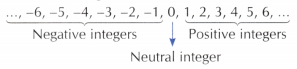
The numbers with the positive signs are called positive numbers, that is +1, +2, +3, … are positive numbers. Generally, we use positive numbers without + sign.
The numbers with the negative signs are called negative numbers and are smaller than 0. That is -1, -2, -3, -4, … are negative numbers.
A collection of negative numbers, zero and positive numbers are called integers.
Thus, …. -3, -2, -1,0, 1,2, 3, … are integers.
Question 2.
Express the following statements mathematically using integers.
(a) Move 9 steps downstairs — ________________________
(b) 21 floors above the ground floor — ________________________
(c) Height of 1 50 m above the sea level — ________________________
(d) 17°C below the freezing point (0°C) — ________________________
(e) Spending of ₹ 1200 on shopping — ________________________
(f) Depositing ₹ 3500 in a bank account — ________________________
(g) Increase of 10 — ________________________
Answer:
(a) -9
(b) + 21
(c) + 150 m
(d) – 17°C
(e) – ₹ 1200
(f) + ₹ 3500
Question 3.
Sumant visits a mall named ‘Building of Joy’ with his father. They use a lift to go up and down between the floors. In the lift, to go 3 floors above the ground floor, he must press the button +3 or 3 and to go down two floors below the ground floor, he have to press the button -2.
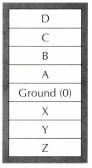
(a) Write the number of floors using integers.
(b) Sumant was at floor Y and he wants to go to 3 floors up, then which button of lift he has to press?
(c) If Sumant is on floor Y and he has to go to floor D through Z, then how many floors does he have to move downward and upward?
Answer:
(a) A: 1. B: 2, C: 3, D: 4, X: (—1). Y: (—2), Z: (—3)
(b) +1
(c) —1 for Z, +7 floors up to D
Think and Answer
In a multi-story building, if you are on the 12th floor, in which direction and by how many floors should you move to reach the following floor?
(a) -3th floor
(b) 15th floor
(c) 0 (ground floor)
(d) -1st floor
Answer:
(a) 15 floors down
(b) 3 floors up
(c) 12 floors down
(d) 13 floors down
Question 4.
Read the given clues and plot the alphabets on the given number line.

- A is a number that is 3 units to the left of 0.
- B is a number that is 4 units to the right of -9.
- C is a number that is 2 units to the Left of 1.
- D is a number that is 3 units to the right of 3.
- E is the predecessor of -3.
- F is the successor of -9.
After plotting the points on the number line, fill in the blanks.
(a) The point that lies between -4 and -2 is _______
(b) The point which represents the predecessor of 0 is _______
(c) The number of points between -3 and 3 are _______
Answer:

(a) -3
(b) C
(c) 5
Comparing And Ordering Integers
Anuj and Neeraj went to a friend’s house who is living in a multi-storey building ‘Building of Joy’. While waiting for a lift at ground level, they observed that the lift is at -2.
They discussed about its position and discovered that the lift is 2 floors below the ground floor. They boarded the lift from the ground floor and reached the 8th floor. If we arrange the floor positions in increasing order of integers, then -2 (2 floors below the ground floor) _______ 0 (ground floor) _______ 8 (8 floors above the ground floor). Show your result by marking the floors on the number line given below.

Question 5.
Represent the following on a number line.
(a) 2 less than 4
(b) 2 more than -3
(c) 3 less than -3
(d) -3 more than 4
Question 6.
Imagine the adjoining number line as the lift of a building. Observe it and answer the following.
(a) Mark the following floors of the building shown on the right.
(i) -7
(ii) -4
(iii) +3
(iv) -10
(b) Compare the numbers and fill in the given boxes with <, >.
(i) -10 _______ -12
(ii) 17 _______ -10
(iii) 0 _______ -20 +
(iv) 17 _______ -10
(v) -25 _______ -7
(vi) +15 _______ -17
Answer:
(i) >
(ii) >
(iii) >
(iv) >
(v) <
(vi) >
(c) If floor A = -12, floor D = -1, and floor E = +1 in the building shown on the right as a number line, find the numbers for Floors B, C, F, G, and H.
Answer:
Floor B = – 10, floor C = -7, floor F : = 2, floor G = 6, floor H = 11
Question 7.
Prateek and his four friends participated in an entrance test of an academy. There is a negative marking Jor each wrong answers. Following are the marks obtained by these 5 friends.

(a) Who scored the maximum and the minimum marks, respectively?
________________________
(b) Who got less marks than Harun?
________________________
Answer:
(a) Aakriti, Megha
(b) Megha
Question 8.
Rajan and Mayur visited two places, A and B, in Shimla and recorded the minimum temperatures on a particular day as -10°C at A and -1°C at B, respectively.
Which of the following statements is true? Give a reason for your answer.
(a) A is cooler than B.
(b) B is cooler than A.
Answer:
(a) True
(b) False
Question 9.
Mayur recorded tke average temperature o/Jive places wkere ke wants to plan kis vacations. Represent tke temperatures as integer values.
| Place | Temperature | Integer |
| Shimla | 1°C below 0°C | |
| Manali | 2°C below 0°C | |
| Jaipur | 30°C above 0°C | |
| Kujri | 4°C below 0°C | |
| Nagpur | 20°C above 0°C |
Answer the following questions.
(a) Which is the coolest place?
(b) Which is the hottest place?
(c) Which places do you think have the maximum chance of snowfall?
Answer:
(a) Kufri
(b) Jaipur
(c) Kufri
ADDITION OF INTEGERS
Using Tokens for addition
Question 10.
Karishma is playing with red and blue tokens. She decided to represent each red token with +1 (1 unit positive integer) and one blue token represents -1 (1 unit negative integer). She is trying to add integers by using tokens.
Add the following by drawing token model diagrams.
(a) 5 + 4
(b) 4 + (-7)
(c) (-6) + 4
(d) (-4) + (-3)
Answer:
(a) 9
(b) (-3)
(c) (-2)
(d) (-7)
Rules of Addition.
From the above model, we can conclude some rules for addition of integers.
Rule 1: Adding two positive integers means adding their absolute values and put the +ve sign before the sum.
Rule 2: Adding two negative integers means adding their absolute values and put the -ve sign before the sum.
Rule 3: Adding a positive and a negative integer or adding a negative and a positive integer means to find the difference of their absolute values and put the sign of that integer whose absolute value is larger before the difference.
Question 11.
Add the following.
(a) (+12) + ( + 9)
(b) (-17) + (-13)
(c) (-23) + ( + 25)
(d) (+ 28) + (-40)
Answer:
(a) 21
(b) (-30)
(c) 2
(d) (-12)
SUBTRACTION OF INTEGERS
We can always convert subtraction to addition. The number that is being subtracted can be replaced by its inverse and then added.
Similarly, a number that is being added can be replaced by its inverse and then subtracted.
(a) (+7)-( + 5) = ( + 7) + (-5)
(b) (-3)-( + 8) = (-3) + (-8)
(c) (+ 8) + (-2) = ( + 8)-( + 2)
(d) (+ 6) + (-9) = ( + 6) -( + 9)
Using token for subtraction
Question 12.
Write the mathematical expressions for the following token models that represent the subtraction of integers.
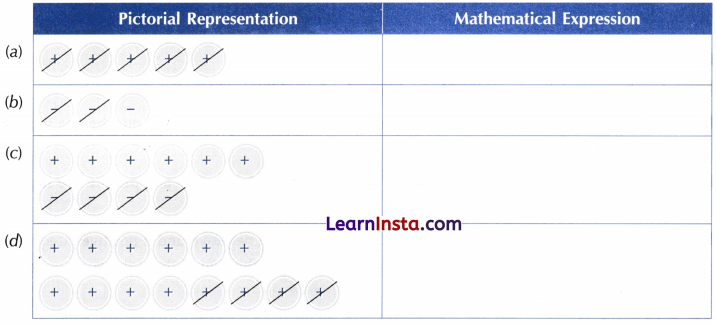
Answer:
(a) (+5) – (+4)
(b) (-3) – (-2)
(c) (+2) – (-4)
(d) (-6) – (+4)
Question 13.
Subtract the following by drawing token model diagrams.
(a) 2 – 7
(b) (-3)-(-4)
(c) (-5) – (+7)
(d) ( + 2)-(-6)
Answer:
(a) (-5)
(b) 1
(c) (-12)
(d) 8
Rules of Subtraction
From the above model, we can conclude some rules for subtraction of integers.
Rule 1: To subtract integers, change the sign of the subtrahend.
Rule 2: (+ve) – (+ve) = (+ve), if the first integer is greater.
(+ve) – (+ve) = (-ve), if the second integer is greater.
(-ve) – (-ve) = (-ve), if the first integer is greater.
(-ve) – (-ve) = (+ve), if the second integer is greater.
Question 14.
Subtract the following.
(a) -9 from 6
(b) 5 from (-7)
(c) (-2) from (-9)
Answer:
(a) 15
(b) (-12)
(c) (-7)
Question 15.
In 2024, Aryan won the Interschool quiz competition. His scores were 10, -8, 3 and -2 for four rounds. What was his final score?
Answer:
3
Question 16.
Rashi parked her car in a the parking 2 floors below the ground level. Then, she gets in the elevator and goes up by 8 floors. On which floor does she get off the elevator?
Answer:
6th floor
Question 17.
A research team placed an underwater research vessel that descends 2,000 feet beneath the surface of the water. They further decided to descend the vessel 500 feet below the previous position and rise 150 feet to get an accurate measurement. Where are they currently located?
Answer:
2,350 feet beneath the surface of the water.
Question 18.
Temperature of a place at 12:00 noon was +10°C. It got increased by 2°C in the first hour and decreased by 1°C in the second hour. What was the temperature at 2:00 pm?
Answer:
+11°C
Think and Answer
1.Find the value of 1 —2 + 3 – 4 + 5 – 6 + 7 – 8 + 9 – … + 19 – 20.
Answer:
(-10)
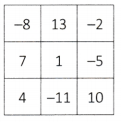
2. Complete the magic square so that they have the same row, column, and diagonal sum.

Answer:
ADDITION AND SUBTRACTION OF INTEGERS USING THE NUMBER LINE
Question 19.
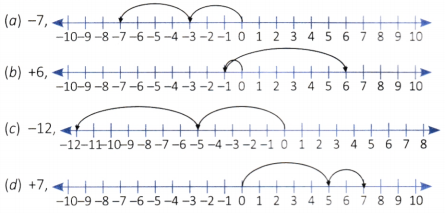
Evaluate the following on the given number line.
(a) (-3) + (-4)

(b) (-1) + (+7)

(c) (-5)-( + 7)

(d) 5 – (-2)

Answer:
Using the unmarked number line to add and subtract
We can add or subtract and compare large numbers by imagining an ‘infinite number line’ or drawing an ‘unmarked number line’ as follows:
For example: 85 + (-60)

Therefore, 85 + (-60) = +25
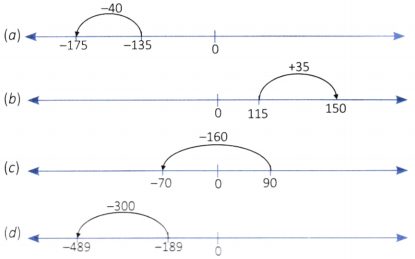
Question 20.
Evaluate the following using tke given
(a) (-135) + (-40)

(b) +115 – (-35)
(c) +90 + (-160) I
(d) -189 – ( + 300)
Answer:
Math Link
Kavita and his family decided to save rainwater by constructing a tank in their garden. The tank is jTiled with 18 litres of rainwater. Due to some leakage, 5 litres of water are lost. By the end of the day, it is filled more with 15 litres of rainwater. They have used 10 litres of water for watering plants. Find the amount of water left in the tank. How can we contribute to our nature or climate by preserving water from rain?