Working through Class 9 English Notes and Class 9 English Kaveri Chapter 7 Carrier of Words Summary in English simplifies the understanding of long chapters.
Summary of Carrier of Words Class 9
Carrier of Words Summary Class 9
- The chapter highlights the vital role of Gramin Dak Sewaks in connecting India’s most remote regions with the rest of the country.
- Through the life and work of Khetaram, a postman in Rajasthan, it shows how dedication, trust and service keep families linked despite harsh conditions.
- The lesson emphasises the dignity of labour and the importance of human effort beyond modern technology.
Main Character
KHETARAM
A Gramin Dak Sewak who delivers mail in the harsh Thar Desert near the Indo-Pakistan border. He is hardworking, dedicated and trusted by villagers.
Carrier of Words Summary in English

Role of Postal Workers
- The passage begins by drawing attention to a time when letters were the primary means of staying connected.
- Even today, in regions beyond proper roads, railways and phone networks, people continue to depend on the postal system.
- In these isolated areas, Gramin Dak Sewaks serve as the sole link between distant families and the outside world.
Khetaram – A Lifeline in the Thar Desert
- Khetaram, a Gramin Dak Sewak, a postman who serves the Somarad
- Branch Post Office in a remote village of Rajasthan.
- For over fifteen years, he has connected villagers living near the Indo-Pakistan border with their families and loved ones.
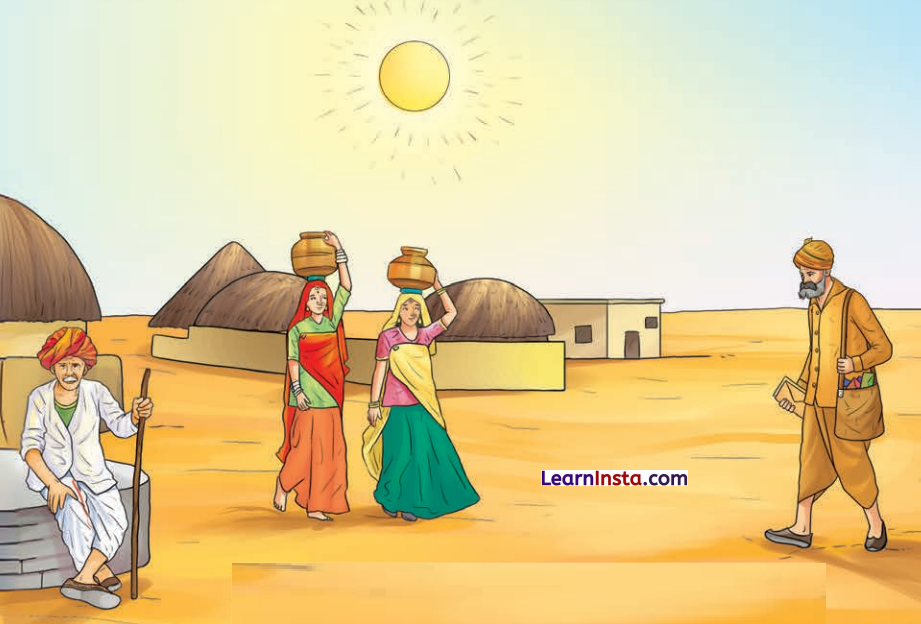
- He works in the harsh Thar Desert, delivering letters to scattered hamlets called dhaanis, located just 2.5 km from the border.
The Journey of a Letter
- Khetaram’s route lies about 120 km beyond the last railhead at Barmer, where modern transport ends.
- Beyond the Barmer-Chohtan road, the land turns into soft sand, making travel difficult.
- The mail starts from Jodhpur, moves by train and bus, and is finally carried on Khetaram’s shoulder.
- Though the journey covers nearly 330 km , the letter is delivered within 24 hours due to Khetaram’s effort.
- His footprints in the sand show the final and hardest part of the delivery.
Enduring Extreme Heat and Desert Conditions
- In summer, desert temperatures rise close to 50°C making every delivery exhausting.
- Khetaram often works even in extreme heat, as a state holiday is declared only if the temperature officially crosses 50° C.
- When the heat becomes unbearable, he delays deliveries until after sundown to cope with the desert conditions.

Sandstorms, Scarcity and Daily Struggle
- Khetaram’s khaki uniform and turban protect him from hot winds and sandstorms.
- As the sand clings to his body and clothes, he often turns into a ‘walking sandman’.
- With water extremely scarce, bathing is impossible; he can only wipe his body clean at the end of the day.
- By evening, sand collects near his feet, reflecting the daily struggle of desert life.
Gramin Dak Sewaks and the Growth of India Post
- Before 2001, workers like Khetaram were called delivery agents in rural areas.
- They were later recognised as Gramin Dak Sewaks (GDS), linking remote villages with India Post.
- Today, GDS form more than half of India Post’s workforce, highlighting their importance in reaching India’s interiors.
- They operate in the toughest terrains of the country, including deserts, islands, mountains and flood-prone regions.
Postal Services as a Source of Trust and Survival
- The British postal system served administrative needs, but after independence, India Post aimed to include the entire population.
- The number of post offices grew from 25,000 in 1947 to over 1.5 lakh today.
- Rural people trust the post office with savings, money orders and official communication, reflecting deep public faith.
Working Conditions of Gramin Dak Sewaks
- To become a Gramin Dak Sewak (GDS), a person must have another source of income, as the job is meant to support, not replace, their livelihood.
- GDS work only five hours a day and they are allowed to continue service after the age of 60 , up to 65 years, unlike regular postmen.
- These special rules ensure a fixed salary and help India Post retain GDS in remote and difficult areas.
Khetaram’s Livelihood and Family Responsibility
- Khetaram explains that akaal (famine) is common in his region. Even in good years, farming yields only one crop of bajra. This is not enough to feed his family of five.
- His work as a Gramin Dak Sewak provides financial stability, dignity and security.
Trust, Respect and Emotional Bonds
- Khetaram is warmly welcomed wherever he goes and is treated with deep trust and respect.
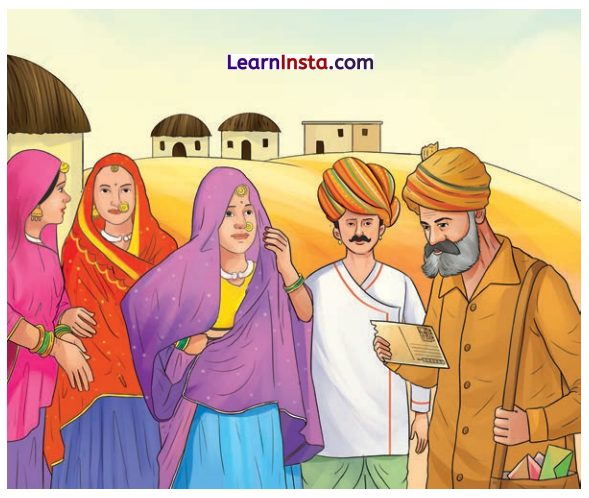
- Villagers feel comfortable asking him to read letters and write replies, while the Border Security Force often offers him tea or a lift.
- Small gestures, such as offering jaggery when he brings news of births or weddings, reflect the strong bond between him and the community.
The Emotional Weight of Delivering Bad News
- One delivery Khetaram dreads is the letter carrying news of death, marked by a torn corner, known as Ashubh Samachar.
He reads the letters outside, repeats it and then tears it up. - This act reflects both cultural belief and the emotional burden he carries as a messenger of life-changing news.
Hope, Change and the Larger Message
- After more than fifteen years of service, Khetaram remains strong and grateful for the opportunity to serve even after the age of sixty.
- He looks forward to becoming a Gramin Sanchar Sewak when mobile connectivity reaches the area, combining postal work with digital communication.
- The passage ends by saluting workers like Khetaram, highlighting the importance of human connection in holding society together.
Why the Title is Appropriate
The title is appropriate because Khetaram does more than deliver letters-he carries emotions, news and human connections across difficult terrain. Through his dedicated service, words reach people with meaning, trust and care.
Themes (Main Ideas) of Carrier of Words
Dedication and Sense of Duty
The chapter highlights how sincere commitment to work keeps essential services running even in the harshest conditions.
Dignity of Labour
Honest work, no matter how difficult or humble, deserves respect and recognition.
Human Connection Beyond Technology
True communication depends on human effort and care, not just modern technology.
Trust and Responsibility
Villagers place complete trust in the postman, showing how responsibility builds strong social bonds.
Resilience in Adversity
The ability to endure extreme heat, distance and hardship reflects strength, perseverance and courage.
Literary Devices of Carrier of Words
- Contrast The contrast between modern communication being ‘just a click away’ and mail delivery in areas ‘beyond the last railhead’ highlights the gap between technological progress and the realities of remote life.
- Imagery Descriptions like ‘sand beds and dunes’, ‘the sands sizzle under his mojri-clad feet’, and ‘swirling sandstorms’ create strong visual images of the harsh desert environment in which Khetaram works.
- Symbolism The envelope with ‘the right comer torn off’ symbolises death and sorrow, marking messages of loss.
- Metaphor Khetaram is presented as the ‘sole link between the oases of humanity’ and distant families, suggesting that he functions as a living bridge connecting isolated people to the outside world.
- Personification The desert is described through phrases like ‘the desert’s furies’, giving human qualities to nature and emphasising its cruelty.
- Anecdote Personal details such as ‘I can only wipe my body’ and villagers offering ‘a piece of jaggery’ add realism and emotional depth to the narrative.
Carrier of Words Class 9 Word Meanings
- Sole – Only; single in number
- Ply – Move
- Hamlets – Settlements
- Hefted – Lifted or carried with effort
- Oases – Fertile spots in a desert
- Stipulate – Specify
- Far-flung – Very distant or remote
- Mojri – Traditional footwear of Rajasthan
- Sizzle – To burn or heat intensely
- Dhaanis – Scattered desert dwellings
- Desolate – Empty and barren
- Operating – Working
- Riverine – Situated on a river bank
- Inaccessible – Unreachable
- Mandate – Official order or authority
- Ambit – Range
- Workforce – Total number of workers
- Outposts – Remote stations
- Arid – Extremely dry
- Famine (Akaal) – Severe shortage of food
- Access – Opportunity
- Remitted – Sent as payment
- Scrap – Remove
- Summarily – Immediately
- Dwell – To stay on for sometime
- BSF – Border Security Force
- Dreads – Fears
- Missive – Letter
- Invaluable – Extremely useful
- Resilient – Able to withstand hardship
- Entail – Involve
- Stride – Walking with long steps