Practicing Class 9 Maths MCQ and Ganita Manjari Class 9 Maths Chapter 5 I’m Up and Down and Round and Round MCQ Questions Online Test with Answers daily helps in time management.
MCQ on I’m Up and Down and Round and Round Class 9
I’m Up and Down and Round and Round MCQ Class 9
Class 9 Maths I’m Up and Down and Round and Round MCQ
Question 1.
A line segment that joins two points on a circle and passes through the centre is called a
(a) radius
(b) segment
(c) diameter
(d) circumference
Answer:
(c) diameter
Explanation:
Let us check the options.
Option (a) A radius is a straight line joining the centre and the circumference.
Option (b) A segment of a circle is the region bounded by a chord and the arc.
Option (c) A diameter is specifically a chord that passes through the centre of the circle.
Option (d) The length of the complete circle is called its circumference.
Question 2.
Where is the circumcentre of an obtuse – angled triangle located?
(a) Inside the triangle
(b) On the hypotenuse
(c) Outside the triangle
(d) At one of the vertices
Answer:
(c) Outside the triangle
Explanation:
The circumcentre in an obtuse-angled triangle is located outside the triangle.

Question 3.
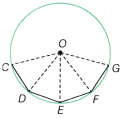
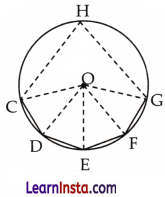
In the given figure, O is the centre of the circle and CD = DE = EF = FG. ∠COD = 40°, then ∠COG is equal to
(a) 160°
(b) 200°
(c) 240°
(d) 280°
Answer:
(b) 200°
Explanation:
Since equal chords of a circle subtend equal angles at the centre.
∴ ∠COD = ∠DOE = ∠EOF
= ∠FOG = 40°
∴ ∠COG = 4 × 40° = 160°
∴ Reflex ∠COG = 360° – ∠COG
= 360° – 160° = 200°
Question 4.
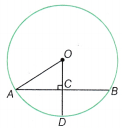
In the given figure, if OA = 10 cm, AB = 12 cm and OD ⊥ AB, find CD.
(a) 2 cm
(b) 3 cm
(c) 4 cm
(d) 6 cm
Answer:
(a) 2 cm
Explanation:
Since, OD ⊥ AB,
AC = BC = 6 cm
[∵ perpendicular drawn from the centre of a circle bisects the chord]
and ∠OCA = 90° and OA = 10 cm
Thus, OA2 = AC2 + OC2
[by Pythagoras’ theorem]
⇒ 102 = 62 + OC2
⇒ OC2 = 100 – 36 = 64
⇒ OC = 8cm
Since OD = OA [∵ radii of the same circle]
OD = 10 cm
Thus, CD = OD – OC
= 10 – 8
= 2 cm
Question 5.
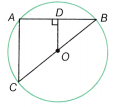
In the given figure, OD is perpendicular to the chord AB of a circle, whose centre is O. If BC is a diameter and OD = 4 cm, then A equals
(a) 6 cm
(b) 8 cm
(c) 10 cm
(d) 12 cm
Answer:
(b) 8 cm
Explanation:
Since OD ⊥ AB and the perpendicular drawn from the centre to a chord bisects the chord.
∴ D is the mid-point of AB.
Also, O being the centre, is the mid-point of BC.
Thus, in ΔABC, D and O are mid-points of AB and BC, respectively.
∴ OD ∥ AC and OD = \(\frac{1}{2}\)CA
[by mid-point theorem]
⇒ CA = 2OD = 2 × 4 = 8 cm
Question 6.
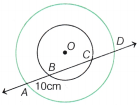
In the given figure, a line intersects two concentric circles with centre O at A, B, C and D. If AB = 10 cm, find CD.
(a) 5 cm
(b) 10 cm
(c) 15 cm
(d) 20 cm
Answer:
(b) 10 cm
Explanation:
Let OP be perpendicular from O on the line
∴ AP = DP and BP = CP
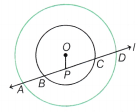
[∵ perpendicular from the centre of a circle to a chord bisects the chord]
⇒ AB = CD
CD = 10 cm
Question 7.
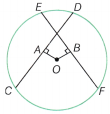
In the given figure, OA and OB are respectively perpendiculars to chords CD and EF of a circle, whose centre is O. If OA = OB, then
(a) CE = DF
(b) CE > DF
(c) CE < DF
(d) None of these
Answer:
(a) CE = DF
Explanation:
We have OA ⊥ CD and OB ⊥ EF
OA = OB
⇒ Chords CD and EF are equidistant from O.
⇒ CD = EF
[Y chords equidistant from the centre of a circle are equal in length]
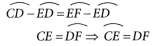
⇒ arc CD = arc EF
On subtracting arc ED (or ED) from both sides, we get
Question 8.
In the given figure, if ∠ABC = 20°, then ∠AOC is equal to

(a) 20°
(b) 40°
(c) 60°
(d) 10°
Answer:
(b) 40°
Explanation:
Given, ∠ABC = 20°
We know that the angle subtended at the centre by an arc is twice the angle subtended by it at any point on the remaining part of the circle.
∴ ∠AOC = 2∠ABC = 2 × 200 = 400
Question 9.
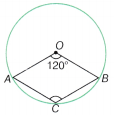
In the given figure. if ∠AOR = 120°, then find the value of ∠ACB.
(a) 100°
(b) 110°
(c) 130°
(d) 120°
Answer:
(d) 120°
Explanation:
Reflex ∠AOB =360° -120° =240°
∴ ∠ACB = \(\frac{1}{2}\) reflex ∠AOB
[Y the angle subtended by an arc at the centre is double the angle subtended by it at any point on the remaining part of the circle]
∴ ∠ACB = \(\frac{1}{2}\) × 240° = 120°
Question 10.
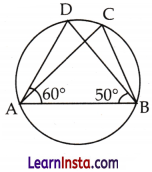
In the given figure, if ∠DAB = 60°, ∠ABD = 50° then ∠ACB is equal to
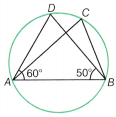
(a) 60°
(b) 50°
(c) 70°
(d) 80°
Answer:
(c) 70°
Explanation:
Given, ∠DAB = 60° and ∠ABD = 50°
Now, ∠ADB = ∠ACB …(i)
[∵ angles in the same segment of a circle are equal]
In ΔABD, ∠ABD + ∠ADB + ∠DAB = 180°
[by angle sum property of a triangle]
50° + ∠ADB + 60° = 180°
⇒ ∠ADB = 180° – 110°
⇒ ∠ADB = 70°
From Eq. (i), ∠ACB = ∠ADB = 70°
Question 11.
In the given figure, BC is a diameter of the circle and ∠BAO = 60°. Then, ∠ADC is equal to
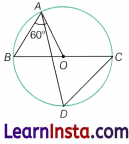
(a) 30°
(b) 45°
(c) 60°
(d) 120°
Answer:
(c) 60°
Explanation:
In ΔAOB, OA = OB
[∵ Both are the radii of the circle]
⇒ ∠OBA = ∠BAO
[∵ angles opposite to equal sides are equal]
⇒ ∠OBA = 60° [∵ ∠BAO = 60°, given]
We know that ∠ABC = ∠ADC
angles in the same segment AC are equal]
∠ADC = 60°
Question 12.
In the given figure, O is the centre of the circle and chord AC and BD intersect at Q such that ∠AQB = 140° and ∠QBC = 25°. Find the value of ∠ADB.
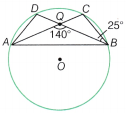
(a) 105°
(b) 140°
(c) 115°
(d) 135°
Answer:
(c) 115°
Explanation:
∠AQB = ∠QCB + ∠CBQ [exterior angle property]
⇒ 140° = ∠QCB + 25°
⇒ ∠QCB = 140° – 25° = 115°
or ∠ACB = 115°
∴ ∠ADB = ∠ACB = 115°
[∵ angles in same segment of a circle are equal]
Question 13.
In the given figure, ∠ABC = 59°, ∠ACB = 40°, find ∠BDC.
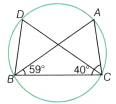
(a) 99°
(b) 90°
(c) 81°
(d) 71°
Answer:
(c) 81°
Explanation:
In ΔABC,
∠ABC + ∠BAC + ∠ACB = 180° [by angle sum property of triangle]
⇒ 59° + ∠BAC + 40° = 180°
⇒ ∠BAC = 180° – 59° – 40°
= 180° – 99° = 81°
∴ ∠BDC = ∠BAC = 81° [∵ angles in same segment of a circle are equal]
Question 14.
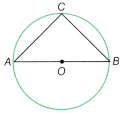
In the given figure, if AOB is a diameter of the circle and AC = BC, then ∠CAB is equal to
(a) 30°
(b) 60°
(c) 90°
(d) 45°
Answer:
(d) 45°
Explanation:
We know that a diameter subtends a right angle at the circle.
∠BCA = 90° …(i)
Given, AC = BC
∠ABC = ∠CAB …(ii)
[∵ angles opposite to equal sides of a triangle are equal]
In ΔABC,
∠CAB + ∠ABC + ∠BCA = 180° [by angle sum property of a triangle]
⇒ ∠CAB + ∠CAB + 90° = 180° [from (i) and (ii)]
⇒ 2∠CAB = 180° – 90°
⇒ ∠CAB = 45°
Question 15.
The sum of opposite angles of a cyclic quadrilateral is
(a) 120°
(b) 90°
(c) 180°
(d) 150°
Answer:
(c) 180°
Explanation:
The sum of opposite angles of a cyclic quadrilateral is always supplementary (180°).
Question 16.
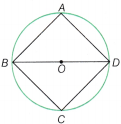
In the given figure, ABCD is a cyclic quadrilateral in which BD is a diameter; then find ∠BAD.
(a) 90°
(b) 100°
(c) 80°
(d) 110°
Answer:
(a) 90°
Explanation:
Since ABCD is a cyclic quadrilateral and BD is a diameter.
∴ ∠BAD = 90° [angle in semi-circle]
Question 17.
The circumcentre of a right-angled triangle is located at __________
(A) inside the triangle
(B) on the hypotenuse
(C) outside the triangle
(D) at the vertex of the right-angle
Answer:
(B) on the hypotenuse
Question 18.
Two points A and B are 10 cm apart. The radius of the smallest circle passing through both A and B is __________
(A) 10 cm
(B) 5 cm
(C) 2.5 cm
(D) 20 cm
Answer:
(B) 5 cm
Explanation:
The smallest circle has AB as a diameter.
∴ Radius = \(\frac {AB}{2}\) = 5 cm
Question 19.
How many circles can pass through three non-collinear points?
(A) Infinitely many
(B) Exactly two
(C) Exactly one
(D) None
Answer:
(C) Exactly one
Question 20.
The circumcentre of an acute-angled triangle lies __________
(A) outside the triangle
(B) on the longest side
(C) inside the triangle
(D) none of these
Answer:
(C) inside the triangle
Question 21.
∆ABC has ∠A = 90°, AB = 6 cm, AC = 8 cm. The circumradius of ∆ABC is __________
(A) 5 cm
(B) 10 cm
(C) 4 cm
(D) 6 cm
Answer:
(A) 5 cm
Explanation:
Hypotenuse BC = \(\sqrt{(36+64)}\) = 10 cm
For a right-angled triangle, the circumcentre is the midpoint of the hypotenuse.
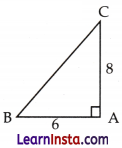
∴ Circumradius = \(\frac {BC}{2}\) = 5 cm
Question 22.
If two chords of the same circle are equal, then
(A) They necessarily subtend equal angles at the centre.
(B) They necessarily do not subtend equal angles at the centre.
(C) They always subtend right angles at the centre.
(D) They always subtend acute angles at the centre.
Answer:
(A) They necessarily subtend equal angles at the centre.
Question 23.
Two chords AB and CD are such that AB = CD; then which of the following options is always true?
(A) ∠AOB > ∠COD
(B) ∠AOB < ∠COD
(C) ∠AOB = ∠COD
(D) ∠AOB + ∠COD = 180°
Answer:
(C) ∠AOB = ∠COD
Question 24.
The line joining the centre of a circle to the midpoint of a chord is __________ the chord.
(A) parallel to
(B) equal to
(C) perpendicular to
(D) a diameter of
Answer:
(C) perpendicular to
Question 25.
The perpendicular from the centre of a circle to a chord __________ the chord.
(A) bisects
(B) trisects
(C) doubles
(D) is parallel to
Answer:
(A) bisects
Question 26.
An isosceles ∆ABC with AB = AC is inscribed in a circle. Which line necessarily passes through the centre O?
(A) The median from B
(B) The altitude from A
(C) The angle bisector from C
(D) The side BC
Answer:
(B) The altitude from A
Explanation:
Since AB = AC, the altitude from A is the perpendicular bisector of chord BC, which passes through the centre of the circle.
Question 27.
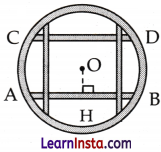
The following figure shows a schematic of a circular window. If AB = 80 cm and OH = 9 cm, then the radius of the window (ignoring the thickness of the bar and the window frame) is
(A) 40 cm
(B) 41 cm
(C) 80 cm
(D) 82 cm
Answer:
(B) 41 cm
Question 28.
If two congruent chords are on the same side of the centre and at equal distance from the centre of the circle, then
(A) the distance between the two chords is equal to the radius.
(B) the distance between the two chords is half the length of any chord.
(C) the distance between the two chords is equal to the diameter.
(D) the two chords coincide.
Answer:
(D) The two chords coincide.
Question 29.
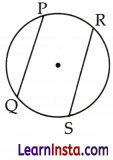
Places P and Q, and places R and S in a certain town are connected with parallel streets as shown in the figure. If PQ = RS and the distance of PQ from the centre of the circle is 100 m, then the distance between the two streets is
(A) 50 m
(B) 100 m
(C) 120 m
(D) 200 m
Answer:
(D) 200 m
Explanation:
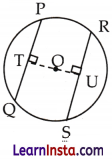
Given that PQ = RS
∴ OT = OU [Equal chords of a circle are equidistant from the centre]
∴ OU = 100 m
Distance between PQ and RS = OT + OU
= 100 + 100
= 200 m
Question 30.
Of two unequal chords of a circle, which one is closer to the centre?
(A) The shorter chord
(B) The longer chord
(C) Both are equidistant
(D) Cannot be determined
Answer:
(B) The longer chord
Question 31.
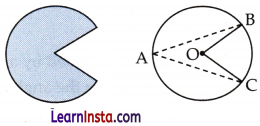
For an arts and crafts project, Mahesh made a Pac-Man model inspired by the video game Pac-Man by cutting a certain part from the circle as shown in the figure. If ∠BOC = 60°, then ∠BAC = __________
(A) 30°
(B) 60°
(C) 120°
(D) 100°
Answer:
(A) 30°
Explanation:
∠BOC = 2∠BAC
[∵ The angle subtended by an arc at the j centre is double the angle subtended by it at any point on the remaining part of the circle]
∴ ∠BAC = \(\frac {1}{2}\) × ∠BOC
= \(\frac {1}{2}\) × 60°
= 30°
Question 32.
In the given figure, O is the centre of the circle and CD = DE = EF = FG. If ∠COD = 40°, then ∠CHG is equal to
(A) 20°
(B) 40°
(C) 80°
(D) 120°
Answer:
(C) 80°
Explanation:
Equal chords of a circle subtend equal angles at the centre.
∴ ∠COD = ∠DOE = ∠EOF = ∠FOG = 40°
∴ ∠COG = 4 × 40° = 160°
∴ ∠CHG = \(\frac {1}{2}\)∠COG
[∵ The angle subtended by an arc at the centre is double the angle subtended by it on any point on the circle]
= \(\frac {1}{2}\) × (160°)
= 80°
Question 33.
In the given figure, if ∠DAB = 60°, ∠ABD = 50°, then ∠ACB is equal to:
(A) 60°
(B) 50°
(C) 70°
(D) 80°
Answer:
(C) 70°
Explanation:
In ∆ADB,
∠DAB + ∠ABD + ∠ADB = 180° [Angle sum property of triangle]
∴ 60° + 50° + ∠ADB = 180°
∴ ∠ADB = 70°
∠ACB = ∠ADB = 70° [Angles in the same segment are equal]
Question 34.
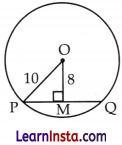
As shown in the figure, O is the centre of a circle of radius 10 units. If OM ⊥ PQ, then PQ = __________
(A) 16 units
(B) 4 units
(C) 6 units
(D) 12 units
Answer:
(D) 12 units
Question 35.
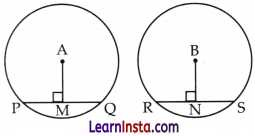
In the given figure, A and B are the centres of two congruent circles. If PQ = RS, then
(A) AM ≠ BN
(B) AM < BN
(C) AM > BN
(D) AM = BN
Answer:
(D) AM = BN
Question 36.
In a circle, among two unequal chords, the longer chord is __________ to the centre than the shorter chord.
(A) farther
(B) closer
(C) at equal distance
(D) cannot be determined
Answer:
(B) closer
Question 37.
In the given figure, PQ = RS = 16 cm. If the diameter of the circle is 20 cm, then the distance between the two chords is

(A) 6 cm
(B) 12 cm
(C) 16 cm
(D) 32 cm
Answer:
(B) 12 cm
Question 38.
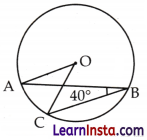
In the given figure, if ∠ABC = 40°, then ∠AOC is equal to:
(A) 20°
(B) 40°
(C) 60°
(D) 80°
Answer:
(D) 80°
I’m Up and Down and Round and Round Class 9 Assertion and Reason Questions
Direction (Q. Nos. 1-9): In the questions given below, there are two statements marked as Assertion (A) and Reason (R).
Read the statements and choose the correct option.
Question 1.
Assertion (A): The length of a chord which is at a distance of 5 cm from the centre of a circle of radius 10 cm is 17.32 cm.
Reason (R) The perpendicular from the centre of a circle to a chord bisects the chord.
(a) Both A and R are true, and R is the correct explanation of A.
(b) Both A and R are true, but R is not the correct explanation of A.
(c) A is true but R is false.
(d) A is false but R is true.
Answer:
(a) Both A and R are true, and R is the correct explanation of A.
Explanation:
Let PQ be a chord of a circle with centre O and radius 10 cm. Draw OR ⊥ PQ.
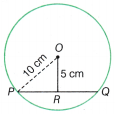
Now, OP = 10 cm and OR = 5 cm
In right-angled ΔORP, we get
OP2 = PR2 + OR2
⇒ PR2 = OP2 – OR2
⇒ PR2 =102 – 52 = 75
⇒ PR = \(\sqrt{75}\) = 8.66 cm
Since the perpendicular from the centre to a chord bisects the chord.
Therefore, PQ = 2 × PR = 2 × 8.66 = 17.32 cm
So, Assertion is true.
Also, Reason is true, and it is the correct explanation of Assertion.
Question 2.
Assertion (A): Two diameters of a circle intersect each other at right angles. Then, the quadrilateral formed by joining their end-point is a rectangle.
Reason (R): Angles in the same segment of a circle are equal.
(a) Both A and R are true, and R is the correct explanation of A.
(b) Both A and R are true, but R is not the correct explanation of A.
(c) A is true but R is false.
(d) A is false but R is true.
Answer:
(b) Both A and R are true, but R is not the correct explanation of A.
Explanation:
Let AB and CD be two perpendicular diameters of a circle with centre O.
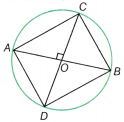
In ΔAOC and ΔBOC, we have
OA = OB [radii of the same circle]
∠AOC = ∠BOC [each equal to 90°)
and OC = OC (common]
∴ ΔAOC ≅ ΔBOC [by SAS congruence rule]
⇒ AC = BC [by CPCT]
Also, ∠ACB = 90° [angle in a semi-circle is a right angle]
Similarly, we get
BC = BDand ∠CBD = 90°
DB = DA and ∠BDA = 90°
Hence, ACBD is a square.
It implies that ACBD is a rectangle.
So, Assertion is true.
Also, Reason is true, but it is not necessary that
Reason is the correct explanation.
Question 3.
Assertion (A): ABCD is a cyclic quadrilateral. AB and DC are produced to meet at E.
Then, ∠ECB = ∠EDA.
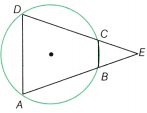
Reason (R): An exterior angle in a cyclic quadrilateral is equal to the opposite interior angle.
(a) Both A and R are true, and R is the correct explanation of A.
(b) Both A and R are true, but R is not the correct explanation of A.
(c) A is true but R is false.
(d) A is false but R is true.
Answer:
(d) A is false but R is true.
Explanation:
∠ECB = ∠EAD
[∵ exterior angle in a cyclic quadrilateral is equal to the interior opposite angle]
Assertion is false, but Reason is true.
Question 4.
Assertion (A): If two chords subtend equal angles at the centre, then they must be parallel.
Reason (R): Equal central angles imply equal chord lengths.
(A) Both (A) and (R) are true, and (R) is the correct explanation of (A).
(B) Both (A) and (R) are true, but (R) is NOT the correct explanation of (A).
(C) (A) is true, but (R) is false.
(D) (A) is false, but (R) is true.
Answer:
(D) (A) is false, but (R) is true.
Question 5.
Assertion (A): The perpendicular from the centre of a circle to a chord bisects the chord.
Reason (R): The centre of a circle is equidistant from every point on the circle.
(A) Both (A) and (R) are true, and (R) is the correct explanation of (A).
(B) Both (A) and (R) are true, but (R) is NOT the correct explanation of (A).
(C) (A) is true, but (R) is false.
(D) (A) is false, but (R) is true.
Answer:
(B) Both (A) and (R) are true, but (R) is NOT the correct explanation of (A).
Question 6.
Assertion (A): Of two chords of a circle, the longer chord is farther from the centre.
Reason (R): If the length of a chord is given by \(2 \sqrt{r^2-d^2}\), where r is the radius of the circle and d is the perpendicular distance of the chord from the centre, then a larger d gives a smaller chord length.
(A) Both (A) and (R) are true, and (R) is the correct explanation of (A).
(B) Both (A) and (R) are true, but (R) is NOT the correct explanation of (A).
(C) (A) is true, but (R) is false.
(D) (A) is false, but (R) is true.
Answer:
(D) (A) is false, but (R) is true.
Explanation:
Assertion (A) is false because the longer chord is closer to the centre, not farther.
Reason (R) is true because it correctly explains that a larger perpendicular distance from the centre gives a smaller chord length.
Question 7.
Assertion (A): Ramesh drew two circles intersecting at two points B and C. Through B, he drew two line segments ABD and PBQ to intersect the circles at A, D and P, Q respectively. As shown in the figure. He concluded that ∠ACP = ∠QCD.
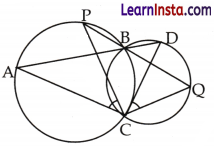
Reason (R): The angle subtended by an arc at the centre is double the angle subtended by it at any point on the remaining part of the circle.
(A) Both (A) and (R) are true, and (R) is the correct explanation of (A).
(B) Both (A) and (R) are true, but (R) is NOT the correct explanation of (A).
(C) (A) is true, but (R) is false.
(D) (A) is false, but (R) is true.
Answer:
(B) Both (A) and (R) are true, but (R) is NOT the correct explanation of (A).
Explanation:
Construction: Join chords AP and DQ.
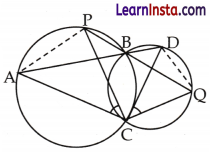
For chord AP, ∠PBA = ∠ACP …(i) [Angles in the same segment]
For chord DQ, ∠DBQ = ∠QCD …(ii) [Angles in the same segment]
But ∠PBA = ∠DBQ [Vertically opposite angles]
∴ ∠ACP = ∠QCD [From (i) and (ii)]
Question 8.
Assertion (A): In the given figure, ∠ACB = 50°.
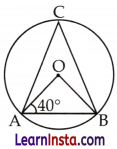
Reason (R): Angles in the same segment of a circle are equal.
(A) Both (A) and (R) are true, and (R) is the correct explanation of (A).
(B) Both (A) and (R) are true, but (R) is NOT the correct explanation of (A).
(C) (A) is true, but (R) is false.
(D) (A) is false, but (R) is true.
Answer:
(B) Both (A) and (R) are true, but (R) is NOT the correct explanation of (A).
Question 9.
Assertion (A): In the given figure, ∠ACB = 70°.
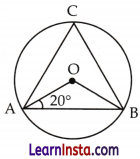
Reason (R): Angles in the same segment of a circle are equal.
(A) Both (A) and (R) are true, and (R) is the correct explanation of (A).
(B) Both (A) and (R) are true, but (R) is not the correct explanation of (A).
(C) (A) is true, but (R) is false.
(D) (A) is false, but (R) is true.
Answer:
(B) Both (A) and (R) are true, but (R) is not the correct explanation of (A).