Get the simplified Extra Questions for Class 9 Maths and Ganita Manjari Class 9 Maths Chapter 3 The World of Numbers Extra Questions with complete explanation.
Class 9 The World of Numbers Extra Questions
Extra Questions on The World of Numbers Class 9
Class 9 Ganita Manjari Chapter 3 Extra Questions
Question 1.
A person has a debt of ₹ 300 and gains ₹ 500. What is his final position?
Solution:
Given, debt = -300 and gain = +500
So, final position = -300 + 500 = 200
Hence, the final position is ₹ 200 profit.
Question 2.
Form a rational number with the numerator and denominator given below.
(i) 3, 5
(ii) -2, -7
Solution:
(i) Given, the numerator and denominator are 3 and 5.
So, the rational number will be \(\frac {3}{5}\).
(ii) Given, the numerator and denominator are -2 and -7.
So, rational number will be \(\frac {-2}{-7}\) i.e. \(\frac {2}{7}\)
Question 3.
Write two rational numbers equivalent to \(\frac {2}{3}\).
Solution:
Given, rational number is \(\frac {2}{3}\) and equivalent rational numbers are \(\frac{2 \times 2}{3 \times 2}=\frac{4}{6}\) and \(\frac{2 \times 3}{3 \times 3}=\frac{6}{9}, \ldots \ldots \ldots .\)
Hence, two equivalent rational numbers are \(\frac {4}{6}\) and \(\frac {6}{9}\).

Question 4.
Express \(-\frac {36}{48}\) as a rational number with denominator 4.
Solution:
We have, \(-\frac {36}{48}\)
∵ HCF of 36 and 48 is 12.
So, \(-\frac{36 \div 12}{48 \div 12}=-\frac{3}{4}\)
Question 5.
Find the standard/simplest form of \(-\frac {21}{27}\).
Solution:
Given, rational number is \(-\frac {21}{27}\)
For the standard/simplest form,
\(-\frac{21 \div 3}{27 \div 3}=-\frac{7}{9}\) [∵ HCF of 21 and 27 is 3]
The standard form of \(-\frac {21}{27}\) is \(-\frac {7}{9}\).
The World of Numbers Class 9 Very Short Question Answer
Question 1.
Evaluate \(\frac{6}{11} \div \frac{3}{11}\)
Solution:
We have, \(\frac{6}{11} \div \frac{3}{11}=\frac{6}{11} \times \frac{11}{3}=\frac{6}{3}=2\)
Question 2.
For which operations, closure property for rational numbers does not hold?
Solution:
Rational numbers are not closed under division.
Question 3.
For two integers p and q, \(\frac {p}{q}\) is a rational number. Then write a condition for q, \(\frac {p}{q}\) to be a rational number.
Solution:
q will be a non-zero integer, i.e., q ≠ 0 is the condition for being \(\frac {p}{q}\) a rational number.
Question 4.
Name the property under addition used in the following expression.
5 + [(-5) + 7] = [5 + (-5)] + 7
Solution:
Associative Property
Question 5.
Given an example to show that subtraction is not associative for rational numbers.
Solution:
For rational numbers \(\frac {5}{4}\), \(\frac {3}{4}\), and \(\frac {1}{4}\), we see that
\(\frac{5}{4}-\left(\frac{3}{4}-\frac{1}{4}\right)=\frac{5}{4}-\frac{2}{4}=\frac{3}{4}\)
and \(\left(\frac{5}{4}-\frac{3}{4}\right)-\frac{1}{4}=\frac{2}{4}-\frac{1}{4}=\frac{1}{4}\)
Thus, \(\frac{5}{4}-\left(\frac{3}{4}-\frac{1}{4}\right) \neq\left(\frac{5}{4}-\frac{3}{4}\right)-\frac{1}{4}\)
So, we can say that subtraction is not associative for rational numbers.
Question 6.
‘Rational numbers are commutative under addition but not commutative under subtraction.’ Justify the statement with an example.
Solution:
Let \(\frac {1}{2}\) and \(\frac {1}{4}\) be two rational numbers.
Now, \(\frac{1}{2}+\frac{1}{4}=\frac{1}{4}+\frac{1}{2}=\frac{3}{4}\), which implies that rational numbers are commutative under addition.
Now, \(\frac{1}{2}-\frac{1}{4}=\frac{2-1}{4}=\frac{1}{4}\)
But \(\frac{1}{4}-\frac{1}{2}=\frac{1-2}{4}=-\frac{1}{4}\)
Thus, \(\frac{1}{2}-\frac{1}{4} \neq \frac{1}{4}-\frac{1}{2}\)
So, rational numbers are not commutative under subtraction.
Question 7.
Write the multiplicative inverse of \(\frac {3}{2}\).
Solution:
The multiplicative inverse of \(\frac {3}{2}\) is \(\frac {2}{3}\).
Question 8.
Give the reason why the multiplicative inverse of 0 does not exist?
Solution:
The multiplicative inverse for any rational number x is \(\frac {1}{x}\).
Here, the multiplicative inverse of 0 is \(\frac {1}{0}\).
But, \(\frac {1}{0}\) is not defined.
So, the multiplicative inverse of 0 is not defined.
Question 9.
Write the multiplicative and additive identities for rational numbers.
Solution:
1 is the multiplicative identity of a rational number
∵ For all rational numbers let x, x × 1 = x = 1 × x
And 0 is the additive identity for a rational numbers.
∵ For all rational numbers let x, x + 0 = x = 0 + x
The World of Numbers Class 9 Short Question Answer
Question 1.
A person has ₹ 1000. He loses ₹ 750 and then gains ₹ 200. Find his final amount and state whether it is a profit or a loss.
Solution:
Given, initial amount = ₹ 1000, loss = – ₹ 750 and gain = + ₹ 200
∴ Final amount = 1000 – 750 + 200
= 250 + 200
= ₹ 450
Hence, it is a profit.
Question 2.
Convert the following rational numbers to rational numbers having the same denominator.
\(\frac{-3}{4}, \frac{2}{3}, \frac{5}{6}, \frac{7}{-8}\)
Solution:
For the same/common denominators, LCM of 4, 3, 6, 8 is 24.
\(\frac{-3 \times 6}{4 \times 6}, \frac{2 \times 8}{3 \times 8}, \frac{5 \times 4}{6 \times 4}, \frac{7 \times 3}{-8 \times 3}\)
So, \(-\frac{18}{24}, \frac{16}{24}, \frac{20}{24},-\frac{21}{24}\)
Question 3.
Draw the number line and represent the following rational numbers on it.
(i) \(\frac {3}{4}\)
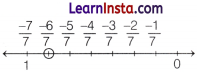
(ii) \(-\frac {6}{7}\)
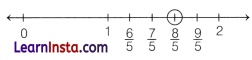
(iii) \(\frac {8}{5}\)
Solution:
(i) Representation of rational number \(\frac {3}{4}\) on number line.
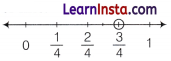
(ii) Representation of rational number \(-\frac {6}{7}\) on the number line.
(iii) Representation of \(\frac{8}{5}=1 \frac{3}{5}\) on number line.
Question 4.
Using commutativity and associativity of addition of rational numbers, express the following as a rational number.
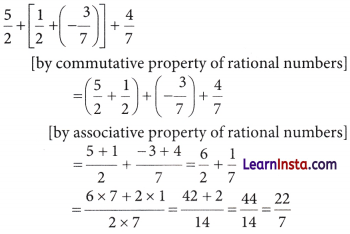
\(\frac{5}{2}+\left(-\frac{3}{7}\right)+\frac{1}{2}+\frac{4}{7}\)
Solution:
Question 5.
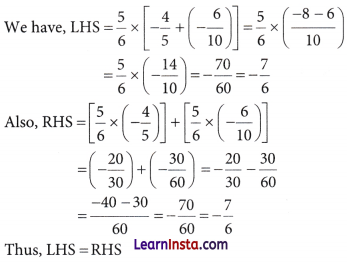
Verify that \(\frac{5}{6} \times\left[-\frac{4}{5}+\left(-\frac{6}{10}\right)\right]=\left[\frac{5}{6} \times\left(-\frac{4}{5}\right)\right]+\left[\frac{5}{6} \times\left(-\frac{6}{10}\right)\right]\)
Solution:
Question 6.
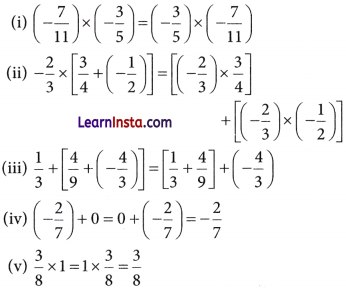
Name the property used in each of the following.
Solution:
(i) Commutative property over multiplication
(ii) Distributive property over addition
(iii) Associative property over addition
(iv) Existence of additive identity
(v) Existence of multiplicative identity
Question 7.
Find the multiplicative inverse of the following.
(i) \(-6 \times\left(-\frac{5}{42}\right)\)
(ii) \(-\frac {33}{119}\)
(iii) -1
(iv) \(-\frac{6}{17} \times \frac{17}{5}\)
Solution:
(i) \(-6 \times\left(-\frac{5}{42}\right)=\frac{5}{7}\)
∴ Multiplicative inverse of \(\frac {5}{7}\) is \(\frac {7}{5}\).
(ii) Multiplicative inverse of (\(-\frac {33}{119}\)) is (\(-\frac {119}{33}\))
(iii) Multiplicative inverse of -1 is -1.
(iv) We have, \(-\frac{6}{17} \times \frac{17}{5}=-\frac{6}{5}\)
∴ Multiplicative inverse of \(-\frac {6}{5}\) is \(-\frac {5}{6}\)
Question 8.
Verify the property x × y = y × x of rational numbers using.
(i) x = \(-\frac {5}{7}\) and y = \(\frac {14}{15}\)
(ii) x = \(\frac {2}{3}\) and y = \(\frac {9}{4}\)
Solution:
(i) We know that x × y = y × x
⇒ \(-\frac{5}{7} \times \frac{14}{15}=\frac{14}{15} \times\left(-\frac{5}{7}\right)\)
∴ \(\left(-\frac{2}{3}\right)=\left(-\frac{2}{3}\right)\)
which shows LHS = RHS
Hence, it is verified.
(ii) We know that x × y = y × x
⇒ \(\frac{2}{3} \times \frac{9}{4}=\frac{9}{4} \times \frac{2}{3}\)
∴ \(\frac{18}{12}=\frac{18}{12}\)
which shows LHS = RHS
Hence, it is verified.
Question 9.
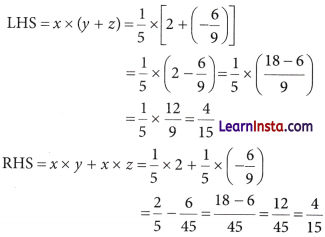
Verify the distributive property under addition for three numbers \(\frac {1}{5}\), 2, and \(-\frac {6}{9}\).
Solution:
Let x = \(\frac {1}{5}\), y = 2, and z = \(-\frac {6}{9}\)
The distributive property under addition is
x × (y + z) = x × y + x × z
Question 10.
Express \(32.12 \overline{35}\) in the form of \(\frac {p}{q}\).
Solution:
Let x = 32.12353535…
∴ 100x = 3212.353535…
and 10000x = 321235.3535…
∴ 10000x – 100x = 321235.3535… – 3212.353535…
⇒ 9900x = 318023
⇒ x = \(\frac {318023}{9900}\)
Question 11.
Find the sum of 0.0333 … and 0.444 ….
Solution:
Let x = 0.0333
⇒ 10x = 0.333…
⇒ 100x = 3.333 [multiply both sides by 10]
∴ 100x – 10x = 3.333…- 0.333…
⇒ 90x = 3
⇒ x = \(\frac {3}{90}\)
Again, let y = 0.444…..
⇒ 10y = 4.444…..
⇒ 10y – y = 4.444…- 0.444…
⇒ 9y = 4
⇒ y = \(\frac {4}{9}\)
∴ Sum of 0.0333… and 0.444… = x + y
= \(\frac{3}{90}+\frac{4}{9}\)
= \(\frac {43}{90}\)
Question 12.
Find the sum of \(2 . \overline{3}\) and \(4 . \overline{15}\).
Solution:
\(2 . \overline{3}+4 . \overline{15}=\frac{21}{9}+\frac{411}{99}=\frac{214}{33}\)
The World of Numbers Class 9 Long Question Answer
Question 1.
(i) If x = 6, y = \(\frac {1}{9}\), z = 0
(ii) If x = \(\frac {4}{5}\), y = \(-\frac {9}{10}\), z = \(\frac {43}{15}\)
Then, verify the following properties and name them.
(a) x × (y + z) = x × y + x × z
(b) x × (y × z) = (x × y) × z
(c) x × y = y × x
(d) x × (y – z) = x × y – x × z
Solution:
(i) We have, x = 6, y = \(\frac {1}{9}\) and z = 0
(a) x × (y + z) = x × y + x × z
This statement follows the distributive property over addition.
LHS = x × (y + z)
= 6 × (\(\frac {1}{9}\) + 0)
= 6 × \(\frac {1}{9}\)
= \(\frac {2}{3}\)
RHS = x × y + x × z
= 6 × \(\frac {1}{9}\) + 6 × 0
= \(\frac {2}{3}\) + 0
= \(\frac {2}{3}\)
(b) x × (y × z) = (x × y) × z
This statement follows the associative property under multiplication.
LHS = x × (y × z)
= 6 × (\(\frac {1}{9}\) × 0)
= 6 × 0
= 0
RHS = (x × y) × z
= (6 × \(\frac {1}{9}\)) × 0
= \(\frac {2}{3}\) × 0
= 0
(c) x × y = y × x
This statement follows the commutative property under multiplication.
LHS = x × y
= 6 × \(\frac {1}{9}\)
= \(\frac {2}{3}\)
RHS = y × x
= \(\frac {1}{9}\) × 6
= \(\frac {2}{3}\)
(d) x × (y – z) = x × y – x × z
This statement follows the distributive property over subtraction.
LHS = x × (y – z)
= 6 × (\(\frac {1}{9}\) – 0)
= 6 × \(\frac {1}{9}\)
= \(\frac {2}{3}\)
RHS = x × y – x × z
= 6 × \(\frac {1}{9}\) – 6 × 0
= \(\frac {2}{3}\) – 0
= \(\frac {2}{3}\)
(ii) We have, x = \(\frac {4}{5}\), y = \(-\frac {9}{10}\), z = \(\frac {43}{15}\)
(a) x × (y + z) = x × y + x × z
This statement follows the distributive property over addition.
LHS = x × (y + z)
= \(\frac{4}{5} \times\left(-\frac{9}{10}+\frac{43}{15}\right)\)
= \(\frac{4}{5} \times\left(\frac{-27+86}{30}\right)\)
= \(\frac{4}{5} \times \frac{59}{30}\)
= \(\frac {118}{75}\)
RHS = x × y + x × z
= \(\frac{4}{5} \times\left(-\frac{9}{10}\right)+\frac{4}{5} \times \frac{43}{15}\)
= \(-\frac{18}{25}+\frac{172}{75}\)
= \(\frac {118}{75}\)
(b) x × (y × z) = (x × y) × z
This statement follows the associative property under multiplication.
LHS = x × (y × z)
= \(\frac{4}{5} \times\left\{\left(-\frac{9}{10}\right) \times \frac{43}{15}\right\}\)
= \(\frac{4}{5} \times\left(-\frac{129}{50}\right)\)
= \(\frac {-516}{250}\)
RHS = (x × y) × z
= \(\left\{\frac{4}{5} \times\left(-\frac{9}{10}\right)\right\} \times \frac{43}{15}\)
= \(-\frac{18}{25} \times \frac{43}{15}\)
= \(\frac {-258}{125}\)
= \(\frac {-516}{250}\)
(c) x × y = y × x
This statement follows the commutative property under multiplication.
LHS = x × y
= \(\frac{4}{5} \times\left(-\frac{9}{10}\right)\)
= \(\frac {-18}{25}\)
RHS = y × x
= \(-\frac{9}{10} \times \frac{4}{5}\)
= \(\frac {-18}{25}\)
(d) x × (y – z) = x × y – x × z
This statement follows the distributive property under subtraction.
LHS = x × (y – z)
= \(\frac{4}{5} \times\left(-\frac{9}{10}-\frac{43}{15}\right)\)
= \(\frac{4}{5} \times\left(\frac{-27-86}{30}\right)\)
= \(\frac{4}{5} \times\left(-\frac{113}{30}\right)\)
= \(\frac {-226}{75}\)
RHS = x × y – x × z
= \(\frac{4}{5} \times\left(-\frac{9}{10}\right)-\frac{4}{5} \times \frac{43}{15}\)
= \(-\frac{18}{25}-\frac{172}{75}\)
= \(\frac{-54-172}{75}\)
= \(\frac {-226}{75}\)
Question 2.
Give one example each to show that the rational numbers are closed under addition, subtraction, and multiplication. Are rational numbers closed under division? Give two examples in support of your answer.
Solution:
We know that rational numbers are closed under addition, subtraction, and multiplication.
We can understand this from the following examples.
Rational numbers are closed under.
Addition
e.g. \(\frac{4}{7}+\frac{1}{2}=\frac{8+7}{14}=\frac{15}{14}\), which is a rational number.
Subtraction
e.g. \(\frac{4}{7}-\frac{1}{2}=\frac{8-7}{14}=\frac{1}{14}\), which is a rational number.
Multiplication
e.g. \(\frac{4}{7} \times \frac{1}{2}=\frac{4}{14}=\frac{2}{7}\), which is a rational number.
But rational numbers are not closed under division.
If zero is excluded from the collection of rational numbers, then we can say that rational numbers are closed under division.
Now, we see the examples given below.
\(\frac{4}{7} \div \frac{1}{2}=\frac{4}{7} \times 2=\frac{8}{7}\), which is a rational number.
But, \(\frac{4}{7} \div 0=\frac{4}{7} \times \frac{1}{0}\), which is not defined and so, it is not a rational number.
Also, \(\frac{1}{2} \div 0=\frac{1}{2} \times \frac{1}{0}\), which is not defined and also not a rational number.
Question 3.
Robin writes the properties of rational numbers as
Property 1: For any two rational numbers x and y, x + y = y + x.
Property 2: For any two rational numbers x and y, x – y = y – x.
Property 3: For any two rational numbers x and y, x/y = y/x.
Property 4: For any two rational numbers x and y, x × y = y × x.
Which properties written by Robin are incorrect? Why are they incorrect?
Solution:
Property 2 and Property 3 written by Robin are incorrect, i.e., for any two rational numbers x and y,
x – y ≠ y – x
and \(\frac{x}{y} \neq \frac{y}{x}\)
e.g. Let \(\frac {3}{4}\) and \(\frac {6}{5}\) be any two rational numbers.
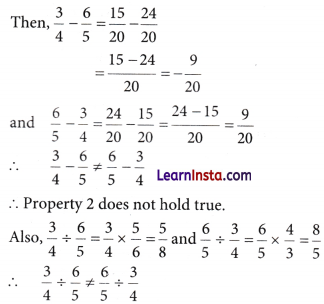
Hence, Property 3 does not hold.
Question 4.
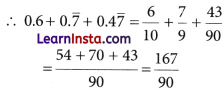
Express 0.6 + 0.7 + 0.47 in the form of \(\frac {p}{q}\), where p and q are integers and q ≠ 0.
Solution:
Question 5.
Prove that √p + √q is irrational, where p and q are primes.
Solution:
Let us suppose that √p + √q is a rational number
and let √p + √q = a, where a is rational.
Therefore, √q = a – √p
On squaring both sides, we get
q = a2 + p – 2a√p [∵ (a – b)2 = a2 + b2 – 2ab]
⇒ \(\sqrt{p}=\frac{a^2+p-q}{2 a}\)
Since p and q are primes and a is a rational number, \(\frac{a^2+p-q}{2 a}\) is rational.
Therefore, √p is a rational number.
But this contradicts the fact that √p is an irrational number, as p is prime.
So, our assumption was incorrect.
Hence, √p + √q is irrational.
Hence proved.
Question 6.
If √ab is an irrational number, then prove that (√a + √b) is an irrational number.
Solution:
Let (√a + √b) be a rational number.
Then, √a + √b = r, where a, b, and r are rational.
⇒ (√a + √b)2 = r2 [squaring both sides]
⇒ a + b + 2√ab = r2 [∵ (A + B)2 = A2 + B2 + 2AB]
⇒ 2√ab = r2 – a – b
⇒ \(\sqrt{a b}=\frac{r^2-a-b}{2}\)
Since r, a, and b are rational numbers.
⇒ \(\frac{r^2-(a+b)}{2}\) is rational number.
⇒ √ab is a rational.
This contradicts, because √ab is an irrational number.
So, our assumption is incorrect.
Hence, (√a + √b) is an irrational number.
Hence proved.
Question 7.
Deep draws the spiral of irrational numbers below on a paper.
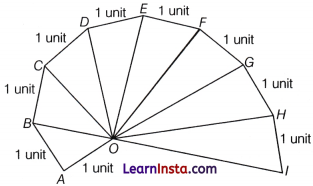
Based on the above information, answer the following question.
What is the length of OE in the spiral?
Solution:
In the spiral, we use Pythagoras theorem.
∴ OE = √5 units
The World of Numbers Class 9 Case Based Questions
Question 1.
To support helpless people and orphans is the collective responsibility of the whole society. To measure this spirit, a survey was conducted in a city. It was found that 7 out of every 13 households are donating some amount of their income to an orphanage or old age home, or institutions for the physically handicapped.
Based on the given information, answer the following questions.
(i) Write the fraction of households that are donating their income?
(ii) Write the fraction of households that are not donating their income?
(iii) (a) Write the decimal form of the fraction of households that are donating their income.
Or
(b) Write the decimal form of the fraction of households that are not donating.
Solution:
(i) Given, total households = 13
and the number of households, which are donating their income = 7
∴ Fraction of household, which are donating = \(\frac {7}{13}\)
(ii) Given, total households = 13
and the number of houses, which are not donating their income = 13 – 7 = 6
∴ Fraction of households, which are not donating = \(\frac {6}{13}\)
(iii) (a) We have, \(\frac {7}{13}\)
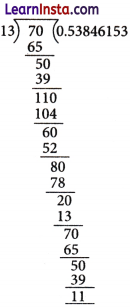
∴ \(\frac{7}{13}=0 . \overline{538461}\)
Or
(b) We have, \(\frac {6}{13}\)
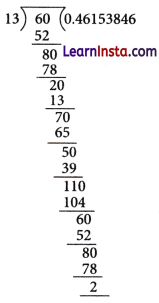
∴ \(\frac{6}{13}=0 . \overline{461538}\)
Question 2.
To judge the preparation of students of Class IX on the topic ‘Number System’, Mathematics teachers write two numbers on the blackboard (as shown in the figure).
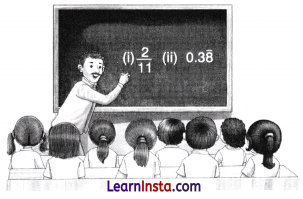
He asks some questions about the two members, which are following then answer the questions.
(i) Write the decimal form of \(\frac {2}{11}\).
(ii) Write the \(\frac {p}{q}\) form of \(0.3 \overline{8}\).
(iii) (a) Is \(\frac {2}{11}\) a terminating, non-terminating repeating, non-terminating non-repeating.
Or
(b) If \(\frac {p}{q}\) form of \(0.3 \overline{8}\) is \(\frac {m}{n}\) then find the value of m + n.
Solution:
(i) We have, \(\frac {2}{11}\)
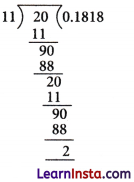
∴ 2 = \(0 . \overline{18}\)
(ii) Let x = \(0.3 \overline{8}\)
⇒ x = 0.3888…
∴ 10x = 3.888… …..(i)
and 100x = 38.888… ……(ii)
On subtracting Eq. (i) from Eq. (ii), we get
100x – 10x = 38.888.. – 3.888…
⇒ 90x = 35
⇒ x = \(\frac{35}{90}=\frac{7}{18}\)
(iii) (a) \(\frac{2}{11}=0 . \overline{18}\)
∴ \(\frac {2}{11}\) has non-terminating repeating decimal expansion.
Or
\(\frac{m}{n}=\frac{7}{18}\)
∴ m + n = 25