Practicing Class 9 Maths MCQ and Ganita Manjari Class 9 Maths Chapter 1 Orienting Yourself The Use of Coordinates MCQ Questions Online Test with Answers daily helps in time management.
MCQ on Orienting Yourself The Use of Coordinates Class 9
Orienting Yourself The Use of Coordinates MCQ Class 9
Class 9 Maths Orienting Yourself The Use of Coordinates MCQ
Question 1.
If the point A(a, b) lies in the II quadrant, then which of the following is correct?
(a) a > b
(b) a < b
(c) a = b
(d) None of these
Answer:
(b) a < b
Explanation:
The point A (a, b) lies in the II quadrant.
Thus, the x-coordinate, i.e., a, is negative and the y-coordinate, i.e., b, is positive.
a < b
Question 2.
The perpendicular distance of a point from the x-axis is known as
(a) intersection point
(b) origin
(c) abscissa
(d) ordinate
Answer:
(c) abscissa
Explanation:
Perpendicular distance of a point from the Y-axis is called abscissa or x-coordinate.
Question 3.
Abscissa of all the points on the X-axis is
(a) 0
(b) 1
(c) 2
(d) any number
Answer:
(d) any number
Explanation:
The abscissa of all the points on the X-axis is any real number because the X-axis is a number line, which contains infinite real numbers on it.
Question 4.
The point which lies on the Y-axis at a distance of 5 units in the negative direction of the Y-axis is
(a) (0, 5)
(b) (5, 0)
(c) (0, -5)
(d) (-5, 0)
Answer:
(c) (0, -5)
Explanation:
Given that the point lies on the y-axis, this shows that its x-coordinate is zero.
Also, it is at a distance of 5 units in the negative direction of the y-axis, so its y-coordinate is negative.
Hence, the required point is (0, -5).
Question 5.
If the coordinates of two points are A (4, 5) and B (- 3, 6), then the value of (Abscissa of A) – (Ordinate of B) is
(a) 3
(b) 5
(c) -2
(d) 9
Answer:
(c) -2
Explanation:
Given, point A(4, 5), i.e., abscissa of A is 4, and point B (- 3, 6), i.e., ordinate of B is 6.
∴ Abscissa of A – Ordinate of B
= 4 – 6
= -2

Question 6.
The distance of point C (8,9) from the Y-axis is
(a) 7 units
(b) 8 units
(c) 9 units
(d) 1 unit
Answer:
(b) 8 units
Explanation:
Given, the point is C (8,9).
Thus, distance of C from the Y-axis = x – corrdinate of the point = 8 units
Question 7.
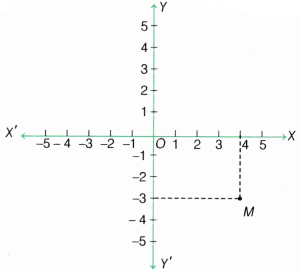
From the figure given below, the coordinates of point M are
(a) (-4, -3)
(b) (4, -3)
(c) (-4, 3)
(d) (4, 3)
Answer:
(b) (4, -3)
Explanation:
In the given figure, point M lies at a distance of 4 units from the Y-axis and at a distance of 3 units from the X-axis along the negative direction of the Y-axis.
The x-coordinate is 4, and the y-coordinate is -3. Thus, the coordinates of point M are (4, -3).
Question 8.
If the perpendicular distance of a point P from the X-axis is 5 units and the foot of the perpendicular lies in the negative direction of the X-axis, then the point P has
(a) x-coordinate = – 5
(b) y-coordinate = 5 only
(c) y-coordinate = – 5 only
(d) y-coordinate = 5 or – 5
Answer:
(d) y-coordinate = 5 or – 5
Explanation:
We know that the perpendicular distance of a point from the X-axis gives the y-coordinate at that point.
Here, the foot of the perpendicular lies in the negative direction of the X-axis, so the perpendicular distance can be measured from the II quadrant or the III quadrant.
Hence, the point P has y-coordinate = 5 or – 5.
Question 9.
The point D lies at a distance of 3 units from the X-axis along the positive direction of7-axis and 6 units from 7-axis along the negative direction of the X-axis. The coordinates of the point D are
(a) (-6, 3)
(b) (6, 3)
(c) (3, -6)
(d) (-3, 6)
Answer:
(a) (-6, 3)
Explanation:
The point D lies at a distance of 3 units from the x-axis, i.e., the y-coordinate is 3, and at a distance of 6 units from 7-axis along the negative direction of the x-axis, i.e. x coordinate is -6.
Thus, the coordinates of point D are (-6, 3).
Question 10.
The distance between the points (-7,8) and (1,6) is
(a) 2\(\sqrt{17}\) units
(b) 4\(\sqrt{17}\) units
(c) 2√5 units
(d) 2\(\sqrt{15}\) units
Answer:
(a) 2\(\sqrt{17}\) units
Explanation:
Let x1 = -7, y1 = 8, x2 = 1, and y2 = 6
Using the distance formula,
Distance = \(\sqrt{\left(x_2-x_1\right)^2+\left(y_2-y_1\right)^2}\)
= \(\sqrt{(1-(-7))^2+(6-8)^2}\)
= \(\sqrt{8^2+(-2)^2}=\sqrt{64+4}\)
= \(\sqrt{68}\)
= 2\(\sqrt{17}\) units
Question 11.
The distance of point (2a, – b) form X-axis is
(a) a
(b) -a
(c) b
(d) -b
Answer:
(c) b
Explanation:
Let the given point be A(2a, -b) and the perpendicular from A on the X-axis intersects at B.
The point lies on the X-axis, so the coordinates of points is (2a, 0).
Distance of the given point from the X-axis = AB
Using the distance formula, we have
AB = \(\sqrt{(2 a-2 a)^2+(0-(-b))^2}\)
= \(\sqrt{0+b^2}\)
= b units
Question 12.
ABCD is a rectangle with its vertices at (2, -2), (8, 4), (4, 8) and (-2,2) taken in order. Length of its diagonal is
(a) 4√2 units
(b) 6√2 units
(c) 4√26 units
(d) 2√26 units
Answer:
(d) 2√26 units
Explanation:
ABCD is a rectangle with its vertices at (2, – 2), (8, 4), (4, 8) and (-2, 2).
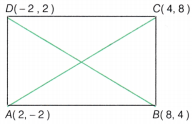
Now, the length of diagonal AC by using the distance formula,
\(\sqrt{\left(x_2-x_1\right)^2+\left(y_2-y_1\right)^2}=\sqrt{(4-2)^2+(8+2)^2}\)
[∵ x1 = 2, x2 = 4, y1 = -2 and y2 = 8]
= \(\sqrt{100}\)
= \(\sqrt{104}\)
= 2\(\sqrt{26}\) units
Question 13.
If the distances of the point P(x, y) from (2, 0) and (0, 2) are equal, then which of the following is true?
(a) x + y = 0
(b) x = y + 2
(c) y = x + 2
(d) x = y
Answer:
(d) x = y
Explanation:
Let the points be A(2, 0) and S (0, 2).
Given that the distances of the point P(x, y) from (2, 0) and (0, 2) are equal.
∴ PA = PB
⇒ PA2 = PB2
⇒ (x – 2)2 + (y – 0)2 = (x – 0)2 + (y – 2)2
⇒ x2 + 4 – 4x + y2 = x2 + y2 + 4 – 4y
⇒ -4x = -4y
⇒ x = y
Question 14.
The distance of which of the following points from the origin is less than 5 units?
(a) (3, 4)
(b) (2, 6)
(c) (-3, -4)
(d) (1, 4)
Answer:
(d) (1, 4)
Explanation:
We know that the distance from the origin is d = \(\sqrt{(x-0)^2+(y-0)^2}=\sqrt{x^2+y^2}\)
Now, we calculate the distance from each point.
(a) (3,4)
∴ d = \(\sqrt{3^2+4^2}=\sqrt{25}\) = 5 units
(b) (2, 6)
∴ d = \(\sqrt{2^2+6^2}=\sqrt{40}\) >5 units
(c) (-3,-4)
∴ d = \(\sqrt{(-3)^2+(-4)^2}=\sqrt{25}\) = 5 units
(d) (1, 4)
∴ d = \(\sqrt{1^2+4^2}=\sqrt{17}\) <5 units
Hence, the only point (1, 4), whose distance from the origin is less than 5 units.
Question 15.
M is a point on 7-axis at a distance of 4 units from the x-axis, and it lies below the X-axis. The distance of point M from point Q(5, 1) is
(a) √2 units
(b) \(\sqrt{34}\) units
(c) \(\sqrt{50}\) units
(d) \(\sqrt{90}\) units
Answer:
(c) \(\sqrt{50}\) units
Explanation:
Coordinates of point M are (0, – 4).
MQ = \(\sqrt{(5-0)^2+(1+(-4))^2}\)
[by distance formula]
= \(\sqrt{50}\) units
Question 16.
If (3, 5) is the mid-point of the line segment joining the points (2,1) and (a, 9), then the value of a is
(a) 2
(b) 4
(c) 6
(d) 8
Answer:
(b) 4
Explanation:
Given, the midpoint is (3, 5) and the points are (2, 1) and (a, 9).
Using the midpoint formula,
\(\frac{2+a}{2}\) = 3
⇒ 2 + a = 6
⇒ a = 4
Question 17.
The vertices of a AOAB are O (0, 0), A (4, 0) and B(0,6). The median AD is drawn on OB. The length of AD is

(a) \(\sqrt{52}\) units
(b) 5 units
(c) 25 units
(d) 10 units
Answer:
(b) 5 units
Explanation:
AD is a median on OB in ΔAOB.
So, D is the midpoint of OB.
Coordinates of D = \(\left(\frac{0+0}{2}, \frac{0+6}{2}\right)\) = (0, 3)
Length of AD = \(\sqrt{(4-0)^2+(0-3)^2}\)
= \(\sqrt{16+9}\)
= 5 units
Question 18.
A(-5, 6) and C(9, 1) are the two opposite vertices of a parallelogram ABCD. Its diagonals intersect each other at P(a, b). The relation between a and
(a) b = a – 1.5
(b) b = a + 1.5
(c) b = a – 4.5
(d) b = a + 4.5
Answer:
(b) b = a + 1.5
Explanation:
Hint: Mid-point of AC is P(a, b).
Then, a = 2 and b = 3.5
(a) b = a – 1.5, not satisfied
(b) b = a + 1.5, satisfied
(c) b = a – 4.5, not satisfied
(d) b = a + 4.5, not satisfied
Question 19.
Which of the following lies on the x-axis?
(A) (0, 5)
(B) (-3, 0)
(C) (2, 4)
(D) (1, 1)
Answer:
(B) (-3, 0)
Question 20.
Which point lies on the y-axis?
(A) (4, 0)
(B) (0, -6)
(C) (3, 2)
(D) (-5, 1)
Answer:
(B) (0, -6)
Question 21.
Which of the following points lies on both axes?
(A) (2, 0)
(B) (0, 3)
(C) (0, 0)
(D) (-1, 1)
Answer:
(C) (0, 0)
Question 22.
How many points lie on the x-axis?
(A) One
(B) Two
(C) Finite
(D) Infinitely many
Answer:
(D) Infinitely many
Question 23.
Point (-3, 5) lies in the
(A) first quadrant
(B) second quadrant
(C) third quadrant
(D) fourth quadrant
Answer:
(B) second quadrant
Question 24.
A point both of whose coordinates are negative will lie in
(A) I quadrant
(B) II quadrant
(C) III quadrant
(D) IV quadrant
Answer:
(C) III quadrant
Question 25.
Points (1, -1), (2, -2), (4, -5), (-3, -4)
(A) lie in II quadrant
(B) lie in III quadrant
(C) lie in IV quadrant
(D) do not lie in the same quadrant
Answer:
(D) do not lie in the same quadrant
Quadrant 26.
If the y-coordinate of a point is zero, then this point always lies
(A) in I quadrant
(B) in II quadrant
(C) on x-axis
(D) on y-axis
Answer:
(C) on x-axis
Question 27.
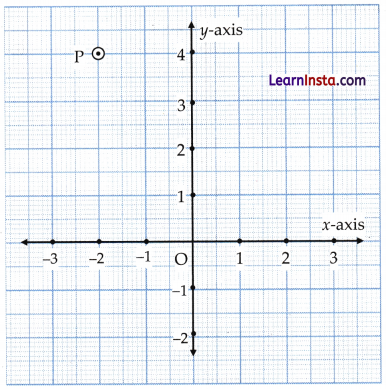
In the given figure, the coordinates of P are
(A) (-4, 2)
(B) (-2, 4)
(C) (4, -2)
(D) (2, -4)
Answer:
(B) (-2, 4)
Question 28.
Point (0, -7) lies
(A) on the x-axis
(B) in the second quadrant
(C) on the y-axis
(D) in the fourth quadrant
Answer:
(C) on the y-axis
Question 29.
Point (-10, 0) lies
(A) on the x-axis
(B) on the y-axis
(C) in the third quadrant
(D) in the fourth quadrant
Answer:
(A) on the x-axis
Question 30.
The points (-5, 2) and (2, -5) lie in the
(A) same quadrant
(B) II and III quadrants, respectively
(C) II and IV quadrants, respectively
(D) IV and II quadrants, respectively
Answer:
(C) II and IV quadrants, respectively
Question 31.
If the coordinates of a point are (x, y) and the x-coordinate is negative and the y-coordinate is positive, then it represents which quadrant?
(A) Quadrant IV
(B) Quadrant III
(C) Quadrant II
(D) Quadrant I
Answer:
(C) Quadrant II
Question 32.
The sum of the x and y coordinates of the point of intersection of the two axes is
(A) 0
(B) 1
(C) 2
(D) -1
Answer:
(A) 0
Question 33.
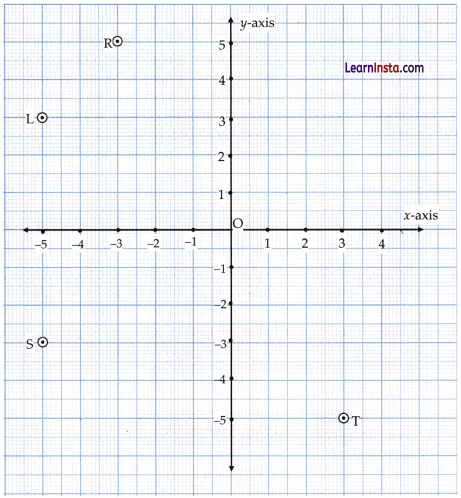
In the figure, the point identified by the coordinates (-5, 3) is
(A) T
(B) R
(C) L
(D) S
Answer:
(C) L
Orienting Yourself The Use of Coordinates Class 9 Assertion and Reason Questions
Direction (Q. Nos. 1-7): In the questions given below, there are two statements marked as Assertion (A) and Reason (R). Read the statements and choose the correct option.
Question 1.
Assertion (A): The point (-6, 0) lies on the Y-axis and the point (0, -7) lies on the X-axis.
Reason (R): Every point on the X-axis has zero distance from the X-axis, and every point on the Y-axis has zero distance from the Y-axis.
(a) Both A and R are true, and R is the correct explanation of A.
(b) Both A and R are true, but R is not the correct explanation of A.
(c) A is true but R is false.
(d) A is false but R is true.
Answer:
(d) A is false but R is true.
Explanation:
Assertion: The point (-6, 0) lies on the X-axis and the point (0, -7) lies on the Y-axis. So, the assertion is false.
Reason: Every point on the X-axis and Y-axis indeed has zero distance from the X-axis and Y-axis, respectively.
Question 2.
Assertion (A): In the following graph, the coordinates of points P and Q are (3,2) and (-1,-2), respectively.
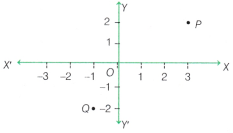
Reason (R): The coordinates of any point can be determined by drawing a perpendicular line to the coordinate axes.
(a) Both A and R are true, and R is the correct explanation of A.
(b) Both A and R are true, but R is not the correct explanation of A.
(c) A is true but R is false.
(d) A is false but R is true.
Answer:
(a) Both A and R are true, and R is the correct explanation of A.
Explanation:
Assertion: The coordinates of points P and Q are (3, 2) and (-1, -2), respectively, which is true.
Reason: The coordinates of any point can indeed be determined by drawing a perpendicular to the coordinate axes. It is also the correct explanation for Assertion.
Question 3.
Assertion (A) The distance of the point (- 4, 5) from the X-axis is 4 units.
Reason (R) The abscissa of a point gives the distance from the Y -axis.
(a) Both A and R are true, and R is the correct explanation of A.
(b) Both A and R are true, but R is not the correct explanation of A.
(c) A is true but R is false.
(d) A is false but R is true.
Answer:
(d) A is false but R is true.
Explanation:
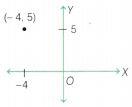
Clearly, we see that the distance of the given point (- 4, 5) is 5 units from the X-axis.
Hence, Assertion is false, but Reason is true.
Question 4.
Assertion (A): The points (2, 4), (4, 8) and (6,12) are collinear.
Reasoning (R): Three points are said to be collinear when all points lie on the same straight line.
(a) Both A and R are true, and R is the correct explanation of A.
(b) Both A and R are true, but R is not the correct explanation of A.
(c) A is true but R is false.
(d) A is false but R is true.
Answer:
(a) Both A and R are true, and R is the correct explanation of A.
Explanation:
Let A = (2, 4), B = (4, 8) and C = (6, 12).
Then, AB = \(\sqrt{(4-2)^2+(8-4)^2}\)
[by distance formula]
= \(\sqrt{(2)^2+(4)^2}\)
= \(\sqrt{4+16}=\sqrt{20}\)
= 2√5 units
BC = \(\sqrt{(6-4)^2+(12-8)^2}\)
= \(\sqrt{(2)^2+(4)^2}=\sqrt{4+16}\)
= √20
= 2√5 units
and AC = \(\sqrt{(6-2)^2+(12-4)^2}\)
= \(\sqrt{(4)^2+(8)^2}=\sqrt{16+64}=\sqrt{80}\)
= 4√5 units,
∵ AC = AB + BC
Therefore, A, B and C are collinear points.
So, Assertion is true.
Clearly, Reason is true.
Hence, both Assertion and Reason are true, and Reason is the correct explanation of Assertion.
Question 5.
Assertion (A): If the points A (4, 5) and B(x, y) lie on a circle with centre O (2, 3), then the values of x and y are 0 and 1, respectively.
Reason (R): The centre of a circle is the midpoint of each chord of the circle.
(a) Both A and R are true, and R is the correct explanation of A.
(b) Both A and R are true, but R is not the correct explanation of A.
(c) A is true but R is false.
(d) A is false but R is true.
Answer:
(c) A is true but R is false.
Explanation:
Assertion given: AB is a diameter, and O is the centre of the circle.
Since O is the midpoint of AB.
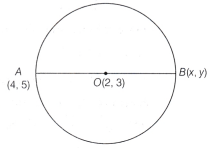
Coordinate of O = \(\left(\frac{x+4}{2}, \frac{y+5}{2}\right)\)
[by midpoint formula]
\(\left(\frac{x+4}{2}, \frac{y+5}{2}\right)=\) = (2, 3)
⇒ \(\frac{x+}{2}\) = 2 and \(\frac{y+5}{2}\) = 3
⇒ x + 4 = 4 and y + 5 = 6
⇒ x = 0 and y = 1
So, the assertion is true.
Clearly, Reason is false.
Question 6.
Assertion (A): The point (-5, -3) is the same as the point (-3, -5).
Reason (R): The coordinates describe a point in the plane uniquely.
(A) Both (A) and (R) are true, and (R) is the correct explanation of (A).
(B) Both (A) and (R) are true, but (R), is not the correct explanation of (A).
(C) (A) is true, but (R) is false.
(D) (A) is false, but (R) is true.
Answer:
(D) (A) is false, but (R) is true.
Question 7.
Assertion (A): The coordinates of the main road intersection at the city centre are (0, 0).
Reason (R): This represents the origin point where the North-South and East-West roads cross, defining the reference for the coordinate plane used in the city map.
(A) Both (A) and (R) are true, and (R) is the correct explanation of (A).
(B) Both (A) and (R) are true, but (R) is not the correct explanation of (A).
(C) (A) is true, but (R) is false.
(D) (A) is false, but (R) is true.
Answer:
(A) Both (A) and (R) are true, and (R) is the correct explanation of (A).