Students often refer to Ganita Manjari Class 9 Solutions and Part 1 Class 9 Maths Chapter 5 I’m Up and Down and Round and Round Solutions to verify their answers.
I’m Up and Down and Round and Round Class 9 Solutions
Class 9 Ganita Manjari Chapter 5 Solutions
Class 9 Maths Ganita Manjari Chapter 5 Solutions I’m Up and Down and Round and Round
Think and Reflect (NCERT Page 93)
Question 1.
Jamuna has a circular piece of paper. She is trying to locate its centre. Amina gives her a suggestion. She follows the instructions and is thrilled to find that it works. Can you guess what Amina told her?
Solution:
Amina likely suggested that Jamuna fold the circular piece of paper along a diameter and make a crease. After opening the paper, she could repeat the process with another fold along another diameter. The point where the two creases intersect would be the center of the circle. This works because the center of a circle is equidistant from all points on the circumference and every diameter passes through the center.
Think and Reflect (NCERT Page 94)
Question 1.
What are the rotational symmetries of a square? How many lines of reflection symmetry does it have? What about a regular pentagon? A regular hexagon?
Solution:
For any regular polygon, the number of lines of symmetry and the order of rotational symmetry are both equal to the number of its sides (n).
- Square (4 sides)
- Rotational Symmetries: A square has 4 rotational symmetries at angles of 90°, 180°, 270°, and 360°.
- Lines of Reflection: A square has 4 lines of reflection symmetry, which are two diagonals and two lines that bisect the sides of the square (horizontal and vertical axes).
- Regular Pentagon (5 sides)
- Rotational Symmetries: A regular pentagon has 5 rotational symmetries at angles of 72°, 144°, 216°, 288°, and 360°.
- Lines of Reflection: A regular pentagon has 5 lines of reflection symmetry, each passing through one vertex and the midpoint of the opposite side.
- Regular Hexagon (6 sides)
- Rotational Symmetry: A regular hexagon has 6 rotational symmetries at angles of 60°, 120°, 180°, 240°, 300°, and 360°.
- Lines of Reflection: A regular hexagon has 6 lines of reflection symmetry, each passing through a vertex and the midpoint of the opposite side.

Question 2.
(i) What is the length of the longest chord in a circle of radius 5 units?
(ii) Is there a smallest chord?
Solution:
(i) The longest chord in any circle is the diameter of the circle.
Diameter = 2 × Radius
= 2 × 5
= 10 units
So, the length of the longest chord of the circle is 10 units.
(ii) There is no smallest chord in a circle. As the two points on the circumference move closer together, the length of the chord approaches zero.
Think and Reflect (NCERT Page 95)
Question 1.
How many circles pass through two points on a plane?
Solution:
There are infinitely many circles that can pass through two points on a plane.
Ex 5.1 Class 9 Ganita Manjari Solutions – Ganita Manjari Class 9 Exercise 5.1 Solutions
Exercise 5.1 Class 9 Ganita Manjari Solutions – Ganita Manjari Class 9 Ex 5.1 Solutions
Question 1.
Draw ∆ABC with AB = 5 cm, ∠A = 70° and ∠B = 60°. Draw the circumcircle of ∆ABC. Is the centre inside or outside the triangle?
Solution:
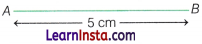
Given, AB = 5 cm, ∠A = 70° and ∠B = 60°
Step-by-Step Constructions:
Step 1: Draw a line segment AB = 5 cm.
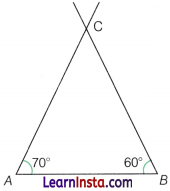
Step 2: Using a protractor, place it at point A and draw a ray making an angle of 70°.
Again, place the protractor at point B and draw a ray marking an angle of 60°.
The point where these two rays intersect is C.
Construction of Circumcircle
Step I: Draw the perpendicular bisectors of atleast two sides, say AB and BC.
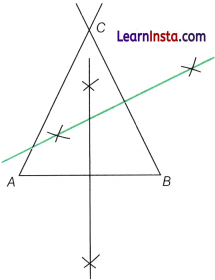
Step II: The point where these perpendicular bisectors intersect is the circumcentre (O).
Place the compass point on O, extend the pencil to any vertex (A, B, or C), and draw the circle.
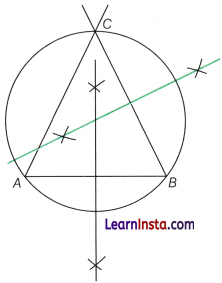
Since all three angles are less than 90°, ∆ABC is an acute-angled triangle.
Hence, the centre of the circumcircle (i.e., circumcentre) lies inside the triangle.
Question 2.
Draw ∆ABC with AB = 5 cm, ∠A = 100°, AC = 4 cm. Draw the circumcircle of ∆ABC. Is the centre inside or outside the triangle?
Solution:
Do it yourself.
Question 3.
Draw ∆ABC with AB = 6 cm, BC = 7 cm, and CA = 7 cm. Draw the circumcircle of ∆ABC. Let the circumcentre be O. Measure OA, OB, OC.
Solution:
Do it yourself.
Question 4.
What is the least possible radius of a circle through two points A and B?
Solution:
The least possible radius of a circle passing through two points A and B is half the distance between them.
Ex 5.2 Class 9 Ganita Manjari Solutions – Ganita Manjari Class 9 Exercise 5.2 Solutions
Exercise 5.2 Class 9 Ganita Manjari Solutions – Ganita Manjari Class 9 Ex 5.2 Solutions
Question 1.
Show that the triangle formed by a chord at the centre of the circle is isosceles.
Solution:
Let O be the centre of the circle, and AB be the chord of a circle.
Join OA and OB.
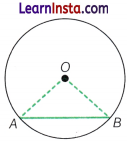
In ∆OAB, we have
OA = OB [∵ radii of the same circle]
Therefore, in ∆OAB, two sides are equal, so triangle OAB is an isosceles triangle.
Question 2.
Show that if two such isosceles triangles (occurring in the previous question) have equal base length, they are congruent to each other.
Solution:
Given: Let O be the centre of the circle, AB and CD are the two equal chords of a circle
i.e. AB = CD.
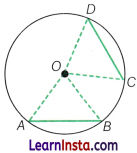
To prove ∆OAB ≅ ∆OCD
Construction: Join OA, OB, OC, and OD.
Proof: In ∆OAB and ∆OCD,
AB = CD [given]
OA = OC [radii of the same circle]
and OB = OD [radii of the same circle]
∴ ∆OAB ≅ ∆OCD [by SSS congruence rule]
Hence, they are congruent to each other.
Ex 5.3 Class 9 Ganita Manjari Solutions – Ganita Manjari Class 9 Exercise 5.3 Solutions
Exercise 5.3 Class 9 Ganita Manjari Solutions – Ganita Manjari Class 9 Ex 5.3 Solutions
Question 1.
Can you explain why the converse of the following theorem?
“The line joining the centre of a circle and the mid-point of a chord of the circle is perpendicular to the chord” is true;
i.e., why does the perpendicular from the centre of a circle to a chord of the circle bisect the chord?
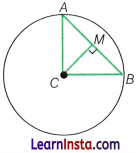
[Hint: Use figure; you are told that ∠CMA = ∠CMB = 90°. You need to show that AM = BM]
Solution:
Given: AB is a chord of a circle with centre C and CM ⊥ AB.
To prove: CM bisects AB, i.e., AM = BM.
Proof: In ∆AMO and ∆BMO, we have
CA = CB [radii of the same circle]
∠CMA = ∠CMB [each90°]
and CM = CM [common sides]
∆AMC ≅ ∆BMC [by the RHS congruence rule]
Then, AM = MB [by CPCT]
Hence proved.
Question 2.
An isosceles triangle ABC is inscribed in a circle, with AB = AC. Show that the altitude from A to BC passes through the centre of the circle.
Solution:
Given: An isosceles triangle ABC is inscribed in a circle with AB = AC.
To prove: The altitude from A to BC passes through the centre of the circle.
Construction: AD be the altitude from A to BC.
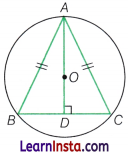
Proof: In an isosceles triangle, the altitude from the vertex also bisects the base.
∴ BD = DC
So, D is the midpoint of BC.
We know that the line joining the centre of a circle to the midpoint of a chord is perpendicular to the chord.
∴ OD ⊥ BC
But, AD is also perpendicular to BC at D.
∴ AD and OD are on the same line.
Hence, the centre O lies on AD.
Hence proved.
Question 3.
Two parallel chords of lengths 6 cm and 8 cm are on opposite sides of the centre of a circle. If the radius of the circle is 5 cm, find the distance between the midpoints of the chords.
Solution:
Let the chords be AB = 6 cm and CD = 8 cm, and the radius = 5 cm.
Draw OE ⊥ AB and OF ⊥ CD.
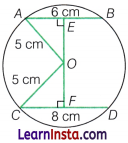
Here, AE = \(\frac {1}{2}\) × AB
= \(\frac {1}{2}\) × 6
= 3 cm
[∵ A perpendicular from the centre of a circle to a chord of the circle bisects the chord]
and CF = \(\frac {1}{2}\) × CD
= \(\frac {1}{2}\) × 8 cm
= 4 cm
In ∆OEA, by the Pythagorean theorem,
OA2 = OE2 + AE2
⇒ 52 = OE2 + 32
⇒ OE2 = 52 – 32 = 25 – 9 = 16
⇒ OE = √16 = 4 cm
In ∆OFC, by the Pythagorean theorem,
OC2 = OF2 + CF2
⇒ 52 = OF2 + 42
⇒ OF2 = 52 – 42 = 25 – 16 = 9
⇒ OF = √9 = 3 cm
So, the distance between the midpoints of the chords
i.e. EF = OE + OB = 4 + 3 = 7 cm
Ex 5.4 Class 9 Ganita Manjari Solutions – Ganita Manjari Class 9 Exercise 5.4 Solutions
Exercise 5.4 Class 9 Ganita Manjari Solutions – Ganita Manjari Class 9 Ex 5.4 Solutions
Question 1.
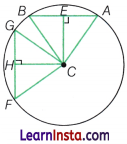
Use the Baudhayana-Pythagoras theorem to show why the theorem “Chords of a circle having the same length are all at the same distance from the centre of the circle” must be true.
Solution:
Given, AB = GF
We know that the line joining the centre of a circle to the midpoint of a chord is perpendicular to the chord.
∴ CE ⊥ AB and CH ⊥ GF
Since E and H are midpoints of chords AB and GF, respectively,
∴ AE = EB = \(\frac {AB}{2}\) and GH = HF = \(\frac {GH}{2}\)
⇒ AE = GH [∵ AB = GH]
In ∆CEA, by the Pythagoras theorem,
CA2 = CE2 + AE2 …….(i)
In ∆CHG, by the Pythagoras theorem,
CG2 = CH2 + GH2 ……..(ii)
Since CA = CG [radii of the same circle]
∴ From Eqs. (i) and (ii), we get
CE2 + AE2 = CH2 + GH2
⇒ CE2 + AE2 = CH2 + AE2 [∵ AE = GH]
⇒ CE2 = CH2
⇒ CE = CH
Hence proved.
Question 2.
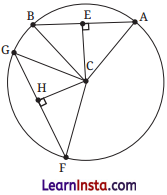
Consider the given figure. If CE is perpendicular to AB, CH is perpendicular to GH, and CE = CH, show that AB = GF.
Solution:
Given: CE is perpendicular to AB, CH is perpendicular to GH, and CE = CH.
To prove: AB = GF
Proof: Since CE ⊥ AB and C is the centre, the perpendicular from the centre to a chord bisects the chord.
∴ AE = EB
Similarly, GH = HF
In ∆CEA and ∆CHG, we have
CA = CG [radii of the same circle]
CE = CH [given]
and ∠CEA = ∠CHG [each 90°]
∴ ∆CEA ≅ ∆CHG [by RHS congruence rule]
So, AE = GH
⇒ 2AE = 2GH [multiply by 2]
⇒ AB = GF [by CPCT]
Hence proved.
Question 3.
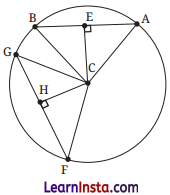
Solve the previous question using the Baudhayana-Pythagoras theorem.
Solution:
Given: CE is perpendicular to AB, CH is perpendicular to GH, and CE = CH.
To prove: AB = GF
Proof: Since CE ⊥ AB and C is the centre, the perpendicular from the centre to a chord bisects the chord.
∴ AE = EB
Similarly, GH = HF
In ∆CEA, by the Pythagoras theorem,
CA2 = AE2 + CE2
⇒ AE2 = CA2 – CE2 …..(i)
In ∆CHG, by the Pythagoras theorem
CG2 = CH2 + GH2
⇒ GH2 = CG2 – CH2
⇒ GH2 = CA2 – CE2 …… (ii)
[∵ CG = CA = radii of same circle and CE = CH]
From Eqs. (i) and (ii), we get
AE2 = GH2
⇒ AE = GH ……(iii)
Similarly, EB = HF ……(iv)
On adding Eqs. (iii) and (iv), we get
AE + EB = GH + HF
⇒ AB = GF
Hence proved.
Ex 5.5 Class 9 Ganita Manjari Solutions – Ganita Manjari Class 9 Exercise 5.5 Solutions
Exercise 5.5 Class 9 Ganita Manjari Solutions – Ganita Manjari Class 9 Ex 5.5 Solutions
Question 1.
Find the length of the chord of a circle where the radius is 7 cm, and the perpendicular distance is 6 cm.
Solution:
Do it yourself.
Question 2.
Explain why the following statement is true. If the perpendicular distance of a chord from the centre is d and the radius is r, then the chord length is \(2 \sqrt{r^2-d^2}\).
Solution:
Given that the perpendicular distance of a chord from the centre is d and the radius is r
i.e. OM = d and OA = r
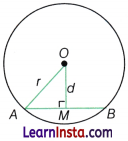
To prove: AB = \(2 \sqrt{r^2-d^2}\)
Proof: In ∆OMA by the Pythagorean theorem
OA2 = OM2 + AM2
⇒ r2 = d2 + AM2
⇒ AM2 = r2 – d2
⇒ AM = \(\sqrt{r^2-d^2}\)
Since the perpendicular from the centre of a circle to a chord bisects the chord.
i.e. AM = MB
⇒ AB = 2AM
Now, AB = 2AM = \(2 \sqrt{r^2-d^2}\)
Hence proved.
Question 3.
In a circle, if the distance of chord AB from the centre is twice the distance of another chord CD from the centre, can we conclude that CD = 2AB? Give reasons for your answer.
Solution:
Let the distances of chords AB and CD from the centre O be d1 and d2, respectively.
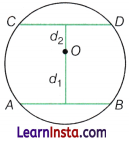
Given, d1 = 2d2
Since d1 > d2, chord AB is farther from the centre than chord CD.
We know that the chord nearer to the centre is longer.
Therefore, CD > AB
However, there is no direct proportional relation between the length of a chord and its distance from the centre.
Hence, we cannot conclude that CD = 2AB
∴ No, CD ≠ 2AB in general.
Ex 5.6 Class 9 Ganita Manjari Solutions – Ganita Manjari Class 9 Exercise 5.6 Solutions
Exercise 5.6 Class 9 Ganita Manjari Solutions – Ganita Manjari Class 9 Ex 5.6 Solutions
Question 1.
In a circle with centre O, the central angle AOB is 60°. If the radius of the circle is 12 cm, what is the length of the chord AB?
Solution:
Given, ∠AOB = 60°
Also, the radius of the circle = 12 cm
Here, OA = OB = Radii of the same circle
∴ ∆AOB is an isosceles triangle.
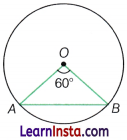
We know that in an isosceles triangle, the angles opposite the equal sides are equal.
∴ ∠OAB = ∠OBA
In ∆AOB, by the angle sum property,
∠AOB + ∠OAB + ∠OBA = 180°
⇒ 60° + 2∠OAB = 180°
⇒ 2∠OAB = 180° – 60° = 120°
⇒ ∠OAB = \(\frac {120}{2}\) = 60° = ∠OBA
∴ ∆AOB is an equilateral triangle,
In an equilateral triangle, all three sides are equal in length.
∴ AB = OA = OB = 12 cm
Question 2.
Let A and B be two points on a circle with centre O.
(i) Are there points X and Y on the circle, on the same side of AB, such that ∠AXB is different from ∠AYB?
(ii) Is it true that if ∠AXB = ∠AYB, then X and Y lie on the same side of the circle?
(iii) If ∠AXB = ∠AYB and X and Y do not lie on the circle, does the circle through A, B and X also pass through Y?
Solution:
(i) No, if X and Y lie on the circle on the same side of AB, then they lie in the same segment.
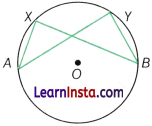
∴ ∠AXB = ∠AYB
(ii) No, only from ∠AXB = ∠AYB, we cannot say that X and Y must lie on the same side of AB.
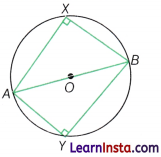
In a general case, if X and Y are on opposite sides and AB is a diameter, then points X and Y on opposite sides will have equal angles (∠AXB = ∠AYB = 90°) because they are both right angles in a semicircle. Therefore, they may lie on opposite sides also.
(iii) Yes, this is the converse of the “angles in the same segment” theorem.
Hence, points that subtend equal angles at the same chord lie on the same circle.
Question 3.
Find x in the given figure.
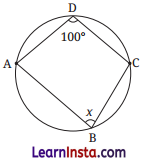
Solution:
Given, ∠ADC = 100°
Here, ABCD is a cyclic quadrilateral.
We know that in a cyclic quadrilateral, opposite angles are supplementary.
∴ ∠ADC + ∠ABC = 180°
⇒ 100° + x = 180°
⇒ x = 180° – 100 = 80°
Hence, the value of x is 80°.
Ganita Manjari Class 9 Maths Chapter 5 End of Chapter Exercise Solutions
I’m Up and Down and Round and Round End of Chapter Exercise Solutions
Question 1.
In a circle, a chord is 5 cm away from the centre. If the radius of the circle is 13 cm, what is the length of the chord?
Solution:
Do it yourself.
Question 2.
An arc of a circle subtends an angle of 70° at the centre. What is the measure of the angle subtended by the arc at a point on the circle?
Solution:
Given: angle at the centre = 70°
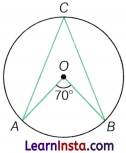
We know that the angle subtended by an arc at the centre is double the angle subtended by it at any point on the remaining part of the circle.
∴ ∠ACB = \(\frac {1}{2}\) × ∠AOB
= \(\frac {1}{2}\) × 70°
= 35°
Hence, the measure of the required angle is 35°.
Question 3.
The diameter of a circle is 26 cm. A chord of length 24 cm is drawn in the circle. Find the distance from the centre of the circle to the chord.
Solution:
Do it yourself.
Question 4.
A circle has a radius of 15 cm. A chord is drawn. The distance from the centre of the circle to the chord is 9 cm. What is the length of the chord?
Solution:
Do it yourself.
Question 5.
Prove that the perpendicular bisector of a chord passes through the centre of the circle.
Solution:
Let AH be a chord of a circle with centre O.
Let the perpendicular bisector of AB meet AB at M.
So, AM = BM and OM ⊥ AB
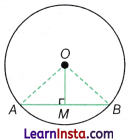
Join OA and OB.
Since OA and OB are radii of the same circle.
∴ OA = OB
Thus, O is equidistant from A and B.
We know that any point equidistant from two points lies on the perpendicular bisector of the line segment joining them.
Hence, O lies on the perpendicular bisector of chord AB.
Question 6.
The diameter of a circle is AB. Point C is on the circumference. What is the measure of ∠ACB? Explain your reasoning.
Solution:
Given: AB is the diameter of the circle.
C is a point on the circumference of the circle.
∠ACB is the angle subtended by the diameter AB at the point C on the circumference.
To find: The measure of ∠ACB.
Since AB is the diameter of the circle and C is a point on the circumference, the angle ∠ACB is subtended by the diameter AB.
By the corollary of Theorem 9, the angle subtended by the diameter at any point on the circumference of the circle is always a right angle.
Therefore, the measure of ∠ACB is 90°.
Question 7.
ABCD is a cyclic quadrilateral inscribed in a circle. If ∠A measures 75°, what is the measure of ∠C? If ∠B measures 110°, what is the measure of ∠D?
Solution:
Given that ABCD is a cyclic quadrilateral.
∠BAD = 75° and ∠ABC = 110°
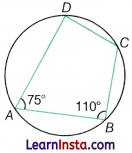
We know that the sum of the opposite angles of a cyclic quadrilateral is 180°.
∴ ∠BAD + ∠BCD = 180°
⇒ 75° + ∠BCD = 180°
⇒ ∠BCD = 180° – 75° = 105°
Similarly, ∠ABC + ∠ADC = 180°
⇒ 110° + ∠ADC = 180°
⇒ ∠ADC = 180° – 110° = 70°
Hence, the measures of ∠C and ∠D are 105° and 70°, respectively.
Question 8.
Quadrilateral PQRS is inscribed in a circle. If ∠P = (2x + 10)° and ∠R = (3x – 20)°, find the value of x and the measures of ∠P and ∠R.
Solution:
Since quadrilateral PQRS is inscribed in a circle, it is a cyclic quadrilateral.
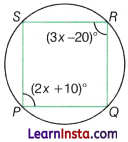
We know that the sum of the opposite angles of a cyclic quadrilateral is 180°.
∴ ∠P + ∠R = 180°
⇒ 2x + 10 + 3x – 20 = 180° [given, ∠P = (2x + 10)° and ∠R = (3x – 20°)]
⇒ 5x – 10 = 180°
⇒ 5x = 180° + 10
⇒ 5x = 190°
⇒ x = 38°
Now, ∠P = 2x + 10 = 2 × 38 + 10 = 86°
and ∠R = 3x – 20 = 3 × 38 – 20° = 94°
Question 9.
The distance of a chord of length 16 cm from the centre of a circle is 6 cm. Find the radius of the circle.
Solution:
Given: The length of the chord AB = 16 cm, the perpendicular distance from the centre of the circle O to the chord AB = 6 cm.
To find: Radius of the circle (r).
P is the midpoint of chord AB.
Since OP is the perpendicular distance from the centre to the chord, P divides the chord AB into two equal parts.
Therefore, the length of AP = \(\frac {16}{2}\) = 8 cm.
In a right-angled ∆OPA,
OA2 = OP2 + AP2 (by Baudhayana-Pythagoras theorem)
⇒ r2 = 62 + 82
⇒ r2 = 36 + 64 = 100
⇒ r = 10 cm
Therefore, the radius of the circle is 10 cm.
Question 10.
A cyclic quadrilateral has sides 5, 5, 12, and 12 units. Find its area.
Solution:
Let the sides of the cyclic quadrilateral be
a = 5 units, b = 5 units, c = 12 units, and d = 12 units.
Using Brahmagupta’s formula,
For a cyclic quadrilateral,
Area = \(\sqrt{(s-a)(s-b)(s-c)(s-d)}\)
where s is the semi-perimeter.
∴ Semi-perimeter, s = \(\frac{a+b+c+d}{2}\)
= \(\frac{5+5+12+12}{2}\)
= \(\frac {34}{2}\)
= 17 units
∴ Area = \(\sqrt{(17-5)(17-5)(17-12)(17-12)}\)
= \(\sqrt{12 \times 12 \times 5 \times 5}\)
= 12 × 5
= 60 sq units
Hence, the area of the cyclic quadrilateral is 60 sq units.
Question 11.
Consider a cyclic quadrilateral. Without drawing its circumcircle, how can we find out whether the centre of the circumcircle lies inside the quadrilateral or outside? What is the best way of finding out?
Solution:
To determine whether the circumcentre of a cyclic quadrilateral lies inside or outside it without drawing the circle, we can use the angles of the triangles formed by its diagonals.
Inside: If all four triangles formed by the sides and the intersection of the diagonals are acute, the circumcentre lies inside the quadrilateral.
Outside: If any of the internal angles of the quadrilateral is obtuse, the circumcentre will lie outside the quadrilateral.
On the boundary: If the quadrilateral has a right angle, it is a special case where a diagonal acts as the diameter of the circumcircle and the circumcentre lies at the midpoint of that diagonal.
Question 12.
When two chords intersect, each of them is divided into two line segments. Show that if the intersecting chords are of equal length, then the line segments of one chord are equal to the corresponding line segments of the other chord.
Solution:
Let MN and AB be two chords of a circle with centre O, AB and MN intersect at P, and MN = AB.
To prove: MP = PB and PN = AP
Construction: Draw OD ⊥ MN and OC ⊥ AB.
Join OP.
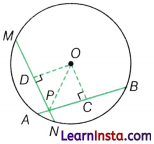
Proof: Here, DM = DN = \(\frac {1}{2}\)MN and AC = CB = \(\frac {1}{2}\)AB
[∵ perpendicular from the centre on the chord bisects the chord]
Since MN = AB, we get
DM = CB = DN = AC ……. (i)
In right-angled ΔODP and ΔOCP,
OD = OC [∵ equal chords of a circle are equidistant from the centre]
∠ODP = ∠OCP [each 90°]
and OP = OP [common side]
∴ ∆ODP ≅ ∆OCP [by the RHS congruence rule]
Then, DP = PC [byCPCT] ……(ii)
On adding DM to both sides, we get
DM + DP = DM + PC
⇒ DM + DP = CB + PC [from Eq. (i)]
⇒ MP = PB
On subtracting Eq. (ii) from DN, we get
DN – DP = DN – PC
⇒ DN – DP = AC – PC [from Eq. (i)]
⇒ PN = AP
Hence, MP = PB and PN = AP
Hence proved.
Question 13.
Draw a circle in which a chord of 6 cm in length stands at a distance of 3 cm from the centre.
[Hint: Is it a circumcircle of a suitable triangle?]
Solution:
Step-by-Step Constructions:
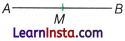
Step 1: Draw a horizontal line segment AB = 6 cm.
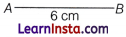
Step 2: Mark the midpoint M of AB.
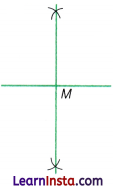
Step 3: Using a compass, draw a perpendicular line from M upwards (or downwards).
Measure 3 cm along this perpendicular line from M and mark it as point O. This is the centre of a circle.
Step 4: Place the compass point at O, extend the pencil to point A or B, and draw the circle with radius OA (or OB).
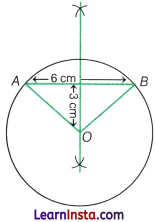
Yes, this circle is the circumcircle of an isosceles right-angled triangle.
Question 14.
Show that a rectangle is the only parallelogram that can be inscribed in a circle.
Solution:
Given: PQRS is a parallelogram inscribed in a circle.

To prove: PQRS is a rectangle.
Proof: Since PQRS is a quadrilateral.
∠P + ∠R = 180° ……(i)
[∵ sum of a pair of opposite angles in a cyclic quadrilateral is 180°]
But ∠P = ∠R …….(ii)
[∵ In a parallelogram, opposite angles are equal]
From Eqs. (i) and (ii), we get
∠P + ∠P = 180°
⇒ 2∠P = 180°
⇒ ∠P = 90°
∴ ∠P = ∠R = 90° [from Eq. (ii)]
Similarly, ∠Q = ∠S = 90°
Thus, each angle of PQRS is 90°.
Hence, PQRS is a rectangle.
Hence proved.
Question 15.
Show that if a rectangle is inscribed in a circle, then the intersection point of its diagonals must lie at the centre of the circle.
Solution:
Let rectangle ABCD be inscribed in a circle, and let its diagonals AC and BD intersect at O.
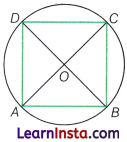
To prove: O is a centre of the circle.
Proof: In a rectangle, the diagonals are equal and bisect each other.
∴ AO = OC and BO = OD
Also, AC = BD
⇒ AO + OC = BO + OD
⇒ AO + AO = BO + BO [∵ AO = OC and BO = OD]
⇒ 2AO = 2BO
⇒ AO = BO
Therefore, AO = BO = CO = DO
So, O is equidistant from all four vertices A, B, C, and D.
Hence, O is the centre of the circle.
Hence proved.
Question 16.
Consider all chords of a circle of a fixed length. What is the shape formed by the midpoints of all these chords?
Solution:
If you draw many chords of the same length inside a circle and mark the middle point of each chord, all those midpoints will form a smaller circle inside the big one. This smaller circle has the same centre as the big circle, so it is called a smaller concentric circle.
Question 17.
In a circle with centre O, chords AB and AC are congruent. Explain why this statement is true: “The centre of the circle lies on the angle bisector of ∠BAC”.
Solution:
Given A circle with centre O, and two chords AB and AC are equal in length
i.e AB = AC
To prove: ∠BAO = ∠OAC
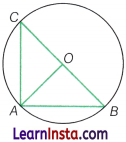
Proof: Equal chords of a circle subtend equal angles at the centre.
∴ ∠AOB = ∠AOC
In ∆AOB and ∆AOC, we have
OA = OA [common]
OB = OC [radii of the same circle]
and AB = AC [given]
∴ ∆AOB ≅ ∆AOC [by SSS congruence rule]
So, ∠BAO = ∠CAO [by CPCT]
Hence, AO bisects ∠BAC.
Question 18.
Two parallel chords of lengths 10 cm and 24 cm are on the same side of the centre of a circle. The distance between the chords is 7 cm. Find the radius of the circle.
Solution:
Let O be the centre of the circle and r be the radius.
Chord 1 (AB) = 10 cm
Chord 2 (PQ) = 24 cm
A perpendicular line drawn from the centre of a circle to a chord bisects that chord.
MQ = 12 cm and NB = 5 cm
Let x be the distance from the centre O to the chord PQ.
Since the distance between the chords is 7 cm, the distance from the centre to the chord AB is x + 7.
In right-angled ∆OMQ,
r2 = x2 + 122 (by Baudhayana Pythagoras theorem)
⇒ r2 = x2 + 144 …..(i)
In right-angled ∆ONB,
r2 = (x + 7)2 + 52 (by Baudhayana-Pythagoras theorem)
⇒ r2 = x2 + 14x + 49 + 25
⇒ r2 = x2 + 14x + 74 …(ii)
From (i) and (ii),
x2 + 144 = x2 + 14x + 74
⇒ 144 = 14x + 74
⇒ 14x = 144 – 74 = 70
⇒ x = 5 cm
Put x = 5 cm in equation (i)
r2= 52 + 144 = 25 + 144 = 169
⇒ r = √169 = 13 cm
Therefore, the radius of the circle is 13 cm.
Question 19.
A regular hexagon is inscribed in a circle of radius r. Find the length of the sides of the hexagon and the distance of each side from the centre of the circle.
Solution:
Let ABCDEF be a regular hexagon inscribed in a circle with centre O and radius r.
A regular hexagon divides the circle into 6 equal parts.
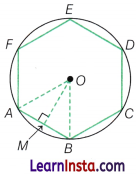
∴ ∠AOB = \(\frac{360^{\circ}}{6}\) = 60°
In ∆AOB, OA = OB = r and ∠AOB = 60°
Then, ∠OAB = ∠OBA = \(\frac{180^{\circ}-60^{\circ}}{2}\) = 60°
So, ∆AOB is an equilateral triangle.
∴ AB = OA = OB = r
Therefore, the length of each side of the regular hexagon is r units.
Now, let OM ⊥ AB, where M is the midpoint of AB.
In right-angled ∆OMA,
OA = r and AM = \(\frac{A B}{2}=\frac{r}{2}\)
By the Pythagoras theorem,
AO2 = OM2 + AM2
⇒ OM2 = AO2 – AM2 = \(r^2-\left(\frac{r}{2}\right)^2\)
⇒ OM = \(\sqrt{r^2-\frac{r^2}{4}}=\frac{\sqrt{3 r^2}}{2}=\frac{\sqrt{3}}{2} r\)
Hence, the distance of each side from the centre is \(\frac{\sqrt{3}}{2} r\) units.
Question 20.
A quadrilateral MNOP is inscribed in a circle. If MN is a diameter, what can you say about ∠MOP and ∠MNP? Explain your reasoning.
Solution:
Given a quadrilateral MNOP is inscribed in a circle with centre C.
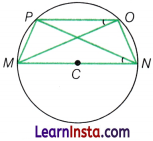
Here, MN is a diameter and PM is a line segment.
We know that the angles in the same segment are equal.
∴ ∠MOP = ∠MNP
Question 21.
Let ABCD be a cyclic quadrilateral. Explain why the exterior angle at any vertex is equal to the interior opposite angle.
(e.g., ∠CDE = ∠ABC, where E is a point on the extension of side CD).
Solution:
Given: ABCD is a cyclic quadrilateral.
To prove: ∠ADE = ∠ABC
Construction: Extend the line CD to a point E.
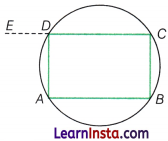
Proof: In a cyclic quadrilateral, the sum of the opposite interior angles is 180°.
∠ABC + ∠ADC = 180° ….. (i)
and ∠ADC + ∠ADE = 180° …… (ii) [by linear pair]
From Eqs. (i) and (ii), we get
∠ABC + ∠ADC = ∠ADC + ∠ADE
⇒ ∠ABC = ∠ADE
Hence proved.
Question 22.
“There is no chord of a circle that is longer than its diameter”. How do you justify this statement?
Solution:
Do it yourself.
Question 23.
Let A be any point within a given circle with centre O. Show that the shortest chord of the circle that passes through point A is the one that is perpendicular to OA.
Solution:
Let A be a point inside the circle with centre O.
Draw a chord PQ through A such that OA ⊥ PQ.
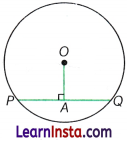
Now, among all chords passing through A, the perpendicular distance from O to the chord is maximum when the chord is perpendicular to OA.
We know that the farther a chord is from the centre, the shorter it is.
Thus, chord PQ, which is perpendicular to OA, is farthest from the centre.
Hence, PQ is the shortest chord passing through A.
Question 24.
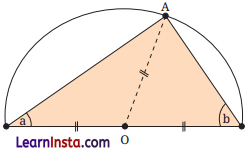
How would you use the following figure to justify the statement that the angle in a semicircle is 90°?
Solution:
Proof: Here, OA = OC [radii]
∴ ∠OCA = ∠OAC ……. (i)
[∵ angles opposite the equal sides of an isosceles triangle are also equal]
Similarly, ∠ODA = ∠OAD [∵ OA = OD] ……(ii)
On adding Eqs. (i) and (ii), we get
∠OCA + ∠ODA = ∠OAC + ∠OAD
⇒ a + b = ∠CAD …..(iii)
In ∆CAD, by the angle sum property of a triangle,
∠ACD + ∠CDA + ∠CAD = 180°
⇒ a + b + ∠CAD = 180°
⇒ ∠CAD = 180° [from Eq. (iii)]
⇒ ∠CAD = 90°
Hence, the angle in a semicircle is 90°.
Hence proved.
Question 25.
In a circle, two chords CC’ and DD’ are drawn perpendicular to a diameter AB. Prove that the segment MM’ joining the midpoints of the chords CD and C’D’ is perpendicular to AB.
Solution:
Let O be the centre of the circle.
Since AB is a diameter and chords CC’ and DD’ are perpendicular to AB, we have CC’ || DD’.
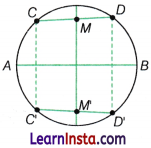
Since M is the midpoint of CD.
∴ CM = MD
Also, M’ is the midpoint of C’D’.
∴ C’M’ = M’D’
Now, CC’ || DD’ and CD and C’D’ are transversals.
Hence, the quadrilateral CDD’C’ is a trapezium, whose parallel sides are CC’ and DD’.
In a trapezium, the line joining the midpoints of the non-parallel sides is parallel to the parallel sides.
Therefore, MM’ || CC’ || DD’
But CC’ ⊥ AB
Hence, MM’ ⊥ AB
Thus, the segment MM’ joining the midpoints of the chords CD and C’D’ is perpendicular to AB.
Question 26.
How would you use the following figure to justify the statement that the sum of the opposite angles of a cyclic quadrilateral is 180°?
Solution:
Given that ABCD is a cyclic quadrilateral with centre O.
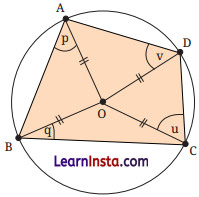
To prove: ∠A + ∠C = 180° and ∠B + ∠D = 180°
Construction: Join OA, OB, OC, and OD.
Proof: OA = OB = OC = OD
So, the triangles formed with O are isosceles triangles.
In ∆OAB, since OA = OB
∴ ∠OAB = ∠OBA = P
In ∆OBC, since OB = OC
∴ ∠OBC = ∠OCB = q
In ∆OCD, since OC = OD
∴ ∠OCD = ∠ODC = u
In ∆ODA,
∴ OD = OA
∴ ∠ODA = ∠OAD = v
Now, ∠A = p + v
∠B = p + q
∠C = q + u and ∠D = u + v
Since the sum of the interior angles of any quadrilateral is 360°.
∴ ∠A + ∠B + ∠C + ∠D = 360°
⇒ p + v + p + q + q + u + u + v = 360°
⇒ 2p + 2q + 2u + 2v = 360°
⇒ 2[p + q + u + v] = 360°
⇒ p + q + u + v = 180°
⇒ (p + v) + (q + u) = 180°
⇒ ∠A + ∠C = 180°
Similarly, ∠B + ∠D = 180°
Therefore, the sum of opposite angles in a cyclic quadrilateral is 180°.
Hence proved.