Students often refer to Ganita Manjari Class 9 Solutions and Part 1 Class 9 Maths Chapter 3 The World of Numbers Solutions to verify their answers.
The World of Numbers Class 9 Solutions
Class 9 Ganita Manjari Chapter 3 Solutions
Class 9 Maths Ganita Manjari Chapter 3 Solutions The World of Numbers
Think and Reflect (NCERT Textbook Page No. 46)
Why does a negative times a negative equal a positive? Think of it in terms of action and debt. If a negative number represents a debt, then multiplying by a negative number represents the removal of that debt.
(Hint: If someone takes away (–) four of your debts that are each worth ₹ 3 (that is, –3), you are effectively ₹ 12 richer! Therefore, (–3) × (–4) = +12.)
Solution:
Think of a negative number as a debt and multiplication as an action being repeated.
Suppose you have a debt of ₹ 3. This is written as -3.
Now, if someone removes this debt, what happens?
You are no longer required to pay ₹ 3, so your position improves.
Mathematically, you go from -3 to 0, which is an increase of ₹ 3.
That is why removing a debt is the same as gaining money.
Now apply this idea to: (-3) × (-4)
Here, -3 represents a debt of ₹ 3, and -4 represents the action of removing this debt 4 times.
So the expression means: “Remove four debts of ₹ 3 each.”
Each time you remove a debt of ₹ 3, you gain ₹ 3. Repeating this action four times:
- After removing one debt → gain ₹ 3
- After removing two debts → gain ₹ 6
- After removing three debts → gain ₹ 9
- After removing four debts → gain ₹ 12
So, after all debts are removed, you are ₹ 12 better off.
Therefore, (-3) × (-4) = +12
In this way, a negative times a negative becomes positive.
Think and Reflect (NCERT Textbook Page No. 47)
Can you explain why we need q ≠ 0 in the definition of a rational number?
Solution:
A rational number is defined as any number that can be written as a fraction of the form \(\frac{p}{q}\), where p and q are integers and q ≠ 0.
Let \(\frac{p}{q}\) = r
⇒ r × q = p
Case I: p is non-zero number and q = 0
e.g Let \(\frac{5}{0}\) = r
⇒ 5 = 0 × r
∴ r × 0 must equal to 5.
But, any number multiplied by zero is always zero, so no such r exists.
Case II:
p is zero and q = O0.
e.g. \(\frac{0}{0}\) = r ⇒ 0 = 0 × r,
which is true for every number.
Since, dividing by zero results in a value that is either impossible or not unique.
Therefore, the denominator q must be any integer except zero.
Think and Reflect (NCERT Textbook Page No. 49)
Question 1.
While adding or subtracting two rational numbers having different denominators, how will you make the denominators equal?
Solution:
We can make the denominators equal by using the following steps.
(i) Determine the LCM of the different denominators.
(ii) Multiply the numerator and denominator of each rational number by the same factor needed to make its denominator equal to the LCM.
Question 2.
Verify the distributive law for rational numbers.
Solution:
For any three numbers p, q, and r, the distributive law is expressed as
p(q + r) = pq + pr
Verification
Let p = \(\frac{1}{2}\), q = \(\frac{2}{3}\) and c = \(\frac{1}{4}\).
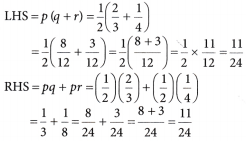
Here, LHS = RHS
∴ p(q + r) = pq + pr
Hence verified.
Think and Reflect (NCERT Textbook Page No. 51)
Question 1.
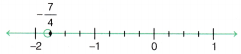
Try and represent \(\frac{8}{5}\) and \(\frac{-7}{4}\) on a number line.
Solution:
We have, \(\frac{8}{5}\) and \(\frac{-7}{4}\)
For \(\frac{8}{5}\) :
\(\frac{8}{5}\) = 1\(\frac{3}{5}\), which is between 1 and 2.
Now, we divide the interval between 1 and 2 into five equal parts and move 3 parts to the right of 1.

For \(\frac{-7}{4}\) :
\(\frac{-7}{4}\) = 1\(\frac{3}{4}\), which is between -1 and -2.
Now, we divide the interval between -1 and -2 into four equal parts and move 3 parts to the left of -1

Think and Reflect (NCERT Textbook Page No. 55)
Question 1.
Try to prove the Irrationality of √3 using the approach of proof by contradiction. Will the same approach work for √5, √7, or √10?
Solution:
Let us assume that √3 is rational.
Then, it will be of the form \(\frac{a}{b}\), where a, b are integers and b ≠ 0.
Again, let a and b have no common factor other than 1.
√3 = \(\frac{a}{b}\), where a and b are co-prime integers.
On squaring both sides, we get
3 = \(\frac{a^2}{b^2}\)
⇒ 3b2 = a2
⇒ 3 divides a2
⇒ 3 divides a
So, 3 is a factor of a. …………..(i)
⇒ a = 3c for some integer c
⇒ a2 = 9 c2
⇒ 3b2 = 9 c2
⇒ b2 = 3c2
⇒ 3 divides b2
⇒ 3 divides b
So, 3 is a factor of b. ……………(ii)
From Eqs. (i) and (ii), we observe that a and b have atleast 3 as a common factor.
But, this contradicts the fact that a and b are co-prime.
This means that our assumption is not correct.
Hence, √3 is an irrational number.
Yes, the same approach will work for √5, √7 and √10, because if a number is not a perfect square, then its square root is irrational.
Think and Reflect (NCERT Textbook Page No. 55)
We have seen how to obtain a line whose length is a rational number. How do we obtain lines whose lengths are irrational?
Solution:
Do it yourself.
Think and Reflect (NCERT Textbook Page No. 56)
Question 1.
Try to extend this method for constructing line segments of lengths √3 and √5 using a ruler and a compass. Generalise this method to construct a line segment of any length of the form 4n, where n is a positive integer.
Solution:
For √3
Step I: Draw a number line and mark point O as zero and mark point A at one unit distance from O, so OA = 1 unit.

Step II: Draw a perpendicular AB on OA such that
AB = 1 unit
In right-angled ∆OAB,
OB2 = OA2 + AB2 [by Pythagoras’ theorem]
⇒ OB22 = 12 + 12 = 2
⇒ OB = √2 units
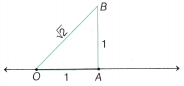
Step III: With O as the centre and OB as the radius, draw an arc that intersects the number line at point A1.
Thus, OA = OB = √2 units, which means A represents on the number line.
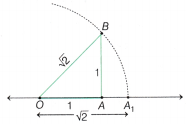
Step IV: Draw another right-angled ∆OA1B1 such that A1B1 is perpendicular of OA1 and A1B1 = 1 unit.
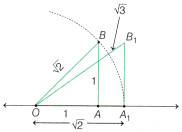
In ∆OA1B1, we get
(OB1)2 =(OA1)2 + (A1B1)2
⇒ (OB1)2 = (√2)2 + 12 = 2 + 1 = 3
⇒ OB = √3 units
Step V: With O as the centre and DB1 as the radius, draw an arc that intersects the number line at A2.
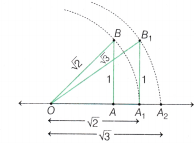
Thus, OA2 = OB1 = √3 units, which means A2 represents √3 on the number line.
Similarly, we can construct line segment of length √5 by continuing the process for √3.
Generalisation In the same way, we can locate √x for any positive integer n, after \(\sqrt{x-1}\) has been located.
Think and Reflect (NCERT Textbook Page No. 57)
Question 1.
Try to find the decimal expansions of \(\frac{10}{3}\) and \(\frac{11}{12}\).
What do you observe about the repetition of the digits after the decimal point?
Solution:
Here, \(\frac{10}{3}\) = 3.3333… = 3.3̄
and \(\frac{11}{12}\) = 0.91666… = 0.916̄
Now, we observe that in \(\frac{10}{3}\), the digit 3 repeats continuously after the decimal point, and in \(\frac{11}{12}\), after some digits, 6 repeats continuously.
Hence, the digits after the decimal point are non-terminating but repeating.
Think and Reflect (NCERT Textbook Page No. 58)
Question 1.
The decimal expansion of \(\frac{p}{q}\) will be terminating precisely when the prime factors of q are only 2, only 5, or both 2 and 5. Can you explain why?
Solution:
For a rational number \(\frac{p}{q}\), first write it in lowest form.
Now, a decimal terminates when its denominator can be changed into 10,100, 1000, ………………..
Also, 10 = 2 × 5
So, 10n = 2n × 5n
Hence, the denominator q can become a power of 10 only when it has prime factors of 2 only, 5 only, or both 2 and 5.
Therefore, \(\frac{p}{q}\) has a terminating decimal expansion precisely when the prime factors of q are only 5 or both 2 and 5.
Think and Reflect (NCERT Textbook Page No. 64)
Consider this puzzle: What is the square root of –1? We know that 1 × 1 = 1. We also know that (–1) × (–1) = 1. There is no Real Number that, when multiplied by itself, results in a negative number. Thus, √-1 cannot exist on the number line.
Solution:
Do it Yourself
Ex 3.1 Class 9 Ganita Manjari Solutions – Ganita Manjari Class 9 Exercise 3.1 Solutions
Exercise 3.1 Class 9 Ganita Manjari Solutions – Ganita Manjari Class 9 Ex 3.1 Solutions
Question 1.
A merchant in the port city of Lothal is exchanging bags of spices for copper ingots. He receives 15 ingots for every 2 bags of spices. If he brings 12 bags of spices to the market, how many copper ingots will he leave with?
Solution:
Given that the merchant receives 15 ingots for every 2 bags of spices.
∴ Ingot for 1 bag = \(\frac{15}{2}\)
So, ingot for 12 bags = \(\frac{15}{2}\) × 12 = 90 ingots.
Hence, the merchant will leave with 90 copper ingots.
Question 2.
Look at the sequence of numbers on one column of the Ishango bone: 11, 13, 17, 19. What do these numbers have in common? List the next three numbers that fit this pattern.
Solution:
The given sequence of numbers is 11, 13, 17, 19.
In the given sequence, all the numbers are prime.
So, to continue this pattern, the next three prime numbers are 23, 29, and 31.
Question 3.
We know that natural numbers are closed under addition (the sum of any two natural numbers is always a natural number). Are they closed under subtraction? Provide a couple of examples to justify your answer.
Solution:
No, natural numbers are not closed under subtraction, e.g. 3 – 5 = – 2, which is not a natural number and 7 – 11 = -4, which is not a natural number.
Question 4.
Ancient Indians used the joints of their fingers to count, a practice still seen today. Each finger has 3 joints and the thumb is used to count them. How many can you count on one hand? How does this relate to the ancient base 12 counting systems?
Solution:
Each finger has 3 joints and there are 4 figures in one hand.
So, the number of joints in one hand = 4 × 3 = 12
Hence, we can 12 counts on one hand.
Now, counting further, the fingers of the other hand can be used to keep track of how many times 12 is counted.
Thus, 1 group = 12, 2 group = 2 × 12 = 24 and so on.
Hence, this method leads to counting in groups of 12, which form the basis of the base -12 system.
Ex 3.2 Class 9 Ganita Manjari Solutions – Ganita Manjari Class 9 Exercise 3.2 Solutions
Exercise 3.2 Class 9 Ganita Manjari Solutions – Ganita Manjari Class 9 Ex 3.2 Solutions
Question 1.
The temperature in the high-altitude desert of
Ladakh is recorded as 4°C at noon. By midnight, it drops by 15°C. What is the midnight temperature?
Solution:
Given, temperature at noon = 4°C
and temperature drop at midnight = 15°C
∴ Mid-night temperature = 4°C – 15°C = -11°C
Question 2.
A spice trader takes a loan (debt) of ₹ 850. The next day, he makes a profit (fortune) of ₹ 1200. The following week, he incurs a loss of ₹ 450. Write this sequence as an equation using integers and calculate his final financial standing.
Solution:
The trader first takes a loan of ₹ 850, which is represented as -850.
The next day, he earns a profit of ₹ 1200, represented as +1200.
Then he incurs a loss of ₹ 450, represented as -450.
So, the situation can be written as:
-850 + 1200 – 450
Now calculate step by step:
-850 + 1200 =350
350 – 450 = -100
So, his final financial standing is -₹100, which means he is still in debt of ₹ 100.
Question 3.
Calculate the following using Brahmagupta’s Laws
(i) (-12) × 5
(ii) (-8) × (-7)
(iii) 0 — (—14)
(iv) (-20) ÷ 4
Solution:
(i) We have (-12) × 5
According to Brahmagupta’s Laws, the product of a fortune (positive number) and a debt (negative number) is a debt (negative number).
∴ (-12) × 5 = -60
(ii) We have, (-8) × (-7)
According to Brahmagupta’s Laws, the product of two debts (negative numbers) is a fortune (positive number).
∴ (-8) × (-7) = 56
(iii) We have 0 – (-14)
According to Brahmagupta’s Laws, subtracting a debt (negative number) from zero is a fortune (positive number).
0 – (-14) = 14
(iv) We have (-20) ÷ 4
According to Brahmagupta’s Laws, a debt (negative number) divided by a fortune (positive number) is a debt (negative number).
(-20) ÷ 4 = -5
Question 4.
Explain, using a real-world example of debt, why subtracting a negative number is the same as adding a positive number (e.g. 10 — (-5) = 15)?
Solution:
You have ₹ 2000 in your savings account, and you owe ₹ 500 (a debt). If your debt is forgiven, how much money do you have in your account?
Here, debt forgiveness means subtracting the negative value, i.e., 2000 – (-500) = 2000 + 500 = 2500.
∴ By ‘subtracting’ the negative ₹ 500 debt, you effectively add that amount back to your total wealth.
Hence, subtracting a number is the same as adding a positive number.
Ex 3.3 Class 9 Ganita Manjari Solutions – Ganita Manjari Class 9 Exercise 3.3 Solutions
Exercise 3.3 Class 9 Ganita Manjari Solutions – Ganita Manjari Class 9 Ex 3.3 Solutions
Question 1.
Prove that the following rational numbers are equal
(i) \(\frac{2}{3}\) and \(\frac{4}{6}\)
Solution:
We know that two rational numbers \(\frac{a}{b}\) and \(\frac{c}{d}\) are said to be equal, if ad = bc.
Given rational numbers are \(\frac{2}{3}\) and \(\frac{4}{6}\) .
Here, a = 2, b = 3, c = 4 and d = 6.
∴ ad = 2 × 6 = 12 and bc = 3 × 4 = 12
Since, ad = be = 12
Therefore, given rational numbers are equal.
(ii) \(\frac{5}{4}\) and \(\frac{10}{8}\)
Solution:
\(\frac{5}{4}\) and \(\frac{10}{8}\);
a = 5 , b = 4 and c = 10, d = 8
5 × 8 = 4 × 10
⇒ 40 = 40 [a × d = b × c]
So, both are equal.
(iii) \(\frac{-3}{5}\) and \(\frac{-6}{10}\)
Solution:
Given rational numbers are \(\frac{-3}{5}\) and \(\frac{-6}{10}\)
Here, a = -3, b = 5, c = -6 and d = 10
∴ ad (-3) × 10 = -30 and be = 5 × (-6) = -30
Since, ad = bc =-30
Therefore, the given rational numbers are equal.
(iv) \(\frac{9}{3}\) and 3.
Solution:
Given rational numbers are \(\frac{9}{3}\) and 3. or \(\frac{9}{3}\) and \(\frac{3}{1}\).
Here, a =9, b =3,c = 3 and d = 1
ad = 9 × 1 = 9 and bc = 3 × 3 =9
Since, ad = bc = 9
Therefore, the given rational numbers are equal.
Question 2.
Find the sum
(i) \(\frac{5}{6}-\frac{1}{4}\)
Solution:
We have, \(\frac{5}{6}-\frac{1}{4}=\frac{5 \times 2}{6 \times 2}-\frac{1 \times 3}{4 \times 3}\)
[LCM of 6 and 4 is 12]
\(=\frac{10}{12}-\frac{3}{12}=\frac{10-3}{12}=\frac{7}{12}\)
(ii) \(\frac{11}{8}-\frac{3}{4}\)
Solution:
We have, \(\frac{11}{8}-\frac{3}{4}=\frac{11}{8}-\frac{3 \times 2}{4 \times 2}\)
[LCM of 4 and 8 is 12]
\(=\frac{11}{8}-\frac{6}{8}=\frac{11-6}{8}=\frac{5}{8}\)
(iii) \(-\frac{7}{9}-\left(-\frac{2}{3}\right)\)
Solution:
We have, \(\frac{-7}{9}-\left(\frac{-2}{3}\right)=\frac{-7}{9}+\frac{2}{3}=\frac{-7}{9}+\frac{2 \times 3}{3 \times 3}\)
[LCM of 9 and 3 is 12]
\(=\frac{-7}{9}+\frac{6}{9}=\frac{-7+6}{9}=\frac{-1}{9}\)
Question 4.
Find the product.
(i) \(\frac{2}{3} \times \frac{3}{10}\)
Solution:
We have, \(\frac{a}{b} \times \frac{b}{c}=\frac{a c}{b d}\)
We have, \(\frac{2}{3} \times \frac{3}{10}=\frac{2 \times 3}{3 \times 10}=\frac{6}{30}=\frac{6 \div 6}{30 \div 6}\)
[∵ HCF of 6 and 0 is 6]
= \(\frac{1}{5}\)
(ii) \(\frac{7}{11} \times \frac{5}{8}\)
Solution:
We have, \(\frac{7}{11} \times \frac{5}{8}=\frac{7 \times 5}{11 \times 8}=\frac{35}{88}\)
[∵ 35 and 88 are coprime]
(iii) \(-\frac{4}{7} \times \frac{5}{14}\)
Solution:
We have, \(\frac{1}{2}\)
[∵ HCF of 20 and 98 is 2]
= \(\frac{-10}{49}\)
Question 5.
(a) \(\frac{2}{3} \div \frac{3}{10}\)
Solution:
We know that \(\frac{a}{b} \div \frac{c}{d}=\frac{a}{b} \times \frac{d}{c}=\frac{a d}{b c}\)
We have, \(\frac{2}{3} \div \frac{3}{10}=\frac{2}{3} \times \frac{10}{3}=\frac{2 \times 10}{3 \times 3}=\frac{20}{9}\)
(b) \(\frac{7}{11} \div \frac{5}{8}\)
Solution:
We have, \(\frac{7}{11} \div \frac{5}{8}=\frac{7}{11} \times \frac{8}{5}=\frac{7 \times 8}{11 \times 5}=\frac{56}{55}\)
(c) \(\frac{-4}{7} \div \frac{5}{1}\)
Solution:
We have, \(\frac{-4}{7} \div \frac{5}{14}=\frac{-4}{7} \times \frac{14}{5}\)
= \(\frac{-4 \times 14}{7 \times 5}=\frac{-56}{35}=\frac{-56 \div 7}{35 \div 7}\)
= \(\frac{-8}{5}\) [∵ HCF of 56 and 35 is 7]
Question 6.
Show that \(\left(\frac{1}{2}+\frac{3}{4}\right) \times \frac{8}{3}=\frac{1}{2} \times \frac{8}{3}+\frac{3}{4} \times \frac{8}{3}\)
Solution:
We have, \(\left(\frac{1}{2}+\frac{3}{4}\right) \times \frac{8}{3}=\frac{1}{2} \times \frac{8}{3}+\frac{3}{4} \times \frac{8}{3}\)
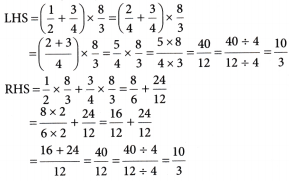
∴ LHS = RHS
Hence Proved.
Question 7.
Simplify the following using the distributive property \(\frac{7}{9}\left(\frac{6}{7}-\frac{3}{4}\right)\)
Solution:
We have, \(\frac{7}{9}\left(\frac{6}{7}-\frac{3}{4}\right)\)
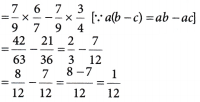
Question 8.
Find the rational number x such that
\(\frac{5}{6}\left(x+\frac{3}{5}\right)=\frac{5}{6} x+\frac{1}{2}\)
Solution:
We have, \(\frac{5}{6}\left(x+\frac{3}{5}\right)=\frac{5}{6} x+\frac{1}{2}\)
⇒ \(\frac{5}{6} \times x+\frac{5}{6} \times \frac{3}{5}=\frac{5}{6} x+\frac{1}{2}\)
⇒ \(\frac{5}{6} x+\frac{1}{2}=\frac{5}{6} x+\frac{1}{2}\)
Since, both sides of the equation are identical. x can be any rational number.
Ex 3.4 Class 9 Ganita Manjari Solutions – Ganita Manjari Class 9 Exercise 3.4 Solutions
Exercise 3.4 Class 9 Ganita Manjari Solutions – Ganita Manjari Class 9 Ex 3.4 Solutions
Question 1.
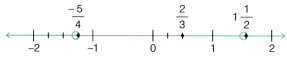
Represent the rational numbers \(\frac{2}{3},-\frac{5}{4}\) and 1\(\frac{1}{2}\) on a single number line.
Solution:
For \(\frac{2}{3}\):
\(\frac{2}{3}\) is lies between 0 and 1.
So, divide the interval between 0 and 1 into 3 equal parts and move two parts right of 0.
For \(-\frac{5}{4}\) :
\(-\frac{5}{4}=-1 \frac{1}{4}\), which is between – 1 and -2.
So, divide the interval between – 1 and -2 into 4 equal parts and move 1 part left of -1.
For 1\(\frac{1}{2}\) :
1\(\frac{1}{2}\) is lies between 1 and 2.
So, divide the interval between 1 and 2 into 2 equal parts and move 1 part right of 1.
Question 2.
Find three distinct rational numbers that lie strictly between –\(\frac{1}{2}\) and \(\frac{1}{4}\).
Solution:
Given number are –\(\frac{1}{2}\) and \(\frac{1}{4}\).
First, change the denominator –\(\frac{1}{2}\) and \(\frac{1}{4}\) to 4
i.e LCM of 2 and 4.
We have, \(\frac{-1 \times 2}{2 \times 2}\) and \(\frac{1 \times 4}{4 \times 4}\) i.e \(\frac{-2}{4}\) and \(\frac{1}{4}\)
Now, multiply both the numerators and denominators by 3 + 1 = 4
\(\frac{-2 \times 4}{4 \times 4}\) and \(\frac{1 \times 4}{4 \times 4}\) i.e. \(\frac{-8}{16}\) and \(\frac{4}{16}\)
Therefore, \(\frac{-7}{16}, \frac{-6}{16}, \frac{2}{16}\) are three rational numbers between –\(\frac{1}{2}\) and \(\frac{1}{4}\).
Question 3.
Simplify the expression \(\left(-\frac{1}{4}\right)+\left(\frac{5}{12}\right)\)
Solution:
We have, \(\left(\frac{-1}{4}\right)+\left(\frac{5}{12}\right)=\frac{-1 \times 3}{4 \times 3}+\frac{5}{12}\)
[∵ LCM of 4 and 12 is 4]
\(\frac{-3}{12}+\frac{5}{12}=\frac{-3+5}{12}=\frac{2}{12}=\frac{1}{6}\)
Question 4.
A tailor has 15\(\frac{3}{4}\) m of fine silk. If making one kurta 4 requires 2\(\frac{1}{4}\) m of silk, exactly how many kuratas can he make?
Solution:
Given, total silk = 15\(\frac{3}{4}\) m = \(\frac{63}{4}\)m
and silk required for one kurta = 2\(\frac{1}{4}\) m = \(\frac{9}{4}\)m
∴ Number of kurtas can he make = \(\frac{\text { Total silk }}{\text { Silk per kurta }}\)
= \(\frac{63}{4} \div \frac{9}{4}=\frac{63}{4} \times \frac{4}{9}\)
= 7
Question 5.
Find three rational numbers between 3.1415 and 3.1416.
Solution:
To find rational numbers between 3.1415 and 3.1416, write them with more decimal places:
3.1415 = 3.14150, 3.1416 = 3.14160
Now choose any three numbers between these:
3.14151, 3.14152, 3.14153
These are all rational numbers and lie strictly between the given numbers.
Therefore, the required rational numbers are: 3.14151, 3.14152, 3.14153 (Answers may vary).
Question 6.
Can you think of other way(s) to find a rational number between any two rational numbers?
Solution:
Let the two rational numbers be a and b such that a < b.
Now, write both numbers with same denominator say \(\frac{a}{c}\) and \(\frac{b}{c}\)
Then, multiply numerator and denominator by a suitable number (say 10, 100, …………) so that many integers come between the numerators.
Hence, we take any integer between them and write it over the same denominator to get a rational number between the given numbers.
Ex3.5 Class 9 Ganita Manjari Solutions – Ganita Manjari Class 9 Exercise 3.5 Solutions
Exercise 3.5 Class 9 Ganita Manjari Solutions – Ganita Manjari Class 9 Ex 3.5 Solutions
Question 1.
Without performing long division, determine which of the following rational numbers will have terminating decimals and which will be repeating \(\frac{7}{20}, \frac{4}{15}\) and \(\frac{13}{250}\). Then, check your answers by explicitly performing the long divisions and expressing these rational numbers as decimals.
Solution:
We know that if the denominator of a rational number in the simplest form has only the prime factors 2 or 5 or both then its decimal expansion is terminating.
Otherwise, it is repeating.
For \(\frac{7}{20}\) :
Here, 20 = 22 × 5
So, \(\frac{7}{20}\) has a terminating decimal.
For \(\frac{4}{15}\):
Here, 15 = 3 × 5
Since, the denominator has factor 3 also, therefore \(\frac{4}{15}\) has a repeating decimal.
For \(\frac{13}{250}\):
Here, 250 = 2 × 53
So, \(\frac{13}{250}\) has a terminating decimal.
Now,
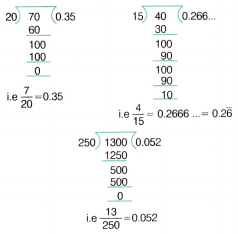
Hence, \(\frac{7}{20}\) and \(\frac{13}{250}\) have terminating decimals and \(\frac{4}{15}\) has a repeating decimal.
Question 2.
Perform the long division for \(\frac{1}{13}\). Identify the repeating block of digits. Does it show cyclic properties if you evaluate \(\frac{2}{13}\)? Now, compute \(\frac{3}{13}, \frac{4}{13}\) etc. What do you notice?
Solution:
We have,
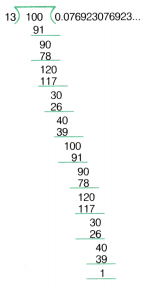
i.e. \(\frac{1}{13}\) = 0.076923076923…. = 0.076923 13
So, the repeating block is 076923.
Now, observe
076923 × 1 = 076923
076923 × 2 = 153846
076923 × 3 = 230769
076923 × 4 = 307692
076923 × 5 = 384615
076923 × 6 = 461538
Also,
\(\frac{2}{13}\) = \(0 . \overline{153846}\)
\(\frac{3}{13}\) = \(0 . \overline{230769}\)
\(\frac{4}{13}\) = \(0 . \overline{307692}\)
Hence, the repeating blocks are not pure cyclic shifts in the same way as 142857 for \(\frac{1}{7}\) but they follow a fixed repeating pattern.
Therefore, \(\frac{1}{13}, \frac{2}{13}, \frac{3}{13}, \frac{4}{13}\) ….. show a patterned cyclic behaviour.
Question 3.
Classify the following numbers as rational or irrational.
(i) \(\sqrt{81}\)
(ii) \(\sqrt{12}\)
(iii) 0.33333…
(iv) 0.123451234512345 …
(v) 1.01001000100001…
(Notice the pattern is it repeating a single block.)
(vi) 23.560185612239874790120
Find the explicit fractions in case they are rational.
Solution:
(i) \(\sqrt{81}\)
\(\sqrt{81}\) = 9
Hence, it is a rational number.
(ii) \(\sqrt{12}\)
\(\sqrt{12}\) = 2√3
Since, √3 is irrational, hence √12 is irrational.
(iii) 0.33333…
0.3̄ = \(\frac{1}{3}\)
Hence, it is a rational number.
(iv) 0.123451234512345…
Here, the block 12345 is repeating, so it is a recurring decimal, hence rational.
Let x = \(0 . \overline{12345}\) …(i)
On multiplying both sides by 100000, we get … (ii)
100000x = 12345.\(\overline{12345}\)
On subtracting Eq. (i) from Eq. (ii), we get
100000x – x = 12345
⇒ 99999x = 12345
⇒ x = \(\frac{12345}{99999}=\frac{4115}{33333}\)
Hence, it is a rational number.
(v) 1.01001000100001…
Here, the number of zeros between l’s keeps increasing, so there is no fixed repeating block, hence it is non-terminating non-repeating. Therefore, it is irrational.
(vi) 23.560185612239874790120
This is a terminating decimal, hence it is a rational number.
and 23.560185612239874790120
= \(\frac{23560185612239874790120}{10000000000000000000000}\)
Question 4.
The number 0.9 (which means 0.99999 …) is a rational number. Using algebra (let x = 0.9 multiply by 10 and subtract), explain why 0.9 is exactly equal to 1?
Solution:
Let x = 0.9̄ …(i)
On multiplying both sides by 10, we get
10x = 9.9̄ …(ii)
On subtracting Eq. (i) from Eq. (ii), we get
10x – x = 9.9̄ – 0.9̄
⇒ 9x = 9
⇒ x = 1
But, x = 0.9̄, hence 0.9̄ = 1
Question 5.
We have seen that the repeating block of \(\frac{1}{7}\) is a cyclic number. Try to find more numbers (n), whose reciprocals \(\left(\frac{1}{n}\right)\)decimals with repeating blocks that are cyclic.
Solution:
We know that
\(\frac{1}{7}=0 . \overline{142857}\)
and 142857 is a cyclic number.
Now, \(\frac{1}{17}=0 . \overline{0588235294117647}\)
Here, the repeating block is 0588235294117647.
Now,
0588235294117647 × 1 = 0588235294117647
0588235294117647 × 2 =1176470588235294
0588235294117647 × 3 = 1764705882352941
.
.
.
.
.
0588235294117647 × 16 =9411764705882352
The same digits simply shift in a cyclic circle.
Hence, the repeating block of \(\frac{1}{7}\) is a cyclic number.
Also, \(\frac{1}{192}\) = \(0 . \overline{052631578947368421}\)
Here, the repeating block is 052631578947368421.
Now, \(\frac{1}{23}=0 . \overline{0434782608695652173913}\)
Here, the repeating block is 0434782608695652173913.
Hence, some more numbers, whose reciprocals produce cyclic repeating blocks are 17, 19, 23,… .
Therefore, \(\frac{1}{17}, \frac{1}{19}\) and \(\frac{1}{23}\) also show cyclic properties like \(\frac{1}{7}\).
Ganita Manjari Class 9 Maths Chapter 3 End of Chapter Exercise Solutions
The World of Numbers End of Chapter Exercise Solutions
Question 1.
Convert the following rational numbers in the form of a terminating decimal or non-terminating and repeating decimal, which ever the case may be, by the process of long division.
(a) \(\frac{3}{50}\)
Solution:
We have, \(\frac{3}{50}\)

∴ \(\frac{3}{50}\) = 0.06
On dividing 3 by 50, we get the exact value 0.06 i.e. remainder is zero. So, latex]\frac{3}{50}[/latex] is in the from of terminating decimal.
(b) \(\frac{2}{9}\)
Solution:
We have, \(\frac{2}{9}\)

\(\frac{2}{9}\) = 0.222……… or \(\frac{2}{9}\) = 0.2 9
On dividing 2 by 9, we get the block of repeated number 2 again and again i.e. remainder never becomes zero. So, \(\frac{2}{9}\) is in the form of non-terminating and repeating decimal.
Question 2.
Prove that √5 is an irrational number.
Solution:
Let √5 be a rational number.
and √5 = \(\frac {p}{q}\), where p and q are integers, q ≠ 0;
and p and q are in lowest terms, i.e., HCF(p, q) = 1.
Squaring both sides
\((\sqrt{5})^2=\left(\frac{p}{q}\right)^2\)
⇒ 5 = \(\frac{p^2}{q^2}\)
⇒ 5q2 = p2
⇒ p has a factor of 5.
∴ p = 5k, where k is an integer
Then 5q2 = (5k)2
⇒ 5q2 = 25k2
⇒ q2 = 5k2
Then q has the factor 5.
⇒ Both p and q have the factor 5.
or p and q are not in lowest terms.
Our assumption is incorrect.
⇒ √5 is not a rational number.
⇒ √5 is an irrational number.
Question 3.
Convert the following decimal numbers into the form \(\frac{p}{q}\).
(i) 12.6
Solution:
Here, 12.6 = \(\frac{126}{10}=\frac{63}{5}\)
(ii) 0.0120
Solution:
Here, 0.0120 = \(\frac{120}{10000}=\frac{3}{250}\)
(iii) \(3.0 \overline{52}\)
Solution:
Let x =3.052 …(i)
Here, we see that one digit (i.e. 0) exist between decimal point and recurring number.
So, on multiplying both sides of Eq. (i) by 10, we get
10x = 30.5252 …(ii)
Here, we see that two digits are repeating.
So, on multiplying Eq. (ii) by 100, we get
1000x = 3052.5252 …(iii)
On subtracting Eq. (ii) from Eq. (iii), we get
990x = 3022
⇒ x = \(\frac{3022}{990}=\frac{1511}{495}\)
Hence, \(=\frac{1511}{495}\)
(iv) \(1.2 \overline{35}\)
Solution:
Let x = 1.2353535…
10x = 12.3535…
1000x = 1235.3535…
1000x – 10x = 1223
⇒ 990x = 1223
⇒ x = \(\frac{1223}{990}\)
(v) \(0 . \overline{23}\)
Solution:
Let x = 0.23
Here, only 2 digits are repeating.
On multiplying both sides of Eq. (i) by 100, we get
100x = 23.2323 …(ii)
On subtracting Eq. (i) from Eq. (ii), we get 23
99x = 23 ⇒ x = \(\frac{23}{99}\)
Hence, \(0 . \overline{23}\) = \(\frac{23}{99}\).
(vi) \(2.0 \overline{5}\)
Solution:
Let x = 20.5555…
100x = 2.0555…
100x – x = 20.5555…. – 2.0555….
9x = 18.5
⇒ x = \(\frac{18.5}{9}=\frac{185}{90}=\frac{37}{18}\)
(vii) \(2.12 \overline{5}\)
Solution:
Let x = 2.125555…
100.x = 212.5555…
1000x = 2125.5555…
1000x – 100x = 2125.5555… – 212.5555…
900x = 1913
⇒ x = \(\frac{1913}{900}\)
(viii) \(3.12\overline{5}\)
Solution:
Let x = 3.125555…
100x = 312.5555…
1000x = 3125.5555…
900x = 2813
x = \(\frac{2813}{900}\)
(ix) \(2.\overline{1625}\)
Solution:
Let x = 2.162516251625…
10000x= 21625.1625…
1000x – x = 21625.1625… – 2.1625…
9999x = 21623
x = \(\frac{21623}{9999}\)
Question 4.
Locate the following rational numbers on the number line.
(i) 0.532
Solution:
Given rational number is 0.532, which is lies between 0 and 1.
Now, we divides the interval between 0 and 1 into 10 equal parts.
So, the number 0.532 lies between 0.5 and 0.6.
Now, divides the interval between 0.5 and 0.6 into 10 equal parts, so the number 0.532 lies between 0.53 and 0.54.
Similarly, divide the interval 0.53 and 0.54 into equal parts and move 2 parts right of 0.53.

(ii) 1.15̄
Solution:
Given, rational number is 1.15 i.e. 1.1555
Now, we divides the interval between 1 and 2 into 10 equal parts and locate 1.1 and 1.2.
Similarly, divide the interval between 1.1 and 1.2 into 10 equal parts and locate 1.15 and 1.16 and divide 1.15 and 1.16 into 10 equal parts.
Since, the number is 1.5555 …, it will lie exactly in the middle between 1.155 and 1.156.

Question 5.
Find 6 rational numbers between 3 and 4.
Solution:
Let a = 3 = \(\frac {3}{1}\); and b = \(\frac {4}{1}\)
The successor of 6 is 7
then a = \(\frac{3}{1} \times \frac{7}{7}\); b = \(\frac{4}{1} \times \frac{7}{7}\)
⇒ a = \(\frac {21}{7}\); b = \(\frac {28}{7}\)
The required 6 rational numbers are:
\(\frac{22}{7}, \frac{23}{7}, \frac{24}{7}, \frac{25}{7}, \frac{26}{7} \text { and } \frac{27}{7}\)
Question 6.
Find 5 rational numbers between \(\frac{2}{5}\) and \(\frac{3}{5}\).
Solution:
Given, number are \(\frac{2}{5}\) and \(\frac{3}{5}\).
Here, the denominators of both numbers are the same.
Now, to find 5 rational numbers between \(\frac{2}{5}\) and \(\frac{3}{5}\), we multiply both the numerator and denominator by 5 + 1 = 6
\(\frac{2 \times 6}{5 \times 6}\) and \(\frac{3 \times 6}{5 \times 6}\) i.e. \(\frac{12}{30}\) and \(\frac{18}{30}\)
Therefore, \(\frac{1}{2}\) and \(\frac{1}{2}\) are five rational numbers between \(\frac{2}{3}\) and \(\frac{3}{5}\).
Question 7.
Find 5 rational numbers between \(\frac{1}{6}\) and \(\frac{2}{5}\).
Solution:
Given, rational numbers are \(\frac{1}{6}\) and \(\frac{2}{5}\).
Firstly, make the same denominator of \(\frac{1}{6}\) and \(\frac{2}{5}\).
∴ \(\frac{1 \times 5}{6 \times 5}\) and \(\frac{2 \times 6}{5 \times 6}\) i.e. \(\frac{5}{30}\) and \(\frac{12}{30}\)
Therefore, \(\frac{6}{30}, \frac{7}{30}, \frac{8}{30}, \frac{9}{30}, \frac{10}{30}\)
i.e. \(\frac{1}{5}, \frac{7}{30}, \frac{4}{15}, \frac{3}{10}, \frac{1}{3}\) are the 5 rational numbers between \(\frac{1}{6}\) and \(\frac{2}{5}\)
Question 8.
If \(\frac{x}{3}+\frac{x}{5}=\frac{16}{15}\), find the rational number x.
Solution:
Given, \(\frac{x}{3}+\frac{x}{5}=\frac{16}{15} \Rightarrow \frac{5 x}{15}+\frac{3 x}{15}=\frac{16}{15}\)
⇒ \(\frac{5 x+3 x}{15}=\frac{16}{15} \Rightarrow \frac{8 x}{15}=\frac{16}{15}\)
⇒ 8x – 16
⇒ x = 2
Question 9.
Let a and b be two non-zero rational numbers such that a + \(\frac{1}{b}\) = 0. Without assigning any numerical values to b, determine whether ab is positive or negative. Justify your answer.
Solution:
Given that a and b are two non-zero rational numbers and a + \(\frac{1}{b}\) = 0
⇒ a = \(\frac{-1}{b}\)
⇒ ab = -1
Hence, ab is negative.
Question 10.
A rational number has a terminating decimal expansion whose last non-zero digit occurs in the 4th decimal place. Show that such a number can be written in the form \(\frac{p}{10^4}\) where p is an integer not divisible by 10. Is it necessary that the denominator of this rational number, when written in the lowest form, is divisible by 24 or 54? Give reasons.
Solution:
Let the rational number be x.
Since its decimal expansion is terminating and its last non-zero digit occurs in the 4th decimal place, it can be written as
x = \(\frac{p}{10^4}\)
where p is an integer.
Also, the last digit of p must be non-zero, so p is not divisible by 10.
Hence, such a number can be written in the form \(\frac{p}{10^4},\), where p is an integer not divisible by 10.
Now, it is not necessary that the denominator of this rational number, when written in lowest form, is divisible by 24 or 54.
For example,
0.9375 = \(\frac{9375}{10000}\)
Here, the last non-zero digit is at the 4th decimal place. Now,
\(\frac{p}{10^4},\)
Thus, the denominator doesn’t need to be always divisible by 24 or 54 because common factors of 2 or 5 may cancel with p, reducing their powers.
However, the denominator in the lowest form will always be of the form 2m × 5m.
Since, only the prime factors 2 and 5 are present.
Question 11.
Without performing division, determine whether the decimal expansion of is terminating or non-terminating. If it terminates, state the number of decimal places.
Solution:
We have, \(\frac{18}{25}\)
Here, 125 = 53
So, \(\frac{18}{125}=\frac{18}{5^3}\)
We know that a rational number has a terminating decimal expansion if the denominator in lowest form is of the form 2m x 5n.
Here, the denominator is 53, which is of the required form.
Hence, the decimal expansion is terminating
Now, to find the number of decimal places, we make the denominator a power of 10.
∴ \(\frac{18}{125}=\frac{18 \times 8}{125 \times 8}=\frac{144}{1000}\) = 0.144
Hence, the number of decimal places is 3.
Question 12.
A rational number in its lowest form has denominator 23 × 5. How many decimal places will its decimal expansion have? Explain your answer
Solution:
Given that a rational number in its lowest form has a denominator 23 × 5.
Now, to find the number of decimal places, we make the denominator a power of 10.
∴ 23 × 5 = 23 × 5 × 52 = 23 × 53 = 103 = 1000
Since the exponent of 10 in the denominator is 3.
∴ The number of decimal places is 3.
Question 13.
Let a = \(\frac{7}{12}\) and b = \(\frac{5}{6}\). Express both a and b in the form — and —, where k1, k2 and m are integers and k2 – k1 > 6. Using the same denominator m, write exactly five distinct rational numbers lying between a and b, keeping an integer numerator. Explain why the condition k2 – k1 > n + 1 is necessary to find n such rational numbers between the two rational numbers a and b using this method.
Solution:
Given, a = \(\frac{7}{12}\) and b = \(\frac{5}{6}\).
Now, taking LCM of 12 and 6, we get m = 12
So, a = \(\frac{7}{12}=\frac{k_1}{m}\)
and b = \(\frac{5}{6}=\frac{10}{12}=\frac{k_2}{m}\)
Here k1 = 7, k2 =10, and k2 – k1 = 10 – 7 = 3.
But, 3 ≱ 6. So, multiply both fractions by 3.
a = \(\frac{7}{12}=\frac{21}{36}\) and b = \(\frac{5}{6}=\frac{30}{36}\)
Here k1 = 21, k2 = 30 and m = 36.
k2 – k1 = 30 – 21 = 9 > 6
Now, five integers between 21 and 30 are 22, 23, 24, 25, 26.
Hence, five distinct rational numbers between a and b are \(\frac{22}{36}, \frac{23}{36}, \frac{24}{36}, \frac{25}{36}, \frac{26}{36}\)
Also, the condition k2 – k1 > n + 1 is necessary because to get n rational numbers between \(\frac{k_1}{m}\) and \(\frac{k_2}{m}\), we need at least n integer numerators strictly between k1 and k2.
Question 14.
Three rational numbers x, y, z satisfy x + y + z = 0 and xy + yz + zx = 0. Show that all the rational numbers x, y, z must be simultaneously zero.
Solution:
Given,x + y + z = 0 and xy + yz + zx = 0
Now, we know that
(x + y + z)2 = x2 + y2 + z2 + 2 (xy + yz + zx)
On putting the given values, we get
02 = x2 + y2 + z2 + 2(0)
0 = x2 + y2 + z2
Since, x, y and z are rational numbers, their squares cannot be negative.
Therefore,
x2 = 0, y2 = 0 and z2 = 0.
Hence, x = 0, y = 0, z = 0
Thus, all the rational numbers x, y, z must be simultaneously zero.
Question 15.
Show that the rational number lies between \(\frac{(a+b)}{2}\) the rational numbers a and b.
Solution:
Given that a and b are two rational numbers.
Now, consider the number = \(\frac{(a+b)}{2}\).
Assume a < b

Thus, the rational number \(\frac{(a+b)}{2}\) lies between a and b.
Question 16.
Find the lengths of the hypotenuses of all the right triangles in the figure, which is referred to as the square root spiral.
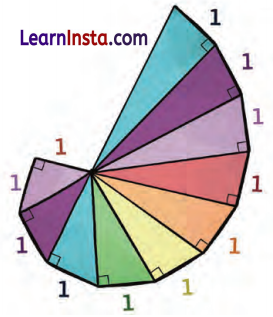
Square root spiral
Solution:
In the square root spiral, each right triangle has one side equal to 1, and the other side is the hypotenuse of the previous triangle.
For the first right triangle,
Hypotenuse = \(\sqrt{1^2+1^2}=\sqrt{2}\)
For the second right triangle,
Hypotenuse = \(\sqrt{(\sqrt{2})^2+1^2}=\sqrt{3}\)
For the third right triangle,
Hypotenuse = \(\sqrt{(\sqrt{3})^2+1^2}=\sqrt{4}\) = 2
Similarly, the lengths of the hypotenuses are
\(\sqrt{2}, \sqrt{3}, \sqrt{4}, \sqrt{5}, \sqrt{6}, \sqrt{7}, \sqrt{8}, \sqrt{9}, \sqrt{10}, \sqrt{11} .\)
Hence, the lengths of the hypotenuses of all the right triangles are \(\sqrt{2}, \sqrt{3}, \sqrt{4}, \sqrt{5}, \sqrt{6}, \sqrt{7}, \sqrt{8}, \sqrt{9}, \sqrt{10}, \sqrt{11} .\)