Get the simplified Extra Questions for Class 9 Maths and Ganita Manjari Class 9 Maths Chapter 1 Orienting Yourself The Use of Coordinates Extra Questions with complete explanation.
Class 9 Orienting Yourself The Use of Coordinates Extra Questions
Extra Questions on Orienting Yourself The Use of Coordinates Class 9
Class 9 Ganita Manjari Chapter 1 Extra Questions
Question 1.
Two points with coordinates (3, 4) and (-5, 4) lie on a line, parallel to which axis? Justify your answer.
Solution:
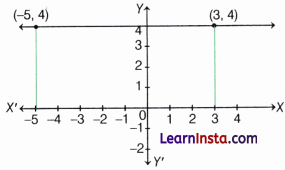
From the graph, it is clear that the line with points (3, 4) and (-5, 4) is parallel to the X-axis.
Question 2.
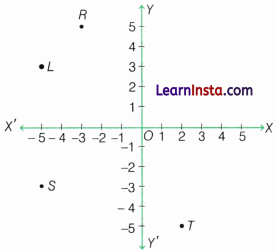
In the following figure, identify the point of the coordinates (-5, 3).
Solution:
For the point (-5, 3), the x-coordinate is negative, and the y-coordinate is positive.
So, it will lie in II quadrant.
Also, its perpendicular distance from the Y-axis is 5 units and from the X-axis is 3 units.
So, the required point is L.
Question 3.
Find the relation between x and y such that the point P(x, y) is equidistant from (7, 1) and (3, 5).
Solution:
Given, point P(x, y) is equidistant from the points A(7, 1) and B(3, 5)
So, AP = BP
⇒ \(\sqrt{(x-7)^2+(y-1)^2}=\sqrt{(3-x)^2+(5-y)^2}\)
⇒ x – y = 2
Orienting Yourself The Use of Coordinates Class 9 Very Short Question Answer
Question 1.
Check whether (5, -2), (6, 4), and (7, -2) are the vertices of an isosceles triangle.
Solution:
Let P(5, -2), Q(6, 4), and R(7, -2) be the given points.
Then, PQ = \(\sqrt{(6-5)^2+(4+2)^2}\) [by distance formula]
= \(\sqrt{(1)^2+(6)^2}\)
= \(\sqrt{1+36}\)
= √37 units
QR = \(\sqrt{(7-6)^2+(-2-4)^2}\)
= \(\sqrt{(1)^2+(-6)^2}\)
= \(\sqrt{1+36}\)
= √37 units
and RP = \(\sqrt{(5-7)^2+(-2+2)^2}\)
= \(\sqrt{(-2)^2+0}\)
= √4
= 2 units
Here, PQ = QP
∴ P, Q, and P will form the vertices of an isosceles triangle.
Question 2.
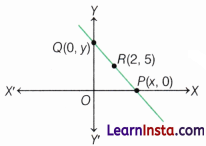
A line intersects the X and Y axes at points P and Q, respectively. If R(2, 5) is the midpoint of line segment PQ, then find the coordinates of P and Q.
Solution:
Let the coordinates of point P and Q be (x, 0) and (0, y), respectively.
∴ (2, 5) = \(\left(\frac{0+x}{2}, \frac{y+0}{2}\right)\) [by midpoint formula]
⇒ (2, 5) = \(\left(\frac{x}{2}, \frac{y}{2}\right)\)
On comparing both sides, we get
\(\frac {x}{2}\) = 2
⇒ x = 4
and \(\frac {y}{2}\) = 5
⇒ y = 10
So, the coordinates of P and Q are (4, 0) and (0, 10), respectively.
Orienting Yourself The Use of Coordinates Class 9 Short Question Answer
Question 1.
Find the coordinates of two points on the X-axis and two points on the Y-axis, which are at equal distance from the origin.
Solution:
Let a be the equal distance from the origin on both axes.
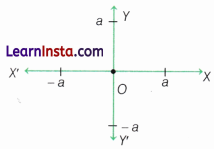
Then, the coordinates of two points on the X-axis are (a, 0) and (-a, 0), and the coordinates of two points on the Y-axis are (0, a) and (0, -a).
Question 2.
In the given figure, ∆ABC and ∆ABD are equilateral triangles. Find the coordinates of points C and D.
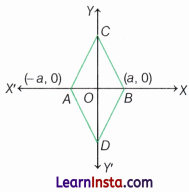
[Hint: Altitude of an equilateral triangle, OC = OD = \(\frac{\sqrt{3}}{2}\) × Side]
Solution:
Given that ∆ABC is equilateral.
∴ AB = BC = CA
⇒ AB = 2a
Since, OC = OD = \(\frac{\sqrt{3}}{2}\) × Side
= \(\frac{\sqrt{3}}{2}\) × 2a
= √3a
Therefore, the coordinates of point C = (0, √3a) and the coordinates of point D = (0, -√3a).
Question 3.
Find the coordinates of the vertices of a rectangle placed in the III quadrant, in the Cartesian plane with length p units on the X-axis and breadth q units on the Y-axis.
Solution:
Let ABCO be a rectangle placed in the III quadrant.
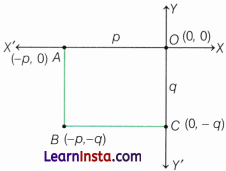
Coordinates of its vertices are O(0, 0), A(-p, 0), B(-p, -q), and C(0, -q).
Question 4.
Find the distance between the following pairs of points.
(i) (2, 3), (4, 1)
(ii) (-5, 7), (-1, 3)
(iii) (a, b), (-a, b)
Solution:
(i) Let A(2, 3) and B(4, 1) be the given points.
Here, x1 = 2, y1 = 3, x2 = 4, and y2 = 1
Now, AB = \(\sqrt{\left(x_2-x_1\right)^2+\left(y_2-y_1\right)^2}\) [by distance formula]
= \(\sqrt{(4-2)^2+(1-3)^2}\)
= \(\sqrt{4+4}\)
= √8
= 2√2 units
(ii) Do the same as Part (i).
(iii) Do the same as Part (i).
Question 5.
Check whether the points (1, 2), (3, 4), and (5, 6) are collinear or not.
Solution:
Let A = (1, 2), B = (3, 4), and C = (5, 6)
Then, AB = \(\sqrt{(3-1)^2+(4-2)^2}\)
= \(\sqrt{(2)^2+(2)^2}\)
= \(\sqrt{4+4}\)
= √8
= 2√2 units
BC = \(\sqrt{(5-3)^2+(6-4)^2}\)
= \(\sqrt{(2)^2+(2)^2}\)
= \(\sqrt{4+4}\)
= √8
= 2√2 units
and AC = \(\sqrt{(5-1)^2+(6-2)^2}\)
= \(\sqrt{(4)^2+(4)^2}\)
= \(\sqrt{16+16}\)
= √32
= 4√2 units
Here, AC = AB + BC [4√2 = 2√2 + 2√2]
∴ A, B, and C are collinear points.
Question 6.
If the point P(2, 1) lies on the line segment joining the points A(4, 2) and B(8, 4), then find the relation between AP and AB.
Solution:

Here, AP = \(\sqrt{(2-4)^2+(1-2)^2}\)
= \(\sqrt{(-2)^2+(-1)^2}\)
= √5 units ……(i)
AB = \(\sqrt{(8-4)^2+(4-2)^2}\) = 2√5 units …..(ii)
On putting √5 = AP from Eq. (i) in Eq. (ii), we get
AB = 2√5 = 2AP
⇒ AP = \(\frac {AB}{2}\)
Question 7.
Find the area of a rhombus, if its vertices are (3, 0), (4, 5), (-1, 4), and (-2, -1) taken in order.
[Hint: Area of a rhombus = \(\frac {1}{2}\) × (Product of its diagonals)]
Solution:
Let A(3, 0), B(4, 5), C(-1, 4), and D(-2, -1) be the vertices of the rhombus ABCD.
We know that
Distance = \(\sqrt{\left(x_2-x_1\right)^2+\left(y_2-y_1\right)^2}\)
Diagonal, AC = \(\sqrt{(-1-3)^2+(4-0)^2}\)
= \(\sqrt{(-4)^2+4^2}\)
= √32
= 4√2 units
Diagonal, BD = \(\sqrt{(-2-4)^2+(-1-5)^2}\)
= \(\sqrt{(-6)^2+(-6)^2}\)
= \(\sqrt{36+36}\)
= √72
= 6√2 units
∴ Area of the rhombus ABCD = \(\frac {1}{2}\) × Product of its diagonals
= \(\frac {1}{2}\) × AC × BD
= \(\frac {1}{2}\) × 4√2 × 6√2
= 2 × 6 × √2 × √2
= 12 × 2
= 24 sq units
Question 8.
If the two vertices of an equilateral triangle are (0, 0) and (3, √3). Find the third vertex.
Solution:
Let O(0, 0) and A(3, √3)
Also, let the third vertex be B(x, y).
Then, OB = OA [∵ ∆OAB is an equilateral triangle]
and OA = AB
Vertex = (0, 2√3) or (3, -√3)
Question 9.
If the points A(6, 1), B(8, 2), C(9, 4), and D(p, 3) are the vertices of a parallelogram taken in order, then find the value of p.
Solution:
Given, vertices of a parallelogram are A(6, 1), B(8, 2), C(9, 4), and D(p, 3).
We know that the diagonals of a parallelogram bisect each other.
∴ Coordinates of the midpoint of diagonal AC = Coordinates of the midpoint of diagonal BD
⇒ \(\left(\frac{6+9}{2}, \frac{1+4}{2}\right)=\left(\frac{8+p}{2}, \frac{2+3}{2}\right)\) [by midpoint formula]
⇒ \(\left(\frac{15}{2}, \frac{5}{2}\right)=\left(\frac{8+p}{2}, \frac{5}{2}\right)\)
On equating x-coordinates from both sides, we get
\(\frac{15}{2}=\frac{8+p}{2}\)
⇒ 15 = 8 + p
⇒ p = 15 – 8
⇒ p = 7
Hence, the required value of p is 7.
Question 10.
Find the coordinates of the point Q on the X-axis, which lies on the perpendicular bisector of the line segment joining the points A(-5, -2) and B(4, -2). Name the type of triangle formed by the points Q, A, and B.
Solution:
First, plot the points A and B on the Cartesian plane and join them.
Now, find the midpoint P of AB.
Then, draw a vertical line passing through the midpoint P, which cuts the X-axis at the point Q(\(-\frac {1}{2}\), 0), which are the required coordinates.
∴ ΔQAB is an isosceles triangle.
Question 11.
In the given figure, in ΔABC, points D and E are midpoints of sides BC and AC, respectively. If given vertices are A(5, -1), B(3, -1), and C(-7, -8) then verify the result DE = \(\frac {1}{2}\)AB.
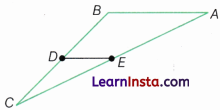
Solution:
Given
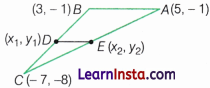
To prove DE = \(\frac {1}{2}\)AB
Since D and E are midpoints of BC and AC, respectively.
So, by the mid-point formula,
\(x_1=\frac{3-7}{2}=-\frac{4}{2}=-2, y_1=\frac{-1-8}{2}=-\frac{9}{2}\)
and \(x_2=\frac{5-7}{2}=-\frac{2}{2}=-1, y_2=\frac{-1-8}{2}=-\frac{9}{2}\)
∴ D(-2, \(-\frac {9}{2}\)) and E(-1, \(-\frac {9}{2}\))
Using the distance formula,
DE = \(\sqrt{(-1+2)^2+\left(-\frac{9}{2}+\frac{9}{2}\right)^2}\) = 1 unit
AB = \(\sqrt{(5-3)^2+(-1+1)^2}\) = 2 units
Therefore, DE = \(\frac {AB}{2}\)
Hence Proved.
Orienting Yourself The Use of Coordinates Class 9 Long Question Answer
Question 1.
See the figure and write the following.
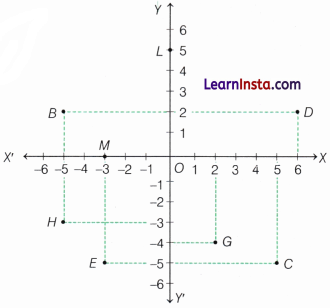
(i) The coordinates of the point B.
(ii) The coordinates of the point C.
(iii) The point identified by the coordinates (-3, -5).
(iv) The point identified by the coordinates (2, -4).
(v) The abscissa of the point D.
(vi) The ordinate of the point H.
(vii) The coordinates of the point L.
(viii) The coordinates of the point M.
Solution:
(i) Point B is at a distance of 5 units from the Y-axis along the negative direction of the X-axis and 2 units from the X-axis along the positive direction of the Y-axis.
Hence, the coordinates of point B are (-5, 2).
(ii) Do the same as part (i)
(iii) Point (-3, -5), which has a distance of 3 units from the Y-axis along the negative direction of the X-axis and 5 units from the X-axis along the negative direction of the Y-axis, is E.
(iv) Do the same as part (iii)
(v) Point D is at a distance of 6 units from the Y-axis along the positive direction of the X-axis.
Therefore, its abscissa is 6.
(vi) Point H is at a distance of 3 units from the X-axis along the negative direction of the Y-axis.
Therefore, its ordinate is -3.
(vii) Do the same as part (i)
(viii) Do the same as part (i)
Question 2.
In the given figure, ABCD is a rhombus with diagonals AC = 16 cm and BD = 8 cm.
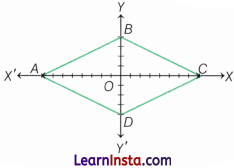
Find the coordinates of A, B, C, and D.
Solution:
Since, AC = 16 cm and BD = 8 cm
So, OA = OC = \(\frac {AC}{2}\) = \(\frac {16}{2}\) cm = 8 cm
and OB = OD = \(\frac {BD}{2}\) = \(\frac {8}{2}\) cm = 4 cm
Thus, the coordinates of A, B, C, and D are A(-8, 0), B(0, 4), C(8, 0), and D(0, -4).
Question 3.
Write the coordinates of the vertices of a rectangle, whose length and breadth are 6 units and 3 units, respectively, one vertex at the origin, the longer side lies on the Y-axis, and one of the vertices lies in the II quadrant. Also, find the area of the rectangle.
Solution:
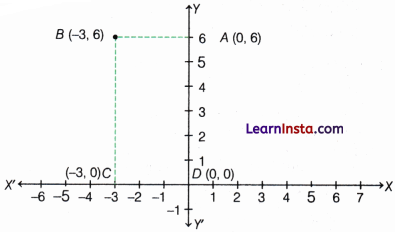
A(0, 6), B(-3, 6), C(-3, 0), and D(0, 0)
Area = 18 sq units
Question 4.
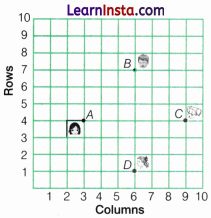
In a classroom, 4 friends are seated at the points A, B, C, and D as shown in the figure. Champa and Chameli walk into the class, and after observing for a few minutes, Champa asks Chameli, “Don’t you think ABCD is a square?”, Chameli disagrees. Using the distance formula, find which of them is correct?
Solution:
From the given figure, the coordinates of points A, B, C, and D are (3, 4), (6, 7), (9, 4), and (6, 1), respectively.
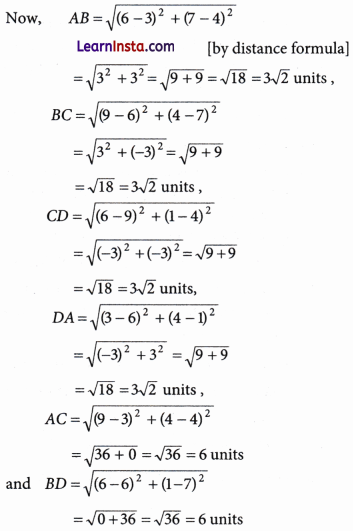
Here, all four sides AB, BC, CD, and DA are equal, and diagonals AC and BD are equal.
Hence, ABCD is a square.
So, Champa is correct.
Alternate Method:
Find four sides AB, BC, CD, and DA, and one diagonal, say AC, the same as above.
Now, AB2 + BC2 = (3√2)2 + (3√2)2
= 18 + 18
= 36
= (6)2
⇒ AB2 + BC2 = AC2
Therefore, by the converse of Pythagoras theorem, ∠B = 90°.
Since a quadrilateral with all four sides equal and one angle 90° is a square.
So, ABCD is a square.
Question 5.
Name the types of quadrilateral formed, if any, by the following points and give reasons for your answer.
(i) (-1, -2), (1, 0), (-1, 2), (-3, 0)
(ii) (-3, 5), (3, 1), (0, 3), (-1, -4)
(iii) (4, 5), (7, 6), (4, 3), (1, 2)
Solution:
(i) Let A(-1, -2), B(1, 0), C(-1, 2), and D(-3, 0) be the given points.
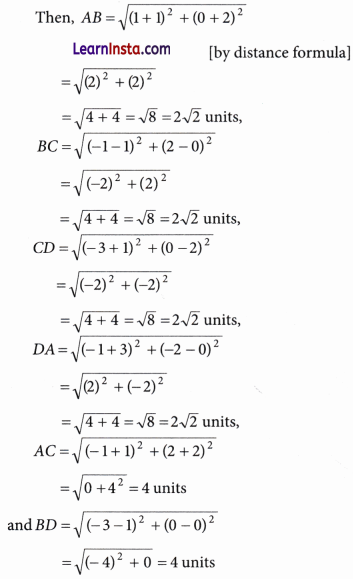
Here, the four sides AB, BC, CD, and DA are equal, and diagonals AC and BD are also equal.
So, the quadrilateral ABCD is a square.
(ii) Do the same as Part (i).
Points A, B, C, and D do not form any type of quadrilateral because AC + BC = AB
i.e., A, B, and C are collinear.
(iii) Do the same as part (i).
The quadrilateral ABCD is a parallelogram because
AB = CD = √10, BC = DA = 3√2 and AC ≠ BD.
Question 6.
The three vertices of a rhombus PQRS are P(2, -3), Q(6, 5), and R(-2, 1).
(i) Find the coordinates of the point where both the diagonals PR and QS intersect.
(ii) Find the coordinates of the fourth vertex S. Show your steps and give valid reasons.
Solution:
(i) We know that the diagonals of a rhombus bisect each other.
Thus, the point of intersection of both the diagonals is the midpoint of P(2, -3) and R(-2, 1).
So \(\left(\frac{2-2}{2}, \frac{-3+1}{2}\right)=(0,-1)\)
(ii) The midpoint of Q(6, 5) and S(x, y) as \(\left(\frac{6+x}{2}, \frac{5+y}{2}\right)\), where x and y are the coordinates of the fourth vertex S.
Use the above steps and equate the respective coordinates of the midpoints to get the following relationships.
(a) 0 = \(\frac{6+x}{2}\) ⇒ x = -6
(b) -1 = \(\frac{5+y}{2}\) ⇒ y = -7
Hence, the coordinates of the fourth vertex S are (-6, -7).
Question 7.
Let P and Q be the points of trisection of AB, with P closer to A and Q closer to B. Find the coordinates of P and Q when the points are A(3, 7) and B(15, 1).
Solution:
Given, A(3, 7) and B(15, 1)
Let P(x1, y1) and Q(x2, y2) be the points of trisection.
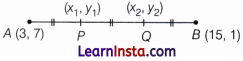
Since P and Q divide AB into three equal parts, P is the midpoint of A and Q, and Q is the midpoint of P and B.
Using the midpoint formula,
\(x_1=\frac{3+x_2}{2}\) …….(i)
\(y_1=\frac{7+y_2}{2}\) …….(ii)
\(x_2=\frac{x_1+15}{2}\) …….(iii)
\(y_2=\frac{y_1+1}{2}\) ……..(iv)
On putting the value of x1 in Eq. (iii), we get
\(x_2=\frac{\frac{3+x_2}{2}+15}{2}\)
⇒ \(x_2=\frac{3+x_2+30}{4}\)
⇒ \(x_2=\frac{x_2+33}{4}\)
⇒ 4x2 = x2 + 33
⇒ 3x2 = 33
⇒ x2 = 11
From Eq. (i), x1 = \(\frac{3+11}{2}\)
⇒ x1 = 7
On putting the value of y1 in Eq. (iv), we get
⇒ \(y_2=\frac{\frac{7+y_2}{2}+1}{2}\)
⇒ \(y_2=\frac{7+y_2+2}{4}\)
⇒ 4y2 = y2 + 9
⇒ 3y2 = 9
⇒ y2 = 3
From Eq (ii), y1 = \(\frac{7+3}{2}\)
⇒ y1 = 5
Therefore, the coordinates of P and Q are (7, 5) and (11, 3), respectively.
Question 8.
To conduct Sports Day activities in your rectangular-shaped school ground ABCD, lines have been drawn with chalk powder at a distance of 1 m each. 100 flower pots have been placed at a distance of 1 m from each other along AD, as shown in the figure.
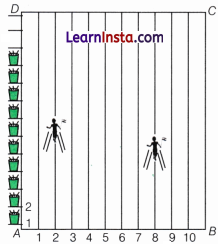
Niharika runs \(\frac {1}{4}\)th the distance AD on the 2nd line and posts a green flag. Preet runs \(\frac {1}{5}\)th the distance AD on the 8th line and posts a red flag. What is the distance between the flags? If Rashmi has to post a blue flag exactly halfway between the line segment joining the two flags, where should she post her flag?
Solution:
From the given figure, the position of the green flag posted by Niharika is M(2 × 1, \(\frac {1}{4}\) × 100) i.e., M(2, 25)
and red flag posted by Preet is N(8 × 1, \(\frac {1}{5}\) × 100) i.e. N(8, 20).
Now, MN = \(\sqrt{(8-2)^2+(20-25)^2}\) [by distance formula]
= \(\sqrt{(6)^2+(-5)^2}\)
= \(\sqrt{36+25}\)
= √61
Hence, the distance between flags is √61 m.
Let P be the position of the blue flag posted by Rashmi at the halfway point of the line segment MN.
Then, coordinates of P = \(\left(\frac{x_1+x_2}{2}, \frac{y_1+y_2}{2}\right)\)
= \(\left(\frac{2+8}{2}, \frac{25+20}{2}\right)\)
= \(\left(\frac{10}{2}, \frac{45}{2}\right)\)
= (5, 22.5)
Hence, the blue flag is on the 5th line at a distance of 22.5 m above it.
Orienting Yourself The Use of Coordinates Class 9 Case Based Questions
Question 1.
Krisha is a Class IX student residing in a village. One day, he went to a city hospital along with his grandfather for a general checkup. From there, he visited three places: the school, library, and police station. After returning to his village, he plotted a graph by taking the hospital as the origin and marked three places on the graph as per his direction of movement and distance. The graph is shown below.
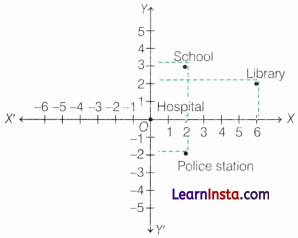
Based on the above information, answer the following questions.
(i) What are the coordinates of the police station?
(ii) What are the coordinates of the school?
(iii) (a) What is the distance between the school and the police station?
Or
(b) In which quadrant does the point (-3, 2) lie?
Solution:
(i) It is clear from the given graph that the police station is at 2 units from the X-axis along the negative direction of the Y-axis and 2 units from the Y-axis in the positive direction of the X-axis.
∴ The coordinates of the police station are (2, -2).
(ii) The school is at 2 units from the Y-axis and 3 units from the X-axis in the positive direction of both axes.
Therefore, the coordinates of the school are (2, 3).
(iii) (a) Since the school is at 3 units from the X-axis, and the police station is at 2 units from the X-axis.
So, the distance between the school and the police station = 3 + 2 = 5 units.
Or
(b) Given, the point is (-3, 2).
Here, the x-coordinate is negative, and the y-coordinate is positive.
Hence, the point (-3, 2) lies in the II quadrant.
Question 2.
A school has planned to construct a playground for junior (from I-V class) and senior (from VI-XII class). The following graph shows the playground.
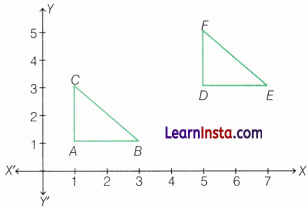
Based on the above information, answer the following questions.
(i) Find the coordinates of A.
(ii) Find the coordinates of F.
(iii) (a) What is the area of playground ABC?
Or
(b) What is the area of playground DEF?
Solution:
(i) From the given graph, we have the coordinates of A as (1, 1).
(ii) From the given graph, we have the coordinates of F as (5, 5).
(iii) (a) Area of playground ABC,
A1 = \(\frac {1}{2}\) × AB × AC [∵ area of a triangle = \(\frac {1}{2}\) × base × height]
= \(\frac {1}{2}\) × (3 – 1) × (3 – 1)
= \(\frac {1}{2}\) × 2 × 2
= 2 sq units
Or
(b) Area of playground DBF,
A2 = \(\frac {1}{2}\) × DE × DF
= \(\frac {1}{2}\) × (7 – 5) × (5 – 3)
= \(\frac {1}{2}\) × 2 × 2
= 2 sq units
Question 3.
Alia and Shagun are friends living on the same street in Patel Nagar. Shagun’s house is at the intersection of one street with another street on which there is a library. They both study in the same school, and that is not far from Shagun’s house. Suppose the school is situated at the point O, i.e., the origin. Alia’s house is at A, Shagun’s house is at B, and the library is at C.
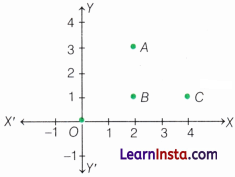
Based on the above information, answer the following questions.
(i) How far is Alia’s house from Shagun’s house?
(ii) How far is the library from Shagun’s house?
(iii) (a) Show that for Shagun’s house, the school is farther as compared to Alia’s house and the library.
Or
(b) Show that Alia’s house, Shagun’s house, and the library form an isosceles right-angled triangle.
Solution:
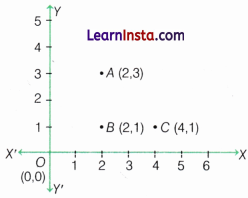
(i) Distance between Alia’s house and Shagun’s house,
AB = \(\sqrt{(2-2)^2+(1-3)^2}=\sqrt{(-2)^2}\) = 2 units
(ii) Distance between the library and Shagun’s house,
CB = \(\sqrt{(4-2)^2+(1-1)^2}=\sqrt{4+0}\) = 2 units
(iii) (a) Distance between Shagun’s house and school,
OB = \(\sqrt{(2-0)^2+(1-0)^2}=\sqrt{4+1}\) = 5 units
Distance between Alia’s house and Shagun’s house, AB = 2 units
and the distance between the library and Shagun’s house, CB = 2 units.
∴ OB > AB and OB > CB
Hence, for Shagun’s house, the school is farther away than Alia’s house and the library.
Or
(b) We have AB = 2 units [from part (i)]
and BC = 2 units [from part (ii)]
Now, AC2 = (4 – 2)2 + (1 – 3)2
= 4 + 4
= 8 units
and AB2 + BC2 = 22 + 22 = 8 units
∵ AC2 = AB2 + BC2
∴ ABC is a right-angled triangle, right-angled at B.
Also, AB = BC = 2 units
∴ ABC is an isosceles right-angled triangle.
Question 4.
Ayush starts walking from his house to the office. Instead of going to the office directly, he goes to a bank first, from there to his daughter’s school, and then reaches the office.
Based on the above information, answer the following questions.
(i) What is the extra distance travelled by Ayush in reaching his office? [Assume that all distances covered are in straight lines. If the house is situated at (3, 5), the bank at (6, 9), the school at (14, 15), and the office at (14, 27), and the coordinates are in kilometres.
(ii) How far from the bank to the office?
(iii) (a) What is the midpoint between the line segment joining the school and the bank?
Or
(b) What is the difference in distance between the house to bank and the school house?
Solution:
(i)
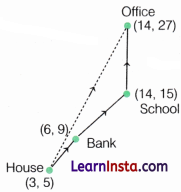
Extra distance travelled by Ayush = Distance between house and office via bank and school – Direct distance between house and office
Now, using the distance formula,
Extra distance = \(\begin{aligned}
& =\sqrt{(6-3)^2+(9-5)^2}+\sqrt{(14-6)^2+(15-9)^2} \\
& +\sqrt{(14-14)^2+(27-15)^2}-\sqrt{(14-3)^2+(27-5)^2}
\end{aligned}\) = 2.4 km
(ii) \(\sqrt{(14-6)^2+(27-9)^2}\) = 2√97 km
(iii) (a) Mid-point = \(\left(\frac{14+6}{2}, \frac{15+9}{2}\right)\) = (10, 12)
Or
(b) Difference = \(\sqrt{(14-3)^2+(15-5)^2}-\sqrt{(6-3)^2+(9-5)^2}\) = 9.87 km
Question 5.
Carpooling is the sharing of car journeys so that more than one person travels in a car and prevents the need for others to have to drive to a location themselves. By having more people use one vehicle, carpooling reduces each person’s travel costs, such as fuel costs, tolls, and the stress of driving. Carpooling is also a more environmentally friendly and sustainable way to travel, as sharing journeys reduces air pollution, carbon emissions, traffic congestion on the roads, and the need for parking spaces. Three friends, Amar, Bhavin, and Chetanya, live in societies represented by the points A(4, 5), B(6, 2), and C(2, 6), respectively. They all work in offices located in a same building represented by the point O(0, 0). Since they all go to the same building every day, they decided to carpool to save money on petrol.
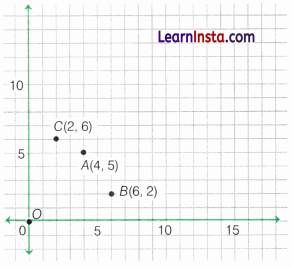
Based on the above information, answer the following questions.
(i) What is the distance between B and C?
(ii) If Bhavin and Chetanya planned to meet at a club situated at the midpoint of the line joining the points B and C, find the coordinates of this point.
(iii) (a) What society is farthest from the office? Also, find its distance from the office.
Or
(b) Out of B and C, which society is nearest to A? Also, find their distances.
Solution:
Given, points are A(4, 5), B(6, 2), and C(2, 6).
Office location, O(0, 0)
(i) Distance between points B(6, 2) and C(2, 6),
BC = \(\sqrt{(2-6)^2+(6-2)^2}\) [by distance formula]
= \(\sqrt{16+16}\)
= 4√2 units
(ii) Mid-point of line joining B and C = \(\left(\frac{6+2}{2}, \frac{2+6}{2}\right)\) [by mid-point formula]
= (4, 4)
(iii) (a) Distance of A(4, 5) from O(0, 0),
AO = \(\sqrt{4^2+5^2}=\sqrt{16+25}\) = √41 units
Distance of B(6, 2) from O(0, 0),
BO = \(\sqrt{6^2+2^2}=\sqrt{36+4}\) = √40 units
Distance of C(2, 6) from O(0, 0),
CO = \(\sqrt{2^2+6^2}=\sqrt{4+36}\) = √40 units
Since √41 > √40
Hence, Society A is the farthest from the office.
Or
(b) Distance of A(4, 5) from B(6, 2),
AB = \(\sqrt{(6-4)^2+(2-5)^2}\)
= \(\sqrt{4+9}\)
= √13 units
Distance of A(4, 5) from C(2, 6),
AC = \(\sqrt{(2-4)^2+(6-5)^2}\)
= \(\sqrt{4+1}\)
= √5 units
Since √13 > √5
Hence, C is nearer to A, and the required distance AC = √5 units.