Practicing Class 9 Maths MCQ and Ganita Manjari Class 9 Maths Chapter 3 The World of Numbers MCQ Questions Online Test with Answers daily helps in time management.
MCQ on The World of Numbers Class 9
The World of Numbers MCQ Class 9
Class 9 Maths The World of Numbers MCQ
Question 1.
The temperature at a place is 6°C in the afternoon. At night it decreases by 11°C. What is the night temperature?
(a) 5°C
(b) -5°C
(c) -17°C
(d) 17°C
Answer:
(b) -5°C
Question 2.
The valuer of (-9) × (-4) is
(a) 9
(b) 4
(c) 36
(d) -36
Answer:
(c) 36
Question 3.
Which pair shows equivalent rational numbers?
(a) \(\frac{3}{4}, \frac{6}{8}\)
(b) \(\frac{5}{6}, \frac{5}{12}\)
(c) \(\frac{3}{2}, \frac{3}{4}\)
(d) None of these
Answer:
(a) \(\frac{3}{4}, \frac{6}{8}\)
Explanation:
\(\frac{3}{4}, \frac{6}{8}\)
\(\frac{4}{3}\)
[on dividing numerator and denominator by 2]
Question 4.
Which of the following is equivalent to \(\frac{4}{5}\)?
(a) \(\frac{5}{4}\)
(b) \(\frac{16}{25}\)
(c) \(\frac{16}{20}\)
(d) \(\frac{15}{25}\)
Answer:
(c) \(\frac{16}{20}\)
Explanation:
\(\frac{4 \times 4}{5 \times 4}=\frac{16}{20}\)

Question 5.
-3 can be written in the form of \(\frac{p}{q}\) as
(a) \(\frac{-3}{-1}\)
(b) \(\frac{-3}{0}\)
(c) \(\frac{0}{-3}\)
(d) \(\frac{-3}{1}\)
Answer:
(d) \(\frac{-3}{1}\)
Explanation:
-3 can be written in the form of \(\frac{p}{q}\) as \(\frac{-3}{1}\)
Question 6.
In which of the following options does point K represent –\(\frac{1}{5}\) on the number line?
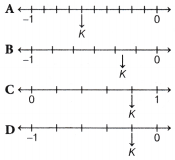
Answer:
(d)
Explanation:
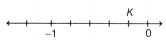
–\(\frac{1}{5}\) is less than 0 and greater than -1.
So, it will lie on the left of 0 on the number line.
Divide the gap between 0 and -1 into 5 equal parts.
Thus, the point K on the number line represents the rational number –\(\frac{1}{5}\) as shown below.
Question 7.
In the standard form of a rational number, the common factor of the numerator and denominator is always
(a) 0
(b) 1
(c) -2
(d) 2
Answer:
(b) 1
Explanation:
In the standard form of a rational number, the common factor of the numerator and denominator is always 1.
Question 8.
The standard form of \(\frac{-32}{40}\) is
(a) \(\frac{-32}{40}\)
(b) \(\frac{-4}{5}\)
(c) \(\frac{4}{5}\)
(d) \(\frac{-32}{40}\)
Answer:
(b) \(\frac{-4}{5}\)
Explanation:
\(\frac{-32 \div 8}{40 \div 8}=-\frac{4}{5}\)
Question 9.
To reduce a rational number to its standard form, we divide its numerator and denominator by their
(a) LCM
(b) HCF
(c) product
(d) multiple
Answer:
(b) HCF
Explanation:
To reduce a rational number to its standard form, we divide its numerator and denominator by their HCF.
Question 10.
Which of the following are equal?
(a) \(\frac{3}{5}\) and \(\frac{9}{15}\)
(b) \(\frac{2}{3}\) and \(\frac{5}{6}\)
(c) \(\frac{4}{7}\) and \(\frac{8}{15}\)
(d) \(\frac{5}{8}\) and \(\frac{10}{17}\)
Answer:
(a) \(\frac{3}{5}\) and \(\frac{9}{15}\)
Question 11.
\(\frac{7}{9}-\frac{2}{3}\) is equal to
(a) \(\frac{5}{6}\)
(b) \(\frac{1}{9}\)
(c) \(\frac{3}{9}\)
(d) \(\frac{2}{9}\)
Answer:
(b) \(\frac{1}{9}\)
Question 12.
The numerical expression \(\frac{3}{8}+\frac{(-5)}{7}=\frac{-19}{56}\), shows that
(a) rational numbers are closed under addition.
(b) rational numbers are not closed under addition.
(c) rational numbers are closed under multiplication.
(d) addition of rational numbers is not commutative.
Answer:
(a) Rational numbers are closed under addition.
Explanation:
The given expression shows that rational numbers are closed under addition.
Question 13.
Which of the following is not true?
(a) Rational numbers are closed under addition.
(b) Rational numbers are closed under subtraction.
(c) Rational numbers are closed under multiplication.
(d) Rational numbers are closed under division.
Answer:
(d) Rational numbers are closed under division.
Explanation:
Rational numbers are not closed under division.
Question 14.
Which of the following is not true?
(a) \(\frac{10}{11}+\frac{11}{12}=\frac{11}{12}+\frac{10}{11}\)
(b) \(\frac{10}{11} \times \frac{11}{12}=\frac{11}{12} \times \frac{10}{11}\)
(c) \(\frac{10}{11} \div \frac{11}{12}=\frac{11}{12} \div \frac{10}{11}\)
(d) \(\frac{10}{11} \div \frac{11}{12}=\frac{10}{11} \times \frac{12}{11}\)
Answer:
(c) \(\frac{10}{11} \div \frac{11}{12}=\frac{11}{12} \div \frac{10}{11}\)
Explanation:
From option (C), we have
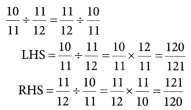
∴ LHS ≠ RHS
Question 15.
Which of the following operations is not associative for rational numbers?
(a) Addition
(b) Division
(c) Subtraction
(d) Both (b) and (c)
Answer:
(d) Both (b) and (c)
Explanation:
Neither subtraction nor division is associative for rational numbers.
Question 16.
Zero (0) is
(a) the identity for addition of rational numbers.
(b) the identity for subtraction of rational numbers.
(c) the identity for multiplication of rational numbers.
(d) the identity for division of rational numbers.
Answer:
(a) the identity for addition of rational numbers.
Explanation:
0 is the identity for addition of rational numbers.
Question 17.
One (1) is
(a) the identity for addition of rational numbers.
(b) the identity for subtraction of rational numbers.
(c) the identity for multiplication of rational numbers.
(d) the identity for division of rational numbers.
Answer:
(c) the identity for multiplication of rational numbers.
Explanation:
1 is the identity for multiplication of rational numbers.
Question 18.
Multiplicative inverse of 0 is
(a) -1
(b) 1
(c) 0
(d) not defined
Answer:
(d) not defined
Explanation:
The multiplicative inverse of 0 is not defined.
Question 19.
Multiplicative inverse of a negative rational number is
(a) 0
(b) -1
(c) a negative rational number
(d) a positive rational number
Answer:
(d) a positive rational number
Explanation:
The multiplicative inverse of a negative rational number is a positive rational number.
Question 20.
Which of the following numbers does not have a multiplicative inverse?
(a) 1
(b) -1
(c) 0
(d) None of these
Answer:
(d) None of these
Explanation:
\(-\frac{3}{8} \times\left(-\frac{24}{13}\right)=\frac{(-3) \times(-3)}{13}=\frac{9}{13}\) and \(\frac{9}{13} \times \frac{13}{9}\)
So, the multiplicative inverse of the given expression is \(\frac{13}{9}\)
Question 21.
Which of the following numbers does not have a multiplicative inverse?
(a) 1
(b) -1
(c) 0
(d) None of these
Answer:
(c) 0
Explanation:
0 does not have a multiplicative inverse.
Question 22.
If is the multiplicative inverse of a number x then multiplicative inverse of \(\frac{a}{b}\) is
(a) \(\frac{1}{x}\)
(b) x
(c) \(\frac{a x}{b}\)
(d) \(\frac{x b}{a}\)
Answer:
(b) x
Explanation:
Since, the multiplicative inverse of \(\frac{a}{b}\) is \(\frac{b}{a}\) and given \(\frac{b}{a}\) = x.
So, the multiplicative inverse of \(\frac{a}{b}\) is x.
Question 23.
Which of the following is an example of the distributive property over addition for rational numbers?
(a) \(-\frac{5}{4} \times\left(\frac{6}{17}+\frac{15}{9}\right)=\left(\frac{6}{17}+\frac{15}{9}\right) \times\left(-\frac{5}{4}\right)\)
(b) \(\frac{2}{3} \times\left(-\frac{7}{18}-\frac{19}{2}\right)=\frac{2}{3} \times\left(-\frac{7}{18}\right)-\frac{2}{3} \times \frac{19}{2}\)
(c) \(\frac{2}{3} \times\left(-\frac{7}{15}+\frac{19}{2}\right)=\frac{2}{3} \times\left(-\frac{7}{18}\right)+\frac{2}{3}+\frac{19}{2}\)
(d) \(\frac{15}{8} \times\left[\frac{6}{17}+\left(-\frac{5}{4}\right)\right]=\frac{15}{8} \times \frac{6}{17}+\left(-\frac{5}{4}\right)\)
Answer:
(b) \(\frac{2}{3} \times\left(-\frac{7}{18}-\frac{19}{2}\right)=\frac{2}{3} \times\left(-\frac{7}{18}\right)-\frac{2}{3} \times \frac{19}{2}\)
Explanation:
The distributive property states that
a × (b + c) = (a × b) ÷ (a × c)
From option (B),
Let a = \(\frac{2}{3}\), b = \(\frac{-7}{18}\) and c = \(\frac{-19}{2}\)
Then, from Eq. (1), we get
\(\frac{2}{3} \times\left(-\frac{7}{18}-\frac{19}{2}\right)=\frac{2}{3} \times\left(-\frac{7}{18}\right)-\frac{2}{3} \times \frac{19}{2}\)
Question 24.
A rational number between 3.1455 and 3.1456.
(a) 3.1355
(b) 3.3246
(c) 3.1555
(d) 3.14555
Answer:
(d) 3.14555
Explanation:
\(\frac{3.1455+3.1456}{2}\) = 3.14555
Question 25.
A rational number between √2 and √3 is
(a) \(\frac{\sqrt{3}-\sqrt{2}}{2}\)
(b) 1.52
(c) 1.92
(d) \(\frac{\sqrt{3}+\sqrt{2}}{2}\)
Answer:
(d) \(\frac{\sqrt{3}+\sqrt{2}}{2}\)
Explanation:
We know that a rational number between a and b is \(\frac{a+b}{2}\)
Question 26.
The decimal representation of a rational number cannot be
(a) terminating
(b) non-terminating
(c) non-terminating repeating
(d) non-terminating non-repeating
Answer:
(d) non-terminating non-repeating
Explanation:
The decimal representation of a rational number cannot be non-terminating non-repeating because the decimal expansion of a rational number is either terminating or non-terminating recurring (repeating).
Question 27.
The value of 1.999… in the form of \(\frac{p}{q}\), where p and q are integers and q ≠ 0, is
(a) \(\frac{19}{10}\)
(b) \(\frac{1999}{1000}\)
(c) 2
(d) \(\frac{1}{9}\)
Answer:
(c) 2
Explanation:
Let x = 1.999… …..(i)
Here, the number of repeating digits is 1.
So, on multiplying both sides of Eq. (i) by 101, we get
10x = 19.999… …(ii)
On subtracting Eq. (i) from Eq. (ii), we get
Question 28.
1.272727 ….. can be expressed in rational form as
(a) \(\frac{14}{99}\)
(b) \(\frac{14}{11}\)
(c) \(\frac{11}{14}\)
(d) \(\frac{99}{14}\)
Answer:
(b) \(\frac{14}{11}\)
Explanation:
Let x = 1.2727…
Here, the number of repeating digits is 2.
So, on multiplying both sides of Eq. (i) by 102
i.e., 100, we get
100x = 127.2727… …(ii)
On subtracting Eq. (i) from Eq.(ii), we get
99x = 126 ⇒ x = \(\frac{14}{11}\)
Question 29.
The value of 2.6̄ – 0.9̄ is
(a) \(\frac{4}{3}\)
(b) \(\frac{1}{3}\)
(c) \(\frac{5}{3}\)
(d) \(\frac{7}{3}\)
Answer:
(c) \(\frac{5}{3}\)
Explanation:
Let x = 2.6̄ =2.666 ……(i)
Here, the number of repeating digits is 1.
So, on multiplying both sides of Eq. (i) by 101.
we get
10x = 26.666 … …(ii)
On subtracting Eq. (j) from Eq. (ii), we get
9x = 24
⇒ x = \(\frac{24}{9}=\frac{8}{3}\) …(iii)
Let y = 0.9 = 0.9999 …(iv)
On multiplying both sides of Eq. (iv) by 10, we get
10y = 9.999… …(v)
On subtracting Eq. (iv) from Eq. (y), we get
10y – y = 9
⇒ y = 1 …(vi)
2.6̄ – 0.9̄ = x – y [using Eqs. (i) and (iv)]
= \(\frac{8}{3}\) (using Eqs. (iii) and (vi))
= \(\frac{5}{3}\)
Question 30.
If 0.142857142857… is expressed in the form of \(\frac{m}{n}\), then the value of 2m + n is
(a) 1
(b) 2
(c) 7
(d) 9
Answer:
(d) 9
Explanation:
Let x = 0.142857142857… …(i)
Here, the number of repeating digits is 6.
So, on multiplying both sides of Eq.(i) by 10 6 i.e. 1000000, we get
1000000x = 142857.142857… …(ii)
On subtracting Eq. (i) from Eq. (ii), we get
1000000x – x = 142857.142857… – 0.142857…
⇒ 999999x = 142857
⇒ x = \(\frac{142857}{999999}\)
⇒ x = \(\frac{1}{7}\)
Here, m = 1 and n = 7
∴ 2m + n = 2 × 1 + 7 =9
Question 31.
Decimal form of \(\frac{1}{17}\) is
(a) terminating
(b) non-terminating
(c) non-terminating repeating
(d) non-terminating non-repeating
Answer:
(d) non-terminating non-repeating
Explanation:
\(\frac{1}{17}\) = 0.058823529411764705 …
= \(0 . \overline{0588235294117647}\)
Question 32.
The set of Natural Numbers (N) is generated by the simple act of counting objects. Which of the following statements about Natural Numbers is mathematically true?
(A) They are closed under both addition and subtraction.
(B) They are closed under subtraction but not addition.
(C) They are closed under addition but not subtraction.
(D) They include zero and negative numbers.
Answer:
(C) They are closed under addition but not subtraction.
Question 33.
Which of the following represents “a debt plus a debt”?
(A) 5 + (-3)
(B) (-5) + (-3)
(C) 5 + 3
(D) 0 + (-3)
Answer:
(B) (-5) + (-3)
Question 34.
A shopkeeper takes a loan of ₹ 840 and the next day earns ₹ 1450. What is his final financial standing?
(A) ₹ 610 debt
(B) ₹ 610 profit
(C) ₹ 720 profit
(D) ₹ 720 debt
Answer:
(B) ₹ 610 profit
Explanation:
Loan means debt = – ₹ 840
Earnings means fortune = + ₹ 1450
Final financial standing = 1450 + (-840) = 610
Question 35.
A diver is at -30 m (30 m below sea level). He ascends 18 m. What is his new position relative to sea level?
(A) -48 m
(B) -12 m
(C) 12 m
(D) 48 m
Answer:
(B) -12 m
Explanation:
Diver is at -30 m below sea level.
He ascends 18 m.
New position = -30 + 18 = -12 m
Question 36.
Which property is shown by \(\frac{2}{3}\left(\frac{1}{2}-\frac{3}{4}\right)=\frac{2}{3} \times \frac{1}{2}-\frac{2}{3} \times \frac{3}{4}\)
(A) Closure Property
(B) Commutative Property
(C) Distributive Property
(D) Associative Property
Answer:
(C) Distributive Property
Question 37.
Which of the following correctly proves that \(\frac {3}{5}\) and \(\frac {9}{15}\) are equal rational numbers?
(A) 3 × 15 = 5 × 9
(B) 3 + 15 = 5 + 9
(C) 3 × 9 = 5 × 15
(D) 3 – 5 = 9 – 15
Answer:
(A) 3 × 15 = 5 × 9
Explanation:
Two rational numbers \(\frac {a}{b}\) and \(\frac {c}{d}\) are equal if ad = bc.
\(\frac {3}{5}\) and \(\frac {9}{15}\)
3 × 15 = 45 and 5 × 9 = 45.
Question 38.
Between two rational numbers
(A) there is no rational number
(B) there is exactly one rational number
(C) there are infinitely many rational numbers
(D) there are only rational numbers and no irrational numbers
Answer:
(C) there are infinitely many rational numbers
Question 39.
One rational number between 6 and 7 is
(A) \(\frac {8}{1}\)
(B) \(\frac {13}{2}\)
(C) \(\frac {5}{1}\)
(D) \(\frac {11}{9}\)
Answer:
(B) \(\frac {13}{2}\)
Explanation:
Rational number between 6 and 7 is \(\frac{6+7}{2}=\frac{13}{2}\)
Question 40.
If a < b, then the rational number \(\frac{a+b}{2}\) will always lie
(A) Outside both numbers
(B) Equal to a
(C) Between a and b
(D) Greater than b
Answer:
(C) Between a and b
Question 41.
Decimal representation of a rational number cannot be
(A) terminating
(B) non-terminating
(C) non-terminating repeating
(D) non-terminating non-repeating
Answer:
(D) non-terminating non-repeating
Question 42.
The decimal expansion of the number √2 is
(A) a finite decimal
(B) 1.41421
(C) non-terminating repeating
(D) non-terminating non-repeating
Answer:
(D) non-terminating non-repeating
Question 43.
The value of 1.999…in the form \(\frac {p}{q}\), where p and q are integers and q ≠ 0, is
(A) \(\frac {19}{10}\)
(B) \(\frac {1999}{1000}\)
(C) 2
(D) \(\frac {1}{9}\)
Answer:
(C) 2
Explanation:
x = 1.999…
⇒ 10x = 19.999…
⇒ 10x – x = 19.999… – 1.999…
⇒ 9x = 18
⇒ x = 2
Question 44.
What kind of decimal expansion does \(\frac {12}{37}\) have?
(A) Terminating
(B) Non-terminating non-repeating
(C) Recurring and terminating
(D) Non-terminating repeating
Answer:
(D) Non-terminating repeating
Explanation:
37 is a prime number.
It has prime factors other than 2 and 5.
∴ The decimal expansion is non-terminating repeating.
Question 45.
The Mathematics teacher asked the students to find out square roots of whole numbers up to 20, and classify the square roots as rational and irrational numbers. Which of the following options is correct about these numbers?
(i) There are exactly 4 rational numbers
(ii) There are exactly 5 rational numbers
(iii) There are exactly 15 irrational numbers
(iv) There are exactly 16 irrational numbers
(v) There are exactly 17 irrational numbers
(A) Only (i) and (iv) are correct
(B) Only (ii) and (iii) are correct
(C) Only (i) and (v) are correct
(D) Only (ii) and (iv) are correct
Answer:
(D) Only (ii) and (iv) are correct
Explanation:
Rational Square roots are √0 = 0, √1 = 1, √4 = 2, √9 = 3, √16 = 4
The square root of the remaining 16 numbers is irrational.
Question 46.
Four students are doing group study. They note down some observations about the number system. They are as follows.
Student 1: All rational numbers are real numbers.
Student 2: All real numbers are rational numbers.
Student 3: Only rational numbers can be represented on a number line.
Student 4: There are infinite irrational numbers between two consecutive rational numbers.
Who among them is correct?
(A) Only Student 1
(B) Only Student 1 and 3
(C) Only Student 1 and 4
(D) Only Student 2 and 3
Answer:
(C) Only Student 1 and 4
Question 47.
How many rational numbers exist strictly between 2.1 and 2.2?
(A) Exactly one
(B) Exactly ten
(C) Zero
(D) Infinitely many
Answer:
(D) Infinitely many
Question 48.
Using Brahmagupta’s rules, what is the value of (-8) × (-5) + (-4) × 3?
(A) 28
(B) 52
(C) -52
(D) -28
Answer:
(A) 28
Question 49.
Which of the following rational numbers will have a non-terminating but recurring decimal expansion?
(A) \(\frac {13}{20}\)
(B) \(\frac {7}{25}\)
(C) \(\frac {11}{15}\)
(D) \(\frac {5}{16}\)
Answer:
(C) \(\frac {11}{15}\)
Question 50.
Which of the following is irrational?
(A) √16
(B) \(\frac {11}{4}\)
(C) √2
(D) 0.75
Answer:
(C) √2
Question 51.
A debt of ₹ 300 is combined with a fortune of ₹ 750. The net result as an integer is:
(A) – ₹ 450
(B) + ₹ 1050
(C) + ₹ 450
(D) – ₹ 750
Answer:
(C) + ₹ 450
The World of Numbers Class 9 Assertion and Reason Questions
Direction (Question Nos 1-15): In the questions given below, there are two statements marked as Assertion (A) and Reason (R). Read the statements and choose the correct option.
Question 1.
Assertion (A) The product of two negative numbers is always a positive number.
Reason (R) The sum of two fortunes is a debt.
(a) Both A and R are true, and R is the correct explanation of A.
(b) Both A and R are true, but R is not the correct explanation of A.
(c) A is true but R is false.
(d) A is false but R is true.
Answer:
(c) A is true but R is false.
Explanation:
We know that the product of two debts (negative numbers) is a fortune (positive number) and the sum of two fortunes (positive numbers) is a fortune.
Hence, Assertion is true, but Reason is false.
Question 3.
Assertion (A): The product of two rational numbers is rational.
Reason (R) Rational numbers are closed under multiplication.
(a) Both A and R are true, and R is the correct explanation of A.
(b) Both A and R are true, but R is not the correct explanation of A.
(c) A is true but R is false.
(d) A is false but R is true.
Answer:
(a) Both A and R are true, and R is the correct explanation of A.
Explanation:
We know that rational numbers are closed under multiplication.
Therefore, the product of two rational numbers is rational.
Question 4.
Assertion (A) For any three rational numbers x, y and z, x + (y x z) = (x + y) x (x + z).
Reason (R) For any three rational numbers a, b and c, a(b+c) = ab + ac.
(a) Both A and R are true, and R is the correct explanation of A.
(b) Both A and R are true, but R is not the correct explanation of A.
(c) A is true but R is false.
(d) A is false but R is true.
Answer:
(d) A is false but R is true.
Explanation:
Here, Assertion is false, but Reason is true.
Question 5.
Assertion (A): The decimal value of is 0.437437…, which is rational.
Reason (R) A non-terminating repeating decimal number is a rational number.
(a) Both A and R are true, and R is the correct explanation of A.
(b) Both A and R are true, but R is not the correct explanation of A.
(c) A is true but R is false.
(d) A is false but R is true.
Answer:
(a) Both A and R are true, and R is the correct explanation of A.
Explanation:
Assertion: When we divide 437 by 999, we get 0.437437…
Here, we see that the decimal number is a non-terminating but repeating, so it is a rational number.
Hence, the assertion is true.
Reason: A non-terminating repeating decimal number is indeed a rational number, and it is a correct explanation of Assertion.
Question 6.
Assertion (A) The decimal expansion of is terminating.
Reason (R) 5 \(\frac{1}{8}\) has a non-terminating decimal 8 expansion.
(a) Both A and R are true, and R is the correct explanation of A.
(b) Both A and R are true, but R is not the correct explanation of A.
(c) A is true but R is false.
(d) A is false but R is true.
Answer:
(c) A is true but R is false.
Explanation:
Assertion: We have, \(\frac{39}{100}\) = 0.39, so it has terminating decimal expansion.
Reason We have, 5\(\frac{1}{8}\) = \(\frac{41}{8}\) = 5.125, so it has terminating decimal expansion.
Hence, Assertion is true, but Reason is false.
Question 7.
Assertion (A): The product of two negative integers is positive.
Reason (R): The product of two debts is a fortune.
(A) Both (A) and (R) are true, and (R) is the correct explanation of (A).
(B) Both (A) and (R) are true, but (R) is not the correct explanation of (A).
(C) (A) is true, but (R) is false.
(D) (A) is false, but (R) is true.
Answer:
(A) Both (A) and (R) are true, and (R) is the correct explanation of (A).
Explanation: (-3) × (-2) = 6
This follows Brahmagupta’s rule that the product of two debts is a fortune.
Thus, both Assertion and Reason are true, and Reason correctly explains the Assertion.
Question 8.
Assertion (A): Zero changes the value of a number when added to it.
Reason (R): According to Brahmagupta, adding zero to a number leaves it unchanged.
(A) Both (A) and (R) are true, and (R) is the correct explanation of (A).
(B) Both (A) and (R) are true, but (R) is not the correct explanation of (A).
(C) (A) is true, but (R) is false.
(D) (A) is false, but (R) is true.
Answer:
(D) (A) is false, but (R) is true.
Question 9.
Assertion (A): Rational numbers are closed under division, except division by zero.
Reason (R): The quotient of two rational numbers is always a rational number, even when dividing by zero.
(A) Both (A) and (R) are true, and (R) is the correct explanation of (A).
(B) Both (A) and (R) are true, but (R) is not the correct explanation of (A).
(C) (A) is true, but (R) is false.
(D) (A) is false, but (R) is true.
Answer:
(C) (A) is true, but (R) is false.
Explanation:
Assertion is true with the condition that rational numbers are closed under division except when the divisor is zero.
Reason is false because division by zero is undefined.
Question 10.
Assertion (A): \(\frac{3}{4}\left(\frac{2}{5}+\frac{1}{3}\right)=\frac{3}{10}+\frac{1}{4}=\frac{11}{20}\)
Reason (R): The distributive property gives a(b + c) = ab + ac.
(A) Both (A) and (R) are true, and (R) is the correct explanation of (A).
(B) Both (A) and (R) are true, but (R) is not the correct explanation of (A).
(C) (A) is true, but (R) is false.
(D) (A) is false, but (R) is true.
Answer:
(A) Both (A) and (R) are true, and (R) is the correct explanation of (A).
Explanation:
\(\frac{3}{4}\left(\frac{2}{5}+\frac{1}{3}\right)=\frac{3}{4} \times \frac{2}{5}+\frac{3}{4} \times \frac{1}{3}\) = \(\frac{3}{10}+\frac{1}{4}=\frac{6}{20}+\frac{5}{20}=\frac{11}{20}\)
∴ Assertion is true.
Question 11.
Assertion (A): Zero is a rational number.
Reason (R): Zero can be expressed as \(\frac {p}{q}\), where p and q are integers and q ≠ 0.
(A) Both (A) and (R) are true, and (R) is the correct explanation of (A).
(B) Both (A) and (R) are true, but (R) is not the correct explanation of (A).
(C) (A) is true, but (R) is false.
(D) (A) is false, but (R) is true.
Answer:
(A) Both (A) and (R) are true, and (R) is the correct explanation of (A).
Explanation:
Zero is a rational number; it can be expressed as \(\frac {0}{1}\), \(\frac {0}{2}\), …etc
Assertion is true, and Reason is also true.
Question 12.
Assertion (A): The rational number between \(\frac {1}{8}\) and \(\frac {1}{4}\) is \(\frac {1}{2}\).
Reason (R): A rational number lying between any two rational numbers a and b is \(\frac{a+b}{2}\).
(A) Both (A) and (R) are true, and (R) is the correct explanation of (A).
(B) Both (A) and (R) are true, but (R) is not the correct explanation of (A).
(C) (A) is true, but (R) is false.
(D) (A) is false, but (R) is true.
Answer:
(D) (A) is false, but (R) is true.
Explanation:
Rational number between \(\frac {1}{8}\) and \(\frac {1}{4}\) is
\(\frac{\frac{1}{8}+\frac{1}{4}}{2}=\frac{\frac{3}{8}}{2}=\frac{3}{16} \neq \frac{1}{2}\)
Assertion is false, and Reason is true.
Question 13.
Assertion (A): 0.101100101010 is an irrational number.
Reason (R): A number is irrational if it cannot be written in the form \(\frac {p}{q}\) (q ≠ 0) where p and q are integers.
(A) Both (A) and (R) are true, and (R) is the correct explanation of (A).
(B) Both (A) and (R) are true, but (R) is not the correct explanation of (A).
(C) (A) is true, but (R) is false.
(D) (A) is false, but (R) is true.
Answer:
(A) Both (A) and (R) are true, and (R) is the correct explanation of (A).
Question 14.
Assertion (A): The number \(\frac {1}{3}\) has a non-terminating repeating decimal expansion.
Reason (R): When dividing 1 by 3, the remainder never becomes zero, and the quotient has a repeating block of digits, resulting in a non-terminating repeating decimal.
(A) Both (A) and (R) are true, and (R) is the correct explanation of (A).
(B) Both (A) and (R) are true, but (R) is not the correct explanation of (A).
(C) (A) is true, but (R) is false.
(D) (A) is false, but (R) is true.
Answer:
(A) Both (A) and (R) are true, and (R) is the correct explanation of (A).
Explanation:
\(\frac{1}{3}=0 . \overline{3}\)
It is a non-terminating repeating decimal.
Question 15.
Assertion (A): Every irrational number is a real number.
Reason (R): Irrational numbers cannot be represented on the number line.
(A) Both (A) and (R) are true, and (R) is the correct explanation of (A).
(B) Both (A) and (R) are true, but (R) is not the correct explanation of (A).
(C) (A) is true, but (R) is false.
(D) (A) is false, but (R) is true.
Answer:
(C) (A) is true, but (R) is false.