Practicing Class 9 Maths MCQ and Ganita Manjari Class 9 Maths Chapter 4 Exploring Algebraic Identities MCQ Questions Online Test with Answers daily helps in time management.
MCQ on Exploring Algebraic Identities Class 9
Exploring Algebraic Identities MCQ Class 9
Class 9 Maths Exploring Algebraic Identities MCQ
Question 1.
Value of x, (x + 2)2 = 49
(a) 9
(b) 7
(c) 2
(d) 5
Answer:
(d) 5
Explanation:
Given, (x + 2)2 =49
⇒ x2 + 4 + 4x = 49
⇒ x2 + 4x = 45
⇒ x2 + 4x – 45 = 0
⇒ x2 + 9x – 5x – 45 = 0
⇒ x(x + 9) – 5(x + 9) = 0
⇒ (x + 9)(x – 5) = 0
⇒ x = -9, 5
Alternate Method
(x + 2)2 = 49
⇒ x+2 =+7
⇒ x =±7 – 2
⇒ x = -9, 5
Question 2.
Value of x,(x +2)2 – 4 = (3x – 5) + x2
(a) 5
(b) -5/7
(c) – 5
(d) 5/7
Answer:
(c) – 5
Explanation:
(x + 2)2 – 4 =(3x – 5) ± x2
⇒ x2 + 4x = 3x – 5 + x2
⇒ 4x – 3x = -5
⇒ x = -5
Question 3.
If x2 + \(\frac{1}{x^2}\) = 4, then value of x – \(\frac{1}{x}\) is
(a) 2
(b) 1
(c) 0
(d) 1/2
Answer:
(a) 2
Question 4.
If x – \(\frac{1}{x}\) = 2, then value of x2 + \(\frac{1}{x^2}\) is
(a) 16
(b) 20
(c) 18
(d) 14
Answer:
(c) 18
Explanation:
(x – \(\frac{1}{x}\))2 = 42
⇒ x2 + \(\frac{1}{x^2}\) = 16 + 2 = 18
Question 5.
Simplify (x + y)3 – (x – y)3
(a) 3(y3 + 3x2y)
(b) 2(y3 + 3x2y)
(c) (y3+ 2x2y)
(d) 2y3 + 3x2y
Answer:
(b) 2(y3 + 3x2y)

Question 6.
Value of x,(x – 7)(x – 9) = x2 – 1
(a) 2
(b) 6
(c) -4
(d) 4
Answer:
(d) 4
Explanation:
(x – 7)(x – 9) = x2 – 1
⇒ x2 – 9x – 7x + 63 = x2 – 1
⇒ – 16x + 63 = – 1
⇒ x = 4
Question 7.
Which one is the common factor of 9a2b4 + 12a3b3?
(a) 3a3b3
(b) 3ab3
(c) 3a2b3
(d) 3a2b2
Answer:
(c) 3a2b3
Explanation:
9a2b4 + 12a3b3.
= 3a2b3(3b + 4a)
3a2b3
Question 8.
By using a suitable formula, the value of 1022 ….982 is
(a) 800
(b) 200
(c) 1800
(d) 400
Answer:
(a) 800
Explanation:
(102 + 98)(102 – 98) = 200 × 4 = 800
Question 9.
Without multip1ication 48 × 52 is equal to
(a) 2486
(b) 2496
(c) 2497
(d) 2476
Answer:
(b) 2496
Explanation:
(50 – 2)(50 + 2) = (50)2 – 22
= 2500 – 4
= 2496
Question 10.
Factorise 4×22 – 12ax – y2 – z2 – 2yz + 9a2.
(a) (2x + y + z – 3a)(2x – y – z – 3a)
(b) (2x + y + z – 3a)(2x + y – z – 3a)
(c) (2x – y + z + 3a)(2x – z + y – 3a)
(d) (2x + y – z + 3a)(2x + y – z – 3a)
Answer:
(a) (2x + y + z – 3a)(2x – y – z – 3a)
Explanation:
(4x2 -12ax + 9a2) – (y2 +2yz + z2) (2x – 3o)2 – (y + z)2
(2x + y + z – 3a)(2x – y – z – 3a)
Question 11.
If \(\frac{x}{y}+\frac{y}{x}\) = 1, then x3 + y3 is
(a) 1
(b) 2y3
(c) -2y3
(d) 0
Answer:
(d) 0
Explanation:
Given, \(\frac{x}{y}+\frac{y}{x}\) = 1
⇒ x2 + y2 = xy …(i)
We know that x3 + y3 = (x + y)(x2 + y2 – xy)
= (x + y)(xy – xy) [from Eq. (i)]
= 0
Question 12.
Simplify
\(\frac{0.87 \times 0.87 \times 0.87+0.13 \times 0.13 \times 0.13}{0.87 \times 0.87-0.87 \times 0.13+0.13 \times 0.13}\)
(a) 0.87
(b) 1
(c) 0.74
(d) 0
Answer:
(b) 1
Explanation:
\(\frac{1}{2}\)
= 0.87 + 0.13
[∵ (x3 + y3) = (x + y)(x2 + y2 – xy)
= 1
Question 13.
When visualizing (a + b)2 geometrically, the area of the outer square is
(A) a2 + b2
(B) ab
(C) (a + b)2
(D) 2ab
Answer:
(C) (a + b)2
Question 14.
In the geometrical representation of (a + b)2, how many rectangles each of area ab are formed?
(A) 0
(B) 1
(C) 2
(D) 4
Answer:
(C) 2
Question 15.
A square is divided into four parts: one square of area x2, one square of area y2, and two rectangles each of area xy. What is the side length of the original square?
(A) 2(x + y)
(B) x + y
(C) xy
(D) x2 + y2
Answer:
(B) x + y
Question 16.
Which of the options given below is the square of the binomial (7 + \(\frac {1}{x}\))?
(A) \(49+\frac{1}{x^2}\)
(B) \(49+\frac{14}{x}+\frac{1}{x^2}\)
(C) \(49+\frac{7}{x}+\frac{1}{x^2}\)
(D) \(49+\frac{14}{x}+\frac{2}{x^2}\)
Answer:
(B) \(49+\frac{14}{x}+\frac{1}{x^2}\)
Question 17.
Which of the following is the correct factorisation of 4y2 – 12y + 9?
(A) (2y + 3)(2y + 3)
(B) (2y – 3)(2y – 3)
(C) (2y – 3)(2y + 3)
(D) (4y – 9)(y – 1)
Answer:
(B) (2y – 3)(2y – 3)
Question 18.
If one factor of 4y2 – 12y + 9 is (2y – 3), then the other factor is
(A) (2y + 3)
(B) (2y – 3)
(C) (y – 3)
(D) (4y – 3)
Answer:
(B) (2y – 3)
Explanation:
4y2 – 12y + 9 = (2y – 3)2 = (2y – 3)(2y – 3)
Question 19.
Which of the following terms is NOT present in the expansion of (a + b + c)2?
(A) 2ab
(B) 2bc
(C) abc
(D) 2ac
Answer:
(C) abc
Explanation:
(a + b + c)2 = a2 + b2 + c2 + 2ab + 2bc + 2ca
Question 20.
The value of 3762 – 3752 is
(A) 1
(B) 751
(C) 771
(D) 781
Answer:
(B) 751
Explanation:
3762 – 3752 = (376 + 375)(376 – 375) = 751 × 1 = 751
Question 21.
If 64x2 – b = \(\left(8 x+\frac{1}{3}\right)\left(8 x-\frac{1}{3}\right)\), then the value of b is
(A) 0
(B) \(\frac {1}{3}\)
(C) \(\frac {1}{9}\)
(D) \(\frac {1}{6}\)
Answer:
(C) \(\frac {1}{9}\)
Explanation:
\(\left(8 x+\frac{1}{3}\right)\left(8 x-\frac{1}{3}\right)=(8 x)^2-\left(\frac{1}{3}\right)^2\) = \(64 x^2-\frac{1}{9}\)
Comparing with 64x2 – b, we get b = \(\frac {1}{9}\)
Question 22.
In the algebra tiles representation of x2 + 9x + 20, the number of x-tiles is
(A) 20
(B) 4
(C) 9
(D) 5
Answer:
(C) 9
Explanation:
Number of x-tiles = coefficient of x = 9
Question 23.
If one of the factors of x2 + 7x – 44 is x – 4, then the other factor is
(A) x – 7
(B) x + 7
(C) x – 11
(D) x + 11
Answer:
(D) x + 11
Explanation:
a + b = 7 and ab = -44
Since 11 + (-4) = 7 and 11 × (-4) = -44
the numbers are 11 and -4.
∴ x2 + 7x – 44 = (x + 11)(x – 4)
Question 24.
Mr Singhania has a rectangular garden. Its area is (2x2 – 3x – 2) sq. units. Mr Singhania wants to cover his garden with a fence. What can be the length and breadth of his garden?
(A) (x – 2), (x + 2)
(B) (x – 2), (2x + 1)
(C) (2x – 1), (x – 2)
(D) (2x – 1), (x + 2)
Answer:
(B) (x – 2), (2x + 1)
Explanation:
Area of rectangular garden = Length × Breadth
= 2x2 – 3x – 2
= (2x + 1)(x – 2)
Question 25.
The coefficient of x in the expansion of (3 – x)3 is
(A) 1
(B) -1
(C) 27
(D) -27
Answer:
(D) -27
Explanation:
(3 – x)3 = 27 – 27x + 9x2 – x3
Question 26.
Which of the following is a factor of (x + y)3 – (x3 + y3)?
(A) x2 + y2 + 2xy
(B) x2 + y2 – xy
(C) xy2
(D) 3xy
Answer:
(D) 3xy
Question 27.
If a + b + c = 0, then a3 + b3 + c3 is equal to
(A) 0
(B) abc
(C) 3abc
(D) 2abc
Answer:
(C) 3abc
Question 28.
The simplified form of \(\frac{x^2+5 x+6}{x+2}\) is
(A) x + 2
(B) x + 3
(C) x + 6
(D) x + 1
Answer:
(B) x + 3
Explanation:
\(\frac{x^2+5 x+6}{x+2}=\frac{(x+2)(x+3)}{x+2}\) = x + 3
Question 29.
Which of the options given below is the square of the binomial (9 + \(\frac {1}{x}\))?
(A) \(81+\frac{1}{x^2}\)
(B) \(81+\frac{8}{x}+\frac{1}{x^2}\)
(C) \(81+\frac{18}{x}+\frac{1}{x^2}\)
(D) \(81+\frac{18}{x}+\frac{2}{x^2}\)
Answer:
(C) \(81+\frac{18}{x}+\frac{1}{x^2}\)
Question 30.
In the geometrical representation of (a + b + c)2, how many rectangular (non-square) regions are formed?
(A) 2
(B) 4
(C) 6
(D) 8
Answer:
(C) 6
Question 31.
If one of the factors of x2 + 5x – 36 is x + 9, then the other factor is
(A) x – 4
(B) x + 4
(C) x – 9
(D) x + 5
Answer:
(A) x – 4
Question 32.
The coefficient of x in the expansion of (5 – x)3 is
(A) -25
(B) 75
(C) -75
(D) 125
Answer:
(C) -75
Question 33.
A square of side x is transformed into a rectangle with length x + y and breadth x – y. What is its area?
(A) x2 + y2
(B) x2 – y2
(C) (x + y)2
(D) 2x + 2y
Answer:
(B) x2 – y2
Exploring Algebraic Identities Class 9 Assertion and Reason Questions
Direction (Q. Nos. 1-10): In the questions given below, there are two statements marked as Assertion (A) and Reason (R). Read the statements and choose the correct option.
Question 1.
Assertion (A): If x2 + 4x +a = (x + 2)2, then the value of a is 4.
Reason (R): (a+b)2 = a2 + 2ab + b2
(a) Both A and R are true, and R is the correct explanation of A.
(b) Both A and R are true, but R is not the correct explanation of A.
(c) A is true but R is false.
(d) A is false but R is true.
Answer:
(a) Both A and R are true, and R is the correct explanation of A.
Explanation:
Given,
x2 + 4x + a = (x + 2)
⇒ x2 + 4x + a = x2 + 2 × x × 2 + 22
[∵ (a + b)2 = a2 + 2ab + b2]
⇒ x2 + 4x + a = x2 + 4x + 4
On comparing both sides, we get
a = 4
So, Assertion is true.
Clearly, Reason is true.
Hence, both Assertion and Reason are true, and Reason is the correct explanation of Assertion.
Question 2.
Assertion (A): If 2x – 5y = 10 and xy = 15 then the value of 8x3 – 125y3 is 5300.
Reason (R): (a – b)3 = a3 – b3 – 3ab(a – b)
(a) Both A and R are true, and R is the correct explanation of A.
(b) Both A and R are true, but R is not the correct explanation of A.
(c) A is true but R is false.
(d) A is false but R is true.
Answer:
(d) A is false but R is true.
Explanation:
We have, 2x – 5y = 10 …(i)
and xy = 15 …(ii)
On cubing both sides of Eq. (i), we get
(2x – 5y)3 = 103
⇒ (2x)3 – (5y)3 – 3 (2x) (5y) (2x – 5y) = 1000
[∵ (a – b)3 = a3 – b3 – 3ab(a – b)]
⇒ 8x3 – 125y3 – 30xy (2x – 5y) = 1000
⇒ 8x3 -125y3 – 30 (15)(10) = 1000
[from Eqs. (i) and (ii)]
⇒ 8x3 – 125y3 -4500 = 1000
⇒ 8x3 – 125y3 =1000 + 4500 = 5500
So, Assertion is false.
Clearly, Reason is true.
Question 3.
Assertion (A): The value of (—14)3 + (9)3 + (5)3 is -1890.
Reason (R) If a + b + c = 0 then a3 + b3 + c3 = 3abc.
(a) Both A and R are true, and R is the correct explanation of A.
(b) Both A and R are true, but R is not the correct explanation of A.
(c) A is true but R is false.
(d) A is false but R is true.
Answer:
(a) Both A and R are true, and R is the correct explanation of A.
Explanation:
We have, (-14)3 + (9)3 + (5)3.
We know that if a + b + c = 0, a3 + b3 + c3 = 3abc
Here, (-14) + 9 + 5 = 0
(-14)3 + (9)3 + (5)3 = 3(-14) (9) (5) = -1890
So, Assertion is true.
Clearly, Reason is true.
Hence, both Assertion and Reason are true, and Reason is the correct explanation of Assertion.
Question 4.
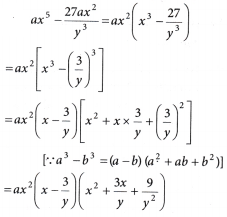
Assertion (A): The factorisation of ax5 – \(\frac{27 a x^2}{y^3}\) is ax2 \(\left(x-\frac{3}{y}\right)\left(x^2+\frac{3 x}{y}+\frac{9}{y^2}\right)\)
Reason(R): a3 – b3 = (a + b)(a2 + ab + b2)
(a) Both A and R are true, and R is the correct explanation of A.
(b) Both A and R are true, but R is not the correct explanation of A.
(c) A is true but R is false.
(d) A is false but R is true.
Answer:
(c) A is true but R is false.
Explanation:
We have,
Question 5.
Assertion (A): For a, b > 0, the area represented by (a + b)2 is greater than the area represented by a2 + b2.
Reason (R): (a + b)2 = a2 + 2ab + b2 where 2ab is the combined area of two rectangles.
(A) Both (A) and (R) are true, and (R) is the correct explanation of (A).
(B) Both (A) and (R) are true, but (R) is not the correct explanation of (A).
(C) (A) is true, but (R) is false.
(D) (A) is false, but (R) is true.
Answer:
(A) Both (A) and (R) are true, and (R) is the correct explanation of (A).
Explanation:
Since (a + b)2 = a2 + 2ab + b2 and a, b > 0, the term 2ab is positive.
∴ (a + b)2 > a2 + b2
Question 6.
Assertion (A): x2 + 18x + 81 can be factorised as (x + 9)2.
Reason (R): An algebraic expression of the form a2 + 2ab + b2 is the expanded form of (a + b)2.
(A) Both (A) and (R) are true, and (R) is the correct explanation of (A).
(B) Both (A) and (R) are true, but (R) is not the correct explanation of (A).
(C) (A) is true, but (R) is false.
(D) (A) is false, but (R) is true.
Answer:
(A) Both (A) and (R) are true, and (R) is the correct explanation of (A).
Explanation:
x2 + 9x + 81 = x2 + 2(x)(9) + 92 = (x + 9)2
Question 7.
Assertion (A): In the expansion of (5x – 2y + 3z)2, the coefficient of xy is -10.
Reason (R): In (a + b + c)2, cross terms appear as 2ab, 2bc, and 2ca, depending on the pairs of terms selected, with signs taken from the original expression.
(A) Both (A) and (R) are true, and (R) is the correct explanation of (A).
(B) Both (A) and (R) are true, but (R) is not the correct explanation of (A).
(C) (A) is true, but (R) is false.
(D) (A) is false, but (R) is true.
Answer:
(D) (A) is false, but (R) is true.
Explanation:
2(5x)(-2y) = -20xy
∴ coefficient of xy = -20.
Question 8.
Assertion (A): Sapna bought 607 frying pans for her business, each costing ₹593 due to bulk purchase. The shopkeeper gave her a total bill of ₹359,951 using a calculator.
Reason (R): (a + b)(a – b) = a2 – b2
(A) Both (A) and (R) are true, and (R) is the correct explanation of (A).
(B) Both (A) and (R) are true, but (R) is not the correct explanation of (A).
(C) (A) is true, but (R) is false.
(D) (A) is false, but (R) is true.
Answer:
(B) Both (A) and (R) are true, but (R) is not the correct explanation of (A).
Explanation:
Total bill amount = Number of frying pans × Cost of each frying pan
= 607 × 593
= (600 + 7)(600 – 7)
= (600)2 – (7)2 [∵ (a + b)(a – b) = a2 – b2]
= 360000 – 49
= ₹ 359,951
Question 9.
Assertion (A): The side of the cube whose volume is 8a3 – b3 – 12a2b + 6ab2 cubic units is (2a – b) units.
Reason (R): (a – b)3 = a3 – 3ab2 + 3a2b – b3
(A) Both (A) and (R) are true, and (R) is the correct explanation of (A).
(B) Both (A) and (R) are true, but (R) is not the correct explanation of (A).
(C) (A) is true, but (R) is false.
(D) (A) is false, but (R) is true.
Answer:
(C) (A) is true, but (R) is false.
Explanation:
8a3 – b3 – 12a2b + 6ab2 = (2a)3 – b3 – 3(2a)2(b) + 3(2a)(b2) = (2a – b)3
[∵ (A – B)3 = A3 – 3A2B + 3AB2 – B3]
∴ Side of the cube is (2a – b) units.
Question 10.
Assertion (A): The side of the cube whose volume is 64a3 – 27b3 – 144a2b + 108ab2 cubic units is (4a – 3b) units.
Reason (R): (a – b)3 = a3 – 3ab2 + 3a2b – b3
(A) Both (A) and (R) are true, and (R) is the correct explanation of (A).
(B) Both (A) and (R) are true, but (R) is not the correct explanation of (A).
(C) (A) is true, but (R) is false.
(D) (A) is false, but (R) is true.
Answer:
(C) (A) is true, but (R) is false.