Get the simplified Extra Questions for Class 9 Maths and Ganita Manjari Class 9 Maths Chapter 2 Introduction to Linear Polynomials Extra Questions with complete explanation.
Class 9 Introduction to Linear Polynomials Extra Questions
Extra Questions on Introduction to Linear Polynomials Class 9
Class 9 Ganita Manjari Chapter 2 Extra Questions
Question 1.
Is 3x2 + 2x + 1 a polynomial?
Solution:
Yes. All powers are non-negative integers.
Question 2.
Find the constant term of 4x2 – 3x + 9.
Solution:
Here, 9 is the independent variable.

Question 3.
Write the standard form of a linear polynomial.
Solution:
The standard form of a linear polynomial is y = ax + b.
Introduction to Linear Polynomials Class 9 Very Short Question Answer
Question 1.
What is the degree of the constant polynomial 5?
Solution:
The degree of the constant polynomial is 0.
Question 2.
Write 2x = -9 in the form of an equation in two variables.
Solution:
Given, 2x = -9
⇒ 2x + 9 = 0
⇒ 2x + 0.y + 9 = 0
Question 3.
Write 5y = 3 in the form ax + by + c = 0.
Solution:
Given, 5y = 3
⇒ 5y – 3 = 0
⇒ 0.x + 5.y – 3 = 0
Question 4.
Does the graph of y = 0 lie along the X-axis or the Y-axis?
Solution:
The graph of y = 0 lies along the X-axis.
Introduction to Linear Polynomials Class 9 Short Question Answer
Question 1.
Find the coefficient of x2 in (x2 + 4x) (x + \(\frac {1}{x}\)).
Solution:
We have, (x2 + 4x)(x + \(\frac {1}{x}\))
= \(x^2 \cdot x+x^2 \cdot \frac{1}{x}+4 x \cdot x+4 x \cdot \frac{1}{x}\)
= x3 + x + 4x2 + 4
So, the coefficient of x2 is 4.
Question 2.
For what value of m, the expression \(x^{(m+1)}+4 x\) will be a quadratic polynomial?
Solution:
We have, \(x^{(m+1)}+4 x\)
For a quadratic polynomial, the highest power of x = 2.
So, m + 1 = 2
⇒ m = 1
Question 3.
Observe the following table.

Find the change in y. Also, find the expression of the polynomial.
Solution:
Observe the change in y
When x = 1, y = 5 = 3 × 1 + 2
When x = 2, y = 8 = 3 × 2 + 2 [8 – 5 = 3]
When x = 3, y = 11 = 3 × 3 + 2 [11 – 8 = 3]
Here, the value of y increases by 3.
So, the linear polynomial is p(x) = 3x + 2.
Question 4.
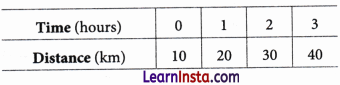
The distance travelled by a car over time is given below. Find whether the pattern is linear or not.
Solution:
Difference in distance,
20 – 10 = 10, 30 – 20 = 10, 40 – 30 = 10
Since the change is constant, the pattern is linear.
Question 5.
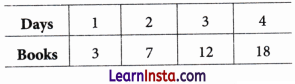
The number of books a student reads over days is given below. Check whether the pattern is linear.
Solution:
Differences,
7 – 3 = 4, 12 – 7 = 5, 18 – 12 = 6
Since the difference is not constant, the pattern is not linear.
Question 6.
Give the equations of two lines passing through (2, 10). How many more such lines are there and why?
Solution:
5x – y = 0 and x + y = 12, infinitely many lines.
Question 7.
Find the equation of the line passing through (2, 4) and making an intercept of 3 on the Y-axis.
Solution:
Given, c = 3
y = mx + 3
∴ 4 = 2m + 3
⇒ 2m = 1
⇒ m = \(\frac {1}{2}\)
y = \(\frac {1}{2}\)x + 3
⇒ 2y = x + 6
⇒ -x + 2y – 6 = 0
⇒ x – 2y + 6 = 0
Question 8.
Find the slope and y-intercept of the line \(\frac{x}{3}+\frac{y}{6}=1\).
Solution:
Given \(\frac{x}{3}+\frac{y}{6}=1\)
On multiplying both sides by 6, we get
2x + y = 6
⇒ y = -2x + 6
On comparing with y = mx + c, we get
m = -2, c = 6
Question 9.
A savings account initially has ₹ 500. Every month, ₹ 200 is deposited. Form a linear polynomial for the total savings after x months.
Solution:
Given, initial amount = 500
and rate of increase = 200 per month
y = 200x + 500
Hence, the required linear polynomial is 200x + 500.
Introduction to Linear Polynomials Class 9 Long Question Answer
Question 1.
Determine which of the following are polynomials. Also, state the reason.
(i) 3x2 – 5x + 7
(ii) √x + 2x
(iii) \(\frac{x^3+2 x}{x}\)
(iv) \(5 x^3-\frac{1}{x}\)
Solution:
(i) 3x2 – 5x + 7
All powers of x are non-negative integers.
Hence, it is a polynomial.
(ii) \(\sqrt{x}+2 x=x^{\frac{1}{2}}+2 x\)
Power is fractional.
Hence, it is not a polynomial.
(iii) \(\frac{x^3+2 x}{x}=x^2+2\)
All powers are non-negative integers.
Hence, it is a polynomial.
(iv) \(5 x^3-\frac{1}{x}=5 x^3-x^{-1}\)
All powers of x are not non-negative integers.
Hence, it is not a polynomial.
Question 2.
Classify the following polynomials based on the number of terms and degree.
(i) 5x2
(ii) 3x + 2
(iii) x2 + 3x + 1
Solution:
(i) 5x2
Number of terms = 1 → Monomial
Degree = 2 → Quadratic
(ii) 3x + 2
Number of terms = 2 → Binomial
Degree = 1 → Linear
(iii) x2 + 3x + 1
Number of terms = 3 → Trinomial
Degree = 2 → Quadratic
Question 3.
The temperature of a chemical solution in a laboratory is recorded at regular time intervals. Initially, at time t = 0 min, the temperature is 15°C. After that, the temperature increases uniformly every minute. The observations are recorded as follows.
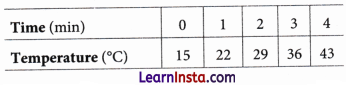
Based on the above information, answer the following.
(i) Find the change in temperature per minute.
(ii) Check whether the pattern is linear or not. Give a reason.
(iii) Form a linear polynomial representing the temperature after x minutes.
(iv) Find the temperature after 10 min.
Solution:
(i) Change in temperature
22 – 15 = 7, 29 – 22 = 7, 36 – 29 = 7
Hence, the temperature increases 7 °C per min.
(ii) Since the temperature change is constant, the pattern is linear.
(iii) Given, initial temperature = 15
and rate of increase = 7
∴ y = 7x + 15
(iv) At x = 10
y = 7(10) + 15
= 70 + 15
= 85
∴ Temperature after 10 min = 85°C
Question 4.
Draw the graphs of the linear equations y = x and y = 2x on the same Cartesian plane. What are your observations in these graphs?
Solution:
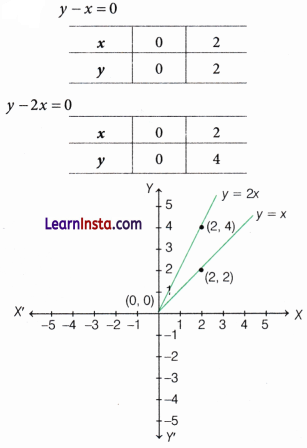
Clearly, both lines are passing through the origin.
Introduction to Linear Polynomials Class 9 Case Based Questions
Question 1.
A farmer grows crops and donates part of his harvest. He produces x2 kg of wheat and 3x kg of rice.
On the above information, answer the following questions.
(i) Find the total quantity of crops.
(ii) Find the degree of the expression.
(iii) (a) Identify whether it is a polynomial or not.
Or
(b) Find the coefficient of x.
Solution:
Given, quantity of wheat = x2 kg
and quantity of rice = 3x kg
(i) Total quantity of crops = Quantity of wheat + Quantity of rice = x2 + 3x
(ii) The highest power of x in x2 + 3x is 2.
Hence, degree = 2
(iii) (a) The expression x2 + 3x has non-negative integer powers of x and finite terms.
Hence, it is a polynomial (specifically, a quadratic polynomial).
Or
(b) In the expression x2 + 3x, the coefficient of x is 3.
Hence, the coefficient of x = 3.
Question 2.
Education plays a vital role in shaping a better future. A teacher observes a pattern in arranging chairs in rows for a school function. In the first row, there are x chairs. In each next row, the number of chairs increases by 2. Thus, the second row has (x + 2) chairs, and the third row has (x + 4) chairs.
On the above information, answer the following questions.
(i) Find the equation of the total number of chairs in three rows.
(ii) Write the type of obtained polynomial from part (i) based on terms.
(iii) (a) Find the degree of the expression, the total number of chairs.
Or
(b) Find the coefficient of x in the expression for the total number of chairs.
Solution:
(i) Given, Row 1 = x chairs,
Row 2 = x + 2 chairs
and Row 3 = x + 4 chairs.
Now, total number of chairs = x + (x + 2) + (x + 4) = 3x + 6
(ii) Binomial polynomial
(iii) (a) The degree of the obtained polynomial is 1.
So, the degree of the expression of the total number of chairs is 1.
Or
(b) The coefficient of x in the expression of the total chair is 3.
Question 3.
A cab service charges a fixed base fare and an additional charge per kilometre travelled. A passenger observes that for a journey of 8 km, the total fare is ₹ 200. For a journey of 12 km, the total fare is ₹ 280. The total fare depends on the distance travelled x, according to the relation y = ax + b.
(i) Find the value of a.
(ii) Find the value of b.
(iii) (a) Find the total fare for a journey of 15 km.
Or
(b) Find the distance travelled if the total fare is ₹ 320.
Solution:
Given, relation y = ax + b
When, x = 8 and y = 200
200 = 8a + b …..(i)
When, x = 12 and y = 280
280 = 12a + b ……(ii)
On subtracting Eq. (i) from Eq. (ii), we get
280 – 200 = 12a + b – (8a + b)
⇒ 80 = 4a
⇒ a = 20
On substituting a = 20 in Eq. (i), we get
200 = 8(20) + b
⇒ 200 = 160 + b
⇒ b = 40
(i) a = 20
(ii) b = 40
(iii) (a) for x = 15,
y = 20(15) + 40
= 300 + 40
= 340
Total fare = ₹ 340
Or
(b) For y = 320,
320 = 20x + 40
⇒ 280 = 20x
⇒ x = 14
Distance travelled = 14 km
Question 4.
Social awareness campaigns help improve society. A student records the relation between the number of hours studied x, and the marks obtained y. The relation is given by y = 2x + 3.
On the above information, answer the following questions.
(i) Find one ordered pair satisfying the equation.
(ii) Represent the equation graphically.
(iii) (a) Identify the type of graph obtained.
Or
(b) Find the y-intercept of the graph.
Solution:
Given,
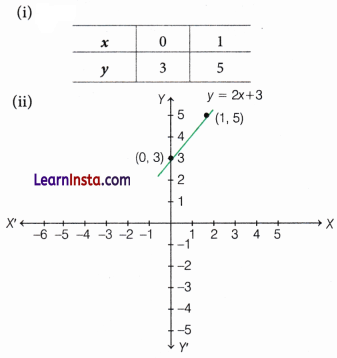
(iii) (a) The graph obtained is linear.
(b) We have, y = 2x + 3
Here, the y-intercept is 3.