Students can refer to the NCERT Class 9 Advanced Maths Solutions and Chapter 6 Exploring Some More Progressions Extra Questions and Answers whenever they need help with difficult questions.
Class 9 Exploring Some More Progressions Extra Questions
Exploring Some More Progressions Class 9 Short Question Answer
Question 1.
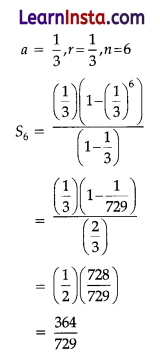
Find the sum of the GP: \(\frac{1}{3}\) + \(\frac{1}{9}\) + \(\frac{1}{27}\) … to 6 terms.
Concept Applied: Sum of n terms of GP:
Sn = \(\frac{a\left(1-r^n\right)}{1-r}\) for |r| < 1
Solution:
Here, we have-
Question 2.
In a GP with first term 2 and common ratio 3, the sum of the first n terms exceeds 700. Find the minimum value of n.
Solution:
∵ Sn = \(\frac{2\left(3^n-1\right)}{3-1}\) = (3n – 1)
Setting Sn > 700:
3n – 1 > 700
3n > 701
Testing 35 = 243 (not > 701)
36 = 729 > 701
∴ Minimum value of n = 6
Question 3.
Write the formula for sum of first n terms of a GP and use it to find S9 or the GP: 3, -6, 12, -24, …
Solution:
Using the formula:
Sn = \(\frac{a\left(1-r^n\right)}{1-r}\) when r ≠ 1
a = 3, r = -2, n = 9
S9 = \(\frac{3\left(1-(-2)^9\right)}{1-(-2)}\)
= \(\frac{3(1+512)}{3}\)
= 513.
Question 4.
If a, b, c are in G.p., then show that a2 + b2, ab + bc, b2 + c2 are also in G.P.
Concept Applied: Property of GP: b2 = ac; proving sequences in GP using algebraic manipulation.
Solution:
Given that, a, b, c are in G.P.
⇒ b2 = ac
⇒ b2 – ac = 0
⇒ (b2 – ac)2 = 0
⇒ b4 + a2c2 – 2b2ac = 0
⇒ a2b2 + b2c2 + 2b2ac = a2b2 + b2c2 + a2c2 + b4
(Adding a2b2 + b2c2 both sides)
⇒ (ab + bc)2 = (a2 + b2)(b2 + c2)
⇒ a2 + b2, ab + bc, b2 + c2 are in G.P.
Question 5.
Find the sum to n terms of the series: 8 + 88 + 888 + 8888 + …
Concept Applied: Rewriting non-standard series using 9 × 1 = (10 – 1) technique; sum of n terms of GP.
Solution:
The given series can be written as
Sn = 8(1 + 11 + 111 + … to n terms)
= (\(\frac{8}{9}\))(9 + 99 + 999 + … to n terms)
= (\(\frac{8}{9}\))[(10 – 1) + (100 – 1) + (1000 – 1) + …]
= (\(\frac{8}{9}\))[(10 + 102 + … + 10n) – n ]
= (\(\frac{8}{9}\)) \(\frac{\left[10\left(10^n-1\right)\right]}{[9-n]}\)
∴ Sn(\(\frac{8}{81}\))[10(10n – 1)] – (\(\frac{8n}{9}\))

Question 6.
The sum of first three terms of a GP is (\(\frac{13}{12}\)) and their product is -1. Find the three terms.
Concept Applied: Use three terms in GP as (\(\frac{a}{r}\)), a, ar; using product and sum conditions.
Solution:
Let the three terms be \(\frac{a}{r}\), a, ar;
According to the given information,
Product of these terms = -1
(\(\frac{a}{r}\))a.ar = -1
⇒ a3 = -1
⇒ a = -1
Sum = \(\frac{a}{r}\) + a + ar = \(\frac{13}{12}\)
– \(\frac{1}{r}\) – 1 – r = \(\frac{13}{12}\)
Multiplying by – r:
⇒ 1 + r + r2 = \(-\frac{13 r}{12}\)
⇒ 12 + 12r + 12r2 = -13r
⇒ 12r2 + 12r + 12 = -13r
⇒ 12r2 + 25r + 12 = 0
⇒ 12r2 + 16r + 9r + 12 = 0
⇒ 4r(3r + 4) + 3(3r + 4) = 0
⇒ (4r + 3)(3r + 4) = 0
⇒ r = –\(\frac{3}{4}\) or r = –\(\frac{4}{3}\)
For a = -1, r = –\(\frac{3}{4}\): terms are \(\frac{4}{3}\), -1, \(\frac{3}{4}\).
For r = –\(\frac{4}{3}\) : terms are \(\frac{3}{4}\), -1, \(\frac{4}{3}\).
Question 7.
Find the least value of n for which 1 + 3 + 32 + … + 3n – 1 > 1000
Solution:
We have,
1 + 3 + 32 + …. + 3n – 1 > 1000
⇒ 30 + 31 + 32 + … + 3n – 1 > 1000
⇒ \(\frac{3^n-1}{3-1}\) > 1000
⇒ 3n – 1 > 2000
⇒ 3n > 2001
Least value of n, which satisfies this inequality is n = 7 (∵ 37 = 2187)
Hence, least value of n = 7.
Question 8.
The sum of first three terms of a G.P. is 15 and sum of next three terms is 120. Find the sum of first n terms.
Concept Applied: Sum of GP; using ratio of consecutive group sums to find r
Solution:
Let the G.P be
a, ar, ar2, ar3, …
According to the given condition,
⇒ a + ar + ar2 = 15
⇒ ar3 + ar4 + ar5 = 120
⇒ a(1 + r + r2) = 15 …….. (i)
⇒ and ar3(1 + r + r2) = 120 ……. (ii)
Dividing Eq. (ii) by Eq. (i), we obtain
\(\frac{a r^3\left(1+r+r^2\right)}{a\left(1+r+r^2\right)}\) = \(\frac{120}{15}\)
⇒ r3 = 8
∴ r = 2
Substituting r = 2 in Eq. (i), we get
a(1 + 2 + 4) = 15
∴ a = \(\frac{15}{7}\)
Now, Sn = \(\frac{a\left(r^n-1\right)}{r-1}\) [∵ r > 1]
Sn = \(\frac{15}{7}\).\(\frac{2^n-1}{2-1}\)
= \(\frac{15\left(2^n-1\right)}{7}\)
Question 9.
If in a G.P., a3 + a5 = 90 and if r = 2, find first term of the G.P.
Solution:
Let a be the first term of the G.P
Given, r = 2 and
a3 + a5 = 90
⇒ ar2 + ar4 = 90
⇒ a(2)2 + a(2)4 = 90
⇒ 4a + 16a = 90
⇒ 20a = 90
⇒ a = \(\frac{9}{2}\)
Hence, the first term of the GP is \(\frac{9}{2}\).
Question 10.
An infinite GP has first term ‘a’ and sum S. Show that the common ratio r = 1 – \(\frac{a}{s}\). Find r if a = 5 and S = 25.
Solution:
S = \(\frac{a}{1 – r}\)
1 – r = \(\frac{a}{S}\)
r = 1 – \(\frac{a}{S}\)[Shown]
If a = 5, S = 25:
∴ r = 1 – \(\frac{5}{25}\)
= 1 – \(\frac{1}{5}\) = \(\frac{4}{5}\)
Question 11.
If a, b, c, d are in G.P., prove that an + bn, bn + cn, cn + dn are in G.P.
Concept Applied: GP property: b = ar, c = ar2, d = ar3; algebraic proof using GP definition
Solution:
∵ a, b, c, d are in G.P
⇒ b = ar, c = ar2, d = ar3 …….. (i)
Now, we are to prove
an + bn, bn + cn, cn + dn are in G.P
⇒ (bn + cn)2 = (an + bn)(cn + dn)
Now, taking RHS
RHS = (an + bn)(cn + dn)
= [an + anrn] × [anr2n + anr3n] [from Eq. (i)]
= an(1 + rn) anr2n (1 + rn)
= a2nr2n(1 + rn)2
= [anrn(1 + rn)]2
= [anrn + anr2n]2
= [(ar)n + (ar2)n]2
= [bn + cn]2 [from Eq. (i)]
= LHS
∴ LHS = RHS
Question 12.
If A = 1 + ra + r2a + … = ∞ then express r in terms of a and A.
Concept Applied: Infinite GP sum with fractional exponent; algebraic rearrangement
Solution:
Given series is in G.P with common ratio ra
Sum of infinite terms of G.P. = \(\frac{x}{1 – r}\)
⇒ A = \(\frac{1}{1-r^a}\)[x = 1]
⇒ A(1 – ra) = 1
⇒ A – Ara = 1
⇒ A – 1 = Ara
⇒ ra = \(\frac{A-1}{A}\)
⇒ r = \(\left(\frac{A-1}{A}\right)^{\frac{1}{a}}\)
Question 13.
Find the sum of the series 1 + (1 + x) + (1 + x + x2) + (1 + x + x2 + x3) + ……….
Concept Applied: Infinite GP; multiplying through by (1 – x) to telescope terms; separating GP from linear terms
Solution:
Let
Sn = 1 + (1 + x) + (1 + x + x2) + (1 + x + x2 + x3) + … to n terms
Hence,
(1 – x)Sn = (1 – x) + (1 – x)(1 + x) + (1 – x)(1 + x + x2) + (1 – x)(1 + x + x2 + x3) + … to n terms
or
(1 – x)Sn = (1 – x) + (1 – x2) + (1 – x3) + (1 – x4) + … to n terms
= n – (x + x2 + x3 + x4 + …) to n terms
= n – \(\frac{x\left(1-x^n\right)}{1-x}\)
Hence,
Sn = \(\frac{n}{ 1 – x}\) – \(\frac{x\left(1-x^n\right)}{(1-x)^2}\)
Question 14.
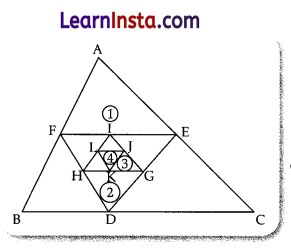
A side of an equilateral triangle is 20 cm long. A second equilateral triangle is inscribed in it by joining the midpoints of the sides of the first triangle. The process is continued as shown in the given diagram. Find the perimeter of the sixth equilateral triangle.
Solution:
Side of equilateral ΔABC = 20 cm. By joining the midpoints of this triangle, we get another equilateral triangle of side equal to half of the length of side of ΔABC.
Continuing in this way, we get a set of equilateral triangles with side equal to half of the side of the previous triangle.
∴ Perimeter of first triangle = 20 × 3 = 60 cm
Perimeter of second triangle = 10 × 3 = 30 cm
Perimeter of third triangle = 5 × 3 = 15 cm
Now, the series will be 60, 30, 15, …
Here, a = 60
∴ r = \(\frac{30}{60}\) = \(\frac{1}{2}\) [∵ \(\frac{second term}{first term}\) ]
Then, the perimeter of the sixth equilateral triangle = a6 = ar6 – 1 [∵ an = an – 1]
= 60 × (\(\frac{1}{2}\))5 = \(\frac{60}{32}\) = \(\frac{15}{8}\) cm
Question 15.
Find the nth term of the sequence 5, 9, 15, 23, 33, …
Concept Applied: Method of Differences: b, a, d identification; nth term formula
Solution:
The given sequence can be written as
1st differences: 4, 6, 8, 10, …
2nd differences: 2, 2, 2 (AP with a = 4, d = 2)
b = 5, a = 4, d = 2
tn is given by-
tn = b + a(n – 1) + \(\frac{d(n-1)(n-2)}{2}\)
= 5 + 4(n – 1) + \(\frac{2(n-1)(n-2)}{2}\)
= 5 + 4n – 4 + (n – 1 )(n – 2)
= 1 + 4n + n2 – 3n + 2
= n2 + n + 3
Hence, nth term of the given sequence is n2 + n + 3.
Question 16.
Find the sum of first 6 terms of the sequence 2, 6, 12, 20, 30, 42,…
Solution:
The given sequence can be written as
1st differences: 4, 6, 8, 10, 12,…
2nd differences: 2, 2, 2, 2
⇒ a = 4, d = 2, b = 2
tn = 2 + 4(n – 1) + \(\frac{2(n-1)(n-2)}{2}\)
= 2 + 4n – 4 + (n2 – 3n + 2)
= n2 + n
S6 = Σn(n + 1) for n = 1 to 6
= Σ(n2 + n) = \(\frac{6(7)(13)}{6}\) + \(\frac{6(7)}{2}\)
= 91 + 21 = 112
Hence, sum of first 6 terms = 112.
Question 17.
Find the nth term and the sum of first n terms of the sequence 1, 9, 25, 49, 81, …
Concept Applied: Method of Differences; identifying (2n – 1)2 pattern; Sn using Σ(2n – 1)2
Solution:
The given sequence is the squares of odd numbers.
Row differences:
| Row | Terms |
| Given | 1, 9, 25, 49, 81, … |
| 1st differences | 8, 16, 24, 32, … |
| 2nd differences | 8, 8, 8,… (constant) |
So, b = 1, a = 8, d = 8
Find nth term:
tn = b.C(n – 1, 0) + a.C(n – 1,1).+ d.C(n -1, 2)
tn = 1(1) + 8(n -1) + 8.\(\frac{(n-1)(n-2)}{2}\)
tn = 1 + 8n – 8 + 4(n – 1)(n – 2)
tn = 1 + 8n – 8 + 4(n2 – 3n + 2)
tn = 1 + 8n – 8 + 4n2 – 12n + 8
tn = 4n2 – 4n + 1 = (2n – 1)2
(These are squares of odd numbers: 12, 32, 52, 72, …)
Find Sn:
Sn = b.C(n, 1) + a.C(n, 2) + d.C(n, 3)
= 1.n + 8.\(\frac{n(n-1)(n-2)}{2}\) + 8.\(\frac{n(n – 1)(n – 2)}{6}\)
= n + 4n(n – 1) + \(\frac{4n(n – 1)(n – 2)}{3}\)
= n[1 + 4(n – 1) + \(\frac{4(n – 1)(n – 2)}{3}\)
= \(\frac{n}{3}\)[3 + 12(n – 1) + 4(n – 1 )(n – 2)]
= \(\frac{n}{3}\)[3 + 12n – 12 + 4n2 – 12n + 8]
Sn = \(\frac{n\left(4 n^2-1\right)}{3}\) = \(\frac{n(2 n-1)(2 n+1)}{3}\)
Question 18.
Find the nth term of the sequence 3, 12, 29, 54, 87,… and hence find its sum to n terms.
Solution:
The given sequence is 3, 12, 29, 54, 87, …
Row differences:
| Row | Terms |
| Given | 3, 12, 29, 54, 87,… |
| 1st differences | 9, 17, 25, 33, … |
| 2nd differences | 8, 8, 8,… (constant) |
So, b = 3, a = 9, d = 8
Find nth term:
tn = b.C(n – 1, 0) + a.C(n – 1, 1) + d.C(n – (n – 1, 2)
tn = 3(1) + 9(n -1) + 8.\(\frac{(n – 1)(n – 2)}{2}\)
tn = 3 + 9n – 9 + 4(n – 1)(n – 2)
tn = 3 + 9n – 9 + 4(n2 – 3n + 2)
tn = 3 + 9n – 9 + 4n2 – 12n + 8
tn = 4n2 – 3n + 2
Find Sn:
Sn = b.C(n, 1) + a.C(n, 2) + d.C(n, 3)
= 3.n + 9.\(\frac{n(n – 1)}{2}\) + 8.\(\frac{n(n – 1)(n – 2)}{6}\)
= 3n + \(\frac{9n(n – 1)}{2}\) + \(\frac{4n(n – 1)(n – 2)}{3}\)
Taking (\(\frac{n}{6}\)) common:
= \(\frac{n}{6}\)[18 + 27(n -1) + 8(n – 1)(n – 2)]
= \(\frac{n}{6}\)[18 + 27n – 27 + 8(n2 – 3n + 2)] 6
= \(\frac{n}{6}\)[18 + 27n – 27 + 8n2 – 24n + 16]
= \(\frac{n}{6}\)[8n2 + 3n + 7]
= \(\frac{n}{6}\)(8n2 + 3n + 7)
Sn = \(\frac{n\left(8 n^2+3 n+7\right)}{6}\)
Question 19.
The seats in rows of an auditorium are arranged as follows: Row 1 has 10 seats, Row 2 has 13 seats, Row 3 has 18 seats, Row 4 has 25 seats and so on. Find the number of seats in the nth row and the total seats in the first 8 rows.
Solution:
The sequence of seats is given by 10, 13, 18, 25, …
Row differences:
| Row | Terms |
| Given | 10, 13, 18, 25, … |
| 1st differences | 3, 5, 7, … |
| 2nd differences | 2, 2, … (constant) |
So, b = 10, a = 3, d = 2
Find nth term (seats in nth row):
tn = b.C(n – 1, 0) + a.C(n – 1, 1) + d.C(n – 1, 2)
tn = 10(1) + 3(n – 1) + 2.\(\frac{(n – 1)(n – 2)}{2}\)
tn = 10 + 3n – 3 + (n – 1)(n – 2)
tn = 10 + 3n – 3 + n2 – 3n + 2
tn= n2 + 9
Hence, there are n2 + 9 seats in nth row.
Find total seats in first 8 rows (S8):
Sn = b.C(n, 1) + a.C(n, 2) + d.C(n, 3)
= 10.n + 3.\(\frac{n(n – 1)}{2}\) + 2.\(\frac{n(n – 1)(n – 2)}{6}\)
= 10n + \(\frac{3n(n – 1)}{2}\) + \(\frac{n(n – 1)(n – 2)}{3}\)
Taking (\(\frac{n}{6}\)) common:
= \(\frac{n}{6}\)[60 + 9(n – 1) + 2(n – 1)(n – 2)]
= \(\frac{n}{6}\)[60 + 9n – 9 + 2(n2 – 3n + 2)]
= \(\frac{n}{6}\)[60 + 9n – 9 + 2n2 – 6n + 4]
= \(\frac{n}{6}\)[2n2 + 3n + 55]
Sn = \(\frac{n\left(2 n^2+3 n+55\right)}{6}\)
Substituting n = 8
S8 = \(\frac{8(2 \times 64+3 \times 8+55)}{6}\)
= \(\frac{8(128 + 24 + 55)}{6}\)
= 8 × \(\frac{207}{6}\)
= \(\frac{1656}{6}\)
S8 = 276 seats
Question 20.
A mobile app had 500 downloads in January. Downloads doubled every month. Find:
(i) total downloads in the first 6 months and
(ii) downloads in the 6th month.
Solution:
GP: a = 500, r = 2, n = 6
(i) ∵ r > 1,
S6 = \(\frac{a\left(r^n-1\right)}{r-1}\)
= \(\frac{500\left(2^6-1\right)}{2-1}\)
= 500 × (64 – 1)
= 500 × 63 = 31,500
(ii) t6 = ar5
= 500 × 25
= 500 × 32 = 16,000
∴Total downloads in 6 months = 31,500; Downloads in 6th month = 16,000
Question 21.
The sum of first three terms of a GP is 13 and their product is 27. Find the three terms.
Solution:
Let the three terms be \(\frac{a}{r}\), a, ar.
Product: (\(\frac{a}{r}\)) × a × (ar) = a3 = 27
⇒ a = 3
Sum: \(\frac{a}{r}\) + a + ar = 13
⇒ \(\frac{3}{r}\) + 3 + 3r = 13
⇒ \(\frac{3}{r}\) + 3r = 10
⇒ 3r2 – 10r + 3 = 0
⇒ (3r – 1)(r – 3) =0
⇒ r = \(\frac{1}{3}\) or r = 3
When r = 3: terms are 1, 3, 9.
When r = \(\frac{1}{3}\): terms are 9, 3, 1.
The three terms are 1, 3, 9 (or 9, 3, 1).
Question 22.
The sum of first n terms of a GP (3, 9, 27,…) is 1092. Find the number of terms n.
Solution:
a = 3, r = 3 (r > 1), Sn = 1092
Sn = \(\frac{a\left(r^n-1\right)}{r-1}\)
= \(\frac{3\left(3^n-1\right)}{3-1}\)
= \(\frac{3\left(3^n-1\right)}{2}\) = 1092
⇒ 3(3n – 1) = 2184
⇒ 3n – 1 = 728
⇒ 3n = 729 = 36
∴ n = 6
Question 23.
The 3rd term of a GP is 24 and the 6th term is 192. Find the first term and the common ratio.
Solution:
t3 = ar2 = 24 ………… (i)
t6 = ar5 = 192 ……….. (ii)
Dividing Eq. (ii) by Eq. (i):
r3 = \(\frac{192}{24}\) = 8
⇒ r = 2
From Eq. (i):
a × 4 = 24 ⇒ a = 6
First term a = 6, Common ratio r = 2
Question 24.
The midpoints of the sides of an equilateral triangle of side 12 cm are joined to form a smaller triangle. This process is repeated indefinitely. Find the sum of areas of all the triangles so formed.
Solution:
Area of equilateral triangle with side a = (\(\frac{\sqrt{3}}{4}\))a2
Side of 1st triangle = 12 cm
Area = (\(\frac{\sqrt{3}}{4}\))(144) = 36√3 cm2
Side of 2nd triangle = 6 cm (midpoints halve the side)
Area of 2nd triangle = (\(\frac{\sqrt{3}}{4}\))(36) = 9√3 cm2
Ratio of areas: r = \(\frac{9 \sqrt{3}}{36 \sqrt{3}}\) = \(\frac{1}{4}\)
Sum of all areas: S∞ = \(\frac{36 \sqrt{3}}{1-\frac{1}{4}}\) = \(\frac{36 \sqrt{3}}{\frac{3}{4}}\)
= 48√3 cm2
Sum of areas of all triangles = 48√3 cm2
Question 25.
A science experiment tracks the growth of bacteria. There are 100 bacteria at the start. The count triples every hour.
(i) How many bacteria are there after 5 hours?
(ii) What is the total count from starting to the 5th hour combined?
(iii) In which hour will the count first exceed 7,000?
Solution:
Here, bacteria form a GP: a = 100, r = 3
(i) Count after 5 hours = t6 = ar5 = 100 × 35
= 100 × 243 = 24,300 bacteria
(ii) S6 = \(\frac{a\left(r^6-1\right)}{r-1}\) = \(\frac{100(729 – 1}{3 – 1}\)
= 100 × \(\frac{728}{2}\) = 36,400
(iii) tn = 100 × 3n – 1 > 7000
⇒ 3n – 1 > 70
31 = 3, 32 = 9, 33 = 27, 34 = 81 > 70
⇒ n – 1 = 4
⇒ n = 5
Hence, t the starting of 5th hour the number of bacteria will first cross 7,000.
Exploring Some More Progressions Class 9 Long Question Answer
Question 1.
A city’s annual electricity consumption (in million units) for 6 consecutive years was recorded as: 10, 20, 40, 80, 160, 320.
(i) Identify the type of progression and find the common ratio.
(ii) Write the formula for S„ and find total consumption over 6 years.
(iii) In how many years will the cumulative consumption first exceed 5000 million units?
Solution:
(i) The sequence 10, 20, 40, 80, 160, 320 is a GP.
r = \(\frac{20}{10}\) = 2
(ii) Sn = \(\frac{a\left(r^n-1\right)}{r-1}\)
Sn = \(\frac{10\left(2^6-1\right)}{2-1}\)
= 10 × 63 = 630 million units.
(iii) Sn = 10(2n – 1) > 5000, Dividing by 10
⇒ 2n – 1 > 500
⇒ 2n > 501
⇒ 28 = 256 < 501;
∴ 29 = 512 > 501.
Therefore n = 9 years.
In 9 years, cumulative consumption exceeds 5000 million units.
Question 2.
The lengths of three unequal edges of a rectangular solid block are in G.P. The volume of the block is 216 cm3. and the total surface area is 252 cm2. Find the length of the longest edge.
Solution:
Let length, breadth and height of a rectangular block be
\(\frac{a}{r}\), a, ar
[As the given length, breadth and height are in G.P]
Volume = length × breadth × height
216 = \(\frac{a}{r}\) × a × ar
⇒ a3 = 216
⇒ a = 6
Now, total surface area = 2 [length × breadth + breadth × height + length × height]
252 = 2[\(\frac{a}{r}\).a + a.ar + \(\frac{a}{r}\).ar]
⇒ 252 = 2a2 [\(\frac{1}{r}\) + r + 1]
⇒ 252 = 2(6)2(\(\frac{1+r^2+r}{r}\))
⇒ 252 = 72(\(\frac{1+r^2+r}{r}\))
⇒ \(\frac{252}{72}\) = \(\frac{1+r^2+r}{r}\)
⇒ 2 + 2r + 2r2 = 7r
⇒ 2r2 – 5r + 2 = 0
⇒ (r – 2)(2r – 1) =0
⇒ r = 2 or r = \(\frac{1}{2}\)
Therefore, edges are 3, 6, 12 when r = 2
and edges are 12, 6, 3 when r = \(\frac{1}{2}\)
Hence, the longest edge is 12 cm.
Question 3.
A square is drawn by joining the midpoints of the sides of a square. A third square is drawn inside the second square in the same way and the process is continued indefinitely. If the side of the first square is 15 cm, then find the sum of the areas of all the squares so formed.
Concept Applied: Area of each new square = half the area of previous; Infinite GP sum with r = \(\frac{1}{2}\)
Solution:
Let A1A2A3A4 be the first square with each side equal to 15 cm. Let B1B2B3B4 be the midpoints of its sides.


Question 4.
The sum of an infinite G.R is 57 and the sum of the cubes of its terms is 9747, find the G.P.
Concept Applied: Setting up two equations using S∞ for original GP and cubed GP; solving for a and r
Solution:
Let the first term of G.P be a and the common ratio be r, where -1 < r < 1
The G.R is a, ar, ar2, …
Therefore, the sum of the infinite terms of the G.P is
\(\frac{a}{1 – r}\) = 57 ……….. (i)
If taking the cube of each terms the new G.E is
a3, a3r3, a3r6…
Therefore, the sum of the cubes is
\(\frac{a^3}{1-r^3}\) = 9747 ………… (ii)
Taking the cube of Eq. (i)
\(\frac{a^3}{(1-r)^3}\) = (57)3
⇒ a3 = (57)3(1 – r)3 ……..(iii)
Substituting the value of a in terms of r in Eq. (ii)

⇒ 19(1 + r2 – 2r) = 1 + r + r2
⇒ 18r2 – 39r + 18 = 0
⇒ 6r2 – 13r + 6 = 0
⇒ 6r2 – 9r – 4r + 6 = 0
⇒ (2r – 3)(3r – 2) = 0
Therefore, r = \(\frac{3}{2}\) or r = \(\frac{2}{3}\)
Since r < 1, r = \(\frac{2}{3}\)
Substitute in Eq. (i), \(\frac{a}{1-\frac{2}{3}}\) = 57
⇒ 3a = 57
⇒ a = \(\frac{57}{3}\) = 19
Thus, the first term of the G.E is 19 and the common ratio is \(\frac{2}{3}\)
The G.P. is
19, \(\frac{38}{3}\), \(\frac{76}{9}\), …
Question 5.
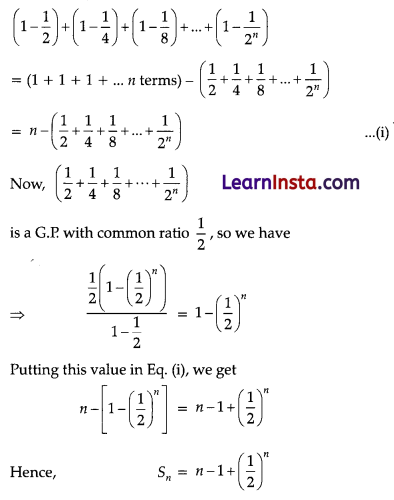
Find the sum of first n terms of the series \(\frac{1}{2}\) + \(\frac{3}{4}\) + \(\frac{7}{8}\) + \(\frac{15}{16}\) + …to n terms.
Solution:
The given sequence is + … to n terms.
\(\frac{1}{2}\) + \(\frac{3}{4}\) + \(\frac{7}{8}\) + \(\frac{15}{16}\) + …to n terms.
We can write each individual as,
⇒ \(\frac{1}{2}\) = 1 – \(\frac{1}{2}\)
⇒ \(\frac{3}{4}\) = 1 – \(\frac{1}{4}\)
⇒ \(\frac{7}{8}\) = 1 – \(\frac{1}{8}\)
and so on till n terms
Now writing each term in its new form, we get,
Question 6.
A city planner is counting trees planted along roads. The number of trees on road sections forms a pattern: 2 trees in section 1, 7 trees in section 2, 16 trees in section 3, 29 trees in section 4, 46 trees in section 5.
(i) Check whether the first differences form an AP.
(ii) Find the nth term (number of trees in section n).
(iii) Find the total trees in first 10 sections.
Solution:
The given sequence can be written as 2, 7, 16, 29, 46
1st differences: 5, 9, 13, 17
2nd differences: 4, 4, 4
(i) 1st differences: 5, 9, 13, 17, … (AP with a = 5, d = 4) YES, they form an AP.
(ii) b = 2, a = 5, d = 4
tn = 2 + 5(n – 1) + \(\frac{4(n – 1)(n – 2)}{2}\)
= 2 + 5n – 5 + 2(n – 1)(n – 2)
= 2 + 5n – 5 + 2(n2 – 3n + 2)
= 2n2 – n + 1
(iii) S10 = Σ(2n2 – n + 1)
= 2 × \(\frac{10(11)(21)}{6}\) – \(\frac{10(11)}{2}\) + 10
= 2 × 385 – 55 + 10
= 770 – 55 + 10
= 725 trees
Question 7.
For the sequence 2, 5, 10, 17, 26, 37, …
(i) Find the nth term using method of differences.
(ii) Find the sum of first n terms.
(iii) Find the sum of first 20 terms.
Concept Applied: Method of Differences; evaluating Sn at n = 20
Solution:
(i) The given sequence can be written as 2, 5, 10, 17, 26, 37,…
1st differences: 3, 5, 7, 9, 11
2nd differences: 2, 2, 2, 2
Here, AP: a = 3, d = 2, b = 2.
tn = 2 + 3(n – 1) + \(\frac{2(n – 1)(n – 2)}{2}\)
= 2 + 3n – 3 + (n2 – 3n + 2)
= n2 + 1


Question 8.
The sum of an infinite GP is 6 and the sum of squares of its terms is 12.
(a) Find the first term and the common ratio.
(b) Hence, find the sum of cubes of all its terms.
Solution:
(a) Let the GP have first term a and common ratio r (|r| < 1).
Given: S∞ = \(\frac{a}{1 – r}\) = 6
The squares form a GP with first term a2 and ratio r2.
Sum of squares: \(\frac{a^2}{1-r^2}\) = 12 ……….. (ii)
Square Eq.(i): \(\frac{a^2}{1-r^2}\) = 36
Divide Eq.(iii) by Eq. (ii):
\(\left[\frac{a^2}{(1-r)^2}\right]\) × \(\left[\frac{1-r^2}{a^2}\right]\) = \(\frac{36}{12}\)
⇒ \(\frac{1-r^2}{(1-r)^2}\) = 3
⇒ \(\frac{(1+r)(1-r)}{(1-r)^2}\) = 3
⇒ \(\frac{1 + r}{ 1 – r}\) = 3
⇒ 1 + r = 3 – 3r
⇒ 4r = 2
⇒ r = \(\frac{1}{2}\)
From Eq.(i): \(\frac{a}{\left(1-\frac{1}{2}\right)}\) = 6
⇒ \(\frac{a}{\left(\frac{1}{2}\right)}\) = 6
⇒ a = 3
(b) Cubes form a GP: first term a3 = 27, ratio r3 = \(\frac{1}{8}\)
Sum of cubes = \(\frac{a^3}{1-r^3}\)
= \(\frac{27}{\left(1-\frac{1}{8}\right)}\)
= \(\frac{27}{\left(\frac{7}{8}\right)}\)
= \(\frac{216}{7}\)
r = \(\frac{1}{2}\), a = 3; Sum of cubes = \(\frac{216}{7}\)
Question 9.
Find the nth term and the sum of the first n terms of the sequence 3, 7,13, 21, 31,… Also evaluate the sum of the first 10 terms.
Solution:
The given sequence is 3, 7, 13, 21, 31, …
1st differences: 4, 6, 8, 10 …
2nd differences: 2, 2, 2
(AP with first term a = 4, d = 2)
First term of sequence: b = 3

= \(\frac{n\left(n^2+3 n+5\right)}{3}\)
S10 = \(\frac{10(100+30+5)}{3}\)
= 10 × \(\frac{135}{3}\) = 10 × 45 = 450
Question 10.
An art teacher designs a wall display using square tiles. The first tile has a side of 32 cm. Each subsequent tile has its midpoints joined to form the next smaller square and this is repeated indefinitely. Find: (a) The side of the 5th tile. (b) The sum of the perimeters of all tiles, (c) The sum of the areas of all tiles.
Solution:
Given: First tile side = 32 cm, r = \(\frac{1}{\sqrt{2}}\)
(a) Side of 5th tile
t5 = ar4
= 32 × (\(\frac{1}{\sqrt{2}}\)) 4
= 32 × \(\frac{1}{4}\) = 8 cm
(b) Sum of perimeters
Sum of perimeters = 4 × S∞ of sides GP

= 32√2(√2 + 1)
= 32(2 + √2)
So, sum of perimeters = 4 × 32(2 + √2)
= 128(2 + √2)
= 128 × 3.414
≈ 437 cm
(c) Sum of areas
Area of 1st tile = 322 = 1024 cm2
Common ratio of areas = (\(\frac{1}{\sqrt{2}}\))2 = \(\frac{1}{2}\)
Since |r| = \(\frac{1}{2}\) < 1
Exploring Some More Progressions Class 9 Case Based Questions
1. Each side of an equilateral triangle is 24 cm. The mid-point of its sides are joined to form another triangle. This process is continuously infinite.
Based on the given information, answer the following questions:
Question 1.
The side of the 5th triangle is (in cm):
(a) 3
(b) 6
(c) 1.5
(d) 0.75
Answer:
Option (c) is correct.
Explanation: The side of first triangle is 24 cm.
Side of second triangle is
24 ÷ 2 = 12 cm
Similarly, side of third triangle is 12 ÷ 2 = 6 cm
Side of fifth triangle is:
a5 = ar4
= 24 × (\(\frac{1}{2}\))4
= 24 × \(\frac{1}{16}\)
= \(\frac{3}{2}\) = 1.5 cm
Question 2.
The sum of perimeter of first 6 triangles is (in cm):
(a) \(\frac{569}{4}\)
(b) \(\frac{567}{4}\)
(c) 120
(d) 144
Answer:
Option (b) is correct.
Explanation: Perimeter of first triangle = 24 × 3 = 72 cm
Perimeter of second triangle is 12 × 3 = 36 cm
⇒ Sum of perimeter of first 6 triangles is

Question 3.
The area of all the triangles is:
(a) 576
(b) 192√3
(c) 144√3
(d) 169√3
Answer:
Option (b) is correct.
Explanation: Area of first triangle is

Question 4.
The sum of perimeter of all triangles is (in cm):
(a) 144
(b) 169
(c) 400
(d) 625
Answer:
Option (a) is correct.
Explanation: Sum of perimeter of all triangles = 3(24 + 12 + 6 + …)
= 3(\(\frac{24}{1-\frac{1}{2}}\)) = 3 × \(\frac{24}{\frac{1}{2}}\)
= 3 × 24 × 2
= 144 cm
Question 5.
Assertion (A): The sum of areas of infinite triangles is \(\frac{a}{1 – r}\)
Reason (R): This formula is used only when |r| < 1.
(a) Both assertion and reason are true and reason is the correct explanation of assertion.
(b) Both assertion and reason are true, but reason is not the correct explanation of assertion.
(c) Assertion is true, but reason is false.
(d) Assertion is false, but reason is true.
Answer:
Option (a) is correct.
Explanation: Areas of triangles form a GE Since each side is halved, each area becomes (\(\frac{1}{2}\))2 = \(\frac{1}{4}\) of the previous.
So, r = \(\frac{1}{4}\) and |r| < 1, hence S∞ = \(\frac{a}{1 – r}\)
Assertion is TRUE.
The formula S∞ = \(\frac{a}{(1 – r)}\) is valid only when |r| < 1, because only then does rn → 0 as n → ∞, allowing the infinite sum to converge.
Reason is TRUE.
Therefore, the reason directly justifies why the formula \(\frac{a}{(1 – r)}\) can be applied to find the sum of infinite triangle areas, since |r| = \(\frac{1}{4}\) < 1.
2. The Bouncing Ball and Shrinking Squares
Aryan is conducting two physics experiments for his school project.
Experiment 1 – Bouncing Ball: Aryan drops a rubber ball from a height of 120 m. The ball bounces back to 2/3 of the height from which it falls each time it hits the ground. Aryan wants to find the total distance the ball travels before it finally comes to rest.
Experiment 2 – Shrinking Squares: Aryan draws a square of side 36 cm on paper. He then joins the midpoints of its sides to form a smaller square inside, then joins the midpoints of that smaller square and continues this process indefinitely.
Question 1.
Identify the type of sequence formed by the heights of successive bounces in Experiment 1. State the first term and the common ratio.
Concept Applied: Identifying GP; first bounce height
= (\(\frac{2}{3}\)) × 120; r = \(\frac{2}{3}\)
Solution:
Each bounce height = (\(\frac{2}{3}\)) × previous height, so the ratio between consecutive terms is constant.
Bounce heights: 120 × (\(\frac{2}{3}\)) = 80 m, 80 × (\(\frac{2}{3}\))
= \(\frac{160}{3}\)m, …
Type: Geometric Progression (GP)
First term: a = 80 m
Common ratio: r = (\(\frac{2}{3}\))
Question 2.
Find the sum of all the heights to which the ball bounces (upward journeys only).
Concept Applied: Infinite GP sum: S∞ = \(\frac{a}{1 – r}\) with a = 80, r = \(\frac{2}{3}\)
Solution:
Since |r| = \(\frac{2}{3}\) < 1, the infinite sum exists.
S∞ = \(\frac{a}{1 – r}\) = \(\frac{80}{\left(1-\frac{2}{3}\right)}\)
= \(\frac{\frac{80}{1}}{\frac{1}{3}}\) = 240 m
Question 3.
Find the total distance (both downward and upward) the ball travels before coming to rest.
Concept Applied: Total distance = initial drop + 2 × (S∞ of all rebound heights)
Solution:
The ball first falls 120 m. After each bounce it travels upward then downward the same height.
Total distance = Initial drop + 2 × (sum of all bounce heights) = 120 + 2 × 240 = 120 + 480 = 600 m
Question 4.
In Experiment 2, write down the areas of the first three squares formed. Show that they form a GP and find the sum of the areas of all infinitely many squares.
Concept Applied: When midpoints of a square of side s are joined, new side = \(\frac{s}{\sqrt{2}}\) area ratio = \(\frac{1}{2}\); S∞ = \(\frac{a}{1 – r}\)
Solution:
When the midpoints of a square of side s are joined, the new side = \(\frac{s}{\sqrt{2}}\)
• Side of 1st square = 36 cm → Area = 362 = 1296 cm2
• Side of 2nd square = \(\frac{36}{\sqrt{2}}\) cm → Area = (\(\frac{36}{\sqrt{2}}\))2 = \(\frac{36^2}{2}\) = 648 cm2
• Side of 3rd square = \(\frac{36}{2}\) = 18 cm → Area = 182
= 324 cm2
Common ratio = \(\frac{648}{1296}\) = \(\frac{324}{648}\)
= \(\frac{1}{2}\)(constant) → GP confirmed.
a = 1296, r = \(\frac{1}{2}\) |r| < 1 → S∞ exists.
S∞ = \(\frac{1296}{\left(1-\frac{1}{2}\right)}\) = 1296 × 2 = 2592 cm2
Question 5.
In Experiment 2, Aryan claims: “If the side of the original square is doubled to 72 cm, the total area of all the squares formed will become exactly 4 times the original total.” Verify his claim with full justification.
Concept Applied: S∞ = \(\frac{(\text { side })^2}{1-r}\); S∞ ∝ (side)2; doubling the side multiplies S∞ by 4
Solution:
For original square (side = 36 cm): S∞ = 2592 cm2 (from above question).
For new square (side = 72 cm): Area of 1st square = 722 = 5184 cm2
The common ratio r = \(\frac{1}{2}\) remains the same (it depends only on the midpoint-joining property, not the side length).
New S∞ = \(\frac{5184}{\left(1-\frac{1}{2}\right)}\) = 5184 × 2 = 10368 cm2
Ratio. \(\frac{\text { New } S_0}{\text { Original } S_0}\) = \(\frac{10368}{2592}\) = 4
Reason: S∞ = \(\frac{a}{1 – r}\) = \(\frac{(\text { side })^2}{1-r}\). Since r is fixed, S∞ ∝ (side)2.
Doubling the side multiplies S∞ by 22 = 4.