Each of our Ganita Manjari Class 9 Worksheet and Class 9 Maths Chapter 3 The World of Numbers Worksheet with Answers focuses on conceptual clarity.
Class 9 The World of Numbers Worksheet
Ganita Manjari Class 9 Chapter 1 Worksheet
Multiple Choice Questions
Question 1.
The value of (-7) × (-4)is
(a) – 28
(b) – 14
(c) 14
(d) 28
Answer:
(d) We have, (- 7) × (- 4)
According to Brahmagupta’s laws, the product of two debts (negative numbers) is a fortune (positive number).
∴ (- 7) × (- 4) = 28
Question 2.
The equation \(\frac{2}{3}\left(x+\frac{3}{5}\right)=\frac{2}{3} x+\frac{2}{5}\) has
(a) exactly one solution
(b) no rational solution
(c) infinitely many rational solutions
(d) Cannot be determined
Answer:
(c) infinitely many rational solutions
Given, \(\frac{2}{3}\left(x+\frac{3}{5}\right)=\frac{2}{3} x+\frac{2}{5}\)
⇒ \(\frac{2}{3} x+\frac{2}{3} \times \frac{3}{5}=\frac{2}{3} x+\frac{2}{5}\)
⇒ \(\frac{2}{3} x+\frac{2}{5}=\frac{2}{3} x+\frac{2}{5}\), which is true for every rational number x.
Hence, given equation has infinitely many rational solutions.
Question 3.
if a = \(\frac{x^2-4}{x(x-2)}\) and b = \(\frac{x+2}{x}\), the value (a-b) is
(a) 1
(b) x + 2
(c) 0
(d) -2
Answer:
(c) 0
Given, a = \(\frac{x^2-4}{x(x-2)}, b=\frac{x+2}{x}\)
Here, x ≠ 0, 2
Now, consider a = \(\frac{x^2-4}{x(x-2)}\)
⇒ a = \(\frac{(x-2)(x+2)}{x(x-2)}\)
⇒ a = \(\frac{x+2}{x}\)
So, a-b = \(\frac{x+2}{x}-\frac{x+2}{x}=\frac{(x+2)-(x+2)}{x}\)
= \(\frac{x+2-x-2}{x}\) = 0
Question 4.
Let S = Q – {0}. For a,b∈S, define a * b = \(\frac{a}{b}\) + b.
Which statement is correct about closure of S under?
(a) S is closed under *, since \(\frac{a}{b}\) + b is rational for all a, b ∈ S.
(b) S is not closed under *, since for some a, b ∈ S, \(\frac{a}{b}\) + b = O ∉ S.
(c) S is closed under * , since * preserves the multiplicative identity.
(d) S is not closed under *, since * is not commutative.
Answer:
(b) S is not closed under *, since for some a, b ∈ S, \(\frac{a}{b}\) + b = O ∉ S.
Given, S = Q – {0}
and a * b = \(\frac{a}{b}\) + b
Consider a = -1, b = 1 where a, b € S.
a * b = \(\frac{-1}{1}\) + 1
⇒ a * b = -1 + 1 = 0
But, 0 ∉ S
Hence, S is not closed under *.

If \(\left(\frac{-7}{12}+x\right) \times\left(\frac{-3}{5}\right)= 0\) and x is rational, then |x| equals
(a) \(\frac{-7}{12}\)
(b) \(\frac{7}{12}\)
(c) \(\frac{5}{7}\)
(d) 0
Answer:
(b) \(\frac{7}{12}\)
Given, \(\left(-\frac{7}{12}+x\right) \times\left(-\frac{3}{5}\right)\) = 0
Since,-\(\frac{3}{5}\) ≠ 0
∴ –\(\frac{7}{12}\) + x = 0
⇒ x = \(\frac{7}{12}\)
So, |x| = |\(\frac{7}{12}\)| = \(\frac{7}{12}\)
Question 6.
The absolute value equation \(\left|x-\frac{3}{4}\right|=\frac{5}{8}\) = represents the distance between two points on the number line. The sum of the possible values of x is
(a) \(\frac{3}{2}\)
(b) \(\frac{5}{4}\)
(c) \(\frac{1}{4}\)
(d) \(\frac{11}{8}\)
Answer:
(a) \(\frac{3}{2}\)
Given, |\(x-\frac{3}{4}\)| = \(\frac{5}{8}\)
⇒ x – \(\frac{3}{4}= \pm \frac{5}{8}\)
So, x = \(\frac{3}{4}+\frac{5}{8}=\frac{11}{8}\)
and x = \(\frac{3}{4}-\frac{5}{8}=\frac{1}{8}\)
So, sum of possible value of x
= \(\frac{11}{8}+\frac{1}{8}=\frac{12}{8}=\frac{3}{2}\)
Question 7.
Exactly how many rational numbers of the form –\(\frac{k}{60}\) are in standard form and lie strictly between \(\frac{-2}{3}\) and \(\frac{-1}{2}\)
(a) 2
(b) 4
(c) 9
(d) 10
Answer:
(a) 2
Given, rational numbers are of the form – \(\frac{k}{60}\)
Also, \(-\frac{2}{3}=-\frac{40}{60},-\frac{1}{2}=-\frac{30}{60}\)
So, \(-\frac{40}{60}<-\frac{k}{60}<-\frac{30}{60}\)
⇒ 30 < K < 40
Here, K = 31, 32,……39
For standard form, k must be co-prime to 60.
∴ k = 31,37
Hence, required numbers = 2.
Question 8.
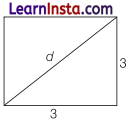
The diagonal of a square of side 3 units lies between which two consecutive integers?
(a) 3 and 4
(b) 4 and 5
(c) 5 and 6
(d) 6 and 7
Answer:
(b) 4 and 5
We know that if p2 is even, then p must also be even. This property is used to prove that both p and q become even, which contradicts their co-prime condition.
Question 9.
The technique used by Hippasus to prove that √2 is irrational is called
(a) Direct method
(b) Proof by contradiction
(c) Spiral construction
(d) None of these
Answer:
(b) Proof by contradiction
To prove √2 is irrational, we assume √2 is rational and show this assumption leads to a logical contradiction.
Hence, the technique used to prove that √2 is irrational is proof by contradiction.
Question 10.
Which of following is an irrational number?
(a) 0.3333
(b) \(\frac{22}{7}\)
(c) √9
(d) √12
Answer:
(d) √12
We have, √12, which cannot be expresses as \(\frac{p}{q}\) since 12 is not a perfect square.
Question 11.
In the proof that √2 is irrational, after assuming √2 = \(\frac{p}{q}\) in lowest terms, we conclude that
p2 -2q2. This shows that
(a) p is odd
(b) p is even
(c) q is odd
(d) p and q are both even
Answer:
(b) p is even
Since, p2 = 2q2
∴ p2 is even.
We know that the square of a number is even only if the number itself is even.
Hence, P is even.
Question 12.
In the contradiction proof of √2, which hidden number property is essential?
(a) Every odd square is even.
(b) If p2 is even, then p is even.
(c) Every rational is an integer.
(d) √2 is approximately 1.414.
Answer:
(b) If p2 is even, then p is even.
Given, side of square = 3 units
Then,diagonal d = \(\sqrt{3^2+3^2}\)
= √18 = 3√5
Since, 42 < 18 < 52
⇒ 4 < √18 < 5
Question 13.
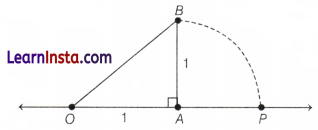
A point P on the number line is constructed by transferring the hypotenuse of a unit square to the line. Which number is represented?
(a) \(\frac{1}{2}\)
(b) √2
(c) 2
(d) \(\frac{3}{2}\)
Answer:
(b) √2
Given, point P is obtained by transferring the hypotenuse of a unit square.
Here, OB = Hypotenuse = \(\sqrt{1^2+1^2}\)
⇒ OB = √2
Question 14.
Which statement about n is correct?
(a) π = \(\frac{22}{7}\) exactly.
(b) π is rational because 3.14 terminates.
(c) π is irrational; \(\frac{22}{7}\) is only an approximation.
(d) π has repeating decimal expansion.
Answer:
(c) π is irrational; \(\frac{22}{7}\) is only an approximation.
Since, it is irrational.
So, π it cannot be written exactly as \(\frac{p}{q}\)
Also,\(\frac{22}{7}\) is only an approximation of π.
Question 15.
Which rational number has a terminating decimal expansion in standard form?
(a) \(\frac{7}{30}\)
(b) \(\frac{13}{250}\)
(c) \(\frac{9}{28}\)
(d) \(\frac{11}{42}\)
Answer:
(b) \(\frac{13}{250}\)
We know that the rational number has a terminating decimal expansion when denominator has only the prime factors 2 or 5 or both.
Here, 250 = 2 × 53
So,\(\frac{13}{250}\) has terminating decimal expansion.
Question 16.
A rational number in standard form has denominator 23 × 52 × 7. Its decimal expansion is
(a) terminating
(b) non-terminating repeating
(c) non-repeating
(d) impossible to decide
Answer:
(b) non-terminating repeating
Given, denominator of a rational number is 23 × 52 × 7.
Since, it has prime factor 7 other than 2 and 5, decimal expansion is non-terminating repeating.
Question 17.
\(0 . \overline{27}\) equals
(a) \(\frac{27}{100}\)
(b) \(\frac{3}{11}\)
(c) \(\frac{27}{90}\)
(d) \(\frac{11}{3}\)
Answer:
(b) \(\frac{3}{11}\)
Let x = \(0 . \overline{27}\) = 0.2727 …(i)
⇒ 100x – x = 27
⇒ 99x = 27
⇒ x = latex]\frac{27}{99}[/latex] = latex]\frac{3}{11}[/latex]
Question 18.
\(1 . 2\overline{34}\) equals
(a) \(\frac{611}{495}\)
(b) \(\frac{1222}{999}\)
(c) \(\frac{1234}{990}\)
(d) \(\frac{34}{99}\)
Answer:
(a) \(\frac{611}{495}\)
Let, x = \(1 . 2\overline{34}\) = 1. 2343434..
⇒ 10x = 12.343434…(i)
⇒ 1000x = 1234.343434….(ii)
On subtracting Eq (i) from Eq. (ii), we get
1000x – 10x = 1222
⇒ 990x = 1222
⇒ x = \(\frac{1222}{990}=\frac{611}{495}\)
Question 19.
If x = \(2 . 4\overline{36}\) then which fraction represents X?
(a) \(\frac{2412}{990}\)
(b) \(\frac{2412}{999}\)
(c) \(\frac{24012}{9900}\)
(d) \(\frac{604}{333}\)
Answer:
(a) \(\frac{2412}{990}\)
Given, x = \(2 . 4\overline{36}\) = 2.4363636…
⇒ 10x = 24.363636…..(i)
⇒ 1000x = 2436.363636…..(ii)
On subtracting Eq. (i) from Eq. (ii), we get
1000x – 10x = 2412
⇒ 990x – 10x = 2412
⇒ x = \(\frac{2412}{990}\)
Question 20.
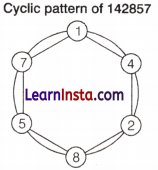
The repeating block of \(\frac{1}{7}\) is 142857. What is 142857 × 5?
(a) 258714
(b) 574182
(c) 714285
(d) 428517
Answer:
(c) 714285
The number 142857 is a cyclic number. When multiplied by any number from 1 to 6, the resultcontains the same digits in the same cyclic order, just starting by a different digit. Here, 714285 contains the same digits in the same cyclic order.
Hence, 142857 × 5 = 714285
Question 7.
in the square root spiral, if the first hypotenuse after the unit segment is √2, the eighth hypotenuse is
(a) √8
(b) √9
(c) √10
(d) 8
Answer:
(b) √9
Given, first hypotenuse after unit segment is √2
So, the hypotenuse sequence is √2, √3, √4 …
Hence, eighth hypotenuse is √9
Assertion-Reason Questions
Direction (Q, Nos. 1-6) Select the correct option from (a), (b), (c), (d) as given below.
(a) Both A and R are true and R is the correct explanation of A.
(b) Both A and R are true but R is not the correct explanation of A.
(c) A is true but R is false.
(d) A is false but R is true.
Question 1.
Assertion (A) \(\frac{x-4}{3 x+2}=\frac{1}{5}\), then the rational number obtained is not in standard form before
simplification.
Reason (R) On solving, x =11 so,\(\frac{x-4}{3 x+2}=\frac{7}{35}\) and 7 and 35 have common factor 7.
Hence, it is not in standard form before simplification.
Answer:
(a) Both A and R are true and R is the correct explanation of A.
Given, \(\frac{x-4}{3 x+2}=\frac{1}{5}\)
⇒ 5(x – 4) = 3x + 2
⇒ 5x – 20 = 3x + 2
⇒ 2x = 22
⇒ x = 11
So, \(\frac{x-4}{3 x+2}=\frac{11-4}{33+2}=\frac{7}{35}\)
Since, 7 and 35 are not co-prime, \frac{7}{35} is not in standard form before simplification.
Hence, both Assertion and Reason are true and Reason is the correct explanation of Assertion.
Question 2.
Assertion (A) The difference of two rational numbers cannot be rational number.
Reason (R) Rational numbers are closed under subtraction.
Answer:
(d) A is false but R is true.
We know that rational numbers are closed under subtraction, i.e, if we subtract one rational number from other, the result is always a rational number.
e.g. \(\frac{1}{2}-\frac{1}{4}=\frac{2}{4}-\frac{1}{4}=\frac{2-1}{4}=\frac{1}{4}\) which is rational.
Hence, Assertion is false but Reason is true.
Question 3.
Assertion (A) Rational numbers between O and 1 are not closed under the operation of addition.
Reason (R) Closure property for additions state for any two rational numbers a and b, a + b will also be a rational number.
Answer:
(a) Both A and R are true and R is the correct explanation of A.
a = \(\frac{2}{3}\), b = \(\frac{3}{4}\)
⇒ \(a+b=\frac{2}{3}+\frac{3}{4}=\frac{17}{12}>1\)
So, a + b is not lies between 0 and 1.
Hence, rational numbers between 0 and 1 are not closed under addition and Reason correctly explains Assertion.
Question 4.
Assertion (A) √2 is irrational.
Reason (R) Irrational numbers cannot be written as p/q, where p and q are integers.
Answer:
(a) Both A and R are true and R is the correct explanation of A.
We know that irrational numbers cannot be expressed as a ratio of integers.
Here, √2 can not be expressed as \(\frac{p}{q}\) where p and q are integers.
Therefore,√2 is irrational.
Hence, both A and R are true and R is the correct explanation of A.
Question 5.
Assertion (A) √2 cannot be written as \(\frac{p}{q}\) with p, q integers and q ≠ 0.
Reason (R) Assuming √2 = \(\frac{p}{q}\) in lowest terms forces both p and q to be even.
Answer:
(a) Both A and R are true and R is the correct explanation of A.
Let, √2 = \(\frac{p}{q}\)
where p, q are co-prime and q ≠ 0.
⇒ 2q2 = p2
So,p2 is even, hence p is even.
Let p = 2m
⇒ 2q2 = 4m2
⇒ q2 = 2m2
So, q is also even, which contradicts that p, q are co-prime.
Hence, both Assertion and Reason are true and Reason correctly explains Assertion.
Question 6.
Assertion (A) A line segment of length √2 units can be constructed on a number line using a right-angled triangle with sides of 1 unit each other than hypotenuse.
Reason (R) According to Pythagoras theorem, in a right-angled triangle, the square of the hypotenuse is equal to the sum of the squares of the other two sides.
Answer:
Let OA = 1 unit on the number time
and AB = 1 unit perpendicular on OA.
Then, Hypotenuse, OB = \(\sqrt{O A^2+A B^2}\)
[By Pythagoras theorem]
\(\sqrt{(1)^2+(1)^2}=\sqrt{1+1}=\sqrt{2}\)
Now, draw an arc with radius OB, which intersects the number line at point P.

The point P locate the exact position of √2 on the number line.
Hence, both A and R are true and R is the correct explanation of A.
Question 7.
Assertion (A) \(\frac{7}{20}\) has a terminating decimal expansion.
Reason (R) In standard form, 20 = 22 × 5 has only prime factors 2 and 5.
Answer:
(a) Both A and R are true and R is the correct explanation of A.
Given, denominator 20 = 22 × 5
Since, denominator has only prime factors 2 and 5, the decimal expansion is of \(\frac{7}{20}\) terminating.
Hence, both Assertion and Reason are true and Reason correctly explains Assertion.
Question 8.
Assertion (A) 0.999… and 1.000… represent the same real number.
Reason (R) A terminating decimal can have an alternative representation ending in repeating 9s.
Answer:
(a) Both A and R are true and R is the correct explanation of A.
Let x = 0.999 ….(i)
⇒ 10x = 9.999 …(ii)
On subtracting Eq. (i) from Eq. (ii), we get
10x – x = 9.999…. – 0.999
⇒ 9x = 9
⇒ x = 1
Thus, Assertion is true
Every non-zero terminating decimal has a twin representation consisting of an infinite string is e.g.
1 = 0.999 and 0.5 = 0.4999 ….
Question 9.
Assertion (A) The square root spiral places numbers like √2, √3 and √4 on the number line geometric plane,
Reason (R) Each new right triangle uses the previous hypotenuse and one unit perpendicular side.
Answer:
(b) Both A and R are true but R is not the correct explanation of A.
Assertion The square root spiral is a geometric construction used to visualise the square roots of consecutive natural number by using a compass, these lengths can be transfered from the spiral onto a number line. Thus, Assertion is true.
Reason To construct the spiral, we start with an isosceles right triangle with perpendicular sides of 1 unit. Then, hypotenuse is √2. The vex and adding a 1-unit perpendicular side.
∴ By the Pythagoras theorem,
\(\sqrt{(\sqrt{n})^2+1}=\sqrt{n+1}\)
Class 9 Maths The World of Numbers Worksheet
Worksheet On The World of Numbers Class 9
Very Short Answer Questions
Question 1.
If \(If \frac{(2 x-3)}{(3 x+4)}\) is equivalent to \(\frac{-5}{7}\) find x and verify that the denominator is non-zero.
Answer:
Given, \(\frac{2 x-3}{3 x+4}=\frac{-5}{7}\)
⇒ 7(2x – 3) = -5(3x + 4)
⇒ 14x – 21 = -15x – 20
⇒ 29x = 1
⇒ x = \(\frac{1}{29}\)
Also, 3x + 4 = \(\frac{3}{29}\) + 4 = \(\frac{119}{29}\) ≠ 0
Question 2.
Find the value of(-3) x (-4) using Brahmagupta’s rule.
Answer:
We know that the product of two debts is a fortune
∴ (-3) × (-4) = 12
Question 3.
Find a rational number between 4.156 and 4.157.
Answer:
Given rational numbers are 4.156 and 4.157 we know that a rational number between a and b is \(\frac{a + b}{2}\).
∴ Rational number between 4.156 and 4.157
= \(\frac{4.156 + 4.157}{2}\) = 4. 1565
Question 4.
Find the sum of –\(\frac{4}{5}\) and \(\frac{5}{10}\).
Answer:
We have, –\(\frac{4}{5}\) + \(\frac{5}{10}\) = \(\frac{-4 x 2}{5 x 2}\) + \(\frac{5}{10}\)
= \(\frac{-8}{10}\) + \(\frac{5}{10}\)
= \(\frac{-8+5}{10}\) + \(\frac{-3}{10}\)
Question 5.
Find the reciprocal of the negative rational number whose absolute value is \(\frac{4}{9}\)
Answer:
Given, absolute value = \(\frac{4}{9}\) and number is negative.
So, the number is \(\frac{-4}{9}\)
∴ The required reciprocal rational number = \(\frac{\frac{1}{\frac{-4}{9}}}{\frac{-9}{4}}=\frac{-9}{}\)
Question 6.
On number line, if point m = \(\frac{7}{20}\) is average of point p = –\(\frac{1}{4}\) and another rational point q, find q.
Answer:
Given, m = \(\frac{7}{20}\) is the average of point p = –\(\frac{1}{4}\)and q.
∴ \(\frac{p+q}{2}\) = m
⇒ \(\frac{\frac{-1}{4}+q}{2}=\frac{7}{20}\)
⇒ \(\frac{-1}{4}\) + q = 2 × \(\frac{7}{20}\) = \(\frac{7}{10}\)
⇒ q = \(\frac{7}{10}\) + \(\frac{1}{4}\)
= \(\frac{14}{20}\) + \(\frac{5}{20}\)
= \(\frac{14+15}{20}\) = \(\frac{19}{20}\)
Question 7.
The side of a square is 2 units, Find the length of its diagonal and state whether it is rational or irrationals.
Answer:
Given, side of the square = 2 units
By Pythagoras theorem,
Diagonal = \(\sqrt{(2)^2+(2)^2}=\sqrt{4+4}=\sqrt{8}\)
Since, √8 cannot be written as \(\frac{p}{q}\), √8 is irrational.
Hence, the diagonal is irrational.
Question 8.
Can an irrational number be written in form p/q, where q ≠ 0?
Answer:
No, by definition, an irrational number cannot be expressed as \(\frac{p}{q}\).
Question 9.
Are the square root of all positive integers irrational? If not, give an example of the square root of a number that is a rational number.
Answer:
No, the square roots of positive perfect square integers are rational.
For example.
√16 = 4, which is a rational number.
Question 10.
Explain why √25 is rational but √5 is irrational.
Answer:
We have √25 = 5, which is an integer.
However, √5 cannot be written as \(\frac{p}{q}\), where p and q are integers.
Hence, √25 is rational and √5 is irrational.
Question 11.
Find the decimal expansion of \(\frac{20}{3}\). What do you observe about the repetition of the digits after
Answer:
Here, \(\frac{20}{3}\) = 6.666 = \(6 . \overline{6}\).
Now, we observe that the digit 6 repeats continuously after decimal point.
Hence, the digits after the decimal point are non-terminating but repeating.
Question 12.
Predict the decimal type of \(\frac{11}{45}\) in standard form.
Answer:
Given, \(\frac{11}{45}\)
Here, 45 = 32 × 5
Since, denominator has prime factor 3, decimal expansion is non-terminating repeating.
Question 13.
Convert \(0 . 1\overline{6}\) into \(\frac{p}{q}\)
Answer:
Let, x = \(0 . 1\overline{6}\) = 0.1666
Then, 10x = 1.666…..(i)
and 100x = 16.666……(ii)
On subtracting Eq. (i) from Eq. (ii), we get
100x – 10x = 15
⇒ 90x = 15
⇒ x = \(\frac{15}{90}\) = \(\frac{1}{6}\)
Question 14.
Classify 0.123456789101112… as rational or irrational.
Answer:
We have, 0.123456789101112…
It is non-terminating and has no fixed repeating block.
Hence, it is irrational.
Question 15.
Classify the number 1.0100100010001 as rational or irrational.
Answer:
We have, 1.01001000100001 ….
Here, the numbers of zeros between is keeps increasing so there is no fiexed repating block, hence it is non-terminating non-repeating.
Hence. it is irrational.
Question 16.
Give the alternate repeating-9 representation of 2.47.
Answer:
Given, terminating decimal number is 2.47
Its alternate repeating-9 form is 2.46999…
Short Answer Questions
Question 1.
A trader begins with a debt of ₹ 750, gains ₹ 1,250, loses ₹ 325. Then as a correction,half of the remaining balance is removed. Write the integer-rational calculation and find the final position.
Answer:
Given, initial debt = ₹ – 750, gain = ₹ 1250, loss
= -₹325.
So, we have, – 750 + 1250 – 325 = 175
Also, half correction = \(\frac{175}{2}\)
So, final position = 175 — \(\frac{175}{2}\) = \(\frac{175}{2}\) = 87.5
Hence, the traider’s final position is a gain of ₹ 87.5.
Question 2.
Find a rational number x such that the number and its additive inverse difference by 2.
Answer:
Let the rational number be x.
Then additive inverse = – x
Now, according to given condituib.
x – (-x) = 2
⇒ x + x = 2
⇒ 2x = 2
⇒ x = 1
Hence, the required rational number is 1.
Question 3.
Reduce the rational number \(\frac{\left(n^2-4\right)}{\left(n^2+n-6\right)}\) to standard form and state the excluded integer values suggested by the original denominator.
Answer:
Given \(\frac{n^2-4}{n^2+n-6}, n>2\)
Consider \(\frac{n^2-4}{n^2+n-6}=\frac{(n-2)(n+2)}{(n-2)(n+3)}\)
⇒ \(\frac{n^2-4}{n^2+n-6}=\frac{n+2}{n+3}\)
Since n + 2 and n + 3 are co-prime, this is standard form.
Since, original denominator is
n2 + n-6 = (n – 2)(n + 3)
and (n – 2)(n + 3) ≠ 0
∴ n = 2 or n ≠ 3
So, excluded values are n = 2, -3
Question 4.
If a and b are non-zero rational numbers, find one example where \(\frac{a}{b}+\frac{c}{d}=\frac{c}{d}+\frac{a}{b}\) Also state which property is used.
Answer:
Given, a, b ≠ 0.
Let \(\frac{a}{b}\) = \(\frac{1}{7}\) and \(\frac{c}{d}\) = \(\frac{3}{4}\)
Then, \(\frac{a}{b}+\frac{c}{d}=\frac{1}{7}+\frac{3}{4}=\frac{4}{28}+\frac{21}{28}=\frac{25}{28}\)
and \(\frac{c}{d}+\frac{a}{b}=\frac{3}{4}+\frac{1}{7}=\frac{21}{28}+\frac{4}{48}=\frac{25}{28}\)
Hence, addition of rational number is commutative property used.
Question 5.
On a number line, points P and Q represent rational numbers a and b, respectively. It is given that
|a| = |b| and PQ = \(\frac{10}{7}\)
If M is the average of P and Q, find the rational number represented by M. Also find its distance from P and Q.

Answer:
Given; |a| = |b| and PQ = \(\frac{10}{7}\)
Since, p ≠ Q
a = -b
So, average, M = \(\frac{a+b}{2}\) = 0
Also, MP = MQ = \(\frac{1}{2}\) × PQ = \(\frac{1}{2}\) × \(\frac{10}{7}\) = \(\frac{5}{7}\)
Hence, M represents O and its distance from P and Q is \(\frac{5}{7}\) each.
Question 6.
Show that 7 – 3√2 is irrational, given that √2 is irrational.
Answer:
Given, √2 is irrational
Let, 7-3√2 be rational.
⇒ 3√2 = 7-rational
⇒ √2 = \(\frac{7-\text { rational }}{3}\)
This makes √2 rational, which is impossible.
So, 7 – 3√2 is irrational.
Question 7.
Show √3 on the number line using a ruler and a compass.
Answer:
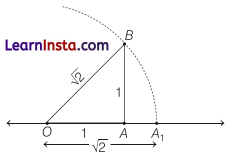
Step – I: Draw a number line and mark point 0 as zero and mark point A at one unit distance from 0, so
OA = l unit.

Step – II: Draw a perpendicular AB on OA such that AB = 1 unit
In right angled ΔOAB,
OB2 = OA2 + AB2 [by Pythagoras theorem]
⇒ OB2 = 12 + 12 = 2
⇒ OB = √2 units
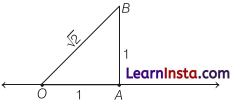
Step – III : With O as the centre and OB as the radius, draw an arc that intersects the number line at point A1.
Thus, OA1 = OB = √2 units, which means A1,
represents k on the number line.
Step – IV: Draw another right angled ΔOA1 B1 such that A1 B1 is perpendicular of OA1 and A1B1 = 1 unit.
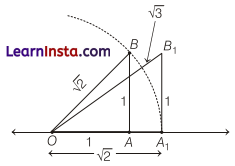
In ΔOA1 B1 we get
(OB1)2 = (OA1)2 + (A1B1)
⇒ (OB1)2 = (√2)2 + 12 = 2 + 1 = 3
⇒ (OB1) = √3
⇒ OB1 = √3 units
Step – V: With 0 as the centre and OB1 as radius, draw an arc that intersect the number line at A1.

Thus, OA2 = OB1 = √3 units, which means A2 represents √3 on the number line.
Question 8.
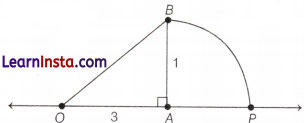
If OA = 3 units and AB = 1 unit perpendicular to OA, what point is obtained on the number line by transferring OB?
Answer:
Given, OA = 3 unit and AB = 1 unit, where AB ⊥ OA.
By Pythagoras theorem, we have
OB = \(\sqrt{O A^2+A B^2}\)
⇒ OB = \(\sqrt{O A^2+A B^2}\)
⇒ OB = \(\sqrt{10}\)
Hence, by transferring OB on the number line, we get the point √10
Question 9.
Without long division, decide whether \(\frac{13}{250}\) terminates. Then write its decimal.
Answer:
We have, \(\frac{13}{250}\)
Here, 250 = 20 × 53<s/up>
Since, denominator has only prime factors 2 and 5, decimal expansion is terminating.
\(\frac{13}{250}\) = \(\frac{52}{1000}\) = 0.052
Question 10.
Find the decimal type of after reducing to standard form.
Answer:
Given, rational number is \(\frac{21}{140}\)
∴ Its standard form = \(\frac{21 \div 7}{140 \div 7}=\frac{3}{20}[/latex
Here, 20 = 22 × 5
Since, denominator has only prime factors 2 and 5, decimal expansion is terminating.
Question 11.
Convert [latex]0 . \overline{36}\) to a fraction in standard form.
Answer:
Let, x = \(0 . \overline{36}\) = 0.3636…(i)
Then, 100x = 36.3636….(ii)
On subtracting Eq. (i) from Eq. (ii), we get 100 x – x = 36
⇒ 99x = 36
⇒ x = \(\frac{36}{99}=\frac{4}{11}\)
Question 12.
Create a rational number whose decimal has exactly two non-repeating digits followed by a two-digit repeating block, and convert it into p/q.
Answer:
Let the required number be x = \(0 . 12\overline{34}\)
= 0.12343434 …..(i)
Here, 12 are two non-repeating digits and 34 is the two-digit repeating block.
On multiplying Eq. (i) by loo and 1000, we get
100x = 12.343434 ….(ii)
and 10000x = 1234.343434 ..0…(iii)
On Subtracting Eq. (ii) from Eq. (iii), we get.
10000x – bOx = 1234343434 … —12.343434.
⇒ 9900x = 1222
⇒ x = \(\frac{1222}{9900}=\frac{611}{4950}\)
Hence, one such rational number is \(\frac{611}{4950}\)
Question 13.
Classify 0.120120012000120000… and give the reason.
Answer:
Given, 0.120120012000120000…
Here, the decimal expansion is non-terminating, but the block does not repeat regularly.
The number of zeros between 120 keeps increasing.
Hence, it is irrational.
Long Answer Questions
Question 1.
A rational number is given by R = 2 , where x is an integer and x —2, 3. Reduce R to (x —x—6) standard form and find all integer x for which R is an integer.
Answer:
Consider R = \(\frac{x^2-9}{x^2-x-6}, x \neq-2,3\)
⇒ R = \(\frac{(x-3)(x+3)}{(x-3)(x+2)}\)
⇒ R = \(\frac{x+3}{x+2}\)
⇒ R = 1 + \(\frac{1}{x+2}\)
For R to be an integer, we must have
x + 2 = ±1
⇒ x = -1, -3
Hence, R is in standard form \(\frac{x+3}{x+2}\) and x = -1, -3.
Question 2.
Represent the rational numbers \(\frac{3}{4}, \frac{-6}{5} \text { and } 2 \frac{1}{2}\) on a single number line.
Answer:
For \(\frac{3}{4}\), \(\frac{3}{4}\) is lies between 0 and 1.
So, divide the interval between O and 1 into 4 equal parts and move 3 parts right of 0.
For \(\frac{-6}{5}\), \(\frac{-6}{5}\) = —1\(\frac{1}{5}\), which is between -1 and -2.
So, divide the interval between -1 and -2 into 5 equal parts and move part left of -l
For 2\(\frac{1}{2}\), 2\(\frac{1}{2}\) is lies between 2 and 3.
So, divide the interval between 2 and 3 into 2 equal parts and move 1 part right of 1.

Question 3.
Represent \(\frac{-17}{6}\) and \(\frac{11}{4}\) on a number iine by converting them into mixed forms, Then find the distance between them and the rational point exactly halfway between them.
Answer:
Given, rational numbers are –\(\frac{17}{6}, \frac{11}{4}\) .
Then, their mixed forms are –\(\frac{17}{6}\) = -2\(\frac{5}{6}\) and \(\frac{11}{4}\) = 2\(\frac{3}{4}\) So, – \(\frac{17}{6}\) lies between -3 and -2, and \(\frac{11}{4}\) lies between 2 and 3.

Now, distance = \(\left|\frac{11}{4}-\left(-\frac{17}{6}\right)\right|=\frac{11}{4}+\frac{17}{6}=\frac{33+34}{12}=\frac{67}{12}\)
and halfway point = \(\frac{1}{2}\left(-\frac{17}{6}+\frac{11}{4}\right)=\frac{1}{2}\left(\frac{-34+33}{12}\right)=-\frac{1}{24}\)
hence, distance = \(\frac{67}{12}\) and mid-point = – \(\frac{1}{24}\)
Question 4.
A rational number x satisfies \(\left|x+\frac{5}{12}\right|=\frac{7}{18}\) and x is closer to O than to -1. Find x and justify the choice.
Answer:
Given, \(\left|x+\frac{5}{12}\right|=\frac{7}{18}\)
⇒ x + \(\frac{5}{12}= \pm \frac{7}{18}\)
So, x = \(-\frac{5}{12}+\frac{7}{18}=\frac{-15}{36}+\frac{14}{36}=\frac{-15+14}{36}=-\frac{1}{36}\)
or x = \(-\frac{5}{12}-\frac{7}{18}=\frac{-15}{36}-\frac{14}{36}=\frac{-15-14}{36}=-\frac{29}{36}\)
Now, –\(\frac{1}{36}\) is closer to 0, while – \(\frac{29}{36}\) is closer to -1
Hence, x = – \(\frac{1}{36}\)
Question 5.
If x is irrational and r, s are rational with r ≠ 0, prove that rx + s is irrational.
Answer:
Given, x is irrational and r, s are rational.
Let rx + s be a rational number.
∴ rx + s = q, where q is rational number
⇒ rx = q – s
⇒ x = \(\frac{q-s}{r}\)
Since, q, r and s are rational.
∴ \(\frac{q-s}{r}\) is rational.
So, this contradicts that fact that x is irrational.
Therefore, our assumption is wrong.
Hence, rx + s is irrational.
Question 6.
Prove that √a + √b is irrational, where a and b are primes.
Answer:
Let √a + √b is a rational number
i.e.,√a + √b = p, where p is rational.
∴ √b = \(\frac{p^2+a-b}{2 p}\)
Since, a and b are primes and p is rational number, so
[/latex]\frac{p^2+a-b}{2 p}[/latex] is rational.
Therefore, √a is a rational number but this contradicts the fact that √a is irrational as a is prime.
So, our assumption was incorrect.
Hence, √a + √b is irrational.
Question 7.
Design a right-triangle construction for √26 using integer side lengths and state how it is transferred to the number line.
Answer:
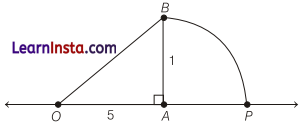
Given, we have to construct √26 by a right triangle.
Take OA = 5 units on a line.
At A, draw AB ⊥ OA such that AB = 1 unit. join OB.
By Pythagoras theorem,OB2 = OA2 + AB2
⇒ OB2 = 52 + 12
⇒ OB2 = 25 + 1 = 26
⇒ OB = √26
So, OB is the required length.
Now, with centre O and radius OB, cut the number line at P.
Then OP = OB = √26
Hence, the point P represents √26 on the number line.
Question 8.
A denominator of a rational number in standard form is 2a5b3c, where a, b, c are non-negative integers. Give exact conditions for terminating and repeating decimals, with examples.
Answer:
Given, denominator of a rational number in standard form is 2a5b3c
where a, b, c are non-negative integers.
For terminating decimal, denominator must have only prime factors 2 or 5 or both 2 and 5.
So, c = O
Example \(\frac{7}{2^2 \cdot 5}=\frac{7}{20}=0.35\)
For repeating decimal, denominator contains prime factor other than 2 or 5.
So, c > O
Example \(\frac{5}{2 \cdot 3}=\frac{5}{6}=0.8333 \ldots=0.8 \overline{3}\)
Hence, terminating if c = 0, and non-terminating repeating if e > 0.
Question 9.
A student writes, ‘0.123451234512345… is irrational because it never terminates.’ Correct the statement and convert it into a fraction.
Answer:
We have, 0.123451234512345…
Here, the fixed block 12345 repeats.
So, it is rational, not irrational.
Let x = \(0 . \overline{12345}\)
Then, 10000x = \(12345 . \overline{12345}\)
⇒ l00000x – x = 12345
⇒ 99999x = 12345
⇒ x = \(\frac{12345}{99999}=\frac{4115}{33333}\)
Hence, \(0 . \overline{12345}\) = \(\frac{4115}{33333}\)
Question 10.
Convert \(1 . \overline{2}\) and \(1 . 2\overline{7}\) into fractions and compare them.
Answer:
For \(1 . \overline{2}\)
Let y = 1222 … (i)
Then, 10y = 12.222 … (ii)
On subtracting Eq. (i) from Eq. (ii), we get
10y – y = 12.222 … 1.222…
⇒ 9y = 11
⇒ y = \(\frac{11}{9}\)
For \(1 . 2\overline{7}\), let x = 1.2777…
Then, 10x = 12.777…..(iii)
and 1000x = 127.777…..(iv)
On subtracting Eq, (iii) from Eq. (iv), we get
100x – 10x = 127.777…. – 12.777…
⇒ 90x = 115
⇒ x = \(\frac{115}{90}=\frac{23}{18}\)
Now, \(\frac{11}{9}=\frac{22}{18}<\frac{23}{18}\)
Hence, \(1 . \overline2{7}\) is greater.
Question 11.
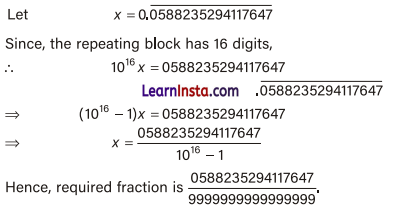
A decimal repeats the block 0588235294117647. Infer its rationality and write the quickest algebraic conversion form without simplifying.
Answer:
Given, decimal repeats the block 0588235294117647
Since, a fixed block repeats, the decimal is rational.
Let x = \(0 . \overline{0588235294117647}\)
Since, the repeating block has 16 digits.
Case-Based Questions
Question 1.
A rational card displays t2 -1/12 + 2t + 1, where t is an integer and t ≠ -1.
Answer the following
Given, \(\frac{t^2-1}{t^2+2 t+1}, t \neq-1\)
(i) Simplify the expression in standard form.
Answer:
Here, \(\frac{t^2-1}{t^2+2 t+1}=\frac{(t-1)(t+1)}{(t+1)^2}=\frac{t-1}{t+1}\)
(ii) Find its value for t = 2.
Answer:
On substituting t = 2 into \(\frac{(t-1)}{(t+1)}\), we get
\(\frac{t-1}{t+1}=\frac{2-1}{2+1}=\frac{1}{3}\)
(iii) (a) For which integer t is the value 0?
Answer:
The given expression is zero only when
t – 1 = 0
⇒ t = 1
Or
(b) Why is t = -1 not allowed?
Answer:
For t = -1,
t2 + 2t + 1 = (t + 1)2 = 0
So, denominator becomes O; hence t = -1 is not allowed.
Question 2.
The segment from A = \(\frac{1}{3}\) to B = \(\frac{2}{3}\) is rewritten using denominator 36 and divided into equal parts as shows

(i) Write \(\frac{1}{3}\) and \(\frac{2}{3}\) with denominator 36.
Answer:
Given, A = \(\frac{1}{3}\) and B = \(\frac{2}{3}\)
Here,\(\frac{1}{3}\) = \(\frac{12}{36}\), \(\frac{2}{3}\) = \(\frac{24}{36}\)
(ii) Write any four rational numbers strictly between them using the same denominator.
Answer:
Four rational numbers between them are \(\frac{13}{36}\),\(\frac{14}{36}\),\(\frac{15}{36}\),\(\frac{16}{36}\)
(iii) (a) Find the rational number obtained by the average method.
Answer:
(a) Average method. \(\frac{\frac{1}{3}+\frac{2}{3}}{2}=\frac{1}{2}=\frac{18}{36}\)

Or
(b) Explain in one sentence why this process can produce infinitely many rational numbers.
Answer:
By increasing the denominator or by taking averages repeatedly, infinitely many rational numbers can be obtained between any two rational numbers.
Question 3.
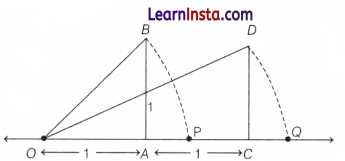
The given figure shows two constructions on a number line.
Here, OA = 1, AC = 1, AB = 1 and CD = 1, with AB ⊥ OA and CD ⊥ OC. The arcs from B and D cut the number line at P and Q, respectively.
Answer the following questions.
Given, OA = 1, AC =1, AB = 1, CD = 1
Also,
AB ⊥ OA, CD ⊥ OC
(i) Using ∆OAB, find the length OB. Hence, identify the irrational number represented by point P.
Answer:
In ∆OAB, by Pythagoras theorem, we have
OB2 = OA2 + AB2
⇒ OB2 = 12 + 12 = 2
⇒ OB = √2
So, point P represents √2.
(ii) Point C represents 2 on the number line. Using ∆OCD, find the length OD. Hence, identify the irrational number represented by point Q.
Answer:
Since, OC = OA + AC = 1 + 1 = 2
In ∆OCD, by Pythagoras theorem, we have
OD2 = OC2 + CD2
⇒ OD2 = 22 + 12 = 5
⇒ OD = √5
(iii) (a) Why do points P and Q represent irrational numbers?
Answer:
Since 2 and 5 are not perfect squares, √2 and √5 are irrational numbers.
Hence, P and Q represent irrational numbers.
OR
(b) Which point lies farther from O: P or Q? Give reason.
Answer:
Since,
√5 > √2
So, Q lies farther from O
Question 4.
A student writes A = \(\frac{7}{40}\), B = \(\frac{5}{12}\), C = \(\frac{1}{7}\) D = 0.999…
He also uses the following rule,
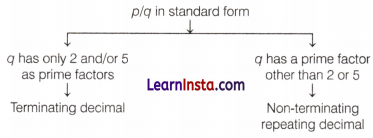
Also, \(\frac{7}{40}\) = \(0 . \overline{142857}\)
and 142857 forms a cyclic pattern.
Answer the following questions.
Given, A = \(\frac{7}{40}\), B\(\frac{5}{12}\), C\(\frac{1}{7}\), D = 0.999..
(i) Which of A, B, C, D has a terminating decimal expansion?
Answer:
Here, 40 = 23 × 5
So, A = \(\frac{7}{40}\) has terminating decimal expansion.
(ii) Which of them has a non-terminating repeating decimal expansion?
Answer:
For B = \(\frac{5}{12}\): The denominator is 12 = 22 × 3.
Since it was a prime factor (3) other than 2 or 5, it is non-terminating and repeating.
For C = \(\frac{1}{7}\). The denominator is 7 (a prime factor other them 2 or 5). making it non-terminating and
repeating.
Hence, B and C are non-terminating repeating decimals.
(iii) (a) Is D equal to 1?
Answer:
We have, D = 0.999… (i)
10D = 9.999 …(ii)
On substracting Eq. (i) from Eq. (ii), we get
⇒ 10D – D = 9
⇒ 9D = 9
⇒ D = 1
Or
(b) Which number shows a cyclic repeating block?
Answer:
Since, \(\frac{1}{7}\) = \(0 . \overline{142857}\)
So, C shows a cyclic repeating block.
Question 5.
The redrawn square-root spiral starts with a unit segment. At each step, a perpendicular segment of length 1 is drawn at the end of the previous hypotenuse.

Answer the following questions.
(i) Write the first three hypotenuse lengths after the initial unit segment.
Answer:
Given, square-root spiral starts with unit segment and each new perpendicular_length
(i) Here, first hypotenuse, \(\sqrt{1^2+1^2}=\sqrt{2}\)
Second hypotenuse, \(\sqrt{(\sqrt{2})^2+1^2}=\sqrt{3}\)
Third hypotenuse, \(\sqrt{(\sqrt{3})^2+1^2}=\sqrt{4}\)
So, first three hypotenuse lengths are √2,√3,√4
(ii) Among √2, √4 and √5, which are irrational?
Answer:
Here, √4 = 2
So, √4 is rational, while and are irrational.
(iii) (a) What kind of decimal expansion does an irrational number have?
Answer:
An irrational number has a non-terminating and non-repeating decimal expansion.
Or
(b) A rational number in its lowest form has denominator containing only powers of 2 and 5. What type of decimal expansion will it have?
Answer:
If denominator has only powers of 2 and 5, then decimal expansion is terminating.