Students can use Exploration Class 9 Science Solutions Chapter 4 Describing Motion Around Us Question Answer NCERT Solutions as a quick reference guide.
Class 9 Science Exploration Chapter 4 Question Answer
Class 9 Science Ch 4 Describing Motion Around Us Question Answer
Describing Motion Around Us Class 9 Questions and Answers (Exercise)
Revise, Reflect, Refine (NCERT Textbook Page No. 68 – 70)
Question 1.
My father went to a shop from home which is located at a distance of 250 m on a straight road. On reaching there, he discovered that he forgot to carry a cloth bag. He came home to take it, went to the shop again, bought provisions and came back home. How much was the total distance travelled by him? What was his displacement from home?
Answer:
The father travels between the home and the shop (250 m) four times:
Home to Shop: 250 m
Shop to Home: 250 m
Home to Shop: 250 m
Shop to Home: 250 m
Total distance = 250 + 250 + 250 + 250 = 1000m.
Since the starting point is home and the final position is also home. Thus, displacement is 0 m.

Question 2.
A student runs from the ground floor to the fourth floor of a school building to collect a book and then comes down to their classroom on the second floor. If the height of each floor is 3 m, find:
(i) the total vertical distance travelled, and
(ii) their displacement from the starting point.
Answer:
Height of each floor = 3 m
The student starts at the ground floor (0 m).
Going up to the fourth floor:
The fourth floor is 4 floors above the ground. Height of fourth floor = 4 × 3 = 12 m.
Coming down to the second floor:
The second floor is 2 floors above the ground. Height of second floor = 2 × 3 = 6 m.
(i) Total vertical distance travelled = Distance going up + Distance coming down
= 12 m + (12 – 6)m
= 12 + 6 = 18 m
(ii) Displacement from starting point:
Displacement = Final position – Initial position
= 6 m – 0 m
= 6 m (in the upward direction)
Question 3.
A girl is riding her scooter and finds that its speedometer reading is constant. Is it possible for her scooter to be accelerating, and if so, how?
Answer:
Yes, it is possible for the scooter to be accelerating even when the speedometer reading is constant.
The speedometer shows the speed of the vehicle, not its velocity. Speed only tells us how fast the object is moving, but velocity also includes direction.
Acceleration is defined as the change in velocity divided by time. Velocity is a quantity that has both magnitude (speed) and direction. So even if the speed (magnitude) remains constant, if the direction of motion changes, the velocity changes, and this means there is acceleration.
Example:
If the girl is riding her scooter along a curved or circular road at a constant speed, her direction of motion keeps changing at every point. This means her velocity is changing, so she has acceleration, even though the speedometer shows a constant reading.
This type of motion with constant speed but changing direction is called uniform circular motion, and it is an example of accelerated motion.
Question 4.
A car starts from rest and its velocity reaches 24 ms-1 in 6 s. Find the average acceleration and the distance travelled in these 6 s.
Answer:
Given:
Initial velocity, u = 0 ms-1 (starts from rest),
Final velocity, v = 24 ms-1,
Time, t = 6 s
Step 1: Finding average acceleration
Average acceleration,
a = \(\frac{v-u}{t}\)
a = \(\frac{24-0}{6}\)
= \(\frac{24}{6}\) = 4 ms-1
Step 2: Finding distance travelled
Using the kinematic equation:
s = ut + ½ × a × t2
= (0 × 6) + ½ × 4 × 62
= 0 + ½ × 4 × 36
= 2 × 36 = 72 m
The average acceleration of the car is 4 ms-2 and the distance travelled is 72 m.
Question 5.
A motorbike moving with initial velocity 28 m/s and constant acceleration stops after travelling 98 m. Find the acceleration of the motorbike and the time taken to come to a stop.
Answer:
Given:
Initial velocity, u = 28 rn/s
Final velocity, v= 0 m/s (stops)
Distance, s = 98 m
Acceleration (using v2 = u2 + 2as):
0 = 282 + 2 × a × 98
0 = 784 + 196a
a = -784 / 196 = -4 m/s2
∴ Acceleration = -4 m/s2
(deceleration of 4 m/s2)
Time to Stop (using v = u + at):
0 = 28 + (-4) × t
t = 28/4 = 7 s
∴ Time taken to stop = 7s
Question 6.
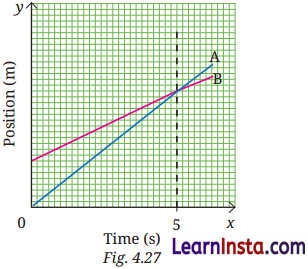
The figure below shows a position-time graph of two objects A and B that are moving along the parallel tracks in the same direction. Do objects A and B ever have equal velocity? Justify your answer.
Answer:
From the position-time graph, both A and B have straight line position-time graphs, which means both are moving with constant velocities.
The velocity of an object is given by the slope of its position-time graph.
Object A has a steeper slope than object B. This means object A has a greater velocity than object B.
Since both lines are straight (slopes are constant and different from each other), the two objects move at different constant velocities throughout. The lines do not have the same slope at any point.
Therefore, objects A and B never have equal velocity.
Note:
If the two lines were to intersect, it would mean they are at the same position at that instant, but that still does not mean they have the same velocity. Equal velocity would require equal slopes of the two lines, which is not the case here.
Question 7.
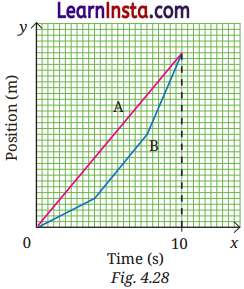
A graph in the figure below shows the change in position with time for two objects A and B moving in a straight line from 0 to 10 seconds. Choose the correct option(s).
(i) The average velocity of both over the 10 s time interval is equal since they have the same initial and final positions.
(ii) The average speeds of both over the 10 s time interval are equal since both cover equal distance in equal time.
(in) The average speed of A over the 10 s time interval is lower than that of B since it covers a shorter distance than B in 10 seconds.
(iv) The average speed of A over the 10 s time interval is greater than that of B since B’s speed is lower than A’s in some segments.
Answer:
From Fig. 4.28, both objects A and B return to the same final position at t = 10 s as their initial position at t = 0 s.
(i) Average velocity of both over 10 s is equal – Correct
Average velocity = Displacement / Time = 0 / 10 = 0 m/s for both, since their initial and final positions are the same.
(ii) Average speeds are equal.
Question 8.
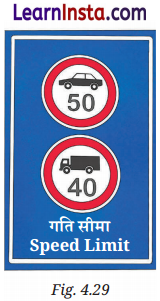
A truck driver driving at 54 kmh-1 notices a road sign with a speed limit of 40 kmh-1 for trucks (Fig.below). He slows down to 36 kmh-1 in 36 s. What was the distance travelled by him during this time? Assume the acceleration to be constant while slowing down.
Answer:
Given: Initial velocity,
u = 54 kmh-1
= 54 × \(\frac{1000}{36}\)
= 15 ms-1
(∵ 1 km = 1000 m, 1 h = 60 min = 60 * 60 second = 3600 second)
Final velocity, v = 36 kmh-1
= 36 × \(\frac{1000}{36}\) = 10 ms-1
Time, t = 36 s
Acceleration
a = \(\frac{v-u}{t}\)
⇒ a = \(\frac{10-15}{36}\)
⇒ a = \(\frac{-5}{36}\) ms-2
Find distance travelled using:
s = ut + ½ × a × t2
⇒ s = 15 × 36 + ½ × \(\frac{-5}{36}\) × 362
⇒ s = 540 + ½ ×  × 36
× 36
⇒ s = 540 + \(\frac{-5 \times 36}{2}\)
⇒ s = 540 – 90
⇒ s = 450 m
Alternatively, we can use:
s = \(\frac{u+v}{2}\)
s = \(\frac{15+10}{2}\) × 36
s = \(\frac{25}{2}\) × 36
s = 25 × 18
s = 450 m
The distance travelled by the truck driver during slowing down is 450 m.
Question 9.
A car starts from rest and accelerates uniformly to 20 ms-1 in 5 seconds. It then travels at 20 ms-1 for 10 seconds and finally applies the brake (with uniform acceleration) to stop in 6 seconds. Find the total distance travelled.
Answer:
The journey has three phases:
Phase 1:
Acceleration from rest to 20 ms-1 in 5 s,
Here, u = 0 ms-1,
v = 20 ms-1,
t = 5 s
Distance in Phase 1:
s1 = \(\frac{u+v}{2}\) × t
= \(\frac{0+20}{2}\) × 5
= 10 × 5 = 50 m
Phase 2:
Constant velocity of 20 ms-1 for 10 s
Here, u = 20 ms-1, t = 10 s
Distance in Phase 2:
s2 = u × t
= 20 × 10 = 200 m
Phase 3:
Braking from 20 ms-1 to 0 in 6 s
u = 20 ms-1,
v = 0 ms-1,
t = 6 s
Distance in Phase 3:
s3 = \(\frac{u+v}{2}\) × t
= \(\frac{0+20}{2}\) × 6
= 10 × 6 = 60 m
Total distance = s1 + s2 + s3
= 50 + 200 + 60 = 310 m
The total distance travelled by the car is 310 m.
Question 10.
A bus is travelling at 36 kmh-1 when the driver sees an obstacle 30 m ahead. The driver takes 0.5 seconds to react before pressing the brake. Once the brake is applied, the velocity of the bus reduces with constant acceleration of 2.5 ms-2. Will the bus be able to stop before reaching the obstacle?
Answer:
Given, initial speed of the bus,
u = 36 kmh-1 1000
= 36 × \(\frac{1000}{3600}\) = 10 ms-1
Reaction time, t =0.5 s
Acceleration after braking.
a = – 2.5 ms-2 (retardation)
Distance to obstacle = 30 m
Distance travelled during reaction time (before brakes are applied)
During reaction time, the bus moves at constant speed:
s1 = u × t
= 10 × 0.5 = 5 m
Distance travelled after brakes are applied
Using v2 = u2 + 2as, with v = 0 (bus stops)
⇒ 02 = 102 + 2 × (- 2.5) × s2
⇒ 0 = 100 – 5 × s2
⇒ 5 × s2 = 100
⇒ s2 = \(\frac { 100 }{ 5 }\)
⇒ s2 = 20 m
Total distance needed to stop
Total distance = s1 + s2 = 5 + 20 = 25 m
Total stopping distance = 25 m
Distance to obstacle = 30 m
Since 25 m is less than 30 m, yes, the bus will be able to stop before reaching the obstacle.
The bus stops 5 m before the obstacle.
Question 11.
A student said, “The Earth moves around the Sun. ” In this context, discuss whether an object kept on the Earth can be considered to be at rest.
Answer:
When we say an object is at rest or in motion, we always mean it with respect to a reference point.
If we choose the Earth as our reference point, then an object kept on the Earth (like a book on a table) does not change its position with respect to the Earth. So, with respect to the Earth, the object is at rest.
However, if we choose the Sun as our reference point, then the Earth itself is moving around the Sun. Therefore, the object on Earth is also moving along with the Earth around the Sun. So, with respect to the Sun, the object is in motion.
This shows that rest and motion are relative terms. An object can be at rest with respect to one reference point and in motion with respect to another reference point at the same time.
So the answer depends on the reference point we choose. In our daily life, we usually take objects on the Earth’s surface as our reference points, so we consider the book to be at rest. But from the Sun’s perspective, the book is moving.
Question 12.
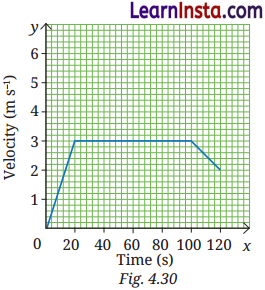
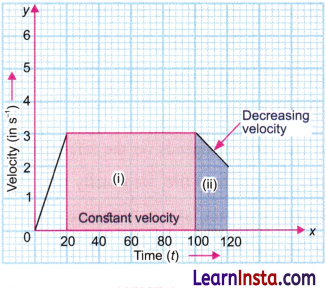
The velocity-time graph from 0 s to 120 s for a cyclist is shown in Fig. (below). Shade the areas (in different colours) representing the displacement of the cyclist (i) while the cyclist is moving with constant velocity, and (ii) when the velocity of the cyclist is decreasing.
Also, calculate the displacement and average acceleration in the 120 s time interval.
Answer:
Shading:
(i) The displacement during constant velocity is represented by the rectangular area under the graph from 20 s to 100 s.
(ii) The displacement when velocity is decreasing is represented by the triangular area from 100 s to 120 s.
Calculating displacement:
Displacement = Area of triangle (0 – 20 s) + Area of rectangle (20 – 100 s) + Area of trapezium (100 – 120 s)
= (½ × 20 × 3) + (80 × 3) + (½ × (3 + 2) × 20)
= 30 + 240 + 50 = 320 m
Calculating average acceleration over 120 s:
Average acceleration, a = \(\frac{v-u}{t}\)
= \(\frac{(2-0)}{120}=\frac{1}{60}\) ms-2
Question 13.
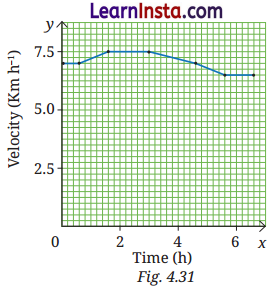
A girl is preparing for her first marathon by running on a straight road. She uses a smartwatch to calculate her running speed at different intervals. The graph (Fig. below) depicts her velocity versus time. Estimate the running distance based on the graph.
Answer:
From Fig., the velocity-time graph shows the girl’s speed in kmh-1 over time in hours.
Reading the graph:
Let’s approximate the area by dividing the graph into sections:
From 0 to 2 hours:
The velocity rises from 7.0 to 7.5.
The average is roughly = \(\frac{7+7.5}{2}\) = 7.25 km/h
Distance (d1) ≈ 7.25 km/h × 2h = 14.5 km
From 2 to 4 hours:
The velocity stays near 7.5, then dips slightly to 7.25.
Average is roughly = \(\frac{7.50+6.50}{2}\) = 7.4 km/h
Distance (d2) ≈ 7.4 km/h × 2h = 14.8 km
From 4 to 6 hours:
The velocity drops from 7.25 to 6.5.
Average is roughly = \(\frac{7.25+6.50}{2}\) = 6.8 km/h
Distance (d3) ≈ 6.8 km/h × 2h = 13.6 km
From 6 to 7 hours:
The velocity is constant at 6.5.
Distance (d2) ≈ 6.5 km/h × 1h = 6.5 km
Final Calculation:
Adding these segments together:
Distance ≈ 14.5 + 14.8 + 13.6 + 6.5 = 49.4 km
Note: Marathon distance is approximately 49.4 km, which matches closely. Students should read their own graph values and calculate accordingly.
Question 14.
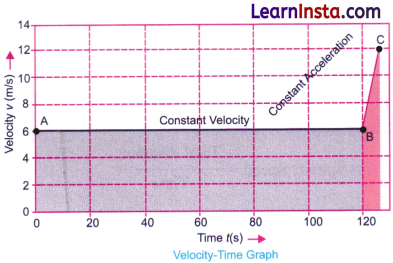
On entering a state highway, a car continues to move with a constant velocity of 6 ms-1 for 2 minutes and then accelerates with a constant acceleration of 1 ms-2 for 6 seconds. Find the displacement of the car on the state highway in the 2 min 6 s time interval by drawing a velocity-time graph for its motion.
Answer:
The motion has two phases:
Phase 1:
Constant velocity of 6 ms-1 for 2 minutes = 120 s
Phase 2:
Acceleration from 6 ms-1 with a = 1 ms-2 for 6 s
On the velocity-time graph:
- Draw a horizontal line at velocity = 6 ms-1 from t = 0 to t = 120 s (this represents constant velocity)
- From t = 120 s, draw a line sloping upward (representing acceleration)
Final velocity at end of Phase 2:
v = u + at
= 6 + 1 × 6
= 6 + 6 = 12 ms-1
Displacement in Phase 1 (area of rectangle):
s1 = 6 × 120 = 720 m
Displacement in Phase 2 (area of trapezium under graph from t = 120 s to t = 126 s):
s2 = \(\frac{u+v}{2}\)
s2 = \(\frac{6+12}{2}\)
s2 = 9 × 6
⇒ s2 = 54 m
Total displacement = s1 + s2
= 720 + 54 = 774 m
The displacement of the car on the state highway in 2 min 6 s is 774 m.
Question 15.
Two cars A and B start moving with a constant acceleration from rest in a straight line. Car A attains a velocity of 5 ms-1 in 5 s. Car B attains a velocity of 3 ms-1 in 10 s. Plot the velocity-time graphs for both the cars in the same graph. Using the graph, calculate the displacement mentioned in the two time intervals
(Hint: Calculate the acceleration in both cases. Then calculate their velocities at five instants of time to plot the graph).
Answer:
For Car A:
u = 0,
v = 5 ms-1,
t = 5 s
aA = \(\frac{v-u}{t}\)
= \(\frac{5-0}{5}\) = 1 ms-1
For Car B:
u = 0,
v = 3 ms-1,
t = 10 s
aB = \(\frac{v-u}{t}\)
= \(\frac{3-0}{10}\) = 0.3 ms-2
Now, we will calculate velocities at five instants of time for each car.
| Time (s) | Velocity of car A v = 1 × t (ms-1) | Velocity of car B v = 0.3 × t (ms-1) |
| 0 | 0 | 0 |
| 2 | 2 | 0.6 |
| 4 | 4 | 1.2 |
| 6 | 6 | 1.8 |
| 8 | 8 | 2.4 |
| 10 | 10 | 3.0 |
Velocity-time graph description:
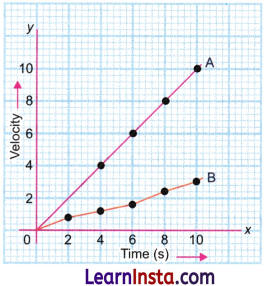
Both lines start at origin (0, 0)
Car A: Steeper straight line (reaches 5 ms-1 at 5 s, 10 ms-1 at 10 s)
Car B: Less steep straight line (reaches 3 ms-1 at 10 s)
Calculate displacement:
For Car A in 5 s (time interval of Car A reaching 5 ms-1):
A = ½ × (u + v) × t
= ½ × (0 + 5) × 5 = 12.5 m
For Car B in 10 s (time interval of Car B reaching 3 ms-1):
B = ½ × (u + v) × t
= ½ × (0 + 3) × 10 = 15 m
(These values equal the areas of the triangles under each line in the velocity-time graph.)
Question 16.
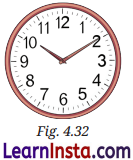
Rohan studies science from 6 PM to 7:30 PM at home. Consider the tip of the minute’s hand of the wall clock. During the given time interval, what is its:
(i) distance travelled,
(ii) displacement,
(iii) speed, and
(iv) velocity?
The length of the minute hand is 7 cm (Fig below).
Answer:
The minute hand completes one full revolution in 60 minutes.
Rohan studies from 6:00 PM to 7:30 PM, which is a time interval of 90 minutes = 1.5 hours.
So the minute hand completes \(\frac {90}{60}\) = 1.5 revolutions.
Given: radius of circular path = length of minute hand = 7 cm
(i) Distance travelled:
In one full revolution,
Distance = circumference = 2πr
= 2 × 3.14 × 7 = 44 cm
In 1.5 revolutions:
Distance = 1.5 × 44 = 66 cm
(ii) Displacement:
At 6:00 PM, the minute hand points at 12 (top).
After 90 minutes (1.5 revolutions), at 7:30 PM, the minute hand points at 6 (bottom).
The tip of the minute hand has moved from the 12 position to the 6 position. These two positions are at opposite ends of a diameter.
Displacement = diameter
= 2 × radius = 2 × 7 = 14 cm
(The displacement is a straight line from the 12 position to the 6 position, which is the diameter of the circle.)
(iii) Speed:
Speed = \(\frac{\text { Total distance }}{\text { time }}\)
Time = 90 minutes
= 90 × 60 = 5400 s 66 cm 11
Speed = \(\frac{66 \mathrm{~cm}}{5400 \mathrm{~s}}=\frac{11}{900}\) cms-1 (approximately)
(iv) Velocity (average velocity):
Average velocity = \(\frac{\text { displacement }}{\text { time }}\)
= \(\frac{14 \mathrm{~cm}}{5400 \mathrm{~s}}=\frac{7}{2700}\) cms-1 (approximately)
The direction of average velocity is from the 12 position towards the 6 position (pointing downward from the centre to the 6 o’clock position).
Note:
The speed and average velocity are different because the minute hand moves in a circular path, not a straight line.
Class 9 Science Chapter 4 Describing Motion Around Us Question Answer (InText)
Think It Over (NCERT Textbook Page No. 48)
Question 1.
How much distance should we maintain from the truck ahead to avoid a collision if it suddenly applies the brakes?
Answer:
Maintain a safe distance (at least 2 seconds gap) to avoid a collision.
Question 2.
Does this safe distance depend upon the speed with which we are moving?
Answer:
Yes, the safe distance absolutely depends on the speed of the vehicle. From the kinematic equation v2 = u2 + 2as, the stopping distance s = u2 / (2 × deceleration). Since stopping distance is proportional to the square of the initial speed, doubling the speed means four times the stopping distance is needed. So the faster you are moving, the more distance you need to maintain from the vehicle ahead. This explains why speed limits exist on roads.
Pause and Ponder (NCERT Textbook Page No. 51)
Question 1.
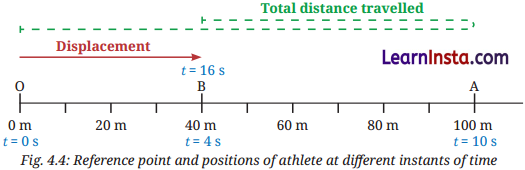
In the example of an athlete running back and forth on a straight track (Fig. below), when will the displacement of the athlete be zero? What will be the total distance travelled in that case?
Answer:
Yes, the displacement is zero because the athlete returns to the starting point. Total distance = non-zero (distance covered back and forth).
Question 2.
Fuel used up in a vehicle depends on which of the following? Justify your answer.
(i) Total distance travelled or
(ii) Displacement?
Answer:
Fuel used in a vehicle depends on
(i) total distance travelled. This is because the engine bums fuel for every metre the vehicle actually moves, regardless of direction. Whether the vehicle goes forward or comes back, fuel is consumed. Displacement only measures the net change in position (shortest straight¬line path between start and end), which does not represent the actual path on which fuel is burned. So more distance = more fuel, regardless of displacement.
Question 3.
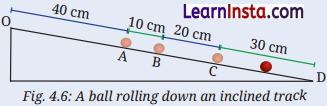
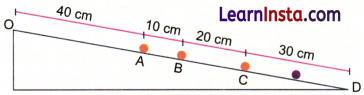
A ball rolls down an inclined track as shown in Fig. below. Is its motion a straight-line motion? Assuming the starting point of the ball (O) to be the origin, can its motion from O to D be depicted using a horizontal line as shown in Fig. 4.3 (See NCERT TB page 50)? Are the values of total distance travelled and magnitude of displacement from O equal or different at positions A, B, C and D?
Answer:
Yes, the ball rolling down the inclined track shown in above Fig. is a straight-line motion, as it moves along a straight inclined surface. If we take O as origin, the ball moves continuously in one direction (downward along the incline) without turning back. Since the ball moves in one direction only, the total distance travelled from O and the magnitude of displacement from O are equal at every position A, B, C, and D. The values are: at A: both equal 40 cm, at B: both equal 50 cm, at C: both equal 70 cm, at D: both equal 100 cm.
Pause and Ponder (NCERT Textbook Page No. 53)
Question 4.
During a family road trip, you drive 200 km north in three hours. Afterwards, you drive 200 km south in two hours. Find the average speed and average velocity for your entire trip.
Answer:
Total distance = 200 + 200 = 400 km
Total time 3 + 2 = 5 hours
Average speed = 400/5 = 80 km/h
Displacement = 0 (since you return to the starting point)
Average velocity = 0/5 = 0 km/h
Question 5.
Under what condition(s) is the
(i) magnitude of average velocity of an object equal to its average speed?
(ii) magnitude of average velocity of an object zero while its average speed is not zero?
Answer:
(i) The magnitude of average velocity equals average speed when the object moves in one direction only, without turning back, throughout the entire time interval. In this case, total distance equals the magnitude of displacement.
(ii) Average velocity is zero while average speed is not zero when the object starts and ends at the same position (displacement is zero) but has actually travelled some distance in between, such as when an object goes from A to B and returns to A. The total distance is non-zero, but displacement is zero.
Class 9 Science Chapter 4 Question Answer (Activities)
Activity 4.1:
Let us Analyse (NCERT Textbook Page No. 51)
Object:
A ball is thrown vertically upward from point O. It goes up to B (highest point, 140 cm above O), passing through A (40 cm above O) on the way up. It then falls back down, passing through C (80 cm above O) on the way down, and returns to O.
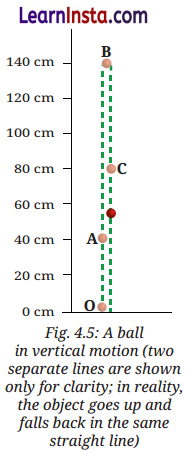
Aim:
You need to find the total distance and displacement at each position.
At O (starting):
Distance = 0 cm. Displacement = 0 cm.
At A (40 cm up, going up):
Distance = 40 cm. Displacement = 40 cm upward.
At B (140 cm up, highest point):
Distance = 140 cm. Displacement = 140 cm upward.
At C (80 cm up, coming down):
The ball went up 140 cm and then came down 60 cm to reach C.
Distance = 140 + 60 = 200 cm. Displacement = 80 cm upward (C is still 80 cm above O).
At O (back at start):
Ball went up 140 cm and came down 140 cm.
Distance = 280 cm. Displacement = 0 cm (back at starting point).
Conclusion:
Option (iii) is true: the magnitude of displacement is less than or equal to the total distance. They are equal only when the ball moves in one direction (O to B). When the ball turns back, distance becomes greater than the magnitude. The magnitude of displacement can never be greater than total distance.
Activity 4.2:
Let us Calculate ((NCERT Textbook Page No. 55)
Object:
Look up on the internet the time taken by various car models to go from 0 kmh-1 to 100 kmh-1.
Calculate the magnitude of average acceleration for each car.
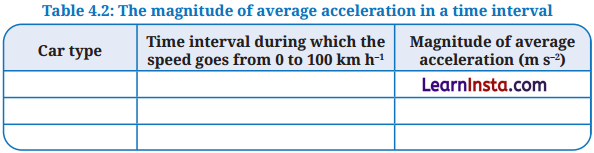
Aim:
Convert 100 kmh-1 to ms-1: 100 kmh-1 = 100 multiplied by (1000/3600) = 27.78 ms-1.
Initial velocity = 0 ms-1.
Time = whatever you looked up.
Average acceleration = (27.78 – 0) divided by time in seconds = 27.78 divided by t ms-2.
Example: If a car goes from 0 to 100 kmh-1 in 10s: 27.78 ,
acceleration = \(\frac {27.78}{10}\) = 2.778 ms-2.
If another car does it in 5 s: acceleration = \(\frac {27.78}{5}\) = 5.556 ms-2.
The car that takes less time has greater acceleration.
Conclusion:
Different cars have different accelerations. Performance/sports cars have larger accelerations (reach 100 kmh-1 faster). Economy cars have smaller accelerations. This activity shows how average acceleration is calculated in real life.
Activity 4.3:
Let us Plot a Graph (NCERT Textbook Page No. 57)
Object:
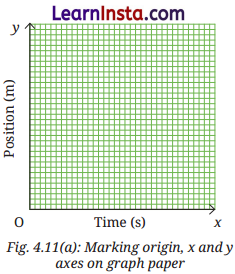
Use the data in Table 4.3 (time: 0, 1,2, 3, 4, 5, 6 s and corresponding positions: 0, 20, 40, 60, 80, 100, 120 m) to plot a position-time graph.

Aim:
Draw two perpendicular lines (x-axis = time, y-axis = position).
Choose a scale:
x-axis : 5 divisions = 1 s.
y-axis : 5 divisions = 20 m.
Mark the values and plot each point by finding where the time value on the x-axis and the position value on the y-axis intersect. Connect all points.
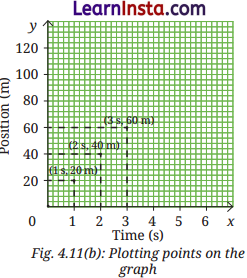
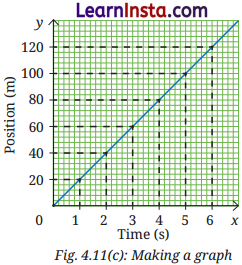
All points lie exactly on a straight line passing through the origin. This is because the vehicle travels 20 m every second, which is uniform motion at a constant velocity of 20 ms-1.
Conclusion:
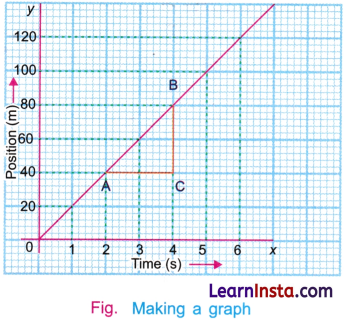
A straight line on a position-time graph = uniform motion = constant velocity.
The slope of the 20 m line = velocity = \(\frac{20 \mathrm{~m}}{1 \mathrm{~s}}\) = 20 ms-1.
Activity 4.4:
Let us Calculate (NCERT Textbook Page No. 59)
Object:
From the position-time graph plotted in Activity 4.3, take a section AB of the graph. Draw lines parallel to the axes from A and B to form a right-angled triangle ABC. Find the velocity from this triangle.
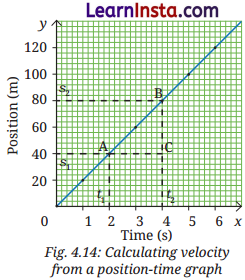
How it works:
Point A is at (2 s, 40 m) and point B is at (4 s, 80 m).
BC = vertical side = change in position = 80 – 40 = 40 m.
CA = horizontal side = change in time = 4 – 2 = 2 s.
Velocity = BC divided by CA = \(\frac{40 \mathrm{~m}}{2 \mathrm{~s}}\) = 20 ms-1.
The ratio \(\frac{\mathrm{BC}}{\mathrm{CA}}\) is called the slope of the line AB. It is the steepness of the line.
Slope = change in y divided by change in x = change in position divided by change in time = velocity. A steeper line = larger slope = higher velocity.
Conclusion:
To find velocity from a position-time graph, draw a right-angled triangle under the line and calculate slope = vertical change divided by horizontal change.
Activity 4.5:
Let us Investigate (NCERT Textbook Page No. 67)
Object:
Take a ring (like an adhesive tape ring) and a marble. Place the ring on a smooth, flat surface and throw the marble inside the ring so it rotates along the inner boundary. After 1 or 2 revolutions, quickly lift the ring while the marble is moving. Observe what happens to the marble.
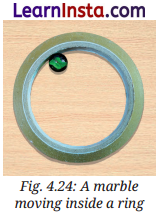
Observation:
When the ring is removed, the marble immediately stops moving in a circle and instead moves in a straight line in the direction it was heading at the moment the ring was removed.
The ring was continuously pushing the marble towards the centre, forcing it to travel in a circle. When the ring is removed, no force acts to change the marble’s direction. The marble continues to move in the direction it had at that instant, which is along the tangent to the circle at that point. This is due to inertia (the tendency of objects to maintain their state of motion), which you will learn more about in Chapter 6.
Conclusion:
In circular motion, a force is needed to continuously change the direction. Without this force, the object moves in a straight line tangent to the circle. The velocity in circular motion is always directed along the tangent to the circle at that point.