Get the simplified Extra Questions for Class 9 Maths and Ganita Manjari Class 9 Maths Chapter 11 The World of Algorithms Extra Questions with complete explanation.
Class 9 The World of Algorithms Extra Questions
Extra Questions on The World of Algorithms Class 9
Class 9 Ganita Manjari Chapter 11 Extra Questions
Question 1.
Why are columns aligned from right to left in the addition algorithm?
Solution:
Columns are aligned from right to left because addition starts from the units place and moves towards higher place values.
Question 2.
What is the purpose of maintaining a list of divisors?
Solution:
A list of divisors helps us store all numbers that divide a given number exactly and use them for further calculations.
Question 3.
Define the greatest common divisor (gcd).
Solution:
The greatest common divisor is the largest number that divides two given numbers completely.
Question 4.
What is a data structure?
Solution:
A data structure is a method of organising and storing data so that it can be used efficiently in an algorithm.

The World of Algorithms Class 9 Short Question Answer
Question 1.
Differentiate between Euclid’s subtraction algorithm and Aryabhata’s division algorithm.
Solution:
| Euclid’s Subtraction Algorithm | Aryabhata’s Division Algorithm |
| Uses repeated subtraction | Uses division and remainder |
| Requires more steps | Requires fewer steps |
| Reduces one number repeatedly | Reduces numbers faster using remainder |
Question 2.
Evaluate the gcd (3125, 15625) using improved version of Euclid’s algorithm.
Solution:
Find gcd(3125, 15625) using the improved version of Euclid’s algorithm.
Step 1: Since 15625 >3125, we write gcd(15625, 3125).
Step 2: Divide 15625 by 3125.

Step 3: The remainder is 0, so
gcd( 15625, 3125) = 3125.
Therefore, gcd(3125, 15625) = 3125.
The World of Algorithms Class 9 Long Question Answer
Question 1.
Write an algorithm to add two decimal numbers. Demonstrate the algorithm by finding the sum of 245.6 and 132.4.
Solution:
Algorithm for add two decimal numbers:
1. Align the numbers according to their place values, keeping the decimal points in the same column.
2. Add the digits from right to left, one column at a time.
3. If the sum of digits in a column is 10 or greater, write down the units digit and carry 1 to the next column.
4. Repeat the process until all columns (including any carry) have been added.
5. Place the decimal point in the result directly below the decimal points of the given numbers.
Demonstration: Add 245.6 and 132.4
Align by place value:

Add column by column, right to left:
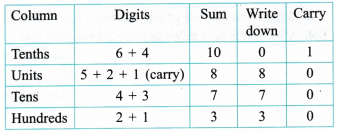
Placing the decimal point in line with the inputs:

Sum = 378.0
Question 2.
Explain the steps involved in finding gcd using Euclid’s subtraction algorithm using an example.
Solution:
Euclid’s subtraction algorithm finds the greatest common divisor (gcd) of two numbers by repeatedly subtracting the smaller number from the larger number until both numbers become equal.The steps are:
1. Compare the two numbers.
2. Subtract the smaller number from the larger number.
3. Replace the larger number with the difference obtained.
4. Repeat the process until both numbers become equal.
5. The common value is the gcd of the two numbers.
Example: Find gcd(60, 16)
Applying Euclid’s subtraction algorithm to gcd(60, 16) Since 60 > 16, Step 3 asks us to reduce the problem to computing gcd(44, 16).
Since 44 > 16, Step 3 asks us to reduce the problem to computing gcd(28, 16).
Since 28 > 16, Step 3 asks us to reduce the problem to computing gcd( 12, 16).
Since 12 < 16, Step 1 asks us to reverse the numbers and compute gcd(16, 12). Since 16 > 12, Step 3 asks us to reduce the problem to computing gcd(12, 4).
Since 12 > 4, Step 3 asks us to reduce the problem to computing gcd(8, 4).
Since 8 > 4, Step 3 asks us to reduce the problem to computing gcd(4, 4).
Therefore, gcd(60, 16) = 4
The World of Algorithms Class 9 Case Based Questions
Question 1.
Riya wants to create an algorithm to find all divisors of 24. She checks every number from 1 to 24 and stores the numbers that divide 24 exactly. Based on the information, answer the following questions.
(i) Which algorithmic concept is Riya using?
(ii) Write the divisors of 24.
(iii) Why is maintaining a list useful in this algorithm?
Solution:
(i) The divisors of a number can be found by checking every number from 1 to the given number and recording those that divide it exactly.
1. Start with an empty list-of-divisors.
2. For each number j in the sequence 1, 2, 3,…, n.
If j divides n, add j to the list-of-divisors.
(ii) Initially list-of-divisors is empty [ ].
- 1 divides 24, so we update list-of-divisors to [1],
- 2 divides 24, so we update list-of-divisors to [1, 2].
- 3 divides 24, so we update list-of-divisors to [1, 2, 3]
- 4 divides 24, so we update list-of-divisors to [1, 2, 3, 4]
- 5 does not divide 24, so we leave list-of-divisors unchanged as [1, 2, 3, 4],
- 6 divides 24, so we update list-of-divisors to [1, 2, 3, 4, 6],
- 7 does not divide 24, so we leave list-of-divisors unchanged as [1, 2, 3, 4, 6].
- 8 divides 24, so we update list-of-divisors to [ 1, 2, 3, 4, 6, 8],
- 9, 10, 11 do not divide 24, so we leave list-of- divisors unchanged as [1, 2, 3, 4, 6, 8].
- 12 divides 24, so we update list-of-divisors to [1,2, 3,4, 6, 8, 12]
- 10, 11, 13, 14, 15, 16, 17, 18, 19, 20, 21, 22 and
- 23 do not divide 24, so we leave list-of-divisors unchanged.
- 24 divides 24, so we update list-of-divisors to: [1, 2, 3, 4, 6, 8, 12, 24]
Therefore, the list of divisors of 24 is: [1,2, 3,4,6, 8, 12, 24]
(iii) A list stores all obtained divisors systematically and allows further processing.
The World of Algorithms Class 9 Competency Based Questions
Question 1.
Kavita wants to add a 4-digit number and a 2-digit number.
But she is not able to find the correct sum using the standard addition algorithm. Modify the algorithm to add 5478 and 95 and apply the algorithm to find the sum.
Solution:
Addition should begin from the rightmost digit because the rightmost digit represents the ones place. If the sum of digits in any column is more than 9, the extra value is carried to the next column on the left. This process continues from the ones place to the higher place values (tens and hundreds).
Algorithm to add a 4-digit number and a 2-digit number
1. Write the two numbers one below the other with their digits aligned according to place value.
2. If the numbers have different numbers of digits, add 10 leading zeros to the smaller-number to. make the number of digits equal.
3. Add the digits in the rightmost column (ones place).
4. If the sum is less than 10, write the sum directly.
5. If the sum is more than 9, write the units digit and carry 1 to the next column.
6. Add the next column along with the carry value.
7. Repeat the process until all columns are added.
8. If any carry remains after adding the last column, write it on the left side.
Applying the algorithm to find 5478 + 95

Step 1: Write as per place values.
Step 2: Add the leading zeros.
Step 3: Add ones place: 8 + 5 = 13 Write 3 and carry 1.
Step 4: Add tens place: 7 + 9 + 1 = 17 Write 7 and carry 1.
Step 5: Add hundreds place: 4 + 1 = 5
Step 6: Add the thousands place: 5 + 0 = 5
Therefore, 5978 + 95 = 5573
Question 2.
A school has 250 red beads and 550 blue beads. The beads have to be arranged into the greatest possible number of identical groups, with each group containing the same number of red and blue beads. Which mathematical concept can be used to solve this problem? Find the required greatest common divisor of 250 and 550 using Euclid’s divison algorithm. How many red and blue beads will each group contain?
Solution:
The problem can be solved using the greatest common divisor (gcd).
Finding gcd(550, 250) using Euclidean algorithm:
Step 1: Divide 550 by 250.
550 = 250 × 2 + 50
So, gcd(550, 250) = gcd(250, 50).
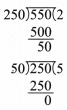
Step 2: Divide 250 by 50.
250 = 50 × 5 + 0
So, gcd(250, 50) = 50.
Step 3: Since the remainder is 0, we stop.
Step 4: Therefore, gcd(550, 250) = 50.
Conclusion:
The greatest common divisor of 550 and 250 is 50. So, the beads can be arranged into 50 identical groups. Each group will contain:
- Red beads per group = 250 + 50 = 5
- Blue beads per group = 550 + 50 = 11
The World of Algorithms Class 9 Extra Questions for Practice
Multiple Choice Questions
Question 1.
Which of the following best describes an algorithm?
(a) A collection of numbers
(b) A step-by-step procedure to solve a problem
(c) A computer device
(d) A mathematical symbol
Question 2.
In the digit-by-digit addition algorithm, addition begins from:
(a) Leftmost digit
(b) Middle digit
(c) Rightmost digit
(d) Largest digit
Question 3.
In the algorithm for finding divisors of a number n, a number j is added to the list of divisors when:
(a) j is greater than n
(b) j divides n exactly
(c) j is a prime number
(d) j is smaller than 1
Assertion-Reason Questions
Two statements are given, one labelled as Assertion (A) and the other labelled as Reason (R). Select the correct answer from the options (a), (b), (c), and (d) given below.
(a) Both Assertion (A) and Reason (R) are true and Reason (R) is the correct explanation of the Assertion (A).
(b) Both Assertion (A) and Reason (R) are true, but Reason (R) is not the correct explanation of the Assertion (A).
(c) Assertion (A) is true, but Reason (R) is false.
(d) Assertion (A) is false, but Reason (R) is true.
Question 1.
Assertion (A): The greatest common divisor of two numbers is the largest number that divides both numbers exactly.
Reason (R): A common divisor may divide only one of the given numbers.
Question 2.
Assertion (A): Euclid’s division algorithm is more efficient than Euclid’s subtraction algorithm.
Reason (R): Division reduces the problem size faster by using remainders.
Short Answer Type Questions
Question 1.
What is an algorithm? Write any two characteristics of an algorithm.
Question 2.
Find the divisors of 18 using the divisor-finding approach.
Question 3.
What are the modifications required in addition algorithm to find the sum of 1.15 and 0.1?
Question 4.
Find the gcd of 60 and 16 using Euclid’s subtraction algorithm.
Question 5.
Give an example to show a number divides m and n if and only if it divides both n and m mod n.
Question 6.
A student writes the following steps to find gcd (825, 375):
825 – 375 = 450
450-375 = 75
Explain why the process needs further steps to find the gcd.
Long Answer Type Questions
Question 1.
The following numbers are given: m = 8732, n = 6459.
(i) Find gcd(m, n) using Euclid’s division algorithm.
(ii) Write all the steps of the algorithm.
(iii) Explain why the last non-zero divisor gives the gcd.
Question 2.
A school has 540 red beads and 810 blue beads. The beads have to be arranged into the greatest possible number of identical groups.
(i) Identify the mathematical concept used to solve this problem.
(ii) Find the gcd of 540 and 810 using Euclid’s division algorithm.
(iii) Find the number of red and blue beads in each group.
Question 3.
Explain how algorithms can be improved. Compare the basic divisor-finding algorithm with an improved algorithm in terms of efficiency and number of steps.