Practice with Understanding Society India and Beyond Class 9 Solutions and Class 9 Social Science SST Part 2 Chapter 2 Life on Earth Social Science Question Answer NCERT Solutions to improve your exam performance.
Life on Earth Class 9 Questions and Answers
Class 9 Life on Earth Question Answer
The Big Questions? (Page No. 21)
Question 1.
How do physiography and climate shape life on Earth?
Answer:
Physiography and climate determine the conditions in which plants, animals, and humans live. Different environments, such as forests and grasslands. deserts, and tundra support different forms of Life. Temperature and rainfall. Landforms and water influence the distribution and adaptation of living organisms.
Question 2.
How are humans and other life forms interconnected?
Answer:
Humans, plants, animals, and microorganisms depend on one another. Animals help in pollination and seed dispersal, humans use and modify natural resources, and microorganisms recycle nutrients. These interactions help maintain ecological balance and biodiversity.
Question 3.
What is the importance of preserving various life forms, and how can we contribute to their conservation?
Answer:
Preserving life forms is important for maintaining biodiversity, ecological balance, and healthy ecosystems. We can contribute by protecting habitats, conserving biodiversity hotspots, supporting protected areas, using natural resources sustainably, and involving local communities in conservation.

Life on Earth Question Answer Class 9
InText Questions
Lets Explore
Question 1.
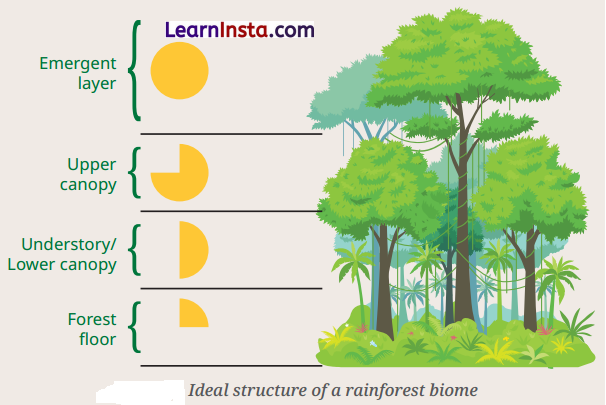
Look at the layers of vegetation in a rainforest. What do the yellow shapes in the figure indicate? (Page No. 24)
Answer:
- The yellow shapes indicate the amount of sunlight
- received at different layers of the rainforest.
- Emergent layer – receives the most sunlight.
- Upper canopy – receives a large amount of sunlight.
- Understory/Lower canopy – receives less sunlight.
- Forest floor – receives the least sunlight.
Question 2.
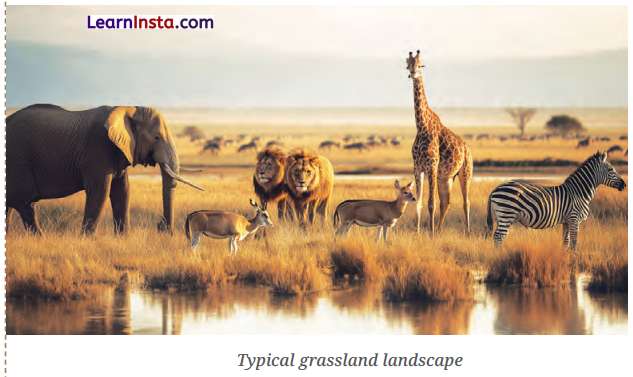
Observe the below figure and explore which of these animals you will find in the grasslands of India. (Page No. 25)
Answer:
Animals from the figure that can be found in the grasslands of India include:
- Elephant
- Lion
- Deer
- Antelope
- Zebra is not found in the grasslands of India.
Question 3.
What types of activities do you think people in desert regions generally undertake to sustain their households and livelihood?
Answer:
People in desert regions generally undertake activities such as animal rearing, agriculture where water is available, handicrafts, trade, and tourism to support their households and livelihoods.
Question 4.
With the help of your teacher, explore how do people address issues related to the availability of water (Page No. 26)
Answer:
People in desert regions address water scarcity by storing water, using available water carefùlly, and adopting methods that help conserve and manage limited water resources.
Question 5.
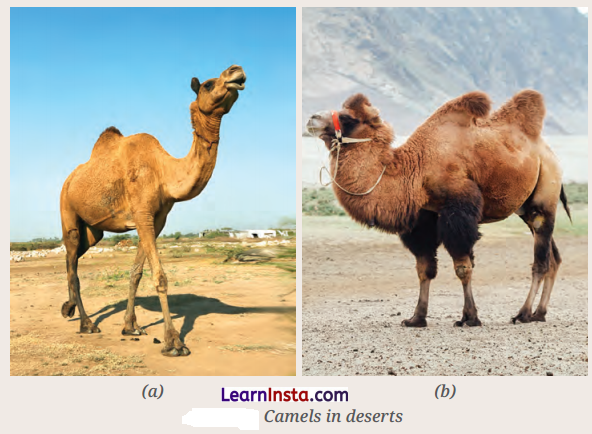
Compare the physical features of the Rajasthan camel (Fig. a) and the Nubra Valley (Ladakh) camel (Fig. b).
Answer:
The Rajasthan camel has a lighter body, longer legs, and a single hump, making it well suited to the hot and dry desert environment. The Nubra Valley camel is generally smaller and has two humps, with a thicker coat that helps it survive the cold climate of Ladakh.
Question 6.
Considering the climatic conditions, why do you think the Nubra Valley camel might have a different fur density than the Rajasthan camel? (Page No. 26)
Answer:
The Nubra Valley camel has denser fur because it lives in the cold climate of Ladakh, where thick fur helps keep its body warm. The Rajasthan camel has thinner fur because it lives in the hot and dry desert climate.
Question 7.
Explore your local environment. This could be your village, city, town, or residential area. Observe how people. plants, and animals build structures and interact. Complete the table with your findings.
| Component type | Examples observed | Interaction with humans |
| Trees/ Vegetaion/ Plants | ||
| Insects | ||
| Animals | ||
| Non-living | ||
| things |
(Page No. 28)
Answer:
| Component type | Examples observed | Interaction with humans |
| Trees/ Vegetaion/ Plants | Trees and other vegetation | Plants provide resources and form part of the natural environment in which humans and animals live. |
| Insects | Insects | Insects are part of the ecosystem and interact with plants, animals, and humans. |
| Animals | Animals | Animals interact with humans and help in processes such as pollination and seed dispersal. |
| Non-living things | Water, soil, and other non-living components | Humans depend on natural resources, while non-living things form part of the environment in which living organisms interact. |
Question 8.
Answer:
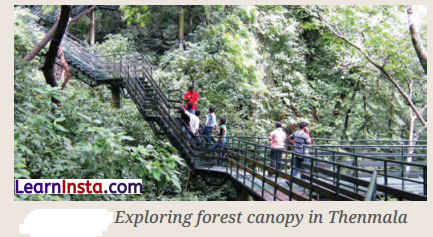
Thenmala Ecotourism in Keralam
Thenmala, located in the Kollam district of Keralam, is India’s first planned ecotourism destination, developed jointly by the Tourism Department, the Forest Department, and the Irrigation Department of Keralam.
The name Thenmala means ‘Honey Hills’, reflecting the area’s natural richness and biodiversity within the Western Ghats-a UNESCO World Heritage Site. The project was launched to promote sustainable tourism while conserving forests and supporting local communities by employing the inhabitants as guides, eco-guards, and service providers, ensuring that the tourism benefits are shared within the community. Thenmala’s success lies in its balanced approach-combining recreation, environmental education, and conservation-making it a model for responsible forest-based ecotourism in India.
(a) Is there any such ecotourism site in your State/UT? Collect some information and discuss with your friends.
(b) What should be a tourist’s behaviour while visiting any tourist site? What should one be mindful of? (Pages No. 32-33)
Answer:
(a) Yes. For example, if the State/UT is Delhi:
Asola Bhatti Wildlife Sanctuary is an important ecotourism site in Delhi. It is known for its natural landscape, forests, wetlands, and wildlife. Visitors can enjoy nature walks and observe plants and animals while following rules that help protect the environment.
(b) A tourist should:
- Respect the environment, local culture and people.
- Keep the place clean and avoid littering.
- Avoid damaging plants, monuments, or other property.
- Do not disturb or harm wildlife.
- Follow the rules and instructions of the tourist site.
- Avoid loud noises and use natural resources responsibly.
- Stay on designated paths and be mindful of safety.
Question 9.
Try to identify and classify the items for sale in the images given below. Also, make a list of the food and medicinal varieties available in your local market. (Page No. 36)
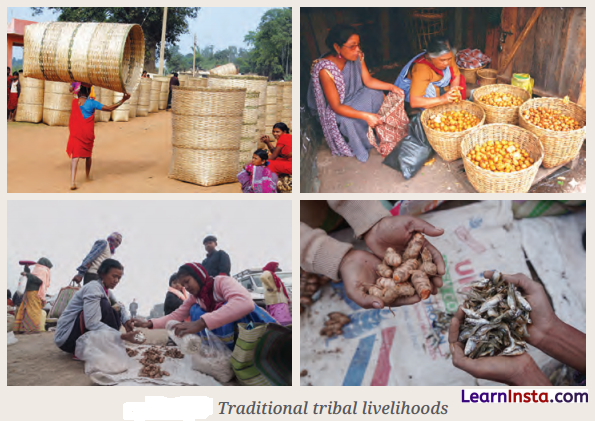
Answer:
The items shown for sale include:
- Bamboo baskets and other bamboo products.
- Wild fruits and berries.
- Tubers and roots.
- Small fish and other aquatic food items.
Food and medicinal varieties in the local market will depend on the region. These can be listed by observing the local market and identifying the products sold there.
Question 10.
Can you explain how GI tagging of the forest products mentioned below connects geography, cultural traditions, local governance, and rural economy? (Page No. 38)
Some GI-tagged forest products of India
1. Ramban Sulai Honey (Jammu and Kashmir): It is highly nutritious, with strong antioxidant and immuno-modulatory potential, and has a distinct flavour, aroma, and taste:
2. Tezpur Utchi (Assam): Grown in the forest-influenced soil and climate of Assam’s Tezpur region.
It has a distinctive bright colour and high pulp content.
3. Channapatna Toys (Karnataka): The notable aspect of this forest-based craft is that they are made from Wrightia tinctoria. A forest tree locally known as ‘Aale mara’.
4. Kandhamal Haldi (Odisha): A variety of turmeric grown by tribal communities in the forest regions of Kandhamal. It is known for its high curcumin content and medicinal value.
5. Erode Manjal/Erode Turmeric (Tamil Nadu): Cultivated in forest-influenced soils, it is used for cooking and Ayurvedic medicine.
6. Nilgiri Tea (Tamil Nadu, Kerala, Karnataka): Though plantation-based, its quality depends on the forest ecosystem conditions of the Western Ghats.
7. Tripura Queen Pineapple (Tripura): With a forest-dependent cultivation, it is famous for its sweetness and aroma.
8. Khasi Mandarin (Meghalaya): A citrus fruit from the forest-rich hills of Meghalaya.
Answer:
GI tagging connects geography and cultural traditions. local governance and the rural economy by linking products to their specific geographical regions and their unique natural and traditional qualities. It recognises the traditional knowledge and skills of local communities, supports local producers, and helps create better market opportunities, thereby strengthening rural livelihoods and preserving cultural heritage.
Question 11.
Can you name some GI-tagged forest products from your State or Union Territory? (Page No. 38)
Answer:
Do it yourself.
Question 12.
You may have heard about the Pradhan Mantri Ujjwala Yojana (PMUY). How are the benefits of this scheme impacting the health of women?
Answer:
The Pradhan Mantri Ujjwala Yojana provides cleaner cooking fuel, reducing women’s exposure to harmful fuelwood fumes. This can help reduce health problems caused by indoor air pollution and make cooking safer and healthier for women.
Question 13.
Below is a figure from the School Bhuvan-NCERT Geoportal. Observe the image carefully and see if you can identify some of the tanks and mark the agricultural fields irrigated by them. (Page No. 42)
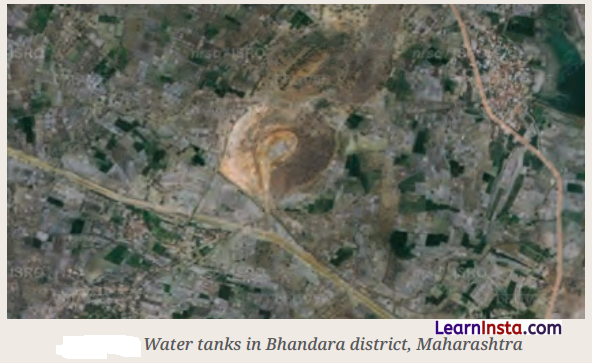
Answer:
Do it yourself.
Let’s Map
Question 1.
Look at the world map given below and answer the following questions. (Page No. 22)
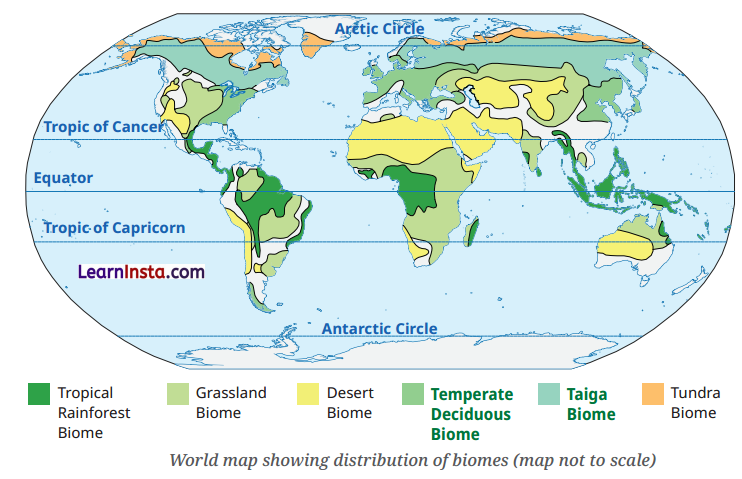
(i) Which type of biome is found in smaller, separate regions, and why?
Answer:
Temperate deciduous forests are found in smaller, separate regions because they require moderate temperatures. adequate rainfall and distinct seasons. which occur only in certain parts of the world.
(ii) Which continent has the least number of biomes? What could he the reason for this?
Answer:
Antarctica has the least number of biomes. Its extremely cold climate, permanent ice cover, and very low precipitation limit the variety of vegetation and animal life.
(iii) Why are there areas that do not have any specific biomes?
Answer:
Some areas do not have a specific biome because their climatic conditions may be too extreme or unsuitable for the vegetation and animal life that characterise a particular biome.
Question 2.
Mark the following regions at appropriate levels on the below figure: Andaman & Nicobar Islands, Keralam, Ladakh, Chhattisgarh, Odisha, Meghalaya, and Lakshadweep. Where will you place your home? There is no arrow on the third side of the triangle. What would happen if we drew an arrow? Would it point upwards or downwards? (Page No. 29)
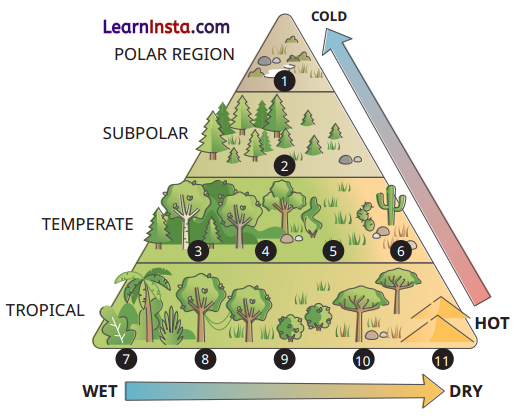
Answer:
- Andaman & Nicobar Islands – Level 7: Rainforest
- Kerala – Level 7: Rainforest
- Ladakh – Level 1: Tundra
- Chhattisgarh – Level 9: Tropical Seasonal Forest
- Odisha – Level 9: Tropical Seasonal Forest
- Meghalaya – Level 7: Rainforest
The third side of the triangle could represent biodiversity. The arrow would point downwards, towards the hot and wet region, because warm and wet conditions generally support greater biodiversity.
Question 3.
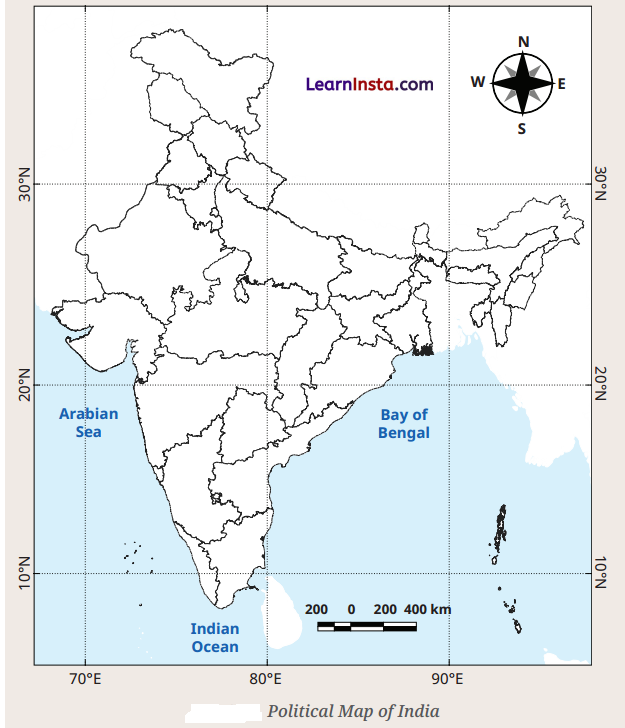
Mark and name the following regions on the map in the given below. Also gather more information about these biodiversity regions from your teacher or other sources and discuss their features with your peers.
1. Namdapha National Park
2. Rann of Kutch
3. Gahirmatha Beach
4. Gulf of Mannar
5. Pachmarhi
6. Achanakmar-Amarkantak
Answer:
Think About It
Question 1.
Tundra in polar regions has mosses, lichens, shrubs, etc., while the Himalaya, in the subtropics, is dominated by conifers. What could be the reason for this? What difference do you find in the animals found in these two regions? Which species are found only in the Himalaya? Discuss in class. (Page No. 27)
Answer:
The difference is mainly due to climate and altitude. The polar tundra has extremely cold conditions, a short growing season, and frozen soil, so only mosses, lichens, and small shrubs can survive. The Himalaya has comparatively warmer conditions at lower and middle altitudes, allowing coniferous forests to grow.
Tundra animals include reindeer, Arctic foxes, polar bears, and other cold-adapted species.
Himalayan regions have animals such as the snow leopard. Himalayan tahr, red panda, yak and musk deer. Species such as the snow leopard, red panda, Himalayan tahr, yak and musk deer are found in the Himalaya and are not typical of the polar tundra.
Question 2.
Sacred groves are small forest patches protected by local communities for religious and cultural purposes. Across India, there are over 1,00,000 sacred groves, though many are not officially recorded. They are known by different names, such as Devrai, Devarakadu, Kavu, and Sarna.
Why are these groves so special? Despite being small, they are rich biodiversity hotspots, often preserving rare plants, medicinal species, and wildlife that may not survive elsewhere. Some groves are even linked to water sources and help to maintain streams and groundwater.
Answer:
Sacred groves are special because they conserve biodiversity and protect rare plants, medicinal species, and wildlife. They are also important for maintaining water sources, streams and groundwater.
Question 3.
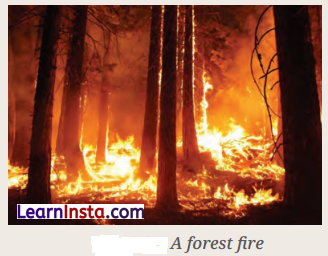
You may already be aware that incidents of forest fires have been reported from different parts of India and are a matter of serious concern. According to the Forest Survey of India (FSI), about 36 per cent of the country’s forest cover is estimated to be prone to forest fires, of which nearly 4 per cent is extremely prone. Climate change as well as human-induced factors are the main reasons for such occurrences, some of which are quite severe and cause extensive damage to human life and the environment (see below figure). Note: You may explore various fire locations on the School Bhuvan-NCERT Geoportal. (Page No. 38 – 39)
Answer:
Do it yourself.
Question 4.
Which wild animals (like monkeys or deer) have you seen in your residential area?
Answer:
Do it yourself.
Question 5.
Identify the causes behind these animals’ presence in human settlements.
Answer:
These animals may enter human settlements because their natural habitats are close to human settlements and are affected by human activities. Roads and other developments through forest areas can also disturb their movement and bring them closer to people.
Class 9 SST Part 2 Chapter 2 Question Answer
Questions and Activities (Page No. 43)
Question 1.
Why does India have diverse biomes? How does the local geography connect to the diversity?
Answer:
India has diverse biomes because different regions have different climates, temperatures, precipitation, landforms, and ecosystems. Local geography affects the types of plants and animals that can survive in each region. Make a list of economically valuable native plants in your region and comment on their abundance.
Question 2.
Make a list of economically valuable native plants in your region and comment on their abundance.
Answer:
Do it yourself.
Question 3.
Prepare a map of your state or Union Territory showing national parks and sanctuaries.
Answer:
Do it yourself.
Question 4.
Study the impact of forest fires on people dependent on forests. Try to include the causes, losses, and preventive measures.
Answer:
Forest fires can destroy homes and forest resources, causing economic losses to forest-dependent communities. The chapter states that climate change and human-induced factors are major reasons for forest fires. Human care and preventive measures can help prevent many forest fires.
Question 5.
Why are forests often called the ‘lungs of the Earth ‘?
Answer:
Forests are called the ‘lungs of the Earth’ because they play an important role in maintaining oxygen levels and balancing the Earth’s climate.
Question 6.
If large forest areas continue to be destroyed, what do you think would be its long-term effect on the global climate?
Answer:
The forests play an important role in balancing the Earth’s climate. Therefore, continued destruction of large forest areas would affect this role and could disturb the global climate balance.
Question 7.
Discuss some traditional forest conservation methods with your grandparents or an elderly person.
Answer:
The traditional practices include community forest management, rituals to honour forest deities before collecting resources, and the protection of forests through movements such as the Bishnoi Movement and Chipko Movement.
Question 8.
How do forest dwellers contribute to the protection and conservation of forests?
Answer:
Forest dwellers contribute by managing and using forest resources responsibly, preserving traditional knowledge, participating in community forest management, and protecting forests from deforestation and fires. The chapter also describes the Bishnol and Chipko Movements and the community forest management of Mendha Lekha.
Question 9.
What is a forest fire? Prepare a plan for prevention and mitigation of forest fires.
Answer:
A forest fire is a fire that spreads through forest vegetation and can destroy homes and forest resources. The chapter states that climate change and human-induced factors are major reasons for forest fires.
Prevention and mitigation:
- Take human care and preventive measures to prevent fires.
- Prevent activities that can cause fires.
- Protect homes and forest resources from spreading fires.
- Use suitable measures to control and reduce the damage caused by fires.