Practice with Understanding Society India and Beyond Class 9 Solutions and Class 9 Social Science SST Part 2 Chapter 3 Resistance and Resilience 1000-1700 CE Social Science Question Answer NCERT Solutions to improve your exam performance.
Resistance and Resilience 1000-1700 CE Class 9 Questions and Answers
Class 9 Resistance and Resilience 1000-1700 CE Question Answer
The Big Questions? (Page No. 45)
Question 1.
How did Indian rulers use resistance and alliances to safeguard their lands?
Answer:
- Indian rulers used military resistance, alliances, diplomacy and negotiation to protect their territories and political power.
- Rajput kingdoms, the Yadavas, Kakatiyas and Hoysalas resisted the expansion of the Delhi Sultanate.
- Mewar continued to resist Mughal authority, while some Rajput kingdoms such as the Kachhwahas of Amber developed cooperative relations with the Mughals.
- Maharana Pratap used guerrilla warfare and the difficult terrain of the Aravalli Hills to resist the Mughals.
- The Ahoms used alliances, knowledge of forests and rivers, guerrilla tactics and their river navy to defend their kingdom.
- The Marathas under Shivaji used strategic alliances, forts and guerrilla warfare to establish and protect Swarajya.
Question 2.
What factors contributed to the resilience of different kingdoms and communities during this period?
Answer:
- Resilience was strengthened by the ability to endure difficulties, adapt to changing circumstances, and sustain their way of life.
- Knowledge of local terrain, forests, and rivers helped communities defend themselves.
- Military strategies such as guerrilla warfare, alliances, and diplomacy helped kingdoms withstand external pressures.
- Cultural traditions, shared beliefs, and community support helped preserve socio-cultural and spiritual traditions.
- Agriculture, irrigation, markets, merchant networks, financial practices, and trade provided economic resources.
- These factors helped different kingdoms and communities maintain their identity and withstand periods of instability.

Question 3.
How did the Bhakti tradition foster a sense of solidarity?
Answer:
- The Bhakti tradition emphasised personal devotion to the divine.
- It encouraged equality, inclusion, and community participation.
- Bhakti saints used local languages, making their teachings accessible to a wider section of society.
- Practices such as sankirtan and satsang encouraged people to come together and participate collectively.
- The tradition focused on devotion rather than elaborate rituals and helped strengthen social and spiritual bonds.
- Women also participated in the Bhakti tradition and composed devotional poetry.
- Thus, Bhakti fostered a sense of community and solidarity among people.
Question 4.
How did the expansion of agriculture, trade and commerce keep the economy sound?
Answer:
- Agriculture expanded during this period and provided the resources needed to support communities and kingdoms.
- Irrigation methods such as the Persian wheel helped increase agricultural production.
- Markets and trade networks connected rural and urban areas.
- Banjaras played an important role in transporting goods between different regions.
- India was connected with the Persian Gulf, Arabian Sea, Indian Ocean, Central Asia, Mediterranean region, and China through trade networks.
- Indian merchants worked as traders, shippers, bankers, money-changers, brokers, interpreters, diplomats, and bureaucrats.
- Financial instruments such as hundis helped in making payments and transferring money over long distances.
- Despite political instability and invasions, agriculture, irrigation, markets, merchant networks, and trade kept the economy dynamic and contributed to resilience and stability.
Resistance and Resilience 1000-1700 CE Question Answer Class 9
InText Questions
Lets Explore
Question 1.
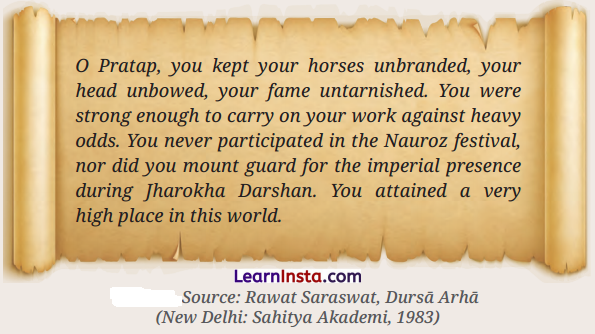
After the death of Maharana Pratap, renowned poet Dursa Arha gave a vivid account of Maharana Pratap in the following lines: (Page No. 54)
Answer:
Two actions that show Maharana Pratap maintained his independence from the Mughal court were:
- He kept his horses unbranded and his head unbowed.
- He never participated in the Nauroz festival or guarded the emperor during Jharokha Darshan.
Question 2.
Explore the contributions of the Nayanar saints, such as Karaikal Ammaiyar, and the Alvar saints, such as Andal, to the spread of the Bhakti tradition in peninsular India. Discuss their teachings and devotional practices and the ways in which they connected with people through their hymns. (Page No. 64)
Answer:
- The Nayanar saints were devotees of Shiva, while the Alvar saints were devotees of Vishnu.
- Karaikal Ammaiyar was an important Nayanar saint, while Andal was a well-known Alvar saint.
- They helped spread the Bhakti tradition in peninsular India through personal devotion and devotional hymns.
- Their hymns expressed deep love and devotion towards the divine and made spiritual ideas accessible to people.
- The Bhakti tradition emphasised inclusivity, social and religious equality, simplicity and connection with everyday life.
- The saints used local languages in their devotional compositions, allowing their teachings to reach wider sections of society.
- Devotional singing and community participation helped people come together and strengthened a shared sense of devotion and community.
- Their hymns and devotional practices helped preserve and spread the Bhakti tradition among the people.
Let’s Map
Question 1.
On a map of India, locate and label the present-day states associated with the saints mentioned in the infographic below. Also, find and mark a saint from your own state who is not one the list. Are you familiar with any songs, poems, or verses composed by these saints? Share with the class and explain what it means or what you like about it.
Northern and Central Region
- LāI Ded
- Vallabhāchārya
- Guru Nānak
- Surdās
- Rāmānanda
- Tulsīdās
- Kabīr
- Mirābāī
- Rāidāsa
Eastern Region :
- Jayadeva
- Chaitanya Mahāprabud
- Krittibāsa
- Madhava Kandalī
- Sankardev
Southern Region :
- Basavannā
- Annamāchārya
- Poonthanam Namboothiri
- Madhavāchārya
- Pothanā
Western Region
- Ekanātha
- Jn̄ānadeva
- Muktābāī
- Namadeva
- Janabai
- Narasimha Mehtā
- Bhalana
- Pipaji
- Tukaram
- Chokhamelā (Page 67)
Answer:
Do it yourself.
Think About It
Question 1.

Translation of a vakh composed by Lāl Ded
LāI Ded says that it is ‘easy’ to learn scriptures but ‘hard’ to live them. What is the difference between knowing a rule and actually following it? Can you give an example from your daily life? (Page No.67)
Answer:
The difference between knowing a rule and actually following it is that knowing a rule means understanding what we should do, while following it means putting that knowledge into practice. For example, we may know that we should not waste water, but actually following the rule means turning off the tap when it is not needed and using water carefully.
Question 2.
What do you think made hundi a safer and more convenient choice than physically transporting money across long distances?
Answer:
A hundi was a safer and more convenient choice because it allowed money to be transferred over long distances without physically carrying large amounts of cash. It reduced the risk of theft or loss and made long-distance payments easier.
Question 3.
Identify some cultural and economic pillars that exist in any community, such as places of faith, traditions, business and trade. How do you think these contribute to resilience in a society facing invasions or external pressures?
Answer:
Places of faith, traditions, agriculture, business, markets, and trade are important cultural and economic pillars of a community. They help people maintain their beliefs, cultural identity, and social connections. Economic activities provide resources and support people during difficult times. Together, these pillars strengthen community support and help society adapt to external pressures and maintain its way of life.
Class 9 SST Part 2 Chapter 3 Question Answer
Questions and Activities (Page No. 77-79)
Question 1.
Choose the most appropriate answer.
Resistance and resilience are closely connected because:
(a) Resistance always involves warfare:
(b) Resilience enables communities to endure difficulties and sustain resistance.
(c) Resistance is possible only when a kingdom has a large army.
(d) Resilient societies avoid all forms of conflict.
Answer:
(b) Resilience enables communities to endure difficulties and sustain resistance.
Question 2.
Why and how did groups such as the Sikhs, Marathas, and Rajputs assert their political power and identity during periods of changing political authority?
Answer:
- The Sikhs developed a stronger organisational and political orientation in response to growing Mughal intervention.
- Guru Hargobind established the Akal Takht, a seat of temporal authority, and Guru Gobind Singh established the Khalsa in 1699.
- The Marathas, under Chhatrapati Shivaji, established an independent Maratha state in 1674 based on the idea of Swarajya. or self-rule.
- The Marathas used strategic alliances, military skills, guerrilla warfare, and forts such as Raigad and Sinhagad.
- The Rajputs used resistance, military strength, and alliances to protect their territories and political interests. Mewar maintained resistance to Mughal authority, while some Rajput kingdoms developed cooperative relationships with the Mughals.
Question 3.
Why did some Rajput rulers decide to negotiate alliances with the Mughal power?
Answer:
- Relations between the Rajputs and the Mughals were shaped by strategic considerations.
- Some Rajput kingdoms, such as Mewar, maintained resistance to Mughal authority, while others, such as the Kachhwaha Rajputs of Amber, negotiated cooperative relationships.
- The Mughals needed the military strength, loyalty, and administrative abilities of the Rajputs to consolidate and stabilise the Mughal Empire.
- To achieve this, the Mughals integrated some Rajputs into the empire through the grant of mansabs and other understandings.
Question 4.
Imagine a market in a port town of India such as Sural, Masulipatnam, or Puducherry. You are a foreign trader from Italy or France and want to make a deal of cotton textiles. How would you secure the product in the local market? Whose help would you seek, and what kind of challenges would you face in terms of language, quality of product, prices of commodities, etc.?
Answer:
- I would approach the local merchant groups involved in buying and selling goods.
- I would seek the help of brokers and dubhashis, who worked as interpreters and translators.
- I would depend on local merchants to facilitate and finance the trade.
- I would negotiate with merchants regarding the purchase and prices of cotton textiles.
- I would have to deal with the competition and growing influence of British, Dutch, and French traders.
- The established merchant networks and India’s position in the Indian Ocean trading network would help in conducting the transaction.
Question 5.
Watch any video at the given link (https:// www indianculiure. govt. in/forts-of- india/tales-of-forts) and analyse the various functions of forts and fortresses. How did rulers perceive the importance of forts in terms of strategic concerns?
Answer:
Do it yourself.
Question 6.
What architectural changes occurred in temple construction during the period under study? How do these changes reflect upon the resilient nature of Indian civilisation?
Answer:
- Temple construction proliferated across the subcontinent between the 7th and 13th centuries under the patronage of different dynasties.
- From the 11th century onwards, many temples were destroyed, particularly during the Ghaznavid and Ghurid invasions.
- Local rulers, merchant guilds and religious communities actively maintained and restored temples, allowing sacred centres to continue functioning.
- From the 16th century onwards, a shift occurred in the design and location of temples.
- Many temples were situated in less visible locations, along narrow lanes, with entrances that did not open onto main streets.
- Many lacked the conventional appearance of temples and resembled ordinary houses. Detailed exteriors became less common, and tall shikharas were frequently avoided.
- Many temples were situated in less visible locations, along narrow lanes, with entrances that did not open onto main streets. ‘
- Many lacked the conventional appearance of temples and resembled ordinary houses. Detailed exteriors became less common, and tall shikharas were frequently avoided.
- These changes show how communities adapted temple architecture to avoid destruction while continuing their religious traditions.
Question 7.
A kingdom has limited military resources but possesses fertile agricultural land, strong local support, and detailed knowledge of its terrain. Explain two ways in which these resources could contribute to the kingdom’s resilience when faced with a threat.
Answer:
- Fertile agricultural land could provide economic resources that would help the community withstand periods of instability. The chapter explains that economic resources strengthened resilience.
- Knowledge of the terrain could help the kingdom adapt its methods of resistance. The chapter gives examples of communities using knowledge of forests, rivers, and difficult terrain to resist external forces.
- Strong local support could help communities maintain resistance and preserve their way of life.
- Thus, resilience did not depend only on military strength; community support, knowledge, and economic resources also helped people endure difficulties and adapt to challenges. Consider the following statement: “A tradition becomes more resilient when people can carry it with them.” Do you agree? Explain using examples from the Bhakti tradition.
Question 8.
Consider the following statement: “A tradition becomes more resilient when people can carry it with them.” Do you agree? Explain using examples from the Bhakti tradition.
Answer:
- Yes. The Bhakti tradition showed resilience by adapting devotional practices and using local languages.
- Bhakti flourished through local songs and community participation, or satsang, making it accessible to wider sections of society.
- Chaitanya Mahaprabhu and Guru Nanak used community singing, or sankirtan, which brought people together and fostered a shared sense of community.
- Tulsidas composed the Ramcharitmanas in Awadhi, making the spiritual knowledge and teachings of the Ramayana accessible to wider sections of society.
- Women saints also expressed their spirituality through devotional hymns composed in their own languages.
- The use of local languages strengthened shared identities and fostered a sense of solidarity.
Question 9.
Voices from the Past
Choose any two of the following and write a short first-person account explaining what resilience means from that person’s perspective:
A Bhakti saint
A Rajput soldier
An Ahom commander
A Maratha administrator
A merchant
A Jat leader
Answer:
1. A Bhakti Saint: “I believe resilience means keeping my devotion alive even when circumstances change. I use local languages, songs, and devotional hymns to share spiritual teachings with people. Community singing and participation help bring people together. By encouraging equality, inclusion, and devotion, I help preserve our traditions and strengthen a sense of solidarity.”
2. A Rajput Soldier: “For me, resilience means protecting our land, political power, and cultural identity despite external threats. We use resistance, alliances, and diplomacy to safeguard our territory. Knowledge of the local terrain also helps us in our struggle. By adapting our strategies and continuing to resist, we can protect our way of life.”
3. An Ahom Commander: “For me, resilience means defending our kingdom by adapting to our surroundings and using our strengths wisely. We use forests, rivers, and knowledge of the monsoon to our advantage. Alliances, guerrilla tactics, the Paik system, and our river navy strengthen our resistance. At Saraighat, these strengths helped us defeat the Mughal fleet.”
4. A Niaratha Administrator: “For me, resilience means protecting our Swarajya by using our resources and adapting to challenges. Our forts provide defence, places of retreat, water and food storage, and administrative support. We also use strategic alliances, guerrilla warfare and knowledge of the Deccan terrain to strengthen our resistance.”
5. A Merchant: “For me, resilience means adapting to changing political and economic conditions while continuing trade. Indian merchants worked as traders, shippers, bankers, money-changers, brokers, interpreters, diplomats and bureaucrats. Merchant networks, financial practices such as hundi, markets, and Indian Ocean trade helped keep the economy dynamic despite instability.”
6. A Jat Leader: “For me, resilience means continuing to resist despite difficulties and setbacks. We faced heavy taxes and economic hardships under Mughal authority. Under Gokul Jat, we rebelled in 1669 and continued our resistance. Even after the Mughals gained the upper hand in 1691, Jat resistance continued.”
Question 10.
Design a Fort
You are a military architect advising a ruler. Draw a simple, labelled plan of a fort that includes the following:
Residential complex
Defensive walls
Water source
Food storage
Escape route
Watchtower
Administrative area
Now, write a few sentences explaining how your design would help the kingdom withstand a long siege.
Answer:
Do it yourself.