Practice with Understanding Society India and Beyond Class 9 Solutions and Class 9 Social Science SST Part 2 Chapter 4 Governance and Public Policy Social Science Question Answer NCERT Solutions to improve your exam performance.
Governance and Public Policy Class 9 Questions and Answers
Class 9 Governance and Public Policy Question Answer
The Big Questions? (Page No. 81)
Question 1.
What is governance, and how have its meaning and practice evolved over time?
Answer:
Governance is the process of making. implementing and monitoring decisions for public welfare. In ancient India, institutions such as the Sabha and Samiti discussed matters of governance. Ideas such as Ram Rajya and Rajadharma emphasised the welfare and protection of people. Over time, these ideas developed into modern democratic governance based on the Constitution, with emphasis on participation, transparency, accountability, rule of law, and public welfare.
Question 2.
What is public policy? How does it affect our day-to-day lives, and what makes it ‘public’?
Answer:
Public policy is a course of action adopted by the government to solve public problems, meet people’s needs, and promote social welfare. It affects daily life through areas such as education, healthcare, transportation, sanitation, environmental protection, and public safety. It is called ‘public’ because it is made for the benefit of society, implemented by public institutions, and often financed through taxes.
Question 3.
What are the various stages of policy-making and policy implementation?
Answer:
The policy process begins with identifying a public problem or need and consulting experts, stakeholders, and the public. The government then formulates, reviews, and approves the policy. After approval, the policy is implemented through programmes and schemes. Its implementation is monitored and evaluated, and feedback is used to identify shortcomings and make necessary improvements.

Question 4.
Who are the major contributors to policy-making and implementation?
Answer:
Major contributors include government institutions, citizens, elected representatives, and government officials. Civil society organisations identify public problems, create awareness, and provide feedback. Experts and researchers contribute knowledge and expertise, while the media, the private sector, and international organisations also contribute through information, participation, resources, and technical support.
Question 5.
What role do citizens play in shaping public policy and strengthening good governance?
Answer:
Citizens play an important role by voting, participating in public affairs, and raising concerns. They follow laws and take part in decision-making processes. Citizens can also provide suggestions and feedback on government policies and services. Their participation and feedback help public institutions understand people’s needs and improve governance and public policies.
Governance and Public Policy Question Answer Class 9
InText Questions
Let’s Explore
Question 1.
Let us see how a government and citizens come together to address various challenges. Imagine that your town experiences several days of unusually heavy rainfall. Roads become flooded, schools remain closed, electricity is disrupted in some areas, public health concerns rise, and many people find it difficult to reach schools, workplaces, or even hospitals. During such situations, organisations and individuals come together to help all in need. The municipal corporation clears drains and removes garbage.
The Public Works Department repairs damaged roads. The police manage traffic. School authorities inform parents that schools will remain closed. Health workers prevent the spread of diseases. Local representatives raise people’s concerns, while residents volunteer to help vulnerable neighbours and report on flooded areas. The situation improves with the collective efforts of all.
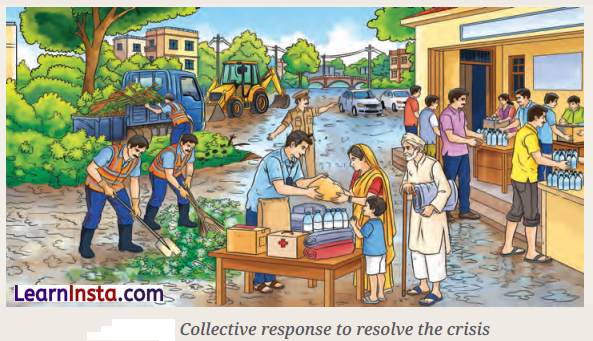
Share your ideas with the class. Make a list of the qualities that help the town respond effectively. These qualities are essential whenever governments and society work together to solve public problems. (Pages No. 81-82)
Form groups and discuss the following:
(i) Who are the different people and organisations involved in dealing with this situation?
Answer:
The municipal corporation, public works department, police, school authorities, health workers, local representatives, residents, volunteers, and citizens are involved in dealing with the situation.
(ii) Why cannot a single department solve the problem on its own?
Answer:
The heavy rainfall creates many problems such as flooded roads, damaged roads, disrupted electricity, closed schools, traffic problems, and health concerns. These problems require different departments and organisations to work together.
(iii) What would happen if these departments did not communicate or coordinate with one another?
Answer:
Their efforts would not be properly organised, which could delay relief work and make the situation worse. People may not receive timely information or essential services.
(iv) What role can citizens play before, during, and after the heavy rainfall?
Answer:
Citizens can prepare for emergencies, follow safety instructions, and help vulnerable people during the rainfall. They can report flooded areas and other problems to the authorities. After the rainfall, they can help their neighbours and support cleanliness and recovery efforts.
(v) What makes the collective response effective?
Answer:
Coordination, communication, cooperation, and active participation of government departments, organisations and citizens make the collective response effective. Working together helps address different problems and provides timely support to people in need.
Question 2.
Government refers to the institution that has the authority to provide public services. For example, the municipal corporation or panchayat is responsible for installing street lights. Governance is the process by which this Street lighting is planned, implemented, and maintained, involving people in identifying dark spots, reporting non-functional lights, and providing feedback. It ensures the continuous delivery of public services-in this case, street lighting and greater public safety. Can you identify more such examples from your day-to-day life to understand the difference between government and governance? (Pages No. 83-84)
Answer:
Yes. Some everyday examples are:
- Water supply: The government provides water services, while governance involves planning supply, maintaining pipelines, addressing complaints, and ensuring regular water availability.
- Waste management: The municipal corporation manages waste collection, while governance involves citizens separating waste, reporting problems, and giving feedback.
- Public transport: The government provides transport services, while governance involves planning routes, maintaining services, and considering passengers’ needs.
- Public health: The government provides health services. While governance involves planning services, monitoring their delivery, and responding to people’s concerns.
Question 3.
The Sengol, a cultural marker of rulership and good governance, was placed in India’s newly inaugurated Parliament building in the year 2023 by Prime Minister Narendra Modi. The tradition of using the Sengol as a mark of righteous governance began more than a thousand years ago during the reign of the Chola dynasty. To mark the occasion of India’s Independence, at the stroke of midnight on 15th August 1947, the first Prime Minister, Jawaharlal Nehru, received the Sengol from the Adheenam Saints (an old Shaivite tradition) of Tamil Nadu. Try to find out more about the journey of the Sengol through its historic pictures. (Page No. 85)

Answer:
The Sengol has a long historical journey connected with the tradition of righteous governance. According to the government’s account, the tradition of the Sengol as a symbol of righteous rule dates back to the Chola period. In 1947, a special Sengol was prepared by the Thiruvaduthurai Adheenam in Tamil Nadu. Jawaharlal Nehru received it on the night of 14 August 1947 in connection with the transfer of power at Independence.
After Independence, the Sengol was kept at Anand Bhawan in Prayagraj. In 2023, it was brought to the new Parliament building and installed near the Speaker’s podium on 28 May 2023. It was presented as a symbol connecting India’s historical traditions with the present democratic system.
Timeline: Chola tradition 1947: Sengol prepared and presented to Nehru → kept at Anand Bhawan → 2023: installed in the new Parliament building.
Question 4.
Select two cities (one should be from a region other than yours) in India that have received awards for being the cleanest city. Make a visual presentation (chart paper or slideshow) to explain the ‘good governance model’ used in those cities by looking into the role played by government agencies (local, state, and national), residents, market associations, civil society organisations, etc. Also look into the steps they are taking to continue being clean cities. (Page No. 87)
Answer:
Do it yourself.
Question 5.
Form pairs or groups and assign one State or Union Territory to each group. Prepare a short classroom discussion paper on:
(i) Good governance initiatives being implemented.
(ii) Suggestions for further improving governance.
Answer:
Do it yourself.
Question 6.
Did you know that 25th December is celebrated as National Good Governance Day? Can you find out why this date was chosen? How is National Good Governance Day celebrated in your district? Discuss in your class. (Page No. 88)
Answer:
25th December is observed as National Good Governance Day because it is the birth anniversary of former Prime Minister Atal Bihari Vajpayee. The day was first observed in 2014 to promote awareness about transparent, accountable and citizen-centred governance.
In districts, Good Governance Day may be observed through activities such as public grievance redressal camps, improving delivery of government services, awareness programmes, cleanliness drives and sharing good governance practices. Recent Good Governance Week programmes have involved district and tehsil-level outreach and grievance- resolution activities.
For class discussion: Students can find out from their District Administration website or local newspaper what activities are organised in their own district and discuss how these activities help citizens.
Question 7.
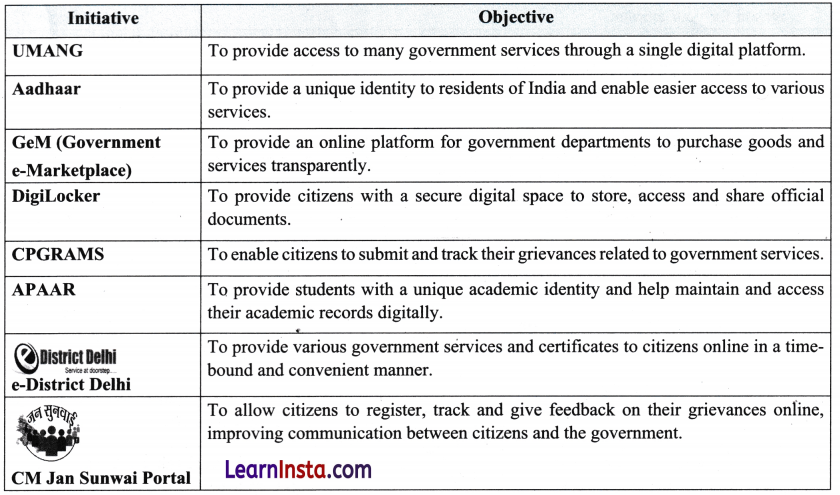
Below is a chart of a few e-governance initiatives. Complete the chart and also add two such initiatives undertaken by your state government. (Page No. 89)
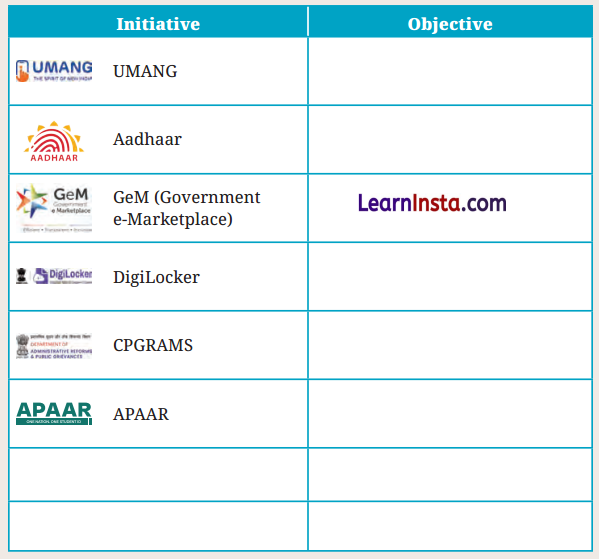
Answer:
Question 8.
Let us try to understand the quality of life of citizens before and after e-governance. Form five groups and interview your seniors, teachers, security guards, administrative staff, and parents regarding the issues listed below. Did they have access to the internet and a smartphone or computer to make use of these e-governance facilities? Find out what problems they had faced before e-governance and whether they felt the same issues were easily handled after e-governance.
1. Obtaining a birth certificate
2. Obtaining an admit card
3. Collecting and storing marksheets
4. Receiving salary
5. Booking rail/flight tickets
6. Registering a vehicle (Page No. 90)
Answer:
The following is a sample response based on the experiences commonly shared by people who used these services before and after e-governance.
| Issue | Before e-Governance | After e-Governance |
| 1. Obtaining a birth certificate | People had to visit government offices, fill forms, and wait in queues. | Applications can be submitted online, and certificates can be accessed digitally. |
| 2. Obtaining an admit card | Students had to collect admit cards from their school or institution. | Admit cards can be downloaded online, saving time and effort. |
| 3. Collecting and storing mark sheets | Students usually collected paper mark sheets and had to keep them safely. | Mark sheets can be stored and accessed digitally through platforms such as DigiLocker. |
| 4. Receiving salary | Salary-related work involved paperwork and delays in some cases. | Salaries can be transferred directly to bank accounts through digital systems. |
| 5. Booking rail/flight tickets | People often had to visit booking counters and wait in queues. | Tickets can be booked online quickly from home. |
| 6. Registering a vehicle | Vehicle registration required visits to government offices and submission of documents. | Many registration-related services can be accessed online, reducing paperwork and visits. |
Conclusion: E-governance has made many public services faster, more convenient, and easier to access. It has reduced paperwork, waiting time, and the need to visit government offices repeatedly. However, access to the Internet, smartphones/computers, and digital skills is important for using these services.
Question 9.
Read each of the following examples carefully. Identify whether they are a policy or a public policy. Give a reason for your answer. (Page No. 92 – 93)
| Example | Policy/Public Policy | Why? |
| The government introduces a sports policy. | ||
| The government launches a campaign to provide safe drinking water to every household. | ||
| A company allows employees to work from home twice a week | ||
| A municipality introduces waste segregation in the city. A housing society fixes visiting hours for guests. | ||
| The government introduces free vaccination for children. |
Answer:
| Example | Policy / Public Policy | Why? |
| The government introduces a sports policy. | Public Policy | It is introduced by the government and is intended to promote sports and serve the public interest. |
| The government launches a campaign to provide safe drinking water to every household. | Public Policy | It addresses a public need and aims to provide an essential service to people. |
| A company allows employees to work from home twice a week. | Policy | It is an internal rule made by a company for its employees. |
| A municipality introduces waste segregation in the city. | Public Policy | It is a government/local authority measure that addresses a public problem and benefits the community. |
| A housing society fixes visiting hours for guests. | Policy | It is a rule made by a housing society for its residents and visitors. |
| The government introduces free vaccination for children. | Public Policy | It is a government measure aimed at protecting public health and benefiting children. |
Question 10.
Your school’s main gate faces a road that connects residential areas and a major market area. There is heavy traffic congestion on the road. especially during morning and afternoon hours. Pedal rickshaws, electric rickshaws, school buses, private vehicles, and pedestrians-all struggle to get their way. (Page No.95)
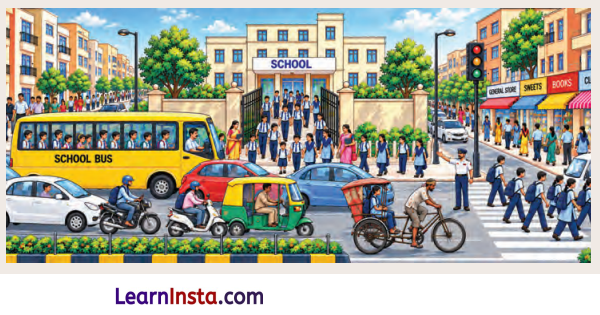
Form groups in your class and choose a course of action from the options given below.
1. Form a group of volunteers to regulate traffic in rush hours.
2. Write an application to the principal about the issue.
3. Meet the principal, along with all the class representatives of the school, to discuss the gravity of the situation and then impress upon the principal the need to take up the issue with the local people’s representative so that a traffic signal can be installed.
4. Request the school management to construct and open another gate on the other side of the school.
5. Suggest that the school shift its pick-up and drop-off point to a location slightly away from the main gate.
6. Change school timings so that the school’s opening and closing hours do not coincide with the busiest traffic hours in the market.
Answer the following based on the information given above.
Which option did you choose and why?
Can you suggest a better solution to address the given problem? Compare your suggestion with other options.
Answer:
Do it yourself.
Question 11.
Case Study-A Ramp to Better Healthcare Smt. Shanti Devi, a 72-year-old woman, visits the hospital for a health check-up. On arriving at the hospital, she finds that she has to climb stairs to reach the Outpatient Department (OPD). There is no ramp or handrail to support her. At the same time, a man in a wheelchair arrives but is unable to enter the building because the entrance has only steps, with no wheelchair-accessible ramp. A visually impaired person may be able to climb the steps to enter the hospital but finds it difficult to locate different hospital departments because there are no tactile paths or Braille signs.
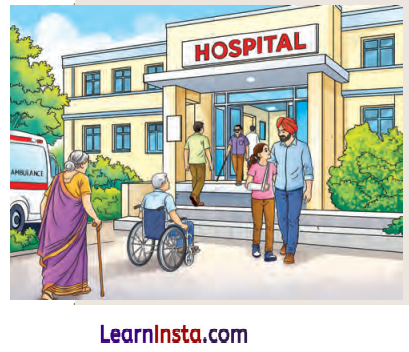
Many patients and their family members realise that the hospital infrastructure is not accessible to everyone. They decide to raise this issue with the hospital authorities and local representatives. A local disability rights organisation also highlights the problem through newspapers and social media.
The district administration takes note of the issue and asks the Public Works Department (PWD) and the Health Department to inspect the hospital. After consulting doctors, hospital staff, architectural experts, organisations working with persons with disabilities (PwDs), senior citizens, and residents, a plan is prepared to make the hospital more accessible. The government approves the funds needed to construct ramps, lifts, handrails, tactile pathways, and accessible toilets, and to install clear signboards. Once the work is complete, the hospital becomes easier to use for older persons, persons with disabilities, pregnant women, patients, and children.
Read the case study and follow the journey’of the issue from identifying the problem to implementing a solution. As you read, identify the problem, the people and institutions involved, the actions taken, and the steps through which the solution was developed and implemented. Then, answer the questions below:
(i) Arrange the various stages of the policy process in sequence for upgrading the hospital to be more patient-friendly. (Page No. 96-97)
Answer:
The stages are:
- Identifying the problem – The hospital was not accessible to senior citizens, persons with disabilities, and other patients.
- Raising the concern – Patients, family members, a disability rights organisation, and local representatives highlighted the problem.
- Consulting stakeholders – Doctors, hospital staff, architectural experts, organisations working with persons with disabilities, senior citizens, and residents were consulted.
- Formulating the solution – A plan was prepared to make the hospital more accessible.
- Approval and implementation – The government approved funds, and ramps, and lifts. Handrails, tactile pathways, accessible toilets, and clear signboards were installed.
(ii) Which stakeholders were involved in solving this problem? Identify at least three.
Answer:
The stakeholders included:
- Patients and their family members
- Hospital authorities and staff
- Local representatives
- Disability rights organisations
- Doctors and architectural experts
- Senior citizens and residents
- Public Works Department (PWD) and Health Department.
(iii) Can you think of any public building in your locality that could be made more accessible? What improvements would you suggest?
Answer:
A local government office or public hospital could be made more accessible. I would suggest installing ramps and lifts, handrails, accessible toilets, tactile pathways, and clear signboards so that senior citizens and persons with disabilities can use the building more easily.
Question 12.
As a student, what role can you play in the successful implementation of Khelo Bharat Niti 2025? (Page No. 102)
Answer:
- I can actively participate in sports and encourage my classmates to take part in games and physical activities.
- I can respect sports rules, practise regularly, and encourage equal participation of girls and boys.
- I can identify and support sports talent in my school and community.
Question 13.
Your school is designated as the ‘state’s sports ambassador’. What actions should it take to fulfil its role as sports ambassador? (Page No. 102)
Answer:
- The school should organise regular sports activities, competitions, and training programmes for students.
- It should encourage participation of girls, local talent, and students from different backgrounds.
- It should identify talented students and provide them opportunities to participate in higher-level competitions.
Question 14.
Which ministries of the government can contribute towards the success of Khelo Bharat Niti 2025? How? ( Page No. 102)
Answer:
- Ministry of Youth Affairs and Sports — It can develop sports programmes, provide training, and support sports infrastructure.
- Ministry of Education – It can promote sports and physical education in schools and encourage student participation.
- Ministry of Health and Family Welfare – It can support fitness, health awareness, and healthy lifestyles among citizens.
Think About It
Question 1.
If any step in policy-making and implementation is skipped, what would be the implications? Discuss with a suitable example. (Page No. 99)
Answer:
If any step in the policy-making or implementation process is skipped, the policy may not address the actual problem properly, may not meet people’s needs, and may not achieve its objectives. For example, in the case of making a hospital more accessible, if the government does not consult patients, persons with disabilities, doctors, and other stakeholders, important needs such as ramps, handrails, tactile pathways, and accessible toilets may be missed. As a result, the hospital may remain difficult to use for many people.
Class 9 SST Part 2 Chapter 4 Question Answer
Questions and Activities (Page No. 104 – 106)
Question 1.
“Good governance is the responsibility of the government alone.” Do you agree with this statement? Give reasons to support your answer.
Answer:
No, good governance is not the responsibility of the government alone. It requires the participation of citizens and other stakeholders.
- Citizens can participate by voting, raising concerns, and providing feedback on government policies and services.
- Civil society organisations can identify public problems, suggest solutions and monitor government policies.
- Media, experts, researchers and private organisations can provide information, knowledge and expertise.
- Government officials and elected representatives help formulate, implement and monitor policies.
- Cooperation among all stakeholders makes governance more transparent, accountable, responsive and effective.
Question 2.
Do you think students can contribute to good governance? Write a short note describing any five ways in which students can become more responsible and active citizens.
Answer:
Yes, students can contribute to good governance by becoming responsible and active citizens.
- They can follow laws, rules, and regulations and encourage others to do the same.
- They can participate in community activities and help address local problems.
- They can share their concerns and provide constructive feedback about public services.
- They can spread awareness about important public issues and avoid sharing misinformation.
- They can respect public property, keep their surroundings clean, and cooperate with others for the welfare of the community.
Question 3.
Choose anyone public policy [for example, Right to Education (RTE), Swachh Bharat Mission, PM POSHAN, Ayushman Bharat, Digital India, or Jal Jeevan Mission] and prepare a chart showing the following aspects:
The problem it addresses
The major stakeholders involved
How different actors coordinate
The role of citizens in its success
Present your findings to the class.
Answer:
Do it yourself.
Question 4.
Answer the following in one or two sentences.
(a) What is governance?
Answer:
Governance is the process of making, implementing, and monitoring decisions for the welfare and public interest of people.
(b) How is governance different from government?
Answer:
Government refers to the institutions that exercise political authority, while governance is the process of making, implementing, and monitoring decisions involving the government, citizens, and other stakeholders.
(c) What is meant by public policy?
Answer:
Public policy is a course of action adopted by the government to solve public problems, meet people’s needs and promote public welfare.
(d) Name any four principles of good governance.
Answer:
The four principles are transparency, accountability, participation, and rule of law.
Question 5.
Compare the following and present your answer in a tabular form.
(a) Government and governance
(b) Policy and public policy
Answer:
(a) Government and Governance
| Basis | Government | Governance |
| Meaning | Government refers to the institutions that exercise political authority. | Governance is the process of making, implementing, and monitoring decisions. |
| Focus | It focuses on institutions and their authority. | It focuses on the process of decision-making and implementation. |
| Participants | . Government, citizens, and other stakeholders | Mainly government institutions and officials participate. |
| Purpose | To exercise authority and provide public services. | To ensure effective, transparent, accountable, and responsive decision- making. |
(b) Policy and Public Policy
| Basis | Policy | Public Policy |
| Meaning | A policy is a course of action or set of guidelines adopted to achieve a particular purpose. | Public policy is a course of action adopted by the government to solve public problems and promote public welfare. |
| Who makes it? | It can be made by governments, organisations, or institutions. | It is adopted by the government and public institutions. |
| Scope | It may apply to a particular organisation or group. | It addresses issues affecting society or the public. |
| Examples | A company’s work-from-home policy. | Policy on education, healthcare or transportation. |
Question 6.
Imagine you have been appointed to advise the district administration on improving governance. You have proposed six points (given below), but the administration decides to prioritise only three areas for improvement. Which three would you recommend as priority areas, and which one out of the three do you feel is the most important?
(a) Improve drinking water facilities in schools.
(b) Improve sanitation and public toilets in schools and market areas.
(c) Provide tricycles for orthopedically challenged students.
(d) Install open-area swings and open-air gym in public parks.
(e) Ensure the vaccination of stray dogs to prevent rabies.
(f) Ensure distribution of iron and folic acid tablets for female students in schools.
Answer:
If I were advising the district administration, I would recommend these three priority areas:
- Improve sanitation and public toilets in schools and market areas.
- Improve drinking water facilities in schools.
- Ensure vaccination of stray dogs to prevent rabies.
Among these, I would consider improving sanitation and public toilets the most important because proper sanitation is essential for public health, cleanliness, and the well-being of students and the wider community.
Question 7.
Match the policy action point to its corresponding stage in the policy cycle.
| Policy action point | Stage of policy cycle |
| 1. Assessing the impact of the policy | (a) Policy implementation |
| 2. Putting the policy into action | (b) Policy evaluation |
| 3. Framing the legislation | (c) Policy adoption |
| 4. Multi-dimensional consultation with stakeholders | (d) Policy formulation |
| 5. Addressing a new need of the people | (e) Policy desirability (problem identification) |
Answer:
1. (b), 2. (a), 3. (e), 4. (d), 5. (e)
| Policy action point | Stage of policy cycle |
| 1. Assessing the impact of the policy | (b) Policy evaluation |
| 2. Putting the policy into action | (a) Policy implementation |
| 3. Framing the legislation | (c) Policy adoption |
| 4. Multi-dimensional consultation with stakeholders | (d) Policy formulation |
| 5. Addressing a new need of the people | (e) Policy desirability (problem identification) |
Question 8.
Read the following case and answer the given questions.
The government launches a programme to plant one lakh trees in a city. Funds are allocated, but only a few saplings survive because they are not watered or protected.
(a) Which stage of the policy cycle appears to be weak?
Answer:
The policy implementation stage appears to be weak because the saplings were not properly watered or protected.
(b) Which organisations should coordinate to improve the programme?
Answer:
The municipal corporation, forest department, and local community organisations should coordinate to ensure proper planting, watering, and protection of the saplings.
(c) Suggest two measures that could improve the outcome.
Answer:
- Arrange regular watering and protection of the planted saplings.
- Monitor the survival of the trees regularly and take corrective action where needed.
Question 9.
Read each statement carefully. Do you agree or disagree? Give reasons for your answer.
(a) A good public policy can fail if it is not implemented properly.
Answer:
Agree: Even a well-designed policy may not achieve its objectives if it is not properly implemented, monitored, and evaluated. Proper implementation is necessary to ensure that the benefits reach the people.
(b) Citizen participation sometimes makes decision- making slower, but it can improve governance.
Answer:
Agree: Citizen participation helps understand people’s needs and concerns and brings different viewpoints into decision-making. Although consultation may take more time, it can make policies more responsive and effective.
(c) Technology alone cannot ensure good governance.
Answer:
Agree: Technology can improve access to services, communication, and transparency, but good governance also requires responsible institutions, accountability, citizen participation, and effective implementation.
Question 10.
Design a public policy.
You are a member of your school’s student representative body. Identify one issue, for example, plastic waste, water wastage, road safety, energy conservation, or littering in public places. Prepare a simple policy proposal that includes the following aspects of policymaking:
The reason for selecting the issue
Your proposed solution
Who should implement it?
How will students participate?
How will you know whether the policy has succeeded?
Present your proposal to the class as a chart or slideshow presentation.
Answer:
Do it yourself.