Practicing Class 9 Maths MCQ and Ganita Manjari Class 9 Maths Chapter 7 The Mathematics of Maybe Introduction to Probability MCQ Questions Online Test with Answers daily helps in time management.
MCQ on The Mathematics of Maybe Introduction to Probability Class 9
The Mathematics of Maybe Introduction to Probability MCQ Class 9
Class 9 Maths The Mathematics of Maybe Introduction to Probability MCQ
Question 1.
If you roll a standard 6-sided die, how would you describe the probability of rolling a number less than 7?
(a) Impossible
(b) Equally likely
(c) Less likely
(d) Certain
Answer:
(d) Certain
Explanation:
Given, a standard 6-sided die is rolled.
Let S be the sample space of all possible outcomes.
S = {1, 2, 3, 4, 5, 6}
∴ n(S) = 6
Let E be the event of rolling a number less than 7.
Since all numbers on the die (1, 2, 3, 4, 5, 6) are strictly less than 7.
E = {1, 2, 3, 4, 5, 6}
∴ n(E) = 6
Probability is calculated,
∴ P(E) = \(\frac{n(E)}{n(S)}=\frac{6}{6}\) = 1
A probability of 1 indicates that the event is guaranteed to happen.
Question 2.
A coin is tossed 100 times, and heads appear 46 times. Now, if we toss a coin at random, then what is the probability of getting a tail?
(a) \(\frac{23}{50}\)
(b) \(\frac{27}{50}\)
(c) \(\frac{7}{50}\)
(d) \(\frac{9}{50}\)
Answer:
(b) \(\frac{27}{50}\)
Explanation:
Given that a coin is tossed 100 times, the total number of trials = 100
Also, heads appear 46 times.
Now, tail appears 100 – 46 = 54 times
∴ P(getting a tail) = \(\frac{54}{100}=\frac{27}{50}\)
Question 3.
A Mathematics book contains 250 pages. A page is selected at random. What is the probability that the number on the page selected is a perfect square?
(a) \(\frac{4}{25}\)
(b) \(\frac{3}{25}\)
(c) \(\frac{7}{25}\)
(d) \(\frac{9}{25}\)
Answer:
(b) \(\frac{3}{25}\)
Explanation:
∵ Total number of pages = 250 [given]
Now, the numbers on the page that are perfect squares are 1, 4, 9, 16, 25, 36, 49, 64, 81, 100, 121, 144, 169, 196, 225.
So, the total number of pages that are perfect squares = 15.
∴ Required probability = \(\frac{54}{100}=\frac{27}{50}\)
Question 4.
Three coins are tossed simultaneously 200 times with the following frequencies of different outcomes

The probability of getting two heads is
(a) 0.21
(b) 0.36
(c) 0.49
(d) 0.50
Answer:
(b) 0.36
Explanation:
Let us define the event A = Getting two heads
Total number of trials = 200
Number of trials in which we get two heads which event A happens = 72
Hence, P(A) = \(\frac{72}{200}\) = 0.36

Question 5.
In a cricket match, if a batsman hits a boundary 8 times out of 40 balls he plays. Then, the probability that he did not hit a boundary is
(a) 0.2
(b) 0.4
(c) 0.6
(d) 0.8
Answer:
(d) 0.8
Explanation:
Let A denote the event that the batsman did not hit a boundary.
We have, total number of trials = 40
Number of trials in which the event A happened = 40 – 8 = 32
∴ P(A) = \(\frac{32}{40}=\frac{4}{5}\) = 0.8
Question 6.
The record of a weather station shows that out of the past 250 consecutive days, its weather forecasts were correct 175 times. Then, the probability that on a given day it was correct and it was not correct is
(a) 0.1, 0.2
(b) 0.7,0.5
(c) 0.9, 0.1
(d) 0.7, 0.5
Answer:
(b) 0.7,0.5
Explanation:
We have, total number of days for which the weather forecast was made = 250
Number of days for which the weather forecast was correct = 175
Number of days for which the forecast was not correct = 250 – 175 = 75
Therefore, the probability that the forecast was correct on a given day = \(\frac{\text { Number of days for which the forecast was correct }}{\text { Number of days for which the forecast was made }}\)
= \(\frac{175}{250}\)
= 0.7
and probability that the forecast was not correct on a given day = \(\frac{\text { Number of days for which the forecast was correct }}{\text { Number of days for which the forecast was made }}\)
= \(\frac{75}{250}\)
= 0.3
Question 7.
The maximum temperature in Celsius of some cities on a day is given below.
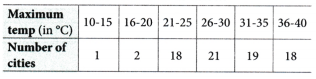
The probability that the maximum temperature lies between 16°C and 30°C is
(a) \(\frac{41}{79}\)
(b) \(\frac{56}{81}\)
(c) \(\frac{21}{53}\)
(d) \(\frac{1}{10}\)
Answer:
(a) \(\frac{41}{79}\)
Explanation:
Total number of cities = 1 + 2 + 18 + 21 + 19 + 18 = 79
Let E be the event which show maximum temperature of cities.
Number of cities, whose maximum temperature lies between 16°C and 30°C = 2 + 18 + 21 = 41
∴ Probabilities that the temperature of cities lies between 16°C and 30°C = \(\frac{41}{79}\).
Question 8.
On one page of a telephone directory, there were 200 telephone numbers. The frequency distribution of their unit place digit (e.g., in the number 25828573 the unit’s place digit is 3) is given in the following table.

Without looking at the page, the pencil is placed on one of these numbers, i.e., the number is chosen at random. What is the probability that the digit in its unit place is 9?
(a) 0.1
(b) 0.03
(c) 0.05
(d) 0.07
Answer:
(a) 0.1
Explanation:
Here, 200 telephone numbers are given on one page of a telephone directory.
∴ Total number of selected telephone numbers = 200
The frequency of digit 9 at unit place is 20
i.e., in 20 telephone numbers 9 is at unit place.
∴ Required probability = \(\frac{\text { Frequency of } 9}{\text { Total number of selected telephone numbers }}\)
= \(\frac{20}{200}\)
= 0.1
Question 9.
A die is thrown 250 times, and the outcomes are noted as given below.

If a die is thrown at random, then the probabilities of getting 1 and 5 are respectively
(a) 0.26, 0.132
(b) 0.21, 0.139
(c) 0.20, 0.139
(d) 0.11, 0.112
Answer:
(a) 0.26, 0.132
Explanation:
Here, a die is thrown 250 times.
So, total number of trials = 250
In a random throw of a die, let E1 and E2 be the events of getting 1 and 5, respectively.
Here, the frequency of outcome 1 is 65 i.e. 1 occurs on a die 65 times.
∴ P (getting 1) = P(E1) = \(\frac{\text { Number of times } 1 \text { occur }}{\text { Total number of trials }}\)
= \(\frac{65}{250}\)
= 0.26
Here, 5 occurs on a die 33 times.
∴ P (getting 5) = P(E5) = \(\frac{\text { Number of times } 5 \text { occurs }}{\text { Total number of trials }}\)
= \(\frac{33}{250}\)
= 0.132
Question 10.
Which of the following is a certain event?
(A) The sun will rise tomorrow.
(B) It will rain in Mumbai in May.
(C) You will win a lottery ticket today.
(D) A stranger will visit your home today.
Answer:
(A) The sun will rise tomorrow.
Question 11.
Which of the following is a more likely event?
(A) Finding a ₹ 10 coin on the road.
(B) Seeing vehicles on a busy road in Mumbai.
(C) Meeting a celebrity today.
(D) Winning a jackpot.
Answer:
(B) Seeing vehicles on a busy road in Mumbai.
Question 12.
A fair coin is tossed 50 times. It lands on heads 28 times and tails 22 times. Which of the following correctly represents the experimental probability of getting heads?
(A) \(\frac {25}{50}\)
(B) \(\frac {28}{50}\)
(C) \(\frac {22}{50}\)
(D) \(\frac {28}{22}\)
Answer:
(B) \(\frac {28}{50}\)
Question 13.
An apartment complex has 20 apartments of different sizes – 2BHK, 3BHK, 4BHK. The probability of a randomly picked apartment being a 3 BHK is \(\frac {2}{5}\). How many 3 BHK apartments are there in the apartment complex?
(A) 2
(B) 4
(C) 5
(D) 8
Answer:
(D) 8
Explanation:
Number of 3 BHK apartments = \(\frac {2}{5}\) × 20 = 8
Question 14.
The sample space when a standard 6-sided die is rolled is
(A) {1, 2, 3, 4, 5}
(B) {2, 4, 6}
(C) {1, 2, 3, 4, 5, 6}
(D) {0, 1, 2, 3, 4, 5}
Answer:
(C) {1, 2, 3, 4, 5, 6}
Question 15.
When two coins are tossed, what is the number of possible outcomes?
(A) 2
(B) 3
(C) 4
(D) 8
Answer:
(C) 4
Question 16.
When two coins are tossed together, the event “no coin shows Head” is
(A) {HH}
(B) {TT}
(C) {HT, TH}
(D) {HH, HT, TH}
Answer:
(B) {TT}
Question 17.
The event ‘getting a prime number when a standard die is tossed’ has how many possible outcomes?
(A) 1
(B) 2
(C) 3
(D) 4
Answer:
(C) 3
Explanation:
E: {2, 3, 5}
Question 18.
Which of the following is an impossible event?
(A) Getting a head on a coin toss
(B) Getting a sum of 1 when two dice are rolled
(C) Drawing a red ball from a bag of red balls
(D) Rolling a 4 on a die
Answer:
(B) Getting a sum of 1 when two dice are rolled
Question 19.
A fair die is rolled once. The probability of getting an even number is
(A) \(\frac {1}{2}\)
(B) \(\frac {1}{3}\)
(C) \(\frac {1}{4}\)
(D) \(\frac {1}{6}\)
Answer:
(A) \(\frac {1}{2}\)
Question 20.
If an event cannot occur, then its probability is
(A) 1
(B) \(\frac {3}{4}\)
(C) \(\frac {1}{2}\)
(D) 0
Answer:
(D) 0
Question 21.
When one coin is tossed, what is the number of possible outcomes?
(A) 1
(B) 2
(C) 4
(D) 8
Answer:
(B) 2
Question 22.
Which of the following is a more likely event?
(A) Getting a full score in every exam
(B) Seeing people in a crowded market
(C) Winning a lottery ticket
(D) Finding a gold coin on the road
Answer:
(B) Seeing people in a crowded market
The Mathematics of Maybe Introduction to Probability Class 9 Assertion and Reason Questions
Direction (Q. Nos. 1-5): In the questions given below, there are two statements marked as Assertion (A) and Reason (R). Read the statements and choose the correct option.
Question 1.
Assertion (A): In a cricket match, a batsman hits a boundary 5 times out of 45 balls he plays. The probability that in a given ball, he does not hit the boundary is \(\frac{8}{9}\).
Reason (R): P(E) + P (not E) = 1
(a) Both A and R are true, and R is the correct explanation of A.
(b) Both A and R are true, but R is not the correct explanation of A.
(c) A is true but R is false.
(d) A is false but R is true.
Answer:
(a) Both A and R are true, and R is the correct explanation of A.
Explanation:
(A) A batsman hits a boundary 9 times out of 45 balls he plays.
P(A) = P (he hits a boundary) = \(\frac{5}{45}=\frac{1}{9}\)
Since, P(A) + P(Ā) = 1
P(Ā) = 1 – P(A)
= 1 – \(\frac{1}{9}=\frac{8}{9}\)
∴ Probability that he does not hit the boundary is \(\frac{4}{5}\).
Both Assertion and Reason are true, and Reason is the correct explanation of Assertion.
Question 2.
Assertion (A): If E is an event such that P(E) = \(\frac{1}{999}\), then P(Ē) = 0.001.
Reason (R): P(E) + P(Ē) = 1.
(a) Both A and R are true, and R is the correct explanation of A.
(b) Both A and R are true, but R is not the correct explanation of A.
(c) A is true but R is false.
(d) A is false but R is true.
Answer:
(d) A is false but R is true.
Explanation:
Given, P(E) = \(\frac{1}{999}\) = 0.001
We know that P(E) + P(E) = 1
∴ P(E) = 1 – P(Ē) = 1 – 0.001 = 0.999
Hence, Assertion is false, but Reason is true.
Question 3.
Assertion (A): The probability of getting an odd number on a fair 6-sided die is \(\frac {1}{2}\).
Reason (R): There are 3 odd numbers (1, 3, 5) out of 6 possible outcomes.
(A) Both (A) and (R) are true, and (R) is the correct explanation of (A).
(B) Both (A) and (R) are true, but (R) is not the correct explanation of (A).
(C) (A) is true, but (R) is false.
(D) (A) is false, but (R) is true.
Answer:
(A) Both (A) and (R) are true, and (R) is the correct explanation of (A).
Question 4.
Assertion (A): The sample space of rolling a standard 6-sided die contains 6 outcomes.
Reason (R): A standard 6-sided die has six faces numbered from 1 to 6.
(A) Both (A) and (R) are true, and (R) is the correct explanation of (A).
(B) Both (A) and (R) are true, but (R) is not the correct explanation of (A).
(C) (A) is true, but (R) is false.
(D) (A) is false, but (R) is true.
Answer:
(A) Both (A) and (R) are true, and (R) is the correct explanation of (A).
Question 5.
Assertion (A): The probability of getting a number greater than 6 when a standard die is rolled is 0.
Reason (R): A standard die has six faces numbered from 1 to 6.
(A) Both (A) and (R) are true, and (R) is the correct explanation of (A).
(B) Both (A) and (R) are true, but (R) is not the correct explanation of (A).
(C) (A) is true, but (R) is false.
(D) (A) is false, but (R) is true.
Answer:
(A) Both (A) and (R) are true, and (R) is the correct explanation of (A).