Practicing Class 9 Maths MCQ and Ganita Manjari Class 9 Maths Chapter 6 Measuring Space Perimeter and Area MCQ Questions Online Test with Answers daily helps in time management.
MCQ on Measuring Space Perimeter and Area Class 9
Measuring Space Perimeter and Area MCQ Class 9
Class 9 Maths Measuring Space Perimeter and Area MCQ
Question 1.
The area of an equilateral triangle with side 2√3 cm is [√3 = 1.732]
(a) 5.196 cm2
(b) 0.866 cm2
(c) 3.496 cm2
(d) 1.732 cm2
Answer:
(a) 5.196 cm2
Explanation:
Area of equilateral triangle = \(\frac{\sqrt{3}}{4}\) a2
Question 2.
The area of a rhombus, whose perimeter is 200m and one of the diagonals is 60 m, is
(a) 2400 m2
(b) 2100 m2
(c) 2000 m2
(d) 4500 m2
Answer:
(a) 2400 m2
Explanation:
Side, a = \(\frac{200}{4}\) = 50 m
and a2 = \(\frac{1}{2}\)
⇒ d2 = 80 m [given d1 = 60 m]
Required area = \(\frac{1}{2}\) × d1 × d2 = 2400 m2
Question 3.
Each side of an equilateral triangle is 4 cm long. The height of the triangle is
(a) 10√3 cm
(b) 2√3 cm
(c) 4√3 cm
(d) \(\frac{\sqrt{3}}{2}\) cm
Answer:
(b) 2√3 cm
Explanation:
Height = \(\frac{\sqrt{3}}{2}\)a2
\(\frac{\sqrt{3}}{2}\)a2 = 25√3
⇒ a2 = \(\frac{25 \times 4}{\sqrt{3}}\) × √3 = 100
⇒ a = 10 cm
Question 4.
The area of an isosceles right-angled triangle having each of the equal sides a is
(a) \(\frac{1}{2}\)a2
(b) 2a2
(c) a2
(d) \(\frac{\sqrt{2}}{3}\)a2
Answer:
(a) \(\frac{1}{2}\)a2
Explanation:
Area = \(\frac{1}{2}\) × Base × Height = a × a = \(\frac{1}{2}\)a2
Question 5.
If the area of an equilateral triangle is 25√3 cm2, then its perimeter will be
(a) 10 cm
(b) 20 cm
(c) 30 cm
(d) 40 cm
Answer:
(c) 30 cm
Explanation:
Area of equilateral triangle = \(\frac{\sqrt{3}}{4}\)a2
∴ \(\frac{\sqrt{3}}{4}\)a2 = 25√3
⇒ a2 = \(\frac{25 \times 4}{\sqrt{3}}\) × √3 = 100
⇒ a = 10 cm
Perimeter of equilateral triangle = a + a + a
= 3a = 3 × 10
= 30 cm

Question 6.
The length of the hypotenuse of an isosceles right triangle with area 72 cm2 is
(a) 12 cm
(b) 12√2 cm
(c) 24 cm
(d) 12.5 cm
Answer:
(b) 12√2 cm
Explanation:
Area of an isosceles right triangle with equal sides a
= \(\frac{1}{2}\)a2
Area = \(\frac{1}{2}\) × Base × height
⇒ \(\frac{1}{2}\)a2 = 72 × 2
= 144
⇒ a = 12 cm
Hypotenuse of an isosceles right-angled triangle = √2a = 12√2 cm
Question 7.
Brahmagupta’s formula is applicable only when.
(a) all sides are equal
(b) opposite sides are parallel
(c) quadrilateral is cyclic
(d) diagonals are equal
Answer:
(c) quadrilateral is cyclic
Question 8.
The area of a cyclic quadrilateral with sides 5 cm, 6 cm, 7 cm and 8 cm is
(a) \(\sqrt{1680}\)
(b) \(\sqrt{1684}\)
(c) \(\sqrt{144}\)
(d) \(\sqrt{1600}\)
Answer:
(a) \(\sqrt{1680}\)
Question 9.
In Heron’s formula
\(\sqrt{s \times(s-a) \times(s-b) \times(s-c)}\), s is equal to
(a) \(\frac{a+b+c}{4}\)
(b) \(\frac{a+b+c}{3}\)
(c) \(\frac{a+b+c}{2}\)
(d) a + b + c
Answer:
(c) \(\frac{a+b+c}{2}\)
Explanation:
s = \(\frac{a+b+c}{2}\)
Question 10.
The area of a triangle with sides 5 cm, 12 cm and 13 cm in length is
(a) 15 cm2
(b) 30 cm2
(c) 60 cm2
(d) 120 cm2
Answer:
(b) 30 cm2
Explanation:
Area of triangle = \(\sqrt{s(s-a)(s-b)(s-c)}\)
s = \(\frac{5+12+13}{2}\) = 15
Area = \(\sqrt{15 \times 10 \times 3 \times 2}\) = 30 cm2
Question 11.
The sides of a triangle are 25 cm, 17 cm and 12 cm. The length of the altitude on the longest side is equal to
(a) 7.5 cm
(b) 7.2 cm
(c) 8.2 cm
(d) 9.8 cm
Answer:
(b) 7.2 cm
Explanation:
s = \(\frac{1}{2}\) = 27 cm
Area of triangle = \(\frac{1}{2}\)
= \(\frac{1}{2}\) = 90 cm2
Also, area of triangle = \(\frac{1}{2}\) × 25 × h = 90
h = 90 × \(\frac{2}{25}\)
= 7.2 cm
Question 12.
If the sides of a triangle are in the ratio 3 : 5 : 7 and its perimeter is 150 m. Then, the area of the triangle is
(a) 100√2 m2
(b) 375√3 m2
(c) 750√3 m2
(d) 375√2 m2
Answer:
(b) 375√3 m2
Explanation:
Sides of a triangle are given by
150 × \(\frac{3}{15}\), 150 × \(\frac{5}{15}\), 150 × \(\frac{7}{15}\), i.e., 30 m, 50 m, 70 m.
Using Heron’s formula,
Area of triangle = 375√3 m2
Question 13.
The difference between the semi-perimeter and the sides of A ABC are 3 cm, 4 cm and 2 cm, respectively. The area of the triangle is
(a) 6√6 cm2
(b) 3√3 cm2
(c) 5√6 cm2
(d) 3√6 cm2
Answer:
(a) 6√6 cm2
Explanation:
We have, s – a = 3 cm, s – b = 4 cm and s – c = 2 cm
⇒ 3s – (a + b + c) = 9 cm
⇒ 3s – 2s = 9 cm [∵ \(\frac{a+b+c}{2}\) = s ⇒ a + b + c = 2s]
⇒ s = 9 cm
Area = \(\sqrt{s(s-a)(s-b)(s-c)}\)
= \(\sqrt{9 \times 3 \times 4 \times 2}\)
= 6√6 cm2
Question 14.
The edges of a triangular board are 6 cm, 8 cm and 10 cm. The cost of painting it at the rate of 9 paise per cm2 is
(a) ₹ 2.0
(b) ₹ 2.16
(c) ₹ 2.48
(d) ₹ 3.00
Answer:
(b) ₹ 2.16
Explanation:
Let the edges of the triangular board be a = 6 cm, b = 8 cm and c =10 cm.
Now, semi-perimeter of the triangular board,
s = \(\frac{a+b+c}{2}=\frac{6+8+10}{2}=\frac{24}{2}\) = 12 cm
Now, area of the triangular board
= \(\sqrt{s(s-a)(s-b)(s-c)}\) [by Heron’s formula]
= \(\sqrt{12(12-6)(12-8)(12-10)}\)
= \(\sqrt{12 \times 6 \times 4 \times 2}\)
= \(\sqrt{(12)^2 \times(2)^2}\)
= 12 × 2
= 24 cm2
Since the cost of painting for area 1 cm2 = ₹ 0.09
∴ Cost of paint for area 24 cm2 = 0.09 × 24 = ₹ 2.16
Hence, the cost of painting is ₹ 2.16.
Question 15.
The length of the diameter of a circle, whose circumference is 44 cm, is
(a) 14 cm
(b) 16 cm
(c) 20 cm
(d) 24 cm
Answer:
(a) 14 cm
Question 16.
The sum of the diameters of two circles is 35 cm, and the difference of their circumference is 22 cm. The area of the smaller circle will be
(a) 121 cm2
(b) 154 cm2
(c) 309 cm2
(d) 146 cm2
Answer:
(b) 154 cm2
Explanation:
Let the diameters be d1 and d2.
d1 + d2 = 35
and πd1 – πd2 = 22
⇒ π(d1 – d2) = 22
⇒ d1 – d2 = 7
On solving the Eqs. (i) and (ii), we get d1 = 21 cm and d2 = 14 cm
So, radius (r) of smaller circle = 7 cm
Area = πr2 = 154 cm2
Question 17.
The area of a circle of radius 14 cm is
(a) 154 cm2
(b) 180 cm2
(c) 616 cm2
(d) 286 cm2
Answer:
(c) 616 cm2
Question 18.
The area of a sector of a circle with radius 7 cm, when the angle of the sector is 60°, is
(a) \(\frac{22}{3}\) cm2
(b) \(\frac{77}{3}\) cm2
(c) \(\frac{44}{3}\) cm2
(d) \(\frac{132}{3}\) cm2
Answer:
(b) \(\frac{77}{3}\) cm2
Explanation:
We have, r =7 cm and angle of sector (0) = 60°
∴ Area of the sector = \(\frac{\theta}{360^{\circ}}\) × πr2
= \(\frac{60^{\circ}}{360^{\circ}}\) × π(7)2
= \(\frac{1}{6} \times \frac{22}{7}\) × 7 × 7
= \(\frac{77}{3}\) cm2
Question 19.
If the area of a sector of a circle is \(\frac{7}{20}\) of the area of the circle, then the angle at the centre is equal to
(a) 110°
(b) 130°
(c) 100°
(d) 126°
Answer:
(d) 126°
Explanation:
Let the angle at the centre be θ.
We know that
Area of a sector of a circle = \(\frac{\theta}{360^{\circ}}\) × πr2
and area of a circle = πr2
According to the question, \(\frac{\theta}{360^{\circ}}\) × πr = \(\frac{7}{20}\) × πr
⇒ \(\frac{\theta}{360^{\circ}}=\frac{7}{20}\)
⇒ θ = \(\frac{7}{20}\) × 360° = 126°
Question 20.
The perimeter of a quadrant of a circle of radius 7 cm is
(a) 18 cm
(b) 11 cm
(c) 22 cm
(d) 25 cm
Answer:
(d) 25 cm
Explanation:
We have, r = 7 cm
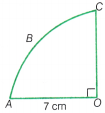
∴ Perimeter of OABCO = 2r + \(\frac{\pi r}{2}\) = 25 cm
Question 21.
OAB is a sector of a circle with centre O and radius 7 cm. If length of arc AB = \(\frac {22}{7}\) cm then ∠AOB is equal to
(a) \(\left(\frac{120}{7}\right)^{\circ}\)
(b) 45°
(c) 60°
(d) 30°
Answer:
(c) 60°
Explanation:
Given, radius = 7 cm
and length of arc AB = \(\frac{22}{3}\) cm.
Let ∠AOB = θ
Now, length of arc = \(\frac{1}{2}\) × 2πr
⇒ \(\frac{22}{3}=\frac{\theta}{360^{\circ}}\) × 2 × \(\frac{22}{27}\) × 7
= \(\frac{1}{2}\) = θ
⇒ θ = 60°
Question 22.
The area (in cm2) of a sector of a circle of radius 21 cm cut off by an arc of length 22 cm is
(a) 441
(b) 321
(c) 231
(d) 221
Answer:
(c) 231
Question 23.
The circumference of a circle is 88 cm. Its radius is:
(A) 7 cm
(B) 14 cm
(C) 22 cm
(D) 11 cm
Answer:
(B) 14 cm
Explanation:
C = 2πr
⇒ 88 = 2 × \(\frac {22}{7}\) × r
⇒ r = \(\frac{88 \times 7}{2 \times 22}\)
⇒ r = 14 cm
Question 24.
The length of the arc of a circle with radius 7 cm and central angle 90° is:
(A) 22 cm
(B) 11 cm
(C) 44 cm
(D) 5.5 cm
Answer:
(B) 11 cm
Explanation:
s = \(\frac{\theta}{360} \times 2 \pi r\)
= \(\frac{90}{360} \times 2 \times \frac{22}{7} \times 7\)
= 44 × \(\frac {1}{4}\)
= 11 cm
Question 25.
A wheel of diameter 28 cm makes one complete revolution. Distance covered is:
(A) 44 cm
(B) 88 cm
(C) 176 cm
(D) 56 cm
Answer:
(B) 88 cm
Explanation:
Distance covered in one revolution = Circumference of circle
C = πd
= \(\frac {22}{7}\) × 28
= 88 cm
Question 26.
The perimeter of a semicircle of radius r is:
(A) πr
(B) 2πr
(C) πr + 2r
(D) πr + r
Answer:
(C) πr + 2r
Explanation:
Perimeter of semicircle = arc length + diameter = πr + 2r
Question 27.
The ratio of circumferences of two circles is 3 : 5. The ratio of their radii is:
(A) 9 : 25
(B) 3 : 5
(C) 5 : 3
(D) 25 : 9
Answer:
(B) 3 : 5
Explanation:
\(\frac{C_1}{C_2}=\frac{3}{5}\) [Given]
\(\frac{\mathrm{C}_1}{\mathrm{C}_2}=\frac{2 \pi r_1}{2 \pi r_2}=\frac{r_1}{r_2}\)
\(\frac{r_1}{r_2}=\frac{3}{5}\)
Question 28.
The perimeter of a quadrant of a circle of radius 7 cm is:
(a) 11 cm
(b) 22 cm
(c) 25 cm
(d) 18 cm
Answer:
(c) 25 cm
Explanation:
Length of quadrant = \(\frac{90}{360} \times 2 \times \frac{22}{7} \times 7\) = 11 cm
∵ Perimeter of quadrant = arc length + 2 × radii
∴ Total perimeter = 11 + 14 = 25 cm
Question 29.
If the perimeters of two circles are equal, then their radii are:
(A) Not equal
(B) Equal
(C) In ratio 1 : 2
(D) Cannot be determined
Answer:
(B) Equal
Explanation:
2πr1 = 2πr2
r1 = r2
∴ If perimeters are equal, radii are equal.
Question 30.
A sector has radius r and angle θ°. If both r and θ are doubled, the arc length becomes __________
(A) Doubled
(B) Tripled
(C) Quadrupled
(D) Unchanged
Answer:
(C) Quadrupled
Explanation:
Length of arc = \(\frac{\theta}{360} \times 2 \pi r\)
r and θ are doubled
∴ arc length = \(\frac{2 \theta}{360} \times 2 \pi \times 2 r\)
= \(4 \times\left(\frac{\theta}{360} \times 2 \pi r\right)\)
= 4 × Length of arc
Question 31.
In Heron’s formula, s represents:
(A) The side of the triangle
(B) The area of the triangle
(C) The semi-perimeter of the triangle
(D) The height of the triangle
Answer:
(C) The semi-perimeter of the triangle
Question 32.
The area of a triangle with sides 3 cm, 4 cm, 5 cm using Heron’s formula is:
(A) 12 cm2
(B) 6 cm2
(C) 8 cm2
(D) 10 cm2
Answer:
(B) 6 cm2
Explanation:
s = \(\frac{3+4+5}{2}\) = 6 cm
Area = \(\sqrt{6(6-3)(6-4)(6-5)}\)
= \(\sqrt{6 \times 3 \times 2 \times 1}\)
= √36
= 6 cm2
Question 33.
Brahmagupta’s formula gives the area of:
(A) Any quadrilateral
(B) A cyclic quadrilateral
(C) A parallelogram only
(D) A rhombus only
Answer:
(B) A cyclic quadrilateral
Question 34.
ABCD is a parallelogram. P and Q are any two points on side AB. The ratio area of (∆PCD) : area (∆QCD) is __________
(A) Depends on the positions of P and Q
(B) 1 : 2
(C) 2 : 1
(D) 1 : 1
Answer:
(D) 1 : 1
Explanation:
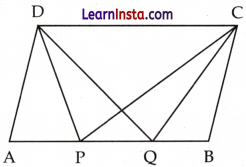
∆PCD and ∆QCD share base CD and the same height (perpendicular distance between parallel sides AB and CD).
∴ Area of ∆PCD = Area of ∆QCD
Question 35.
The area of a sector of a circle with radius 14 cm and angle 90° is:
(A) 308 cm2
(B) 616 cm2
(C) 154 cm2
(D) 44 cm2
Answer:
(C) 154 cm2
Explanation:
Area of sector = \(\frac{\theta}{360^{\circ}} \times \pi r^2\)
= \(\frac{90}{360} \times \frac{22}{7} \times 14^2\)
= \(\frac{1}{4} \times \frac{22}{7} \times 196\)
= 154 cm2
Question 36.
A car wiper of length 21 cm sweeps through 120°. Area cleaned in one sweep is:
(A) 462 cm2
(B) 231cm2
(C) 924 cm2
(D) 154 cm2
Answer:
(A) 462 cm2
Explanation:
Area cleaned in one sweep = \(\frac{\theta}{360^{\circ}} \times \pi r^2\)
= \(\frac{120}{360} \times \frac{22}{7} \times 21^2\)
= \(\frac{1}{3} \times \frac{22}{7} \times 441\)
= 462 cm2
Question 37.
The ratio of the perimeters of two circles is 4 : 3. What is the ratio of their radii?
(A) 16 : 9
(B) 4 : 3
(C) 9 : 16
(D) 3 : 4
Answer:
(B) 4 : 3
Question 38.
The edges of a triangular board are 6 cm, 8 cm, and 10 cm. The cost of painting it at the rate of 9 paise per cm2 is
(A) ₹ 2.00
(B) ₹ 2.16
(C) ₹ 12.48
(D) ₹ 3.00
Answer:
(B) ₹ 2.16
Question 39.
A sector of a circle has radius 7 cm and central angle 90°. What is its area?
(A) 38.5 cm2
(B) 77 cm2
(C) 154 cm2
(D) 44 cm2
Answer:
(A) 38.5 cm2
Question 40.
If the length of an arc of a circle having radius 63 cm is 33 cm, then the angle of the corresponding sector is
(A) 30°
(B) 60°
(C) 90°
(D) 120°
Answer:
(A) 30°
Question 41.
A wire of fixed length is bent into different rectangular shapes. Which shape encloses the maximum area?
(A) Square
(B) Rectangle with largest length
(C) Rectangle with smallest breadth
(D) All enclose equal area
Answer:
(A) Square
Measuring Space Perimeter and Area Class 9 Assertion and Reason Questions
Direction (Q. Nos. 1-14): In the questions given below, there are two statements marked as Assertion (A) and Reason (R). Read the statements and choose the correct option.
Question 1.
Assertion (A): Brahmagupta’s formula gives exact area only for cyclic quadrilaterals.
Reason (R): Opposite angles of a cyclic quadrilateral are supplementary.
(a) Both A and R are true, and R is the correct explanation of A.
(b) Both A and R are true, but R is not the correct explanation of A.
(c) A is true but R is false.
(d) A is false but R is true.
Answer:
(b) Both A and R are true, but R is not the correct explanation of A.
Explanation:
Assertion: Brahmagupta’s formula gives the exact area only for a cyclic quadrilateral, and opposite angles of a cyclic quadrilateral are supplementary.
Hence, both Assertion and Reason are true, but Reason is not the correct explanation of Assertion.
Question 2.
Assertion (A): If the edges of a triangle are 7 cm, 9 cm and 12 cm, then the area of the triangle is 14√5 cm2.
Reason (R): If three sides of a triangle are given, then the area of the triangle cannot always be determined by Heron’s formula.
(a) Both A and R are true, and R is the correct explanation of A.
(b) Both A and R are true, but R is not the correct explanation of A.
(c) A is true but R is false.
(d) A is false but R is true.
Answer:
(c) A is true but R is false.
Explanation:
Assertion given: sides of a triangle are
Now, s = \(\frac{a+b+c}{2}=\frac{7+9+12}{2}=\frac{28}{2}\) = 14
a = 7 cm, b = 9 cm and c = 12 cm.
∴ Area of triangle using Heron’s formula,
∆ = \(\sqrt{s(s-a)(s-b)(s-c)}\)
= \(\sqrt{14(14-7)(14-9)(14-12)}\)
= \(\sqrt{14 \times 7 \times 5 \times 2}\)
= 14√5 cm2
Hence, Assertion is true.
Reason: If three sides of a triangle are given, then we can always determine the area by Heron’s formula.
Hence, Reason is false.
Question 3.
Assertion (A): The area of an equilateral triangle with side 2 cm is 3 cm.
Reason (R): If the lengths of the triangle are a, b and c, then the area of the triangle is \(\sqrt{s(s-a)(s-b)(s-c)}\), where s is the semi-perimeter of the triangle.
(a) Both A and R are true, and R is the correct explanation of A.
(b) Both A and R are true, but R is not the correct explanation of A.
(c) A is true but R is false.
(d) A is false but R is true.
Answer:
(d) A is false but R is true.
Explanation:
Assertion Let the sides of a equilateral triangle be a = 2 cm, b = 2 cm and c = 2 cm
Now, perimeter (s) = \(=\frac{a+b+c}{2}=\frac{2+2+2}{2}\) = 3 cm
Area of the triangle = \(\sqrt{s(s-a)(s-b)(s-c)}\) [by Heron’s formula]
= \(\sqrt{3(3-2)(3-2)(3-2)}\)
= \(\sqrt{3 \times 1 \times 1 \times 1}\)
= √3 cm2
So, Assertion is false.
Clearly, Reason is true.
Question 4.
Assertion (A): If the outer and inner diameters of a circular path are 10 m and 6 m, respectively, then the area of the path is 87π m2.
Reason (R): If R and r are the radii of the outer and inner circular paths, respectively, then the area of the circular path = π(R2 – r2).
(a) Both A and R are true, and R is the correct explanation of A.
(b) Both A and R are true, but R is not the correct explanation of A.
(c) A is true but R is false.
(d) A is false but R is true.
Answer:
(d) A is false but R is true.
Explanation:
Assertion: Let R and r be the outer and inner radius, respectively.
R = \(\frac{10}{2}\) = 5 m and r = \(\frac{6}{2}\) = 3 m
Now. area = π(R2 – r2)
= (25 – 9)
= 16 π m2
Reason: Correctly explains the formula for area.
Hence. Assertion is false, but Reason is true.
Question 5.
Assertion (A): In the figure, O is the centre of a circle. The area of sector OAPB is \(\frac{5}{18}\) of the area of the circle; then the value of x is 100°.
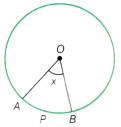
Reason (R): The length of an arc of a circle with radius r and central angle 0 is given by
l = \(\frac{\theta}{360^{\circ}}\) × πr2
(a) Both A and R are true, and R is the correct explanation of A.
(b) Both A and R are true, but R is not the correct explanation of A.
(c) A is true but R is false.
(d) A is false but R is true.
Answer:
(c) A is true but R is false.
Explanation:
Area of sector OAPB = \(\frac{x}{360^{\circ}}\) × πr2
= \(\frac{5}{18}\)πr2
= \(\frac{x}{360^{\circ}}=\frac{5}{18}\)
⇒ x = 100°
So, the assertion is true.
Now, length of an arc of a circle using radius r and central angle θ,
l = \(\frac{\theta^{\circ}}{360^{\circ}}\) × 2πr
So, the reason is false.
Question 6.
Assertion (A): The area of the sector of a circle of radius 5 cm is 9.75 cm2, if the central angle is 90°.
Reason (R): The area of a sector of a circle of radius r and central angle θ is \(\frac{\theta}{360^{\circ}}\) × πr2.
(a) Both A and R are true, and R is the correct explanation of A.
(b) Both A and R are true, but R is not the correct explanation of A.
(c) A is true but R is false.
(d) A is false but R is true.
Answer:
(d) A is false but R is true.
Explanation:
Let the central angle of the sector be θ.
Given that the radius of the sector of the circle, r = 5 cm, and the central angle of the sector, θ = 90°.
Now, the area of the sector with angle θ = 90°
= \(\frac{90^{\circ}}{360^{\circ}}\) × π × (5)
= \(\frac{1}{4} \times \frac{22}{7}\) × 25
= 19.64 cm2
Hence, Assertion is false, but Reason is true.
Question 7.
Assertion (A): If the radius of a sector of a circle is reduced to its half and the angle is doubled, then the perimeter of the sector remains the same.
Reason (R): The length of the arc subtending angle θ at the centre of a circle of radius r = \(\frac{\pi r \theta}{180^{\circ}} .\)
(a) Both A and R are true, and R is the correct explanation of A.
(b) Both A and R are true, but R is not the correct explanation of A.
(c) A is true but R is false.
(d) A is false but R is true.
Answer:
(d) A is false but R is true.
Explanation:
Let r be the radius and θ be the angle of the sector.
Perimeter, P = 2r + rθ
Then the radius is halved, and the angle is doubled.
Then, perimeter, P’ = 2\(\left(\frac{r}{2}\right)+\frac{r}{2}\) 2θ = r + rθ
Question 8.
Assertion (A): The circumference of a circle doubles when its radius is doubled.
Reason (R): Circumference is directly proportional to the radius.
(A) Both (A) and (R) are true, and (R) is the correct explanation of (A).
(B) Both (A) and (R) are true, but (R) is NOT the correct explanation of (A).
(C) (A) is true, but (R) is false.
(D) (A) is false, but (R) is true.
Answer:
(A) Both (A) and (R) are true, and (R) is the correct explanation of (A).
Explanation:
Assertion: Radius is doubled
New radius = 2r
∴ Circumference = 2π(2r) = 4πr = 2(2πr)
∴ Circumference is doubled
Reason: C = 2πr
∴ Circumference is directly proportional to radius.
Question 9.
Assertion (A): The perimeter of a sector with radius r and angle θ° is 2r + \(\frac{2 \pi r \theta}{360} .\)
Reason (R): The perimeter of a sector includes two radii and the arc length.
(A) Both (A) and (R) are true, and (R) is the correct explanation of (A).
(B) Both (A) and (R) are true, but (R) is NOT the correct explanation of (A).
(C) (A) is true, but (R) is false.
(D) (A) is false, but (R) is true.
Answer:
(A) Both (A) and (R) are true, and (R) is the correct explanation of (A).
Explanation:
Perimeter of sector = 2 × radii + length of arc
= 2r + \(2 \pi r \times \frac{\theta}{360}\)
= 2r + \(\frac{2 \pi r \theta}{360}\)
Question 10.
Assertion (A): Heron’s formula can be used to find the area of any triangle.
Reason (R): Heron’s formula requires only the lengths of two sides of the triangle.
(A) Both Assertion (A) and Reason (R) are true, and R is the correct explanation of A.
(B) Both A and R are true, but R is NOT the correct explanation of A.
(C) A is true, R is false.
(D) A is false, R is true.
Answer:
(C) A is true, R is false.
Explanation:
Heron’s formula works for any triangle (scalene, isosceles, equilateral, right-angled).
Area of Triangle by Heron’s Formula = \(\sqrt{s(s-a)(s-b)(s-c)}\)
Question 11.
Assertion (A): Brahmagupta’s formula can be considered as a generalisation of Heron’s formula.
Reason (R): If one side of the cyclic quadrilateral is 0, Brahmagupta’s formula reduces to Heron’s formula.
(A) Both Assertion (A) and Reason (R) are true, and R is the correct explanation of A.
(B) Both A and R are true, but R is NOT the correct explanation of A.
(C) A is true, R is false.
(D) A is false, R is true.
Answer:
(A) Both Assertion (A) and Reason (R) are true, and R is the correct explanation of A.
Explanation:
Brahmagupta’s formula for a cyclic quadrilateral is
Area = \(\sqrt{s(s-a)(s-b)(s-c)(s-d)}\)
Putting d = 0 in the above equation
A = \(\sqrt{s(s-a)(s-b)(s-c)}\) which is exactly Heron’s formula.
Question 12.
Assertion (A): The area of a circle is proportional to the square of its radius.
Reason (R): Circumference = 2πr and π is a constant.
(A) Both (A) and (R) are true, and (R) is the correct explanation of (A).
(B) Both (A) and (R) are true, but (R) is not the correct explanation of (A).
(C) (A) is true, but (R) is false.
(D) (A) is false, but (R) is true.
Answer:
(B) Both (A) and (R) are true, but (R) is not the correct explanation of (A).
Explanation:
Area of circle = πr2
∴ Area of a circle is proportional to the square of the radius.
Assertion is true. Reason is also true.
But reason is not the correct explanation of Assertion.
Question 13.
Assertion (A): Area of a segment = Area of sector – Area of triangle.
Reason (R): Segment and sector are the same region of a circle.
(A) Both (A) and (R) are true, and (R) is the correct explanation of (A).
(B) Both (A) and (R) are true, but (R) is not the correct explanation of (A).
(C) (A) is true, but (R) is false.
(D) (A) is false, but (R) is true.
Answer:
(C) (A) is true, but (R) is false.
Explanation:
Assertion is True.
Reason is false.
Sector and segment are different regions.
A sector includes the triangle; a segment does not.
∴ A is true, and R is false.
Question 14.
Assertion (A): In ∆ABC, D is the midpoint of BC, then area of (∆ABD) = area of (∆ACD)
Reason (R): A median of a triangle divides it into two triangles with equal area.
(A) Both A and R are true, and R is the correct explanation of A
(B) Both A and R are true, but R is not the correct explanation
(C) A is true, but R is false
(D) A is false, but R is true
Answer:
(A) Both A and R are true, and R is the correct explanation of A