Get the simplified Extra Questions for Class 9 Maths and Ganita Manjari Class 9 Maths Chapter 7 The Mathematics of Maybe Introduction to Probability Extra Questions with complete explanation.
Class 9 The Mathematics of Maybe Introduction to Probability Extra Questions
Extra Questions on The Mathematics of Maybe Introduction to Probability Class 9
Class 9 Ganita Manjari Chapter 7 Extra Questions
Question 1.
Can the experimental probability of an event be a negative number? If not, why?
Solution:
No; As probability lies from 0 to 1.
Question 2.
Can the experimental probability of an event be greater than 1? Justify your answer.
Solution:
No; As probability lies from 0 to 1.

Question 3.
List the elements of a sample space for the simultaneous tossing of two coins and rolling of a fair die.
Solution:
Given that two coins are tossed and a fair die is rolled simultaneously.
Let S be the sample space of all possible outcomes.
Since the coin has 4 outcomes {HH, HT, TH, TT} and the die has 6 outcomes {1, 2, 3, 4, 5, 6}.
So, the sample space = {(HH, 1), (HH, 2), (HH, 3), (HH, 4), (HH, 5), (HH, 6), (HT, 1), (HT, 2), (HT, 3), (HT, 4), (HT, 5), (HT, 6), (TH, 1), (TH, 2), (TH, 3), (TH, 4), (TH, 5), (TH, 6), (TT, 1), (TT, 2), (TT, 3), (TT, 4), (TT, 5), (TT, 6)}
∴ n(S) = 24
Question 4.
Check whether \(\frac {8}{7}\) can be empirical probability or not. Give reason.
Solution:
No; As probability lies from 0 to 1.
The Mathematics of Maybe Introduction to Probability Class 9 Very Short Question Answer
Question 1.
Find the probability of the Sun revolving around Earth.
Solution:
Zero because, scientifically, the Sun does not revolve around Earth.
Question 2.
A die is thrown 50 times, and the outcomes are recorded as under.

If a die is thrown at random, then what is the probability of getting 8?
Solution:
Here, number of times 8 occurs = 0
Hence, required probability = \(\frac {0}{50}\) = 0
Question 3.
A die is thrown six times, and the number on it is noted as given below.

What is the probability that it is a prime number?
Solution:
From the given table, prime numbers are 2, 3, and 5.
Total prime outcomes = 3
So, the probability of getting a prime number (2 or 3 or 5) = \(\frac{3}{6}=\frac{1}{2}\)
Question 4.
Some families with 2 children were selected randomly, and the following data were recorded.

If a family is chosen at random, then compute the probability that it has 1 girl.
Solution:
Given, total families = 111 + 714 + 375 = 1200
and families with 1 girl = 714
Required probability = \(\frac {714}{1200}\) = 0.595
Question 5.
Four cards—the ten, jack, queen, and king of hearts are well-shuffled with their face downwards. One card is then picked up at random.
(i) What is the probability that the card is a king?
(ii) If the king is drawn and put aside, then what is the probability that the second card picked up is
(a) a queen?
(b) a king?
Solution:
(i) Total number of cards = 4
∴ Number of all possible outcomes = 4
P(picking a king card) = \(\frac {1}{4}\) [∵ there is only one king]
(ii) Suppose a king is drawn and put aside.
Then, three cards are left, namely, ten, jack and queen of hearts.
Now, the number of all possible outcomes = 3
(a) P(the second card picked up is a queen) = \(\frac {1}{3}\)
(b) P(the second card picked up is a king) = \(\frac {0}{3}\) = 0 [∵ king is already drawn before]
Question 6.
80 bulbs are selected at random from a lot and their lifetime (in hours) is recorded in the form of a frequency table given below.

One bulb is selected at random from the lot. Find the probability that its life is 1150 h.
Solution:
The number of bulbs whose life is 1150 h = 0
∴ Probability of selected bulb having life 1150 h = \(\frac {0}{80}\) = 0
Question 7.
A Mathematics book contains 200 pages. A page is selected at random. What is the probability that the number on the page selected is not a perfect square?
Solution:
Total number of pages = 250 [given]
Now, the numbers on the pages that are perfect square, 1, 4, 9, 16, 25, 36, 49, 64, 81, 100, 121, 144, 169, 196.
So, the total number of pages that are not perfect squares = 1 – \(\frac {14}{200}\) = \(\frac {93}{100}\)
Question 8.
What is the probability of an event that Monday is the first day of a week?
Solution:
The probability of an event that Monday is the first day of the week is 1 because it is a sure event.
Question 9.
As the number of tosses of a coin increases, the ratio of the number of heads to the total number of tosses will be \(\frac {1}{2}\). Is it correct? If not, write the correct one.
Solution:
As the number of tosses increases, the ratio of the number of heads to the total number of tosses approaches \(\frac {1}{2}\), rather than being exactly equal to it.
So, the given statement is not strictly correct.
Question 10.
The percentage of marks obtained by a student in the monthly unit tests is given below.
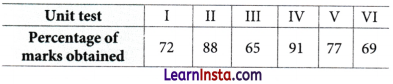
Based on this data, find the probability that the student gets more than 70% marks in a unit test.
Solution:
Here, total number of unit tests held = 6
The number of unit tests in which the student obtained more than 70% marks is 72, 88, 91, and 77.
∴ Number of favourable outcomes = 4
∴ Required probability, P(scoring more than 70% marks) = \(\frac{4}{6}=\frac{2}{3}\)
The Mathematics of Maybe Introduction to Probability Class 9 Short Question Answer
Question 1.
Rank the following events on a scale from 0 (Impossible) to 1 (Certain).
Label each event: Impossible, less likely, equally likely (even chance), more likely, certain.
Give reasons why you gave each event its ranking.
(i) The sun will rise in the West tomorrow.
(ii) You will get a tail when you toss a fair coin.
(iii) It will rain in the desert today.
(iv) You will find a student wearing a school uniform in your school.
Solution:
(i) According to geographical facts, the Earth rotates from West to East.
Therefore, the Sun always rises in the East and sets in the West.
Hence, the ranking is 0 (Impossible).
(ii) A fair coin has two distinct faces, Head and Tail, both having an equal probability of appearing on any given toss.
Hence, the ranking is 0.5 (Equally likely).
(iii) Deserts are characterised by extremely low precipitation and arid conditions.
While rainfall does occur occasionally, it is an infrequent event compared to other regions.
Hence, the ranking is less likely.
(iv) Schools are institutional environments where uniforms are typically a mandatory requirement for attendance.
In a normal school setting, encountering a student in uniform is a near-certainty.
Hence, the ranking is more likely.
Question 2.
In a survey of 364 children aged 19-36 months, it was found that 91 liked to eat potato chips. If a child is selected at random, then find the probability that he/she does not like to eat potato chips.
Solution:
The number of children who do not like to eat potato chips = 364 – 91 = 273
∴ The probability that he/she does not like to eat potato chips = \(\frac {273}{364}\) = 0.75
Question 3.
A die was rolled 200 times and the number of times 6 came up was noted. If the experimental probability calculated from this information is \(\frac {2}{5}\), then how many times did 6 come up?
Solution:
Since a die was rolled 200 times.
Let 6 come up x times.
Probability of getting 6 = \(\frac {2}{5}\)
Then, probability of an event \(=\frac{\text { Frequency of the event occurring }}{\text { Total number of trials }}\)
⇒ \(\frac{2}{5}=\frac{x}{200}\)
⇒ \(\frac {400}{5}\) = 80
Question 4.
In a medical examination 40 students of a class, their blood groups are recorded as follows.
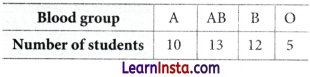
A student is selected at random from the class. Find the probability that he/she has blood group B.
Solution:
Total students = 40
Number of students with group B = 12
∴ Probability = \(\frac{12}{40}=\frac{3}{10}\)
Question 5.
12 packets of salt, each marked 2 kg, actually contained the following weights (in kg) of salt.
1.950, 2.020, 2.060, 1.980, 2.030, 1.970, 2.040, 1.990, 1.985, 2.025, 2.000, 1.980.
Out of these packets, one packet is chosen at random. What is the probability that the chosen packet contains more than 2 kg of salt?
Solution:
Total number of packets of salt = 12 [given]
Number of packets containing more than 2 kg of salt = 5
∴ Required probability = \(\frac {5}{12}\)
Question 6.
Two coins are tossed 1000 times, and the outcomes are recorded as below.
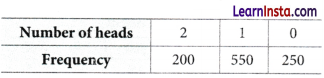
Based on this information, find the probability of at most one head.
Solution:
The number of trials in which at most one head is obtained = 550 + 250 = 800
∴ The probability for atmost one head = \(\frac{800}{1000}=\frac{4}{5}\)
Question 7.
Teachers and students are selected at random to make two teams of 20 members each on sports day to participate in the event of ‘Tug of War.’ The numbers of volunteers are as follows.
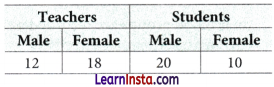
Find the probability that the person chosen at random
(i) is a male teacher.
(ii) is a female student.
Solution:
Given, total number of volunteers = 12 + 18 + 20 + 10 = 60
(i) The number of male teachers = 12
∴ Probability that the person is a male teacher = \(\frac{12}{60}=\frac{1}{5}\)
(ii) The number of female students = 10
∴ Probability that the person is a female teacher = \(\frac{10}{60}=\frac{1}{6}\)
Question 8.
Three coins are tossed simultaneously 150 times with the following frequencies of different outcomes.

Compute the probability of getting
(i) atleast 2 tails.
(ii) exactly 1 tail.
Solution:
(i) Number of atleast 2 tails = 32 + 63 = 95
Probability of getting atleast 2 tails = \(\frac{95}{150}=\frac{19}{30}\)
(ii) Probability of getting exactly 1 tail = \(\frac{30}{150}=\frac{1}{5}\)
Question 9.
80 bulbs are selected at random from a lot and their lifetime is recorded in the form of a frequency table given below.

A bulb is chosen at random from the lot. What is the probability that the bulb chosen has a lifetime less than 900 h?
Solution:
Number of bulbs having life less than 900 h = 10 + 15 + 23 = 48
∴ Required probability = \(\frac{48}{80}=\frac{3}{5}\)
Question 10.
A die is thrown 50 times, and it shows the number 1, 23 times. Find the probability of getting a number other than 1 in the next throw of the die.
Solution:
Probability of getting 1 = \(\frac {23}{50}\)
So, probability of getting a number other than 1 = 1 – \(\frac {23}{50}\) = \(\frac {27}{50}\)
Question 11.
The probability of guessing the correct answer to a certain question is \(\frac {x}{5}\). If the probability of not guessing the correct answer is \(\frac {2x}{3}\), then find the value of x.
Solution:
P(A) + P(\(\bar{A}\)) = 1
⇒ \(\frac{x}{5}+\frac{2 x}{3}\) = 1
⇒ x = \(\frac {15}{13}\)
Question 12.
The following table shows the birth month of 80 students of Class XII.
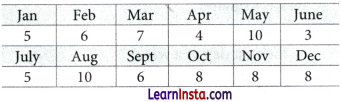
Find the probability that a student was born in a month in which the Independence Day and Republic Day are celebrated.
Solution:
Required probability = P(Jan) + P(Aug)
= \(\frac{5}{80}+\frac{10}{80}\)
= \(\frac {15}{80}\)
= 0.1875
Question 13.
A battery manufacturing company kept a record of the life (in hours) of batteries before they needed replacement. The table shows the results of 800 cases.
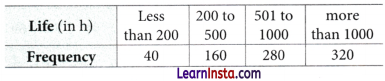
If you buy a battery from this company, what is the probability that
(i) it will need replacement before 200 h?
(ii) it will last more than 500 h?
(iii) it will need replacement between 200 h and 1000 h?
Solution:
Total number of batteries = 800
(i) The frequency of batteries that need replacement before 200 h = 40
∴ P(battery replaced before 200 h) = \(\frac {40}{800}\) = 0.05
(ii) Frequency of batteries lasting more than 500 hours = 280 + 320 = 600
∴ P(battery lasts more than 500 h) = \(\frac {600}{800}\) = 0.75
(iii) Frequency of batteries lasting between 200 and 1000 hours = 160 + 280 = 440
∴ P(battery lasts between 200 and 1000 h) = \(\frac {440}{800}\) = 0.55
Question 14.
Probability of getting a blue ball is \(\frac {2}{3}\), from a bag containing 6 blue and 3 red balls. 12 red balls are added to the bag; then find the probability of getting
(i) a blue ball.
(ii) a red ball.
Solution:
Total number of balls in a bag = 6 + 3 = 9
After adding 12 red balls,
Total number of balls became = 9 + 12 = 21
Number of blue balls = 6
Number of red balls = 3 + 12 = 15
(i) P(getting a blue ball) = \(\frac{\text { Number of blue balls }}{\text { Total number of balls }}\)
= \(\frac {6}{21}\)
= \(\frac {2}{7}\)
(ii) P(getting a red ball) = \(\frac{\text { Number of red balls }}{\text { Total number of balls }}\)
= \(\frac {15}{21}\)
= \(\frac {5}{7}\)
Question 15.
A company selected 4000 households at random and surveyed them to find out a relationship between income level and the number of television sets in a home. The information so obtained is listed in the following table.
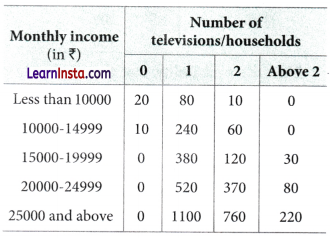
Find the probability
(i) of a household earning ₹ 10000 – ₹ 14999 per month and having exactly one television.
(ii) of a household earning ₹ 25000 and above per month and owning 2 televisions.
(iii) of a household not having any television.
Solution:
(i) The number of households earning ₹ 10000 – ₹ 14999 per month and having exactly one television = 240
∴ Required probability = \(\frac{240}{4000}=\frac{6}{100}\) = 0.06
(ii) The number of households earning ₹ 25000 and above per month and owning 2 televisions = 760
∴ Required probability = \(\frac {760}{4000}\) = 0.19
(iii) The number of households not having any television = 20 + 10 = 30
∴ Required probability = \(\frac{30}{4000}=\frac{3}{400}\) = 0.0075
Question 16.
While working out a question on probability, it was found that there were 286 letters of the English alphabet. The following was the observation of the occurrence of each letter a : 70, b : 14, e : 26, r : 40, and i : 36.
Others (not including vowels) = 100. Then, find the probability of
(i) a vowel letter.
(ii) non-vowel letters.
Solution:
Given, number of occurrences of letter a = 70
Number of occurrences of letter b = 14
Number of occurrences of letter e = 26
Number of occurrences of letter r = 40
Number of occurrences of letter i = 36
Number of occurrences of others = 100
Here, a, e, and i are vowels.
(i) Number of occurrences of a, e, and i = 70 + 26 + 36 = 132
Total number of letters = 286
∴ P(getting a vowel) = \(\frac{132}{286}=\frac{6}{13}\)
(ii) Now, number of occurrences of non-vowel letters = 14 + 40 + 100 = 154
∴ P(getting a non-vowel letters) = \(\frac{154}{286}=\frac{7}{13}\)
Question 17.
The maximum temperatures in Celsius of some cities on a day are given below.
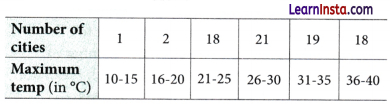
(i) Find the probability that the maximum temperature lies between 16°C and 30°C.
(ii) Find the probability that the minimum temperature is less than 25°C.
Solution:
Total number of cities = 1 + 2 + 18 + 21 + 19 + 18 = 79
(i) Number of cities whose maximum temperature lies between 16°C and 30°C = 2 + 18 + 21 = 41
∴ Probability that the temperature of cities lies between 16°C and 30°C = \(\frac {41}{79}\)
(ii) Number of cities whose maximum temperature is less than 25°C = 1 + 2 + 18 = 21
∴ Probability that the temperature of cities is less than 25°C = \(\frac {21}{79}\)
Question 18.
If the difference between the probability of success and failure of an event is \(\frac {5}{19}\). Find the probability of success and failure of the event.
Solution:
Let p be the probability of success and q be the probability of failure.
Here, we have, p – q = \(\frac {5}{19}\) …… (i)
Also, we know p + q = 1 …… (ii)
On solving Eqs. (i) and (ii), we get
2p = \(\frac {5}{19}\) + 1
⇒ p = \(\frac{24}{2 \times 19}=\frac{24}{38}=\frac{12}{19}\)
From Eq. (ii), \(\frac {12}{19}\) + q = 1
⇒ q = 1 – \(\frac {12}{19}\) = \(\frac {7}{19}\)
Question 19.
The table shows the marks (out of 150) obtained by a student in unit tests.

Find the probability that the student gets 80% or more in the next unit test. Also, find the probability that the student gets less than 80% marks.
Solution:
The marks obtained by the student out of 150 marks = 80% of 150
= \(\frac {80}{100}\) × 150
= 120 marks
Total number of unit test in which the student get 80% or more marks = 2
Probability that the student gets 80% or more marks in the next unit test = \(\frac{2}{6}=\frac{1}{3}\)
Probability that the student gets less than 80% marks = 1 – \(\frac {1}{3}\) = \(\frac {2}{3}\)
Question 20.
Three coins are tossed simultaneously 400 times, and the following frequencies of the outcomes were recorded.

(i) Find the probability of getting no head.
(ii) Find the probability of getting 1 head.
(iii) Find the probability of getting exactly 2 heads.
Solution:
Given, total number of outcomes = 400
Now, outcomes for getting no head = 400 – (103 + 124 + 98) = 75
(i) Probability of getting no head = \(\frac{75}{400}=\frac{3}{16}\)
(ii) Probability of getting 1 head = \(\frac{98}{400}=\frac{49}{200}\)
(iii) Probability of getting exactly 2 heads = \(\frac{124}{400}=\frac{31}{100}\)
Question 21.
Three dice are rolled. Using a tree diagram, find the probability of getting exactly two odd numbers.
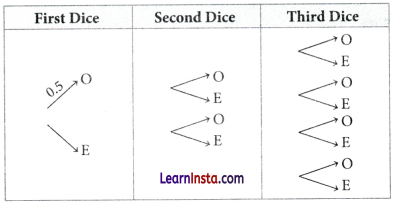
Solution:
On a die, there are six numbers 1, 2, 3, 4, 5, and 6.
∴ Total number of possible outcomes = 6
The probability of getting an odd number on a die
P(O) = \(\frac{3}{6}=\frac{1}{2}\) = 0.5
and the probability of getting an even number
P(E) = \(\frac{3}{6}=\frac{1}{2}\) = 0.5
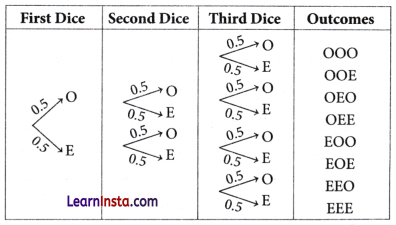
Now, required probability
P(exactly two odd numbers) = P(O, O, E) + P(O, E, O) + P(E, O, O)
= (0.5 × 0.5 × 0.5) + (0.5 × 0.5 × 0.5) + (0.5 × 0.5 × 0.5)
= 3 × 0.125
= 0.375
= \(\frac {3}{8}\)
Question 22.
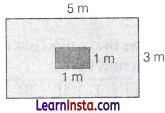
Suppose a bird lands at random on the rectangular region shown in the figure. What is the probability that it will land inside the square with a side of 1 m?
Solution:
Given a rectangular region with length 5 m and breadth 3 m, and a square inside it with a side of 1 m.
Let S represent the total rectangular area (the sample space).
Area of rectangle = Length × Breadth
Area (S) = 5 × 3 = 15 m2
Let E be the event that the bird lands inside the square.
Given the side of the square is 1 m.
Area of square = side2
Area (E) = 12 = 1 m2
∴ P(E) = \(\frac{\text { Area of event region } E}{\text { Total area of sample space } S}=\frac{1}{15}\)
The Mathematics of Maybe Introduction to Probability Class 9 Long Question Answer
Question 1.
Three coins are tossed simultaneously 150 times, and it is found that 3 tails appeared 24 times, 2 tails appeared 45 times, 1 tail appeared 72 times, and no tail appeared 9 times. If three coins are tossed simultaneously at random. Find the probability of getting
(i) 3 tails
(ii) 2 tails
(iii) 1 tail
(iv) 0 tails
Solution:
(i) Number of trials in which 3 tails appeared = 24
∴ P(A) = \(\frac {24}{150}\) = 0.16
(ii) Number of trials in which 2 tails appeared = 45
∴ P(B) = \(\frac {45}{150}\) = 0.30
(iii) Number of trials in which 1 tail appeared = 72
∴ P(C) = \(\frac {72}{150}\) = 0.48
(iv) Number of trials in which no tail appeared = 9
∴ P(D) = \(\frac {9}{150}\) = 0.06
Question 2.
Given below is the frequency distribution of daily wages (in ₹) of 30 workers in a certain factory.
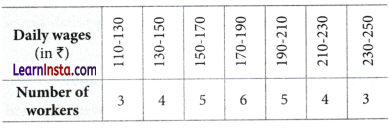
A worker is selected at random. Find the probability that his wage is
(i) less than ₹ 150.
(ii) atleast ₹ 210.
(iii) more than or equal to ₹ 150 but less than ₹ 210.
(iv) in the interval ₹ 190 – ₹ 250.
Solution:
The total number of workers = 30 [given]
(i) Number of workers whose wage is less than ₹ 150 = 3 + 4 = 7
∴ Probability that a worker gets wage less than ₹ 150 = \(\frac {7}{30}\)
(ii) Number of workers whose wage is atleast ₹ 210 = 4 + 3 = 7
∴ Probability that a worker gets wage of atleast ₹ 210 = \(\frac {7}{30}\)
(iii) Number of workers whose wage is more than or equal to ₹ 150 but less than ₹ 210 = 5 + 6 + 5 = 16
∴ Probability that a worker gets a wage more than or equal to ₹ 150 but less than ₹ 210 = \(\frac{16}{30}=\frac{8}{15}\)
(iv) Number of workers whose wage lies in the interval ₹ 190 – ₹ 250 = 5 + 4 + 3 = 12
∴ Probability that a worker gets wage lies in the interval ₹ 190 – ₹ 250 = \(\frac{12}{30}=\frac{2}{5}\)
Question 3.
The table shows the number of people visiting the ‘Good-living pavilion’ in a trade fair during different times of the day.
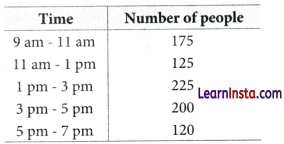
Find the probability that the randomly chosen person visited the pavilion
(i) after 1 pm but before 5 pm.
(ii) between 9 am and 1 pm.
(iii) after 5 pm.
(iv) between 3 pm and 5 pm.
Solution:
Total number of people visited = 175 + 125 + 225 + 200 + 120 = 845
(i) Number of people visited after 1 pm before 5 pm = 225 + 200 = 425
∴ Probability that the people visited after 1 pm before 5 pm = \(\frac {425}{845}\) = 0.50
(ii) 0.355
(iii) 0.142
(iv) 0.236
Question 4.
Over the past 200 working days, the number of defective parts produced by a machine is given in the following table.
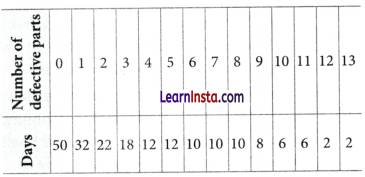
Determine the probability that tomorrow’s output will have
(i) no defective part.
(ii) atleast 1 defective part.
(iii) not more than 5 defective parts.
(iv) more than 13 defective parts.
Solution:
(i) Number of days in which no defective part is produced = 50
∴ The probability that tomorrow’s output will have no defective part = \(\frac{50}{200}=\frac{1}{4}\) = 0.25
(ii) Number of days in which atleast one defective part is produced = 32 + 22 + 18 + 12 + 12 + 10 + 10 + 10 + 8 + 6 + 6 + 2 + 2 = 150
∴ Probability that tomorrow’s output will have atleast one detective part = \(\frac{150}{200}=\frac{3}{4}\) = 0.75
(iii) Number of days in which not more than 5 defective parts are produced = 50 + 32 + 22 + 18 + 12 + 12 = 146
∴ Probability that tomorrow’s output will not have more than 5 defective parts = \(\frac {146}{200}\) = 0.73
(iv) Number of days in which more than 13 defective parts are produced = 0
∴ Probability that tomorrow’s output will have more than 13 defective parts = \(\frac {0}{200}\) = 0
Question 5.
One card is drawn from a well-shuffled deck of 52 cards. Find the probability of getting
(i) a king of red colour.
(ii) a face card.
(iii) a red face card.
(iv) the jack of hearts.
(v) a spade.
(vi) the queen of diamonds.
Solution:
Total number of cards in one deck of cards is 52.
∴ Total number of outcomes = 52
(i) Let E1 be the event of getting a king of red colour.
∴ Number of outcomes favourable to E1 = 2
[∵ there are four kings in a deck of playing cards, out of which two are red and two are black]
Hence, probability of getting a king of red colour,
P(E1) = \(\frac{2}{52}=\frac{1}{26}\)
(ii) Let E2 be the event of getting a face card.
∴ Number of outcomes favourable to E2 = 12
[∵ In a deck of cards, there are 12 face cards, namely 4 kings, 4 jacks, 4 queens]
Hence, probability of getting a face card,
P(E2) = \(\frac{12}{52}=\frac{3}{13}\)
(iii) Do the same as Part (ii).
(iv) Let E4 be the event of getting a jack of hearts.
∴ Number of outcomes favourable to E4 = 1
[∵ there are four jack cards in a deck, namely 1 of hearts, 1 of clubs, 1 of spades and 1 of diamonds]
Hence, probability of getting a jack of hearts,
P(E4) = \(\frac {1}{52}\)
(v) Let E5 be the event of getting a spade.
∴ Number of outcomes favourable to E5 = 13
[∵ In a deck of cards, there are 13 spades, 13 clubs, 13 hearts and 13 diamonds]
Hence, probability of getting a spade,
P(E5) = \(\frac{13}{52}=\frac{1}{4}\)
(vi) Do the same as Part (iv).
Question 6.
Cards marked with the numbers 5 to 104 are placed in a box and mixed thoroughly. One card is drawn from this box. Find the probability that the number on the card is
(i) an odd number.
(ii) a number less than 20.
(iii) a number which is a perfect square.
(iv) a prime number less than 25.
Solution:
Cards marked with numbers 5, 6, 7, 104 are placed in a box.
These numbers are in AP.
Using the nth term of an AP,
l = a + (n – 1)d
⇒ 104 = 5 + (n – 1) (1)
⇒ n – 1 = 104 – 5 = 99
⇒ n = 100
∴ Number of sample points = 100
(i) There are 50 odd numbers between 5 and 104.
Let A = getting a card with an odd number on it
P(A) = 50
∴ Required probability, P(an odd number card) = \(\frac{n(A)}{n(S)}=\frac{50}{100}=\frac{1}{2}\)
(ii) Let E = Getting a number less than 20.
∴ E = {5, 6, 7, 8, 9, 10, 11, 12, 13, 14, 15, 16, 17, 18, 19}
⇒ n(E) = 15
∴ Required probability, P(a number less than 20) = \(\frac{15}{100}=\frac{3}{20}\)
(iii) Let A = Getting a number which is a perfect square.
Perfect squares between 5 and 104 are (9, 16, 25, 36, 49, 64, 81, 100)
⇒ n(A) = 8
∴ Required probability, P(a number which is a perfect square) = \(\frac{8}{100}=\frac{2}{25}\)
(iv) Let E = Getting a prime number less than 25.
∴ E = {5, 7, 11, 13, 17, 19, 23}
⇒ n(E) = 7
∴ Required probability, P(a prime number less than 25) = \(\frac {7}{100}\)
Question 7.
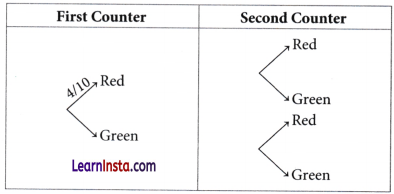
In a bag there are 10 counters, 4 are red, and 6 are green. One counter is drawn at random, its colour is noted and not replaced. Then, a second counter is drawn, and its colour is noted. Using a tree diagram, find the probability that there will be at least one red counter picked.
Solution:
Given, the bag contains 4 red and 6 green counters.
∴ The probability of red and green counters.
P(R) = \(\frac {4}{10}\) and P(G) = \(\frac {6}{10}\)
Now, P(R, R) = \(\frac {3}{9}\), P(G, R) = \(\frac {6}{9}\)
P(R, G) = \(\frac {4}{9}\) and P(G, G) = \(\frac {5}{9}\)
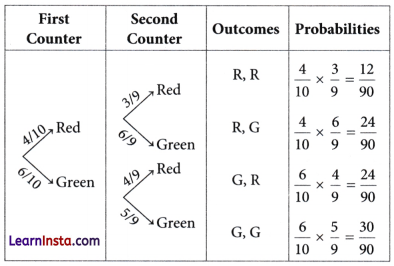
Hence, the probability of drawing at least one red counter is \(\frac {2}{3}\).
So, the required probability,
P(atleast one red) = P(R, R) + P(R, G) + P(G, R)
= \(\left(\frac{4}{10} \times \frac{3}{9}\right)+\left(\frac{4}{10} \times \frac{6}{9}\right)+\left(\frac{6}{10} \times \frac{4}{9}\right)\)
= \(\frac{12}{90}+\frac{24}{90}+\frac{24}{90}\)
= \(\frac {60}{90}\)
= \(\frac {2}{3}\)
Question 8.
Write the sample space and calculate the probability based on the given information.
(i) Two coins are tossed simultaneously. What is the probability of getting no heads?
(ii) Twenty identical cards numbered 1 to 20 are placed in a box. One card is drawn at random. What is the probability of drawing a card with a number divisible by 5?
(iii) A fair die is rolled once. What is the probability of getting a prime number?
(iv) A bag contains 4 white marbles, 3 black marbles, and 2 yellow marbles. One marble is picked at random. What is the probability that it is black?
Solution:
(i) Given, two coins are tossed at the same time.
Let S be the sample space.
S = {HH, HT, TH, TT}
∴ n(S) = 4
Let E be the event of getting no heads.
E = {TT}
∴ n(E) = 1
∴ P(E) = \(\frac{\text { Number of outcomes with no heads }}{\text { Total number of outcomes }}\) = \(\frac {1}{4}\)
(ii) Given, twenty identical cards numbered 1 to 20 are placed in a box.
Let S be the sample space.
Let S = {1, 2, 3, 4, 5, 6, 7, 8, 9, 10, 11, 12, 13, 14, 15, 16, 17, 18, 19, 20}
∴ n(S) = 20
Let E be the event of drawing a card with a number divisible by 5.
E = {5, 10, 15, 20}
∴ n(E) = 4
∴ P(E) = \(\frac{\text { Number of outcomes divisible by } 5}{\text { Total number of outcomes }}\)
= \(\frac {4}{20}\)
= \(\frac {1}{5}\)
(iii) Given, a fair die is rolled once.
Let S be the sample space.
S = {1, 2, 3, 4, 5, 6}
∴ n(S) = 6
Let E be the event of getting a prime number.
E = {2, 3, 5}
∴ n(E) = 3
∴ P(E) = \(\frac{\text { Number of prime number outcomes }}{\text { Total number of outcomes }}\)
= \(\frac {3}{6}\)
= \(\frac {1}{2}\)
(iv) Given, a bag contains 4 white marbles, 3 black marbles, and 2 yellow marbles.
Let S be the sample space.
∴ n(S) = 4 + 3 + 2 = 9
Let E be the event of picking a black marble.
∴ n(E) = 3
∴ P(E) = \(\frac{\text { Number of black marbles }}{\text { Total number of marbles }}=\frac{3}{9}=\frac{1}{3}\)
The Mathematics of Maybe Introduction to Probability Class 9 Case Based Questions
Question 1.
‘Eight Ball’ is a game played on a pool table with 17 balls numbered from 1 to 17 and a ‘Cue ball’ that is solid and white. Out of the 17 balls, eight are solid (non-white) coloured and numbered from 1 to 8, and nine are striped balls numbered from 9 to 17. The 17 numbered pool balls (no cue ball) are placed in a large bowl and mixed, then one ball is drawn out at random.
Based on the above information, answer the following questions.
(i) What is the probability that the drawn ball bears the number 8?
(ii) What is the probability that the drawn ball is a solid coloured and bears an even number?
(iii) (a) What is the probability that the drawn ball bears an even number?
Or
(b) What is the probability that the drawn ball bears a number, which is a multiple of 3?
Solution:
(i) Number of possible outcomes = 17
Number of favourable outcomes = 1
∴ P(drawn balls bears number 8) = \(\frac {1}{17}\)
(ii) Favourable outcomes are when balls numbered as 2, 4, 6, and 8.
∴ P(drawn ball is a solid coloured and bears an even number) = \(\frac {4}{17}\)
(iii) (a) Favourable outcomes are when balls numbered as 2, 4, 6, 8, 10, 12, 14, 16.
∴ P(drawn ball bears even number) = \(\frac {8}{17}\)
Or
(b) Favourable outcomes are when balls numbered as 3, 6, 9, 12, and 15.
∴ P(drawn ball bears a number which is multiple of 3) = \(\frac {5}{17}\)
Question 2.
Some students were asked to list their favourite colour. The measure of each colour is shown by the central angle of a pie-chart given below.
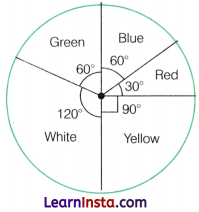
Study the pie-chart and answer the following questions.
(i) If a student is chosen at random, then find the probability of his/her favourite colour being white?
(ii) What is the probability of his/her favourite colour being blue or green?
(iii) If 15 students liked the colour yellow, how many students participated in the survey?
Or
What is the probability of the favourite colour being red or blue?
Solution:
(i) Total angle = 360°
Angle of white = 120°
∴ Probability = \(\frac{120^{\circ}}{360^{\circ}}=\frac{1}{3}\)
(ii) Total angle = 360°
Angle of blue = 60°
Angle of green = 60°
∴ Probability = \(\frac{60^{\circ}+60^{\circ}}{360^{\circ}}=\frac{120^{\circ}}{360^{\circ}}=\frac{1}{3}\)
(iii) (a) Let n students participated in the survey.
\(\frac{90^{\circ}}{360^{\circ}} \times n\) = 15
⇒ n = 15 × 4 = 60
∴ 60 students participated in the survey.
Or
(b) Total angle = 360°
Angle of red = 30°
Angle of blue = 60°
∴ Probability = \(\frac{60^{\circ}+30^{\circ}}{360^{\circ}}=\frac{90^{\circ}}{360^{\circ}}=\frac{1}{4}\)