Get the simplified Extra Questions for Class 9 Maths and Ganita Manjari Class 9 Maths Chapter 6 Measuring Space Perimeter and Area Extra Questions with complete explanation.
Class 9 Measuring Space Perimeter and Area Extra Questions
Extra Questions on Measuring Space Perimeter and Area Class 9
Class 9 Ganita Manjari Chapter 6 Extra Questions
Question 1.
The diagonals of a rhombus are 4 cm and 6 cm. Find the area of a rhombus.
Solution:
Area of rhombus = \(\frac{1}{2} \times d_1 \times d_2\)
= \(\frac {1}{2}\) × 4 × 6
= 12 cm2
Question 2.
If the area of a parallelogram is 64 cm2, the base is 12 cm, find the altitude of the parallelogram.
Solution:
Area of parallelogram = Base × Height
⇒ 64 = 12 × Height
⇒ Height = \(\frac {64}{12}\) = 5.33 cm
Question 3.
When is Brahmagupta’s formula applicable?
Solution:
Brahmagupta’s formula is applicable only when the quadrilateral is cyclic.
i.e., all four vertices lie on a circle.

Question 4.
Find the semi-perimeter of a cyclic quadrilateral if the sides are 4 cm, 5 cm, 6 cm, and 7 cm.
Solution:
Semi-perimeter (s) = \(\frac{a+b+c+d}{2}\)
= \(\frac{4+5+6+7}{2}\)
= \(\frac {22}{2}\)
= 11 cm
Measuring Space Perimeter and Area Class 9 Very Short Question Answer
Question 1.
Find the area of the triangle having perimeter 32 cm, one side 11 cm, and the difference of the other two sides is 5 cm.
Solution:
Let the sides of the triangle be 11 cm, x cm, and y cm.
∴ x + y + 11 = 32
⇒ x + y = 21 and x – y = 5
⇒ x = 13 and y = 8
Now, using Heron’s formula, calculate the area.
Area = 8√30 cm2
Question 2.
The sides of a triangular field are 51 m, 37 m, and 20 m. Find the number of flower beds that can be prepared if each bed is to occupy 9 m2 of space.
Solution:
Number of flower beds \(=\frac{\text { Area of triangular field }}{\text { Space occupied by each flower bed }}\) = 34 flower beds can be prepared.
Question 3.
The sides of a triangle are x, x + 1, 2x – 1 and its area is x√10. Find the value of x.
Solution:
Semi-perimeter, s = \(\frac{x+x+1+2 x-1}{2}\) = 2x
∴ Area of triangle = \(\sqrt{2 x(2 x-x)(2 x-x-1)(2 x-2 x+1)}\)
⇒ \(x \sqrt{10}=\sqrt{2 x \cdot x \cdot(x-1)(1)}\)
⇒ \(x \sqrt{10}=x \sqrt{2(x-1)}\)
⇒ 10 = 2(x – 1)
⇒ x = 6
Question 4.
If the sum of the perimeter and area of a circle is numerically equal to 704 units, find the radius of the circle.
Solution:
The perimeter of a circle is the circumference of the circle.
According to the question,
2πr + πr2 = 704
⇒ \(\frac{22}{7} \times 2 \times r+\frac{22}{7} \times r^2\) = 704
⇒ \(\frac{44}{7} r+\frac{22}{7} r^2\) = 704
⇒ 44r + 22r2 = 4928
⇒ 2r + r2 = 224
⇒ r2 + 2r – 224 = 0
⇒ (r – 14)(r + 16) = 0
⇒ r = 14 cm
Question 5.
The length of the hour hand of a clock is 7 cm. Find the area swept by the hour hand in one hour.
Solution:
Angle described by hour hand in 1 h = \(\frac{360^{\circ}}{12}\) = 30°
∴ Area swept = \(\frac{30^{\circ}}{360^{\circ}} \times \pi \times(7)^2 \mathrm{~cm}^2\) = 12.83 cm2
Question 6.
If the area of a sector of a circle is \(\frac {7}{18}\)th of the area of that circle, then find the central angle of the Sector.
Solution:
Area of sector of circle = \(\frac {7}{18}\) × Area of the same circle
⇒ \(\frac{\theta}{360^{\circ}} \times \pi r^2=\frac{7}{18} \times \pi r^2\) [∵ r = radius of circle]
⇒ θ = 140°
Question 7.
What will be the length of an arc of a sector of a circle with radius r and angle θ?
Solution:
Length of an arc of a sector of a circle with radius r and angle θ is \(\frac{\theta}{360^{\circ}} \times 2 \pi r \text { i.e. } \frac{\theta}{180^{\circ}} \times \pi r\).
Question 8.
The perimeter of a sector of a circle of radius 15 cm is 80 cm. Find the area of the sector.
Solution:
Given, r = 15 cm and perimeter of a sector = 80 cm.
Let the length of arc be l.
∴ Perimeter of a sector = 2r + l
⇒ 80 = 2 × 15 + l
⇒ l = 50 cm
∴ Area of the sector = \(\frac {1}{2}\) × 15 × 50 = 375 cm2
Measuring Space Perimeter and Area Class 9 Short Question Answer
Question 1.
If the sides of a rhombus are 10 cm each and one diagonal is 16 cm, find the area of the rhombus.
Solution:
Let AC be the diagonal of 16 cm and diagonal bisect each other at 90°.
So, AO = \(\frac {16}{2}\) = 8 cm and AB = 10 cm [given]
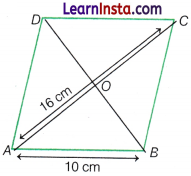
In ∆AOB, by Pythagoras’ theorem
(AB)2 = (AO)2 + (OB)2
⇒ 100 = 64 + (OB)2
⇒ OB = 6 cm
Now, DB = 2 × 6 = 12 cm
∴ Area = \(\frac {1}{2}\) × 16 × 12 = 96 cm2
Question 2.
Find the area of a parallelogram, whose one diagonal is 6.8 cm and the perpendicular distance of the diagonal from an opposite vertex is 7.5 cm.
Solution:
Area of one triangle = \(\frac {1}{2}\) × Base × Height
= \(\frac {1}{2}\) × 6.8 × 7.5
= 25.5 cm2
∴ Total area = 2 × 25.5 = 51 cm2
Question 3.
In ΔABC, AD is a median and BC = 12 cm. A line through D parallel to AB meets AC at E. If the area of ΔABC is 96 cm2, find the area of ΔADE.
Solution:
Given, AD is a median of ΔABC.
∴ D is the midpoint of BC and DE || AB, and DE meets AC at E.
So, E is the midpoint of AC. [By midpoint theorem]
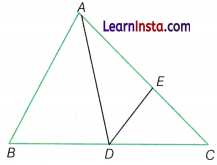
Since AD is the median of ΔABC.
Then, ar (ΔADC) = \(\frac {1}{2}\) × ar (ΔABC)
Also, DE is a median because E is the midpoint of AC.
∴ ar (ΔADE) = \(\frac {1}{2}\) × ar (ΔADC)
⇒ ar (ΔADE) = \(\frac {1}{2}\) × \(\frac {1}{2}\) × ar (ΔABC)
⇒ ar (ΔADE) = \(\frac {1}{4}\) × ar (ΔABC)
Now, ar (ΔABC) = 96 cm2
So, ar (ΔADE) = \(\frac {1}{4}\) × 96 = 24 cm2
Hence, the area of ΔADE is 24 cm2
Question 4.
The triangular side walls of a flyover have been used for advertisements. The sides of the walls are 13 m, 14 m, and 15 m. The advertisements yield an earning of ₹ 2000 per m2 per year. A company hired one of its walls for 6 months. How much rent did it pay?
Solution:
Area = \(\sqrt{21(21-13)(21-14)(21-15)}\)
= \(\sqrt{21 \times 8 \times 7 \times 6}\)
= 84 m2
Given, rent per year = ₹ 2000 per m2
∴ Rent for 6 months = \(\frac{84 \times 2000}{2}\) = ₹ 84000
Question 5.
The perimeter of a triangle is 50 cm. One side of a triangle is 4 cm longer than the smaller side, and the third side is 6 cm less than twice the smaller side. Find the area of the triangle.
Solution:
Let the smallest side be x cm.
Then, the sides of the triangle are x, x + 4, 2x – 6.
∴ x + x + 4 + 2x – 6 = 50
⇒ 4x = 52
⇒ x = 13
Sides of the triangle are 13, 17, 20.
Now, use Heron’s formula to calculate the area.
Area = 109.54 cm2
Question 6.
The triangular side walls of a flyover have been used for advertisements. The sides of the walls are 122 m, 22 m, and 120 m (see figure).
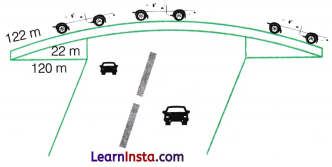
The advertisements yield an earning of ₹ 5000 per m2 per year. A company hired one of its walls for 3 months. How much rent did it pay?
Solution:
Let the sides of the wall be a = 122 m, b = 22 m, and c = 120 m.
Then, semi-perimeter, s = \(\frac{a+b+c}{2}\)
= \(\frac{122+22+120}{2}\)
= \(\frac {264}{2}\)
= 132
Now, area of the wall = \(\sqrt{s(s-a)(s-b)(s-c)}\) [By Heron’s formula]
= \(\sqrt{132(132-122)(132-22)(132-120)}\)
= \(\sqrt{132 \times 10 \times 110 \times 12}\)
= \(\sqrt{11 \times 12 \times 10 \times 11 \times 10 \times 12}\)
= 11 × 12 × 10
= 1320 m2
Given, earning on 1 m2 per year = ₹ 5000
∴ Earning on 1320 m2 per year = 1320 × 5000 = ₹ 6600000
Now, earnings in 12 months = ₹ 6600000
∴ Earning in 3 months = \(\frac{6600000 \times 3}{12}\) = ₹ 1650000
Question 7.
The minute hand of a wall clock is 18 cm long. Find the area of the face of the clock described by the minute hand in 35 min.
Solution:
Here, the angle described by the minute hand in 5 min is 30°.
Length of minute hand = 18 cm = r
Angle described by minute hand in 35 min = 7 × 30° = 210°
∴ Area swept by minute hand in 35 min = \(\frac{\theta}{360^{\circ}} \times \pi r^2\)
= \(\frac{210^{\circ}}{360^{\circ}} \times \frac{22}{7} \times 18 \times 18\)
= 594 cm2
Question 8.
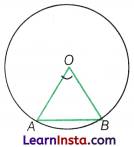
A chord of a circle of radius 14 cm subtends an angle of 90° at the centre. Find the perimeter of the shaded region. [use √2 = 1.41]
Solution:
Given, radius of circle (r) = 14 cm
and angle subtended at centre ∠AOB = θ = 90°.
Using Pythagoras’ theorem,
AB2 = OA2 + OB2
= (14)2 + (14)2
= 196 + 196
AB2 = 392
AB = 14√2
= 14 × 1.41
= 19.74 cm
Now, length of arc, AB = \(\frac{2 \pi r \theta}{360^{\circ}}\)
= \(2 \times \frac{22}{7} \times 14 \times \frac{90^{\circ}}{360^{\circ}}\)
= 22 cm
∴ Perimeter of shaded region = AB + length of arc AB
= 22 + 19.74
= 41.74 cm
Question 9.
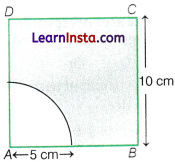
In the given figure, ABCD is a square of side 10 cm. A sector of radius 5 cm is cut out from one of the corners. Find the area of the shaded region. [take, π = 3.14]
Solution:
Area of shaded region = Area of square – Area of sector
= \(10^2-\frac{90^{\circ}}{360^{\circ}} \times 3.14 \times 25\)
= 100 – 19.625
= 80.375 cm2
Question 10.
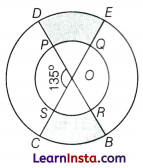
In the given figure, O is the centre of the concentric circles. The radius of the inner circle is half the radius of the outer circle. If ∠DOC = 135° and OD = 14 cm, then calculate the area of the shaded region. [leave your answer in terms of π]
Solution:
∠DOE = ∠COB = θ [vertically opposite angles]
⇒ ∠DOE + 135° = 180° [by linear pair as EOC is a line]
⇒ ∠DOE = 45°
∴ Area of shaded region = 2(Area of sector DOE – Area of sector POQ) = \(\frac{147}{4} \pi\) cm2
Question 11.
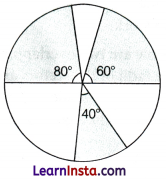
In the given figure, three sectors of a circle of radius 7 cm, making angles of 60°, 80°, and 40° at the centre are shaded. Find the area of the shaded region.
Solution:
Area of shaded region = Sum of area of three sectors
= \(\frac{60^{\circ}}{360^{\circ}} \pi r^2+\frac{80^{\circ}}{360^{\circ}} \pi r^2+\frac{40^{\circ}}{360^{\circ}} \pi r^2\)
= \(\frac{\pi r^2}{360^{\circ}}\left[60^{\circ}+80^{\circ}+40^{\circ}\right]\)
= \(\frac{22}{7} \times 49 \times \frac{180^{\circ}}{360^{\circ}}\)
= 77 cm2
Question 12.
In a circular agricultural field, a sector subtending an angle of 120° at the centre is dedicated to growing sugarcane. If the radius of the circular field is 30 m, then what is the area of the land used for growing sugarcane? Show your work. [take, π = 3.14]
Solution:
Given, angle subtended by a sector of a circular field = 120°
and radius of the circular field = 30 m.
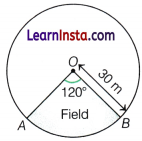
∴ Area of the land used for growing sugarcane = Area of sector of the circle.
= \(\pi r^2 \times \frac{\theta}{360^{\circ}}\)
= 3.14 × 30 × 30 × \(\frac{120^{\circ}}{360^{\circ}}\)
= 314 × 9 × \(\frac {1}{3}\)
= 314 × 3
= 942 m2
Hence, the area of land used for growing sugarcane is 942 m2
Question 13.
In the given figure, OABC is a square of side 7 cm. If OAPC is a quadrant of a circle with centre O, then find the area of the shaded region.
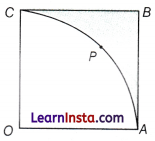
Solution:
Area of shaded region = Area of square OABC – Area of quadrant OAPCO
= \((O A)^2-\frac{1}{4} \times \pi(O A)^2\)
= 10.5 cm2
Question 14.
In the given figure, O is the centre of the circle with radius equal to 14 cm. The length of the arc AB = 13.2 cm. Find the area of the shaded sector of the circle.
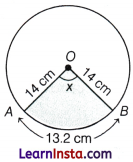
Solution:
Area of shaded region = \(\frac {1}{2}\) × Length of arc × Radius
= \(\frac {1}{2}\) × 13.2 × 14
= 92.4 cm2
Question 15.
The perimeter of the sector of a circle of radius 14 cm and central angle 45° is
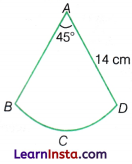
Solution:
We have, radius =14 cm, ∠BAD = 45°.
According to the question,
Perimeter = 2(Radius) + arc BCD
∴ Length of arc = \(\frac{\theta}{360^{\circ}} \times 2 \pi r\)
= \(\frac{45^{\circ}}{360^{\circ}} \times 2 \times \frac{22}{7} \times 14\)
= 11 cm
and perimeter = 2 × 14 + 11
= 28 + 11
= 39 cm
Hence, the perimeter of the sector ABCDA is 39 cm.
Question 16.
A ceiling fan has three wings as shown in the figure. Find the length of arc described between two consecutive wings, where the length of each wing is 0.98 m.
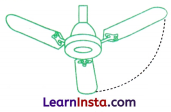
Solution:
Area of each sector = \(\frac{120^{\circ}}{360^{\circ}}\) × Area of circle form by wings of fan
= \(\frac{1}{3} \times \frac{22}{7} \times(0.98)^2\) …..(i)
∴ Area of each sector = \(\frac {1}{2}\) × 0.98 × l …… (ii)
From Eqs. (i) and (ii), we get
\(\frac{1}{2} \times 0.98 \times l=\frac{1}{3} \times \frac{22}{7} \times(0.98)^2\)
∴ l = 2.05 m
Measuring Space Perimeter and Area Class 9 Long Question Answer
Question 1.
In ∆ABC, AD is a median, and E is a point on AD. Compare the areas of ∆ABE and ∆ACE.
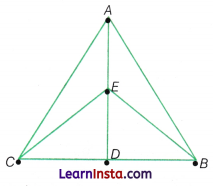
Solution:
Given, AD is a median of ∆ABC.
∴ D is the midpoint of BC.
Also, E is a point on AD.
Now, in ∆BEC, ED is a median.
Since a median divides a triangle into two triangles of equal area.
Then, ar (∆BDE) = ar (∆CDE)
Now, ar (∆ABE) = ar (∆ABD) – ar (∆BDE)
and ar (∆ACE) = ar (∆ACD) – ar (∆CDE)
Also, AD is a median of ∆ABC.
ar (∆ABD) = ar (∆ACD)
Hence, ar (∆ABE) = ar (∆ACE).
Therefore, the areas of ∆ABE and ∆ACE are equal.
Question 2.
In ∆ABC, the sides are a, b, and c, the circumradius is R, the inradius is r, and the semi-perimeter is s.
(i) Prove that \(\frac{a b c}{4 R}\) = rs
(ii) If ha, hb, and hc are the altitudes corresponding to sides a, b, and c respectively, show that \(\frac{1}{h_a}+\frac{1}{h_b}+\frac{1}{h_c}=\frac{1}{r}\).
Solution:
(i) Given, in ∆ABC, sides are a, b, c, and circumradius R, inradius r, and semi-perimeter s.
Now, the area of triangle = ar (∆ABC) = \(\frac{a b c}{4 R}\)
Also, ar (∆ABC) = rs
Therefore, \(\frac{a b c}{4 R}\) = rs
Hence, the required result is proved.
(ii) Now, ha, hb, hc are the altitudes corresponding to sides a, b, and c, respectively.
Let ar (∆ABC) = ∆
So, the area of ∆ = \(\frac{1}{2} a h_a\)
⇒ \(h_a=\frac{2 \Delta}{a}\)
⇒ \(\frac{1}{h_a}=\frac{a}{2 \Delta}\)
Similarly, \(\frac{1}{h_b}=\frac{b}{2 \Delta}, \frac{1}{h_c}=\frac{c}{2 \Delta}\)
Now, \(\frac{1}{h_a}+\frac{1}{h_b}+\frac{1}{h_c}=\frac{a}{2 \Delta}+\frac{b}{2 \Delta}+\frac{c}{2 \Delta}\) = \(\frac{a+b+c}{2 \Delta}\)
Since, a + b + c = 2s
Then, \(\frac{1}{h_a}+\frac{1}{h_b}+\frac{1}{h_c}=\frac{2 s}{2 \Delta}=\frac{s}{\Delta}\)
Also, ∆ = rs
So, \(\frac{s}{\Delta}=\frac{s}{r s}=\frac{1}{r}\)
Hence, \(\frac{1}{h_a}+\frac{1}{h_b}+\frac{1}{h_c}=\frac{1}{r}\)
Hence proved.
Question 3.
Find the difference of the areas of a sector of angle 120° and its corresponding major sector of a circle of radius 21 cm.
Solution:
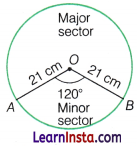
Difference of the area of minor sector AOBA and its corresponding major sector ABOA = Area of major sector ABOA – Area of minor sector AOBA
= (Area of circle – Area of minor sector AOBA) – Area of minor sector AOBA
= 462 cm2
Question 4.
In the figure, \(\overparen{P Q}\) and \(\overparen{A B}\) are two arcs of concentric circles of radii 7 cm and 3.5 cm, respectively, with centre O. If ∠POQ = 30°, then find the area of the shaded region.
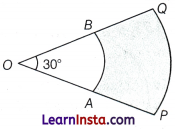
Solution:
PQ and AB are the arcs of two concentric circles of radii 7 cm and 3.5 cm, respectively.
Let r1 and r2 be the radii of the outer and inner circles, respectively.
∴ Area of shaded region = Area of sector OPQ – Area of sector OAB
= \(\frac{\theta}{360^{\circ}} \pi r_1^2-\frac{\theta}{360^{\circ}} \pi r_2^2\)
= \(\frac{30^{\circ}}{360^{\circ}} \times \frac{22}{7}\left[7^2-3.5^2\right]\)
= \(\frac{1}{12} \times \frac{22}{7}[49-12.25]\)
= \(\frac{1}{12} \times \frac{22}{7} \times 36.75\)
= 9.625
Thus, the area of the shaded region is 9.625 cm2
Question 5.
ABCDEF is a regular hexagon. With vertices A, B, C, D, E, and F as the centres, circles of the same radius r are drawn. Find the area of the shaded portion shown in the given figure.
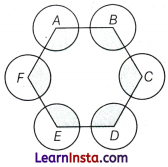
Solution:
Each angle of regular hexagon = \(\frac{\text { Sum of all angles }}{\text { Number of sides }}\)
= \(\frac{(6-2) \times 180^{\circ}}{6}\)
= 120°
∴ ∠A = ∠B = ∠C = ∠D = ∠E = ∠F = 120°
Area of shaded region = 6 × Area of sector with ∠A = 2πr2
Question 6.
A horse, a cow, and a goat are tied, each by ropes of length 14 m, at the corners A, B, and C, respectively, of a grassy triangular field ABC with sides of lengths 35 m, 40 m, and 50 m. Find the area of the grass field that can be grazed by them.
Solution:
The length of the rope is the radius of the circular area each animal can graze, so r = 14 m.
Now, area of the grass field that can be grazed by them = \(\frac{\theta_1}{360^{\circ}} \pi r^2+\frac{\theta_2}{360^{\circ}} \pi r^2+\frac{\theta_3}{360^{\circ}} \times \pi r^2\)
= \(\frac{\pi r^2}{360^{\circ}}\left(\theta_1+\theta_2+\theta_3\right)\)
= \(\frac{\pi r^2}{360^{\circ}} \times 180^{\circ}\) [by angle sum property of triangle]
= \(\frac{1}{2} \times \frac{22}{7} \times 14 \times 14\)
= 308 m2
Question 7.
Avikant bought a pair of glasses with wiper blades. He was curious to know the area being cleaned by each of the wiper blades. With the help of a ruler and a protractor, he found the length of each blade as 3 cm, and the angle swept as 60°. [Note:The figure is for visual representation only]
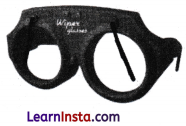
(i) Find the area that each wiper cleans in one swipe, in terms of π.
(ii) If the diameter of each circular glass is 5 cm, what percent of the area of the glass will be cleaned by the blade in one swipe?
Show your work.
Solution:
(i) Here, radius = Length of wiper = 3 cm and angle (θ) = 60°.
∴ Area that the wiper cleans = Area of sector
= \(\frac{\theta}{360^{\circ}} \pi r^2\)
= \(\frac{60^{\circ}}{360^{\circ}} \times \pi \times(3)^2\)
= 1.5π cm2
(ii) Area of glass = πr2
= \(\pi \times \frac{5}{2} \times \frac{5}{2}\)
= \(\frac{25}{4} \pi \mathrm{~cm}^2\)
Percentage of area cleaned = \(\frac{1.5 \pi}{\frac{25}{4} \pi} \times 100\)
= \(1.5 \pi \times \frac{4}{25 \pi} \times 100\)
= 24%
Question 8.
Shown below are two overlapping sectors of a circle. The radii of the sectors are 6 cm and 8 cm. The figure is divided into three regions I, II, and III. [Note: the figure is not to scale]
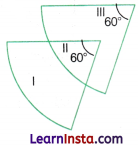
Find the difference in the areas of regions I and III. Show your work. [take, π = \(\frac {22}{7}\)]
Solution:
Let radius of sector (I + II) = 8 cm
and radius of sector (II + III) = 6 cm
Area of sector (I + II) = \(\frac{60^{\circ}}{360^{\circ}} \times \pi \times 8 \times 8=\frac{64}{6} \pi \mathrm{~cm}^2\)
Area of sector (II + III) = \(\frac{60^{\circ}}{360^{\circ}} \times \pi \times 6 \times 6=\frac{36}{6} \pi \mathrm{~cm}^2\)
∴ Difference in areas of region I and III = \(\frac{64}{6} \pi-\frac{36}{6} \pi\)
= \(\frac{28}{6} \pi\)
= \(\frac{28}{6} \times \frac{22}{7}\)
= \(\frac {44}{3}\) cm2
Question 9.
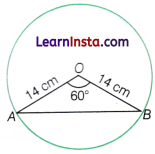
AB is a chord of a circle centred at O such that ∠AOB = 60°. If OA = 14 cm, then find the area of the minor segment. [take, √3 = 1.73]
Solution:
Given, AB is a chord of a circle centred at O such that ∠AOB = 60° and OA = 14 cm.
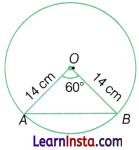
In ∆AOB, ∠A = ∠B [angle opposite to the equal sides]
⇒ ∠A = ∠B = ∠O = 60°
Hence, ∆ABO is an equilateral triangle.
∴ Area of equilateral ∆ABO = \(\frac{\sqrt{3}}{4} \times(O A)^2\) = \(\frac{\sqrt{3}}{4} \times(14)^2\)
Now, area of sector OABO = \(\frac{\theta}{360^{\circ}}\left(\pi r^2\right)\) = \(\frac{60^{\circ}}{360^{\circ}} \times \frac{22}{7} \times(14)^2\)
So, area of minor segment = Area of sector OABO – Area of ∆OAB
= \(\frac{60^{\circ}}{360^{\circ}} \times \frac{22}{7} \times 14 \times 14-\frac{\sqrt{3}}{4} \times 14 \times 14\)
= 102.66 – 84.77
= 17.89 cm2
Question 10.
The perimeter of sector OACB of the circle centred at O of radius 24 is 73.12 cm.
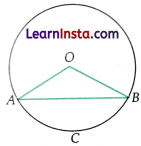
(i) Find the central angle ∠AOB.
(ii) Find the area of the minor segment ACB. [take, π = 3.14 and √3 = 1.73]
Solution:
Given, perimeter of sector OACB = 73.12 cm and radius = 24 cm.
Let θ be the angle of sector OACB.
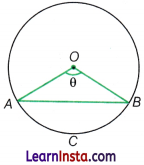
(i) Perimeter of sector OACB = 2r + \(\frac{2 \pi r \theta}{360^{\circ}}\) = 73.12
⇒ 2 × 24 + \(\frac{2 \times 3.14 \times 24 \times \theta}{360}\) = 73.12
⇒ 48 + \(\frac{48 \times 3.14 \times \theta}{360}\) = 73.12
⇒ θ = 60°
(ii) In ∆OAB, ∠OAB = ∠OBA [∵ OA = OB = radii of circle]
∴ ∠OAB + ∠OBA + 60° = 180°
⇒ ∠OAB + ∠OAB = 180° – 60°
⇒ 2∠OAB = 120°
⇒ ∠OAB = 60°
⇒ ∠OAB = ∠OBA = 60°
∴ ∆OAB is an equilateral triangle.
Thus, area of minor segment ACB = \(\frac{\pi r^2 \theta}{360^{\circ}}-\frac{\sqrt{3}}{4} r^2\)
= \(\frac{3.14 \times 24 \times 24 \times 60}{360}-\frac{1.73}{4} \times 24 \times 24\)
= 301.44 – 249.12
= 52.32 cm2
Question 11.
A car has two wipers, which do not overlap. Each wiper has a blade of length 25 cm sweeping through an angle of 115°. Find the total area cleaned at each sweep of the blades.
Solution:
Given, length of wiper blade = 25 cm = r
and angle made by this blade (θ) = 115°.
∴ Area cleaned by one blade = Area of sector formed by blade
= \(\frac{\theta}{360^{\circ}} \times \pi r^2\)
= \(\frac{115^{\circ}}{360^{\circ}} \times \frac{22}{7} \times(25)^2\)
= \(\frac{23 \times 11 \times 625}{36 \times 7}\)
= \(\frac{158125}{252} \mathrm{~cm}^2\)
Hence, total area cleaned by both blades = 2 × Area cleaned by one blade
= \(\frac{2 \times 158125}{252}\)
= \(\frac{158125}{126} \mathrm{~cm}^2\)
Question 12.
A brooch is made with silver wire in the form of a circle with diameter 35 mm. The wire is also used in making 5 diameters, which divide the circle into 10 equal sectors as shown in the figure.

(i) Find the total length of the silver wire required.
(ii) Find the area of each sector of the brooch.
Solution:
Given, diameter of circle (d) = 35 mm
∴ Circumference of circle = πd [∵ d = 2r]
= \(\frac {22}{7}\) × 35
= 110 mm
Now, length of 5 diameters = 5 × 35 = 175 mm
(i) Total length of the silver wire = Circumference of circle + Length of 5 diameters
= 110 + 175
= 285 mm
(ii) Here, we see that the total circle is divided into 10 sectors.
Angle of each sector = \(\frac{360^{\circ}}{10}\) = 36°
Then, area of each sector of the brooch = \(\frac{\theta}{360^{\circ}} \times \pi r^2\)
= \(\frac{36^{\circ}}{360^{\circ}} \times \frac{22}{7}\left(\frac{35}{2}\right)^2\) [∵ r = \(\frac{d}{2}=\frac{35}{2}\) mm]
= \(\frac{1}{10} \times \frac{22}{1} \times \frac{5}{2} \times \frac{35}{2}\)
= \(\frac{11 \times 35}{2 \times 2}\)
= \(\frac {385}{4}\) mm2
Question 13.
A horse is tied to a peg at one corner of a square-shaped grass field of side 15 m by means of a 5 m long rope (see the figure).
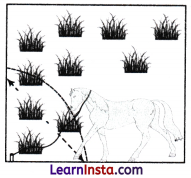
(i) Find the area of the part of the field in which the horse can graze.
(ii) Find the increase in the grazing area if the rope were 10 m long instead of 5 m. [take, π = 3.14]
Solution:
Given, side of a square = 15 m
∴ Area of square = (15)2 = 225 m2
[∵ area of square = (side)2]
Also given, length of rope = 5 m
⇒ Radius of arc = 5 m
(i) Area of the field grazed by the horse,
A1 = \(\frac{\theta}{360^{\circ}} \times \pi r^2\)
= \(\frac{90^{\circ}}{360^{\circ}} \times 3.14 \times(5)^2\) [∵ each angle of a square is 90°]
= \(\frac{3.14 \times 25}{4}\)
= \(\frac {78.5}{4}\)
= 19.625 m2
(ii) If length of rope = 10 m = r1 [say]
Then, area of the field grazed by the horse
A2 = \(\frac{\theta}{360^{\circ}} \times \pi r_1^2\)
= \(\frac{90^{\circ}}{360^{\circ}} \times 3.14 \times(10)^2\)
= \(\frac{3.14 \times 100}{4}\)
= \(\frac {314}{4}\)
= 78.5 m2
∴ Required increase in the grazing area = A2 – A1
= 78.5 – 19.625
= 58.875 m2
Measuring Space Perimeter and Area Class 9 Case Based Questions
Question 1.
Glass buildings can be strengthened using iron frames. A glass structure and its iron frame are shown below.
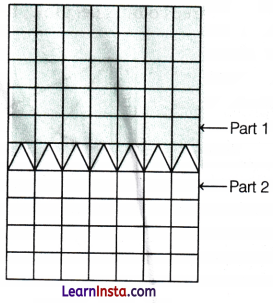
The frame consists of equal triangles. The dimensions of a triangle are shown below.
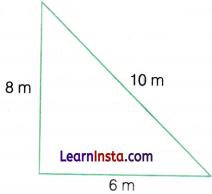
Based on the above information, answer the following questions.
(i) How much area is enclosed by one triangle?
(ii) What is the area of Part 1 of the frame?
(iii) (a) Is the area of Part 1 equal to the area of Part 2? Why?
Or
(b) Maintenance of the building’s exterior is done by a company. The company charges ₹ 750 per m2 per month. Which of the following calculations represents the monthly maintenance charges?
Solution:
(i) Area = \(\sqrt{s(s-a)(s-b)(s-c)}\)
∵ s = \(\frac{8+10+6}{2}\) = 12 m
∴ Area = \(\sqrt{12 \times 4 \times 2 \times 6}\) = 24 m2
(ii) Area of Part 1 of frame = (Area of 1 triangle × 14) + (Area of 1 rectangular box × 35)
= 24 × 14 + (12 × 8) × 35
= 336 + 3360
= 3696 m2
(iii) (a) The area of Part 2 = (Area of 1 rectangular box × 35) – (Area of 1 triangle × 14)
= 3360 – 336
= 3024 m2
No
Or
(b) Area of frame = Area of Part 1 + Area of Part 2
= 3696 + 3024
= 6720 m2
Monthly maintenance = 750 × 6720 = ₹ 5040000
Question 2.
In the marriage of Raj’s brother Rajesh, a conical tent is made by stitching 12 triangular pieces of cloth of two different colours, red and white, alternately, each piece measuring 10 cm, 20 cm, and 20 cm.
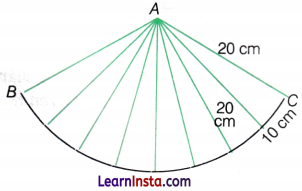
Based on the above information, answer the following questions.
(i) Write the formula to find the area of a triangle [by Heron’s formula].
(ii) Find the semi-perimeter of one red colour triangle.
(iii) (a) Find the area of one red colour triangle (see in figure).
Or
(b) How much cloth of red colour is required to make a conical tent?
Solution:
(i) ∴ Area of triangle = \(\sqrt{s(s-a)(s-b)(s-c)}\)
(ii) In a conical tent, pieces are in the form of a triangle, whose sides are 10 cm, 20 cm, and 20 cm.
∴ a = 10 cm, b = 20 cm, and c = 20 cm
So, s = \(\frac{a+b+c}{2}=\frac{10+20+20}{2}=\frac{50}{2}\) = 25 cm
(iii) (a) ∵ s = 25 cm
∴ Area of triangle = \(\sqrt{s(s-a)(s-b)(s-c)}\)
= \(\sqrt{25(25-10)(25-20)(25-20)}\)
= \(\sqrt{25 \times 15 \times 5 \times 5}\)
= \(\sqrt{5 \times 5 \times 5 \times 3 \times 5 \times 5}\)
= 5 × 5√15
= 25√15 cm2
Or
(b) Since the area of one red colour triangular piece is 25√15 cm2
Since the tent is made of 12 triangular pieces of two colours.
So, the number of triangular pieces of red colour is 6.
Hence, cloth of red colour required to make a conical tent is 6 × 25√15 = 150√15 cm2
Question 3.
Green cleaning refers to cleaning methods and products that use environmentally friendly ingredients and procedures to preserve human health and environmental quality. To preserve the environment, Ramesh made a slide in the park of his society. On the side walls of the slide, there was a message ‘TAKE SHORT WALK IN PARK DOWN A HAPPY TRAIL’ (see figure). If the sides of the wall are 15 m, 11 m, and 6 m, then answer the questions by looking at the figure. [take √2 = 1.41]
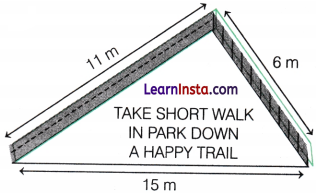
Based on the above information, answer the following questions.
(i) Find the semi-perimeter of the triangle.
(ii) Write the type of triangle given in the question.
(iii) (a) Find the area (in m2) of the wall.
Or
(b) Find the cost of painting the side wall if the price is ₹ 8 per m2.
Solution:
(i) Given that a = 15 m, b = 11 m, and c = 6 m.
Semi-perimeter (s) = \(\frac{a+b+c}{2}\)
= \(\frac{15+11+6}{2}\)
= \(\frac {32}{2}\)
= 16
(ii) Since all three sides of the triangle are unequal, the given triangle is scalene.
(iii) (a) ∵ s = 16 m
Now, area of the wall = \(\sqrt{16(16-15)(16-11)(16-6)}\)
= \(\sqrt{16 \times 1 \times 5 \times 10}\)
= \(\sqrt{4 \times 4 \times 1 \times 5 \times 5 \times 2}\)
= 4 × 5√2
= 20√2 m2
Or
(b) ∵ Area of the wall = 20√2 m2
∴ Cost of painting = 20√2 × 8
= 160√2
= 160 × 1.41
= ₹ 225.6
= ₹ 226 (approx)
Question 4.
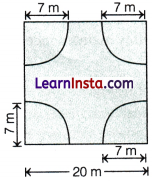
A stable owner has four horses. He usually ties these horses with a 7 m long rope to pegs at each corner of a square-shaped grass field of 20 m length, to graze on his farm. But tying with a rope sometimes results in injuries to his horses, so he decided to build a fence around the area so that each horse can graze.
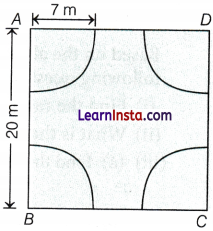
Based on the above information, answer the following questions.
(i) Find the area of the square-shaped grass field.
(ii) (a) Find the area of the total field in which these horses can graze.
Or
(b) If the length of the rope of each horse is increased from 7 m to 10 m, then find the area grazed by one horse. [take, π = 3.14]
(iii) What is the area of the field that is left ungrazed, if the length of the rope of each horse is 7 cm?
Solution:
(i) Length of the square-shaped grass field = 20 m
∴ Area of the square shaped grass field = 20 × 20 = 400 m2
(ii) (a) Length of the rope = 7 m
Thus, each horse can graze upto 7 m of distance along the side.
The grazed area is making a complete circle by taking all the four grazed parts.
So, area of grazed part = πr2
= \(\frac{22}{7} \times 7^2\)
= 22 × 7
= 154 m2
Therefore, the area of the total field in which these horses can graze is 154 m2.
Or
(b) New length of the rope of each horse = 10 m
∴ Area grazed by one horse = \(\frac{1}{4} \pi r^2\)
= \(\frac{1}{4} \times 3.14 \times 10^2\)
= \(\frac {314}{4}\)
= 78.5 m2
Hence, the required area grazed by one horse is 78.5 m2.
(iii) Length of rope of each horse = 7 m
Area of square shaped grass field = 400 m2 [from part (i)]
Area of total field grazed by horses = 154 m2 [from part (ii) (a)]
∴ Area of field left ungrazed = Area of square field – Area of grazed field by horses
= 400 – 154
= 246 m2
Hence, the area of the field left ungrazed is 246 m2.
Question 5.
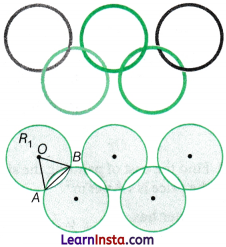
The Olympic symbol comprising five interlocking rings represents the union of the five continents of the world and the meeting of athletes from all over the world at the Olympic Games. In order to spread awareness about the Olympic Games, students of Class X took part in various activities organised by the school. One such group of students made 5 circular rings in the school lawn with the help of ropes. Each circular ring required 44 m of rope. Also, in the shaded regions as shown in the figure, students made rangoli showcasing various sports and games. It is given that ∆OAB is an equilateral triangle and all unshaded regions are congruent.
Based on the above information, answer the following questions.
(i) Find the radius of each circular ring.
(ii) What is the measure of ∠AOB?
(iii) (a) Find the area of shaded region R1.
Or
(b) Find the length of rope around the unshaded regions.
Solution:
Given, each ring requires 44 m of rope (circumference), ∆OAB is an equilateral triangle, and all unshaded regions are congruent.
(i) Circumference of a circle = 2πr
⇒ 2πr = 44
⇒ r = \(\frac{44}{2 \pi}\) = 7 m
Thus, radius of each circular ring = 7 m
(ii) We have, ∆OAB is an equilateral triangle.
⇒ ∠AOB = 60°
(iii) (a) Area of sector OABO = \(\frac{60^{\circ}}{360^{\circ}} \times \pi \times 7^2\)
= \(\frac{1}{6} \times \frac{22}{7} \times 49\)
= \(\frac {154}{6}\)
= 25.67 m2
Since the side lengths of the triangle are equal to r = 7 m.
∴ Area of ∆AOB = \(\frac{\sqrt{3}}{4}(\text { side })^2\)
= \(\frac{\sqrt{3}}{4} \times 7^2\)
= 21.22 m2
∴ Area of shaded region R1 = π × 72 – 2(Area of sector OABO – Area of ∆AOB)
= 154 – 2(4.45)
= 145.1 m2
Or
(b) Length of an arc = \(\frac{60^{\circ}}{360^{\circ}} \times 2 \times \frac{22}{7} \times 7\)
= \(\frac {1}{6}\) × 44
= 7.33 m
∴ Length of rope around the unshaded regions = 8 × 7.33 = 58.66 m
Question 6.
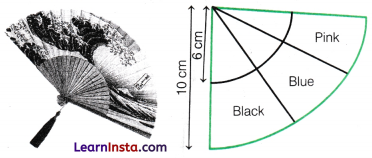
Heena holds a Japanese fan in her hand as shown in the figure. It is shaped like a sector of a circle and made of a thin material such as paper or feather. The inner and outer radii are 6 cm and 10 cm, respectively. The fan has three colours, i.e., pink, blue, and black.
Based on the above information, answer the following questions.
(i) If the region containing blue colour makes an angle of 80° at the centre, then find the area of the region having blue colour.
(ii) If the region containing black colour makes an angle of 40° at the centre, then find the area of the region having black colour.
(iii) (a) If the region containing pink colour makes an angle of 30° at the centre, then find the perimeter of the region containing pink colour.
Or
(b) Find the area of the region having radius 6 cm.
Solution:
(i) Area of region having blue colour = \(\frac{80^{\circ}}{360^{\circ}} \pi\left[(10)^2-\left(6^2\right)\right]\) = 44.69 cm2
(ii) Area of region having black colour = \(\frac{40^{\circ}}{360^{\circ}} \pi\left[(10)^2-(6)^2\right]\) = 22.34 cm2
(iii) (a) Perimeter of the region having pink colour = 2(10 – 6) + Length of arc having radius 6 cm + Length of arc having radius 10 cm = 16.38 cm
Or
(b) Area of region = \(\frac{150^{\circ}}{360^{\circ}} \times \pi r^2\) = 47.14 cm2
Question 7.
NSS (National Service Scheme) aims to connect the students to the community and to involve them in the problem-solving process. NSS symbol is based on the ‘Rath’ wheel of the Konark Sun Temple situated in Odisha. The wheel signifies the progress cycle of life. The diagrammatic representation of the symbol is given below.
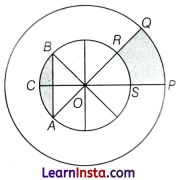
Observe the figure given above. The diameters of the inner circle are equally spaced.
Given that OP = 21 cm and OS = 10 cm.
Based on the above information, answer the following questions.
(i) Find ∠ROS.
(ii) Find the perimeter of sector OPQ.
(iii) (a) Find the area of the shaded region PQRS.
Or
(b) Find the area of the shaded region ACB, i.e., the segment ACB.
Solution:
Given, OP = 21 cm and OS = 10 cm
(i) The inner circle is divided into 8 equal sectors.
Since the central angle of the circle = 360°
∴ ∠ROS = \(\frac{360^{\circ}}{8}\) = 45°
Thus, ∠ROS = 45°
(ii) We know that perimeter of sector OPQ = \(\frac{\theta}{360^{\circ}} \times 2 \pi r+2 r\)
= \(\frac{45}{360} \times 2 \times \frac{22}{7} \times 21+2 \times 21\) [∵ OP = 21 cm and ∠ROS = 45°]
= 16.5 + 42
= 58.5 cm
(iii) (a) Area of shaded region PQRS = Area of sector OPQO – Area of sector ORSO
= \(\frac{\theta}{360^{\circ}} \times \pi(O P)^2-\frac{\theta}{360^{\circ}} \times \pi(O S)^2\)
= \(\frac{\theta}{360^{\circ}} \times \pi\left[(O P)^2-(O S)^2\right]\)
= \(\frac{45}{360} \times \frac{22}{7}\left[(21)^2-(10)^2\right]\)
= \(\frac{1}{8} \times \frac{22}{7} \times[441-100]\)
= \(\frac{1}{8} \times \frac{22}{7} \times 341\)
= 133.96 cm2
Or
(b) From the given figure, we have ∠AOB = 90°
∴ Area of segment ACS = \(\pi(O A)^2 \frac{90^{\circ}}{360^{\circ}}\) – ar(∆AOB)
= π × 100 × \(\frac {1}{4}\) – \(\frac {1}{2}\) × 10 × 10
= 25π – 100 × \(\frac {1}{2}\)
= 25π – 50
= 25(π – 2)
= 25(\(\frac {22}{7}\) – 2)
= 25 × \(\frac {8}{7}\)
= \(\frac {200}{7}\) cm
Question 8.
Anurag purchased a farmhouse, which is in the form of a semi-circle of diameter 70 m. He divided it into three parts by taking a point P on the semi-circle in such a way that ∠PAB = 30° as shown in the following figure, where O is the centre of the semi-circle.
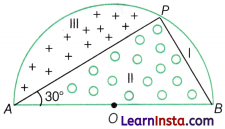
In Part I, he planted saplings of a mango tree; in Part II, he grew tomatoes; and in Part III, he grew oranges.
Based on the above information, answer the following questions.
(i) What is the measure of ∠POA?
(ii) Find the length of wire needed to fence the entire piece of land.
(iii) (a) Find the area of the region in which saplings of mango tree are planted.
Or
(b) Find the length of wire needed to fence the Region III.
Solution:
(i) Join OP.
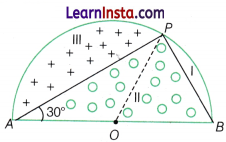
Here, ∠OAP = ∠OPA = 30° [∵ OA = OP]
In ∆OAP, ∠OAP + ∠OPA + ∠POA = 180°
⇒ 30° + 30° + ∠POA = 180°
⇒ ∠POA = 120°
(ii) Radius (OA) = \(\frac {70}{2}\) = 35 m
∴ Length of the wire = \(\frac{2 \pi r}{2}\) + AB
= 110 + 70
= 180 m
(iii) (a) Area of Region I = Area of sector POBP – Area of ∆POB
= \(\frac{\theta}{360^{\circ}} \pi r^2-\frac{1}{2} r^2 \sin \theta\)
= \(\frac{60^{\circ}}{360^{\circ}} \pi \times(35)^2-\frac{1}{2} \times(35)^2 \times \sin 60^{\circ}\)
= 641.67 – 530.44
= 111.23 m2
Or
(b) We know, ∠APB = 90°
In ∆APB, cos 30° = \(\frac {AP}{AB}\)
⇒ \(\frac{\sqrt{3}}{2}=\frac{A P}{70}\)
⇒ AP = 35√3 m
∴ Length of the wire to fence the Region III = Length of the arc making angle 120° at the centre + Length of AP
= \(\frac{120^{\circ}}{360^{\circ}} \times 2 \times \pi \times 35+35 \sqrt{3}\)
= \(\frac {220}{3}\) + 60.62
= 133.95 (approx)
Question 9.
A water sprinkler is a device used to irrigate crops, lawns, landscapes, golf courses and other areas. Water sprinklers can be used for residential, industrial and agricultural usage.
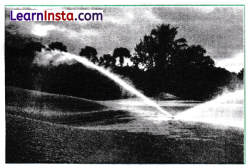
A water sprinkler is set to shoot a stream of water a distance of 21 m and rotate through an angle, which is equal to the complementary angle of 10°.
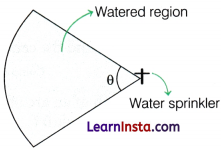
Based on the above information, answer the following questions.
(i) What is the area of the sector in terms of arc length?
(ii) What is the area of the watered region (in terms of π)?
(iii) (a) If the radius (r) changes to 28 m, find the angle θ so that the area of the watered region remains the same.
Or
(b) If the radius (r) is increased from 21 m to 28 m and the angle remains the same, what is the increase in the area of the watered region?
Solution:
Given, radius (r) = 21 m
and angle (θ) = Complement of 10°
= 90° – 10°
= 80°
Let = l length of the arc.
(i) Area of sector = \(\frac{\text { Arc length × Radius }}{2}=\frac{l \times 21}{2} \mathrm{~m}\)
(ii) Area of watered region = \(\frac{\theta}{360^{\circ}} \times \pi r^2\)
= \(\frac{80^{\circ}}{360^{\circ}} \times \pi \times(21)^2\)
= \(\frac {2}{9}\) × π × 441
= 98π
(iii) (a) We have, radius (r) = 28 m
Let θ be the angle.
Given, area remains the same.
∴ Area = 98π
⇒ \(\frac{\theta}{360^{\circ}} \times \pi \times(28)^2=98 \pi\)
⇒ \(\frac{\theta}{360^{\circ}} \times 784\) = 98
⇒ θ = \(\frac{360 \times 98}{784}\)
⇒ θ = 45°
Or
(b) Here, old area = \(\frac{80^{\circ}}{360^{\circ}} \times \pi \times(21)^2\) = 98π m2
New area = \(\frac{80^{\circ}}{360^{\circ}} \times \pi \times(28)^2\)
= \(\frac {2}{9}\) × π × 784
=174.22π m2
Increase = New area – Old area
= 174.22π – 98π
= 76.22π m2