Experts have designed these Class 9 Maths Notes and Chapter 1 Orienting Yourself The Use of Coordinates Class 9 Ganita Manjari Notes for effective learning.
Class 9 Maths Chapter 1 Orienting Yourself The Use of Coordinates Notes
Class 9 Maths Ganita Manjari Chapter 1 Notes
Ganita Manjari Class 9 Chapter 1 Notes – Class 9 Orienting Yourself The Use of Coordinates Notes
Coordinate geometry was developed by the French mathematician Rene Descartes in the 17th century. He introduced a method to represent geometric figures using algebraic equations through a system of coordinates.
In this chapter, students will learn how to locate points on the cartesian plane and understand their positions using coordiantes.
Cartesian System
In cartesian system, there are two perpendicular straight lines XX’ (horizontal line) and YY’ (vertical line), which intersect at point O as shown below.
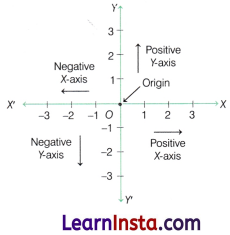
- The point of intersection of these lines is called origin and it is denoted by O.
- The horizontal line XOX’ is called X-axis and the vertical line YOY’ is called Y-axis.
- Directions OX and OY are called the positive directions of X-axis and Y-axis, respectively.
- Directions OX’ and OY’ are called the negative directions of X-axis and Y-axis, respectively.
- The two lines X’ OX and Y’ OY taken together are called coordinate axes or the axes of coordinates.
Quadrant:
The X and Y-axes divide the plane into four parts. These four parts are called quadrant (i. e.\(\frac{1}{4}\)th part), numbered I, II, III and IV anti-clockwise from OX.
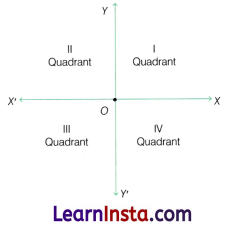
- XOY is called the I quadrant.
- XOY is called the II quadrant.
- XOY’ is called the III quadrant.
- XOY’ is called the IV quadrant.
So, the plane consists of two axes and four quadrants.
The plane is known as XY-plane or cartesian plane or coordinate plane.
Coordinates of a Point in Cartesian Plane
To locate a point in the cartesian plane, its perpendicular distances from X-axis and Y-axis are required, these distances are called coordinates of the point, namely x-coordinate (abscissa) and y-coordinate (ordinate).
(i) The x-coordinate is the perpendicular distance from the Y-axis measured along the X-axis (positive along the positive direction of the X-axis and negative along the negative direction of X-axis).
(ii) The y-coordinate is the perpendicular distance from the X-axis measured along the Y-axis (positive along the positive direction of the Y-axis and negative along the negative direction of Y-axis).
The x-coordinate and y-coordinate taken together are called cartesian coordinates or coordinates of a point, denoted by (x, y).
Here, x-coordinate comes first and y-coordinate comes second, forming an ordered pair.
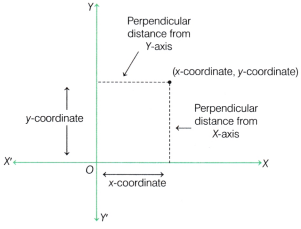
Coordinates uniquely determine a point in the plane.
Hence, (a, b) (b, a) i.e. point (a, b) is not same as (b, a).
If x ≠ y then (x, y) ≠ (y, x) and if x = y then (x, y) = (y, x).
Some Important Terms
- Point on X-axis Every point on the X-axis has zero perpendicular distance from the X-axis, so its ordinate is 0. Hence, coordinates of every point on the X-axis are of the form (x, 0).
- Point on Y-axis Every point on the Y-axis has zero perpendicular distance from the Y-axis, so its abscissa is 0. Hence, coordinates of every point on the Y-axis are of the form (0,y).
- Origin The origin has zero distance from both the axes. So, its coordinates are (0,0).
- If the x-coordinate of two or more points are same then the line joining these points is parallel to Y-axis.
- If the y-coordinate of two or more points are same then the line joining these points is parallel to X-axis.

Convention of Signs of Coordinates in Different Quadrants
Useful rules to determine the signs of the coordinates of a point in a quadrant are given below.
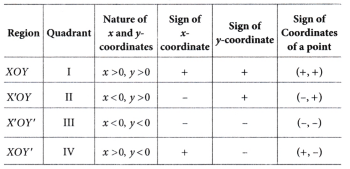
(i) If a point lies in the I quadrant then the coordinates of the point will be of the form (+, +), as the I quadrant is enclosed by the positive X-axis and the positive Y-axis.
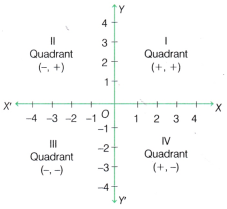
(ii) If a point lies in the II quadrant then the coordinates of the point will be of the form (-, +), as the II quadrant is enclosed by the negative X-axis and the positive Y-axis.
(iii) If a point lies in the III quadrant then the coordinates of the point will be of the form (-, -), as the III quadrant is enclosed by the negative X-axis and the negative Y-axis.
(iv) If a point lies in the IV quadrant then the coordinates of the point will be of the form (+, -), as the IV quadrant is enclosed by the positive X-axis and the negative Y-axis.
Convention of Signs of Coordinates
Example 1:
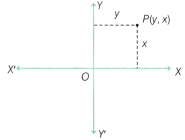
Write the coordinates of the point, which lies at a distance of x units from X-axis and y units from Y-axis.
Solution:
Required point is P (y, x) as shown in figure.
Example 2:
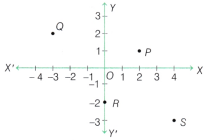
Write the coordinates of the points given in the following graph.
Solution:
Here, given points on the graph areP, Q,RandS.
Now, draw the perpendicular lines from points P, Q, R and S on theX-axis andY-axis.
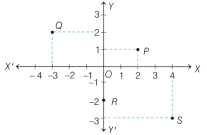
The point P is at a distance of 2 units from the Y-axis and 1 unit from the X-axis. Thus, point P lies in I quadrant.
∴ Coordinates of point P are (2,1).
The point Q is at a distance of 3 units from the Y-axis in negative direction of X-axis and 2 units from the X-axis. Thus, point Q lies in II quadrant.
∴ Coordinates of point Q are (-3,2).
The point R is at a distance of 0 unit from the Y-axis and 2 units from the X-axis in negative direction.
Thus, point R is in negative direction of Y-axis.
∴ Coordinates of point R are (0, -2).
The point S is at a distance of 4 units from the Y-axis and 3 units from the X-axis in the negative direction of Y-axis.
Thus, point S lies in IV quadrant.
Example 3:
In which quadrant or on which axis each of the following points lie?
(i) (-3, 5)
(ii) (4, -1)
(iii) (2, 0)
(iv) (2, 2)
(v) (-3, -6)
Solution:
(i) For point (-3,5), x-coordinate is negative and y-coordinate is positive , so it lies in II quadrant.
(ii) For point (4, -1), x-coordinate is positive and y-coordinate is negative, so it lies in IV quadrant.
(iii) For point (2, 0), x-coordinate is positive and y-coordinate is zero, so it lies on X-axis.
(iv) For point (2, 2), x-coordinate and y-coordinate both are positive , so it lies in I quadrant.
(v) For point (-3, – 6), x-coordinate and y-coordinate both are negative, so it lies in III quadrant.
Example 4:
If the coordinates of two points are 4(3,4) and B(-2,5) then find the value of (Abscissa of A) – (Abscissa of B).
Solution:
Given, point A (3, 4) i.e. abscissa of A =3
and point B (-2,5) i.e. abscissa of B = – 2
Abscissa of A – Abscissa of B = 3 – (-2)
= 3 + 2 = 5
Example 5:
A point lies on X-axis at a distance of 9 units from Y-axis. What are its coordinates? What will be the coordinates of a point, if it lies on Y-axis at a distance of 9 units from X-axis in negative direction?
Solution:
We know that coordinates of any point lie on X-axis at
the distance a from the Y-axis are (a, 0) and (- a, 0).
Since, the given point lies on X-axis at a distance of 9 units from Y-axis, so its coordinates are (9, 0) or (- 9, 0).
Now, if point lies on Y-axis at a distance of 9 units from X-axis in negative direction then its coordinates is (0, -9).
Example 6:
Find the values of x and y, if two ordered pairs (x -3, -6) and (4, x + y) are equal.
Solution:
Given, ordered pairs are (x – 3, -6) and (4, x + y).
Since, these ordered pairs are equal, so their corresponding coordinates are also equal.
Thus, first components are equal. x – 3 = 4 ⇒ x = 7
and second components are also equal.
-6 = x + y
⇒ – 6 =7 + y = -13
Hence, x = 7 and y = -13.
Example 7:
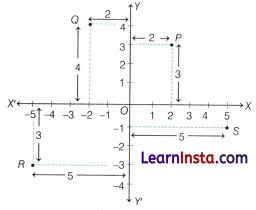
Write down the
(I) coordinates
(II) quadrant for the points P. Q, Rand S.
Solution:
For Point P
(i) Coordinates of the point = (2, 3)
(ii) The point (2,3) lies in the I quadrant.
For Point Q
(i) Coordinates of the point = (-2, 4)
(ii) The point (-2, 4) lies in the II quadrant.
ForPoint R
(i) Coordinates of the point (-5, -3)
(ii) The point (-5, -3) lies in the III quadrant.
For Point S
(i) Coordinates of the point = (5, -1)
(ii) The point (5, -1) lies in the IV quadrant.
Example 8:
Using figure, answer the following questions.
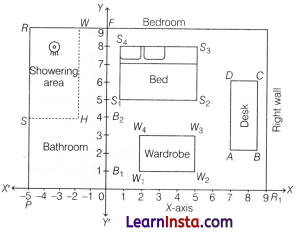
(i) Place Meera’s rectangular study table with three of its feet at the points (7,6), (9, 6) and (9, 8).
(a) Where will the fourth foot of the table be?
(b) Is this a good spot for the table?
(c) What are the width and length of the table?
(ii) What are the coordinates of the four corners A, B, C and D of the desk?
(iii) If the bathroom door has a hinge at B1 and opens into the bedroom, will it hit the wardrobe? Would you suggest any changes?
(iv) First, look at Meera’s bathroom. Then, answer the following questions.
(a) What are the coordinates of the four comers 0, F, R and P of the bathroom?
(b) What is the shape of the showering area SHWR? Write the coordinates of the four corners.
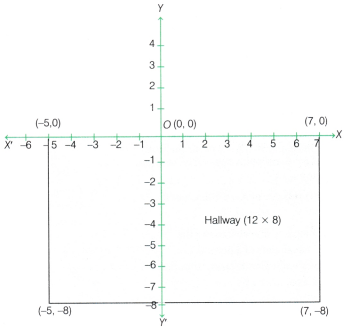
(v) Meera’s room door opens into a hallway that has length 12 units and width 8 units. The hallway extends from point P to point R1. Sketch the hallway and mark the coordinates of its corners.
Solution:
(i) Given three feet of the rectangular table (7, 6), (9, 6) and (9, 8).
(a) Since, the table is rectangular, opposite sides are parallel and equal.
Points (7,6) and (9, 6) lie on the same horizontal line (y = 6).
Points (9,6) and (9,8) lie on the same vertical line (x = 9).
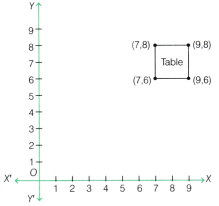
So, the fourth foot has x -coordinate of (7,6) i.e. 7 and y-coordinate of (9, 8) i.e. 8.
∴ The fourth foot is at (7, 8).
(b) Yes, this is a good spot because the table lies within the room boundaries (x: 0-9, y: 0-9).
It does not block the door or wardrobe.
It is placed near the right wall, making it convenient for studying with light.
(c) Width = Distance between (7,6) and (9, 6)
= 9- 7 = 2 units
Length = Distance between (9,6) and (9, 8)
= 8 – 6 = 2 units
The table is a 2 × 2 square table. Height cannot be determined from a 2D coordinate diagram.
(ii) The coordinates of the four corners of the desk are A(7, 2), B(8.5, 2), C(8.5, 6) and D(7, 6).
(iii) From the figure, B1 = (0, 1) and B2 = (0, 4).
Width of bathroom door B1B2 = 4 – 1 = 3 units.
If the door is hinged at B1 = (0, 1) and opens into the bedroom, it sweeps an arc of radius 3 units. The wardrobe starts at W4 =(2, 3) and W1 =(2, 0). The nearest edge of the wardrobe from B1 is at x =2.
Since, the door arc radius = 3 units > 2 units (distance to wardrobe), the door will hit the wardrobe.
There are some suggestions below.
(a) The door can be made to open outwards into the bathroom instead.
(b) The wardrobe can be repositioned further from the Y-axis (e.g. Starting at x = 4).
(c) The hinge position can be changed to B2 instead of B1.
(iv) (a) From the given figure, coordinates of the four corners of the bathroom OFRP are O (0, 0), F (0, 9), R (-5, 9) and P (-5, 0).
(b) From the figure, corrdinates of the four corners of the showering area are S (-5, 4), H (-2, 4), W (-2, 9) and R (-5, 9).
Since, all four angles are rights angles and opposite sides are equal, so SFIWR is a rectangle,
(v) From the figure, P (-5, 0) and R1 (10, 0)
Hence, PA = 10 – (-5) = 15 units
But the hallway is given as 12 units long. So, the hallway extends 12 units along the X-axis from P(-5, 0). It ends at x = – 5 + 12 = 7.
The hallway has width 8 units extending downward (below the X-axis).
Coordinates of the four corners of the hallway are (-5, 0), (7, 0), (7, -8) and (-5, -8).
The hallway is sketched on the coordinate plane and its corners are marked as shown below.
Distance Between Two Points and Mid-point of Two Points
Distance Between Two Points
By the Baudhayana-Pythagoras theorem, the distance between any two points P(Xj, yx) and Q(x2, y2) is given by
PQ = \(\sqrt{\left(x_2-x_1\right)^2+\left(y_2-y_1\right)^2}\)
or PQ = \(\sqrt{\left(x_1-x_2\right)^2+\left(y_1-y_2\right)^2}\)
i.e PQ = \(\sqrt{\begin{array}{l}
\text { (Difference of abscissae) }{ }^2 \\
+ \text { (Difference of ordinates) }^2
\end{array}}\)
Note:
Let P(x, y) be a point and O0(0,0) be the origin. Then, by g distance formula, distance of P from 0 is
OP = \(\sqrt{(x-0)^2+(y-0)^2}=\sqrt{x^2+y^2}\)
Example 1:
Find the distance between the points P(-3, 4) and Q(9, -1).
Solution:
Here, x1 =-3, y1 = 4, x2 = 9 and y2 = -1.
Distance between two points,
PQ = \(\sqrt{\left(x_2-x_1\right)^2+\left(y_2-y_1\right)^2}\) [by distance formula]
= \(\sqrt{(9-(-3))^2+(-1-4)^2}\)
= \(\sqrt{(9+3)^2+(-1-4)^2}=\sqrt{(12)^2+(-5)^2}\)
= \(\sqrt{144+25}=\sqrt{169}\)
= 13 units
Example 2:
Find the distance of the point (15, 8) from the origin.
Solution:
Let the given point be P(x, y) = (15, 8).
The distance of a point from the origin O(0, 0) is given by the direct formula OP = \(\sqrt{x^2+y^2}\)
Here, x = 15 and y = 8
Distance, OP = \(\sqrt{(15)^2+(8)^2}=\sqrt{225+64}\)
= \(\sqrt{289}\) = 17 units
Example 3:
Find the values of y for which the distance between the points P(2, -3) and Q(10, y) is 10 units.
Solution:
Given, points are P(2, -3) and Q(10, y).
According to the given condition,
PQ = 10
⇒ \(\sqrt{(10-2)^2+(y-(-3))^2}\) = 10 [by distance formula]
On squaring both sides, we get
(8)2 + (y + 3)2 = 100
⇒ 64 + y2 + 6y + 9 = 100
⇒ y2 + 6y +73 – 100 = 0
⇒ y2 + 6y – 27 = 0
⇒ y2 + 9y – 3y – 27 = 0
⇒ y(y + 9) – 3(y + 9) =0
⇒ (y + 9) (y – 3) = 0
⇒ y = 3, -9
Hence, the values of y are 3 and-9.
Different Problems Related to Distance Formula
There are so many problems, which can be solved using the distance formula. Some problems are given below.
Type I Problems Based on Collinearity of Points
When three or more than three points lie on a same line then they are called collinear points.
To show collinearity of three points say A, B and C, find AB, BC and CA and then show that sum of two shorter lengths is equal to the largest length
i.e. AB + BC = AC
or AC + CB = AB
or BA + AC = BC
If sum of shorter lengths is not equal to the largest length then points are not collinear (or non-collinear).
Example 4:
Check whether the points (1, 5), (2, 3) and (-2,11) are collinear or not.
Solution:
Let A = (1, 5), B = (2, 3) and C = (-2, 11).
Then, AB = \(\frac{1}{2}\) [by distance formula]
= \(\frac{1}{2}\) units,
BC = \(\frac{1}{2}\)
= \(\frac{1}{2}\) units
and AC = \(\frac{1}{2}\)
= \(\frac{1}{2}\) units
Here, BC = AB + AC [as 4√5 = √5 + 3√5]
A, B and C are collinear points.
Type II Problems Based on Equidistant Points
To find a point say X, which is equidistant from two points say A and B, we take AX = BX and then simplify.
Example 5:
If the point P(x, y) is equidistant from the points A(5, 1) and B(-1, 5) then prove that 3x =2y.
Solution:
Given, point P(x, y) is equidistant from the points A(5, 1) andB(-1, 5).
AP = BP
⇒ AP2 = BP2 [squaring both sides]
⇒ (x – 5)2 +(y – 1)2 = (x – (-1))2 + (y – 5)2
[by distance formula]
⇒ x2 + 25 – 10x + y2 + 1 – 2y = (x + 1)2 + y2 + 25 – 10y
⇒ x2 + 26 – 10x + y2 – 2y = x2 + 1 + 2x + y2 + 25 – 10y
⇒ -10x – 2y = 2x – 10y
⇒ -10x – 2x = -10y + 2y
⇒ -12x = -8y
⇒ 12x = 8y
⇒ 3x = 2y
Hence proved.
Example 6:
Find the points on the X-axis each of which is at a distance of 10 units from the point 4(7, 6).
Solution:
Let the points on X-axis be (x1, 0) and (x2,0).
Using distance formula, \(\sqrt{\left(7-x_1\right)^2+(6-0)^2}\) = 10
and \(\sqrt{\left(7-x_2\right)^2+(6-0)^2}\) = 10
On squaring both sides, we get
(7 – x12 + 36 = 100
⇒ (7 – x1)2 = 64
⇒ 7 – x1 = ±8
⇒ 7 – x1 = 8 or 7 – x1 = -8
⇒ x1 =-1 or x1 = 15
Similarly, x2 =-1 or 15
The points onX-axis are (-1, 0) and (15, 0).
Type III Problems Based on Geometrical Figures
Sometimes, three or four points are given and we have to show that the given points form a particular geometrical figure. To show that the given points form a
(i) triangle prove that sum of lengths of any two sides is greater than the length of third side.
(ii) isosceles triangle prove that two sides are equal.
(iii) right-angled triangle prove that sides of triangle satisfy Pythagoras theorem.
(iv) equilateral triangle prove that all three sides are equal.
(v) parallelogram prove that the opposite sides are equal and diagonals are unequal.
(vi) rectangle prove that opposite sides are equal and diagonals are also equal.
(vii) square prove that the four sides are equal and diagonals are also equal.
(viii) rhombus prove that the four sides are equal and diagonal are unequal.
Calculate the length of different sides of a figure using distance formula and then show with the help of above results.
Example 7:
Show that the points 4(-2,3), B(8,3) and C(6,7)are vertices of a right angled triangle.
Solution:
Given, A(-2, 3), B (8, 3) and C (6, 7).
Using distance formula,
AB2 = (8 – (-2))2 + (3 – 3)2 = 100 + 0 = 100
BC2 = (6 – 8)2 + (7 – 3)2 = 4 + 16 = 20
and CA2 = (-2 – 6)2 + (3 – 7)2 = 64 + 16 = 80
⇒ AB2 = BC2 + CA2 [as 100 = 20 + 80]
∴ ΔABC is a right angled triangle.
Example 8:
Show that 4 (0, -1), B (2, 1), C(0, 3) and D(-2, 1) are vertices of a square ABCD.
Solution:
We know that the distance between the two points
and (x2, y2) is d = \(\sqrt{\left(x_2-x_1\right)^2+\left(y_2-y_1\right)^2} .\)
AB = \(\sqrt{(2-0)^2+(1-(-1))^2}\)
= \(\sqrt{4+4}\)
= √8
= 2√2 units
BC = \(\sqrt{(0-2)^2+(3-1)^2}=\sqrt{4+4}\)
= √8
=2√2 units
CD = \(\sqrt{(-2-0)^2+(1-3)^2}=\sqrt{4+4}\)
=√8 = 2√2 units
DA = \(\sqrt{(0-(-2))^2+(-1-1)^2}\)
= \(\sqrt{4+4}\)
= √8 = 2√2 units
AC = \(\sqrt{(0-0)^2+(3-(-1))^2}=\sqrt{0+16}=\sqrt{16}\)
= 4 units
and BD = \(\sqrt{(-2-2)^2+(1-1)^2}=\sqrt{16+0}=\sqrt{16}\)
= 4 units
Here, lengths of all sides AB, BC, CD and DA are equal and diagonals AC and BD are also equal.
Thus, ABCD is a square.
Mid-point of Two Points
If a point divides the line segment joining the points (x1, y1) and (x2, y2) internally in the ratio 1:1 then we get mid-point of this line segment. Thus, coordinates of the mid-point P of the line segment joining the points
A(x1, y1) and B(x2, y2) are
Example 9:
Find the coordinates of the mid-point of the line segment joining the points 4(2, -4) and B(6, 10).
Solution:
Here x1 = 2, y1 = -4, x2 = 6 and y2 = 10.
∴ Coordinates of the mid-point of the line segment AB
= \(\left(\frac{x_1+x_2}{2}, \frac{y_1+y_2}{2}\right)=\left(\frac{2+6}{2}, \frac{-4+10}{2}\right)\)
= (4, 3)
Example 10.
Find the coordinates of point A, where AB is a diameter of the circle with centre 0(2-3) and the point Sis (1, 4).
Solution:
Given, AB is the diameter and O is the centre of the circle.
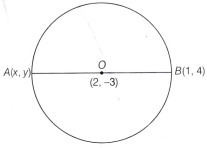
Let coordinates of A be (x,y).
Clearly, O will be the mid-point of AB.
∴ Coordinates of O = \(\left(\frac{x+1}{2}, \frac{y+4}{2}\right)\) [by mid-point formula]
= (2, -3) = \(\left(\frac{x+1}{2}, \frac{y+4}{2}\right)\)
[∵ coordinates of O = (2, -3), given]
On comparing the coordinates x and y, we get
2 = \(\frac{1}{2}\) and -3 = \(\frac{1}{2}\)
⇒ 4 = x + 1 and -6 = y + 4
⇒ x = 4 – 1 and y = -6 – 4
⇒ x = 3 and y = -10
Hence, the coordinates of point A are (3, -10).
Example 11.
If the points A (1, 2), B(4, y), C(x, 6) and D(3, 5)are the vertices of a parallelogram, taken in order, then find the values of x and y.
Solution:
Given, vertices of a parallelogram are A(1, 2), B(4, y), C(x, 6) and D(3, 5).
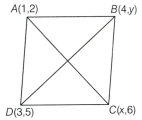
We know that diagonals of a parallogram bisect each other.
∴ Coordinates of mid-point of diagonal AC = Coordinates of mid-point of diagonal BD
⇒ \(\left(\frac{1+x}{2}, \frac{2+6}{2}\right)=\left(\frac{4+3}{2}, \frac{y+5}{2}\right)\) [by mid-point formula]
⇒ \(\left(\frac{1+x}{2}, \frac{8}{2}\right)=\left(\frac{7}{2}, \frac{y+5}{2}\right)\)
On equating x-coordinate from both sides, we get
\(\frac{1+x}{2}=\frac{7}{2}\) ⇒ 1 + x = 7 ⇒ x = 6
On equating y-coordinate from both sides, we get
\(\frac{8}{2}=\frac{y+5}{2}\) ⇒ 8 = y + 5 ⇒ y = 3
Hence, the required values are x = 6 and y = 3.
Trisection of a Line Segment
Trisection means a line is divided into three equal parts.

This can be done by finding two points P and Q on the line segment AB such that AP = PQ = QB.
Using the mid-point concept.
- Point P is the mid-point of A and Q.
- Point Q is the mid-point of P and B
Thus, the coordinates of points P and Q can be found using the mid-point formula.
Example 12:
Let P and Q be the point of trisection of AB, with P closer to A and Q closer to B. Find the coordinates of P and Q, when the points are A (6, 3) and B (18, – 3).
Solution:
Given, A(6, 3) andB (18, -3).
Let P(x1, y1) and Q(x2, y2) be the points of trisection.
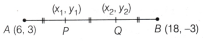
Since, P and Q divide AB into three equal parts, P is the mid-point of A and Q, and Q is the mid-point of P and B.
Using mid-point formula,
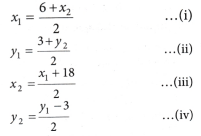
On substituting the value of x1 in Eq. (iii), we get
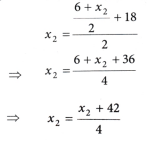
⇒ 4x2 = x2 + 42
⇒ 3x2 =42
⇒ x2 = 14
From Eq(i). we ge x1 = \(\frac{6+14}{2}\)
⇒ x1 = 10
On substituting the value of y1 in Eq. (iv), we get
y2 = \(\frac{\frac{3+y_2}{2}-3}{2}\)
y2 = \(\frac{3+y_2-6}{4}\)
y2 = \(\frac{y_2-3}{4}\)
4y2 = y2 – 3
3y2 = -3
y2 = -1
From Eq. (ii), we get y1 = \(\frac{3+(-1)}{2}\)
⇒ y1 = 1
Therefore, the coordinates of P and Q are (10, 1) and (14, -1). respectively.